Showing posts with label Romans. Show all posts

Friday, March 27, 2026

In evangelical ideology, sin is bad because it separates you from God, not because you hurt another person

Image text: "Isaiah 61:1a. The spirit of the sovereign Lord is on me, because the Lord has anointed me to preach good news to the poor." Image source.

Here's a good post from Sheila Wray Gregoire: Who Is the Real Victim When Men Lust? Every Man’s Battle Says It’s Men! It's about how the book "Every Man's Battle" (a best-selling book in Christian culture) seems to have the assumption that the reason it's bad when a man lusts is that it damages the man's purity. The authors of "Every Man's Battle" don't seem to have any awareness of how men's lust can be harmful to the women who are being objectified/harassed/assaulted because of that lust.

This is a very good point, and I want to talk about how it connects to evangelical Christianity's overall concept of what sin is, and what the gospel is. 

Evangelicalism teaches that this is the main message of Christianity, the "good news" we are supposed to share with the world: We have all sinned, and therefore we all deserve to go to hell. God cannot tolerate any sin at all- only perfect people who have never sinned can be in God's presence. But, fortunately, Jesus lived a perfect sinless life and died for us. This solves the problem of us being separated from God because of our sin (which is the biggest problem we have)- when we believe in Jesus, God forgives our sins, and we can go to heaven.

In this framing, when someone sins, it's bad because it means they have committed a terrible offense against a holy and perfect God, and therefore they deserve to go to hell. They desperately need Jesus' forgiveness. When I was a little kid, hearing gospel presentations in Sunday school, it was all about making us feel bad for how terrible we are because we are sinners and God is judging us.

So when they talk about "sin", as an abstract concept, it leads us to have empathy for the sinner. We feel bad for them because they are in danger of going to hell, and we want to save them. And also, we can't really judge them too much, because we are sinners too.

There's very little concern for the victims of your sin- the people you are sinning against. Actually, the way that I understood the definition of "sin" when I was evangelical, it doesn't even need to have a victim. It just meant I was breaking God's rules. Like if I had a selfish thought, or I didn't prioritize my daily bible reading, or if I dated someone that God didn't give me permission to date.

(The example that really takes the cake is Psalm 51, where David writes, "Against you, you only, have I sinned". Yeah, this is after David raped Bathsheba, then when he found out she was pregnant, he had her husband killed, and married her, then the prophet Nathan came and said that was wrong, and as a punishment, the baby would die. In David's prayer of repentance he says, "Against you, you only, have I sinned" as if the problem was just between him and God and didn't really affect anyone else.)

Reading arguments from gay Christians in support of same-sex relationships, that's where I came across the idea that sin is defined as something that hurts people, and it blew my mind. I had never thought about sin that way before. Upon hearing this, I listed a few commonly-recognized sins- lying, stealing, cheating on one's spouse- and was surprised to find that they did share a common thread of you're doing harm to another person. Was that really what "sin" meant? Well, Romans 13:8-10 says it is:

Let no debt remain outstanding, except the continuing debt to love one another, for whoever loves others has fulfilled the law. The commandments, “You shall not commit adultery,” “You shall not murder,” “You shall not steal,” “You shall not covet,” and whatever other command there may be, are summed up in this one command: “Love your neighbor as yourself.” Love does no harm to a neighbor. Therefore love is the fulfillment of the law.

The apostle Paul is saying here that all you need to know is "Love your neighbor as yourself." Similarly, Jesus said the 2 greatest commandments are to love God and love your neighbor as yourself, and "All the Law and the Prophets hang on these two commandments." Sin is *not* about reading through the bible and making a list of everything God said not to do, however arbitrary it may seem. Sin is hurting people

And the gospel... In evangelicalism, the gospel is good news for people who feel bad about their sin and worry that it means they will go to hell. Evangelicalism claims that this is the main problem that we need to be saved from. But check this out; I believe something completely different now: I believe the gospel is good news for the victims, for the marginalized, for those who are suffering, for those who are suffering the effects of other people's sin.

Sin is not just between you and God, where you did something bad, and so you are deserving of sympathy because now you are at risk of going to hell. No, sin affects other people, and the sympathy should be for the people on the receiving end of it.

The starkest example I have experienced, of these two opposite ways of understanding "sin" and "the gospel", was when I was part of a Christian group in college, and we were planning a series of events we called Human Trafficking Awareness Week. (I wrote about this in 2013: How "the gospel" almost stopped us from fighting human trafficking.) We knew that human trafficking was bad, and we wanted to raise awareness and take action against it. And also, we were evangelical, so we felt it was important to "share the gospel" at our outreach events.

But we couldn't figure out how to get from "let's fight human trafficking" to the gospel. We thought long and hard, and couldn't come up with anything that could work as a natural connection between the two. We believed the message of "the gospel" was "you, as an individual, have sinned against God, and so you deserve to go to hell, but good news! Jesus forgives you!" And that didn't seem to have anything to do with the realities of injustice in the world, and our obligation to take action to fight it.

And now I'm like, really? Seriously? We couldn't figure out how freedom for the captives has anything to do with the main message of Christianity? I guess we never paid attention to how Jesus began his ministry on earth by proclaiming:

“The Spirit of the Lord is on me,

    because he has anointed me

    to proclaim good news to the poor.

He has sent me to proclaim freedom for the prisoners

    and recovery of sight for the blind,

to set the oppressed free,

     to proclaim the year of the Lord’s favor.”

Then he rolled up the scroll, gave it back to the attendant and sat down. The eyes of everyone in the synagogue were fastened on him. He began by saying to them, “Today this scripture is fulfilled in your hearing.”

Proclaim good news to the poor! Set the oppressed free! Freedom for the captives! *This* is what Jesus came to do. It's not about how every individual needs to make a private spiritual deal with God in order to escape hell; it's about transforming this world into the kingdom of heaven, defined by love, justice, and freedom.

That's the gospel. And, I would say, if our Christianity is not "good news to the poor", then it's not good news at all; it's not the gospel. 

---

And also, I didn't want to get into this because it could be a whole separate post, but: the power dynamics about what sorts of "sins" result in people being shamed and labelled as "sinners." Why is it that when Christians say someone is "living in sin", they mean a couple who is living together and presumably having sex, without being married? Why don't we say that employers who don't pay their workers a living wage are "living in sin"?

---

Related:

Being Right vs Doing Good

"The Big Wide Welcome" (kids' book review) 

Forgiveness for Sins You Don't Know You've Committed

Why did I think David was the good guy in the story of Abigail?

Don't Protect God

Yes, I Want Justice (A post about white evangelicals and #BlackLivesMatter)

"Christians Aren't Perfect" When It's Convenient

Friday, September 26, 2025

Blogaround

Links not related to the antichrist:

1. Mark Zuckerberg Demos New Facebook AI And It Couldn’t Have Gone Worse (September 18, via) "You’ve already combined the base ingredients, so now grate a pear to add to the sauce."

And here's another one about AI: California issues historic fine over lawyer’s ChatGPT fabrications (September 22) "The fine appears to be the largest issued over AI fabrications by a California court and came with a blistering opinion stating that 21 of 23 quotes from cases cited in the attorney’s opening brief were made up."

2. Giving people money helped less than I thought it would (August 19) "Many of the studies are still ongoing, but, at this point, the results aren’t “uncertain.” They’re pretty consistent and very weird."

3. Your Review: Participation in Phase I Clinical Pharmaceutical Research (September 5) "This phrase, 'better safe than sorry,' overwhelmingly characterizes the protocols of research clinics at every level, except the level where they start to ask whether participants might become more likely to pass through their filters by lying than meeting all their criteria."

4. Groundbreaking Analysis Upends Our Understanding of Psychiatric Holds (July 23) "Why would an intervention intended to help end up doing harm? The researchers offer and investigate several plausible explanations. Involuntary hospitalization can be a deeply disruptive experience. Patients are often forcibly taken by police, held for days, and sometimes medicated without consent. Such experiences might isolate individuals from their support networks, including family and existing mental health providers. Furthermore, hospitalizations can disrupt employment and increase homelessness, causing a spiral of instability that exacerbates rather than alleviates mental distress."

5. Did Amazon trick people into paying for Prime? Federal case goes to trial (September 23) "One example regulators offered showed a large yellow button 'Get FREE Two-Day Shipping' as a swift way to sign up without much detail about recurring membership costs, while a small blue hyperlink 'No thanks, I do not want fast, free shipping' would avoid signing up for Prime."

Yeah, that aspect of the Amazon checkout process is one of the best examples of a company being dishonest and trying to trick you into signing up for something. You literally have to click "I do not want fast, free shipping" to get past that page.

And an update on that: Amazon to pay $2.5 billion to settle U.S. lawsuit that it 'tricked' people into Prime (September 25)

6. Beastly Christianity (September 24) "It was a powerful, compelling argument and it prevailed in the World Alliance of Reformed Churches. This was theology from “the global south” contributing to and reforming the dominant theology from Europe and America. It changed the way white Reformed Christians around the world understood a key passage from the book of Romans, an epistle that is one of the most-studied texts in all of the Bible for Reformed Christians."

7. China’s ‘Worst Handwriting Group in History’ Rewrites Grief (September 25) "The turning point came in October, when one user shared her father’s nearly illegible scrawl from an ICU bed."

Oh man, I am so bad at reading Chinese handwriting. Yes, I can read Chinese- by which I mean, on a computer screen. In a book. On a sign. Printed on a label. You know, Chinese in a standard font. But people's handwriting, that's totally different. You see, each Chinese character, if written correctly, has certain strokes that go in certain places- but when people are writing by hand, they often collapse a bunch of strokes into some kind of scribble, in order to write faster. I very much do not have the skill of figuring out what strokes a scribble was originally supposed to be.

8. On Thought Experiments (September 24) "Everywhere I go people are proposing thought experiments that involve people-seeds landing on the carpet or filling the observable universe with tightly packed shrimps or something wacky about pills and then getting very angry at each other about the results."

---

Links related to the antichrist:

1. Jimmy Kimmel's show is returning to ABC on Tuesday, but not all stations will air it (September 23, via

Jimmy Kimmel is Back! (September 24) 

"Our leader celebrates Americans losing their livelihoods because he can't take a joke."

2. 3 thoughts from an autism researcher on Trump's acetaminophen and vaccine claims (September 23) That felon is out here saying that pregnant people shouldn't take Tylenol, or their baby will end up autistic. (And no, this is very much NOT what the scientific evidence says.)

This annoys me so much, because even though it's not true, it's going to get added to "the pregnancy rules." Yeah, when you're pregnant, random people feel entitled to judge you for what you're eating/doing/etc, and tell you that you are harming your baby. And there are SO MANY pregnancy rules. Don't eat deli meat. Don't eat pre-cut fruit. Don't eat sushi. Don't eat fish that are high in mercury. Everyone is so paranoid- including the pregnant people themselves- and there's this huge burden placed on pregnant people, all these things you're not allowed to do. And you have to follow these rules because you'd do anything for your baby, right? You wouldn't want to be selfish and put your baby at risk, right?

(I wrote about "the pregnancy rules" here: "Expecting Better": Asking the Right Questions About Pregnancy)

Any kind of medicine at all, pregnant people are already paranoid about taking it, and feel like they should just tough it out and take no medicine because it might put their baby at risk. Any kind of medicine, regardless of what evidence there is about its safety. This is not logical- there's also a risk to the unborn baby if the pregnant person has an actual medical problem and it goes untreated. Why isn't anybody talking about that? Anyway, now Tylenol is gonna be one of those things that brings random busybodies into pregnant people's lives. One of those things which feels so emotionally high-stakes when you're pregnant because "how could you put your baby at risk????" but the evidence doesn't say that at all.

And another link: Trump admin 'seems to care very little about autistic people,' says advocate (September 24) "But it also just continues to ratchet up the stigma. They talk about autistic people, like our existence is some sort of plague."

3. Georgia senators demand answers on more than a dozen deaths in immigration detention (September 23)

4. Trans Patients File Groundbreaking Legal Complaint Against UPMC For Capitulation To Trump (September 24) "Now, plaintiffs are seeking reimbursement for medical expenses associated with the termination of care, emotional distress, and attorneys’ fees and costs; urging the Human Relations Commission to investigate UPMC for discriminatory practices; and pursuing immediate injunctive relief, so that all trans people and families devastated by the care stoppage can once again access evidence-based, life-saving treatment for gender dysphoria."

5. Deadly shooting at Dallas ICE detention facility may have been politically motivated (September 24)

Despite fear, migrants show up for ICE appointments in Dallas and are turned away (September 25) "Marcos, who asked to use his first name because he has a pending immigration case, says he is worried that ICE will not excuse his missed appointment, even though the building is closed and still an active crime scene."

6. A statue of Trump and Epstein holding hands in D.C. is removed as fast as it appeared (September 24) You guys have to see this statue, it's amazing.


Monday, October 2, 2023

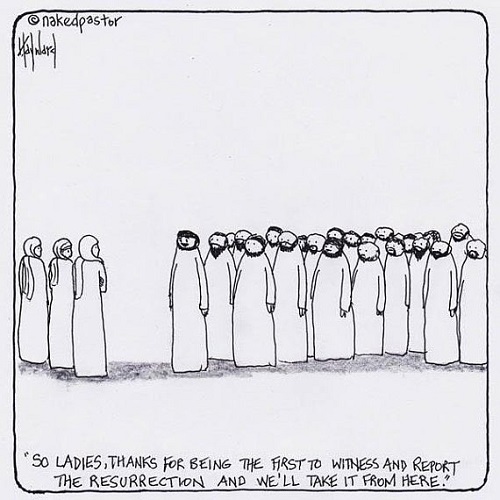
Men have no idea what it's like for women in complementarian churches

Cartoon by Naked Pastor (David Hayward) which shows 3 women and a large group of men. The men say, "So ladies, thanks for being the first to witness and report the Resurrection. And we'll take it from here." Image source.

I read this post, Life under Patriarchy: Death by a Thousand Cuts, which has a bunch of anecdotes about what it's like to be a woman in a conservative/complementarian church. This one in particular stuck out to me:

When I was alone as a woman in a meeting with the all-male eldership of my church, I explained how difficult it was as a woman to discern how to have both a gentle and quiet spirit and also have a voice in the church. One of the male elders, the NT greek “expert”, interrupted me to soften the meaning of 1 Timothy 2:12. I was referencing 1 Peter 3:4. His interruption (mansplaining) and my confusion about his confusion began the whole meeting badly. Afterwards, as I contemplated his mistake, I realized he had no idea of the burden women carry from these verses. No woman who takes her bible seriously in the conservative church world would confuse these two passages with one another. I’ve been processing the realization that men in the church don’t sit with the call to a “gentle and quiet spirit” the way women do ever since that terrible meeting when I tried to use my voice in a room full of aggressive men.

This struck me because it shows how Christian women who believe in complementarianism have to struggle with it because it just makes no sense. And Christian men who believe in complementarianism aren't experiencing that struggle. Maybe they aren't even aware of it at all! 

This has inspired me to write a few of my own anecdotes, here in this post. (Important background information: I'm a woman.) But first, let me define "complementarianism": So, "complementarian" Christians believe that God created men and women to be equal in worth, but to have different roles. In marriage, the wife has to submit to the husband, and the husband has to love the wife as Christ loves the church. Also, women are restricted in what leadership roles they can have in the church. This plays out differently in different churches, but basically, the senior pastor of the church has to be a man. Maybe a woman can be an "associate pastor" or a "children's director" or "women's pastor" or some other jargon. And in some churches, women can't teach adult men- they can only teach women or children. The details of this differ- is a woman allowed to read a bible passage out loud in front of the church? Does that count as "teaching"? Is a woman allowed to sing in front of the church? Sometimes when a woman talks from the pulpit, these churches have to call it "sharing" instead of "teaching." And some churches don't allow women to speak in front of the church at all.

(Trying to understand how this is "equal in worth" is always left as an exercise to the reader.)

---

When I was growing up, I believed in complementarian because I was taught that's what all Christians have to believe. That's what the bible said, supposedly. I was told that there were some Christians who didn't believe in complementarianism, but that's because they were rejecting the bible, they are bad Christians, they've been influenced by the evils of feminism, they think they know better than God, who made this perfect plan about gender.

So yes, I believed in complementarianism because I didn't know there were other options.

But, the thing is, complementarianism simply makes no sense. Why wouldn't a woman be allowed to do everything a man can do in the church? That sounds sexist and wrong. And what does it mean that a wife has to "submit" to her husband? So like, the husband can control her and tell her what to do? What? That sounds so wrong. Or, when they can't agree on something, the tiebreaker is gender? What? What on earth, that makes no sense.

So, the issue is, I believed I was required to believe in this. But, it makes no sense. So I needed to convince myself that it made sense.

And really, that's what all of Christian apologetics is. That's the problem with apologetics. It's not about following logic and changing your beliefs accordingly, as you search for the truth. It's about "I know I am supposed to believe this, please help me force myself to believe it." 

And yes, there are loads of ways that Christians try to argue that complementarianism isn't as sexist and wrong as it sounds. The wife has to submit to the husband, but they husband has to love the wife, even to the point of laying down his life for her, so actually the husband has the more difficult role. And, it's a lot of responsibility for the husband, to be the leader and have to make the decisions for the family, so the wife should be glad she doesn't have to worry her pretty little head about any of that. Also, she knows he loves her, and she trusts that he will make decisions that are best for their family, because he's such a great guy, so actually it's easy for her to submit to him.

And, they said, this doesn't apply to abusive situations. Some people hate these "wives submit to your husbands" passages because they've been used to justify abuse- but that's wrong! The husband should NOT abuse the wife! And if he is, she has the right to get away from him.

And, they said, normally the husband and wife should discuss things as equals, and agree on their decision together! It's only when they really really can't agree, that's the only time that "submit to your husband" comes into play. If they really really really can't agree, then the husband can make the final decision. But that would happen very rarely- in some people's marriages it never even happens at all!!!

Yeah, I don't buy any of this.

I used to. Because I believed this is what Christians had to believe.

But really, all it adds up to is, trying to make "wives submit to your husbands" mean something different than "wives submit to your husbands." Like... Don't worry! It's not what it sounds like!

How about instead, we just reject the entire thing, rather than concocting these elaborate rationalizations where we basically treat women and men as equals while claiming we totally believe that the women are "submitting" to the men?

Sheila Wray Gregoire has pointed out, the majority of Christians who say they believe in complementarianism don't actually practice it. In their actual, practical, day-to-day lives, they DON'T have situations where the husband and wife simply can't agree, so the husband pulls rank. In actual reality, they live like they are equals. 

They claim they are complementarian, but in practice they are egalitarian. Egalitarian is the alternative, the ideology which I was told Christians are not allowed to believe in. Egalitarian means equality between men and woman, and you don't make rules to restrict people based on their gender. (Please note, though, that many egalitarians don't support queer rights unfortunately. It's equality between straight cis men and straight cis women, and doesn't necessarily go any farther than that.)

And it's a good thing that most complementarians don't actually put it into practice. When people actually live that way, it is sexist, and harmful to women, and abusive.

So how about we just reject the whole thing, instead of pretending we're following it?

---

One time, at church, when I was in high school, I heard someone mention an organization called CBE- Christians for Biblical Equality. This is an egalitarian organization, whose mission is to promote the idea that women shouldn't be restricted from being leaders in the church, etc. Equality.

I was very surprised to hear about this, and my reaction was "... is that... legit?" And somebody at church told me, yes.

I couldn't make sense of it at the time. I guess I thought, surely if that's a legitimate interpretation of the bible, then of course that's what we should all believe. If Christians are truly allowed to be egalitarian, then why on earth would anybody be complementarian? Complementarianism just makes no sense at all, just so clearly makes no sense at all. Surely we believe in complementarianism because there aren't any other options, right? If this CBE stuff really is an option, well... of course I would believe it. Of course all of us would immediately believe it. ...Right?

I guess at the time, I knew very little about it, and didn't really believe it was legit. Because, surely if it was legit, if Christians were allowed to believe in it, well then how do you explain all the complementarian pastors I had met?

---

I used to have such faith that this was right, that when the bible said wives must submit to their husbands, or that women are more easily deceived, or women can't speak in church, I believed somehow it was right and good. I didn't understand how it was right, because obviously it sounds so wrong, but I had complete faith that if we just understood the bible correctly, and followed it, there would be no problems.

I remember one time, when I was in college, and I was with a group of friends driving home from a Christian conference. And we were discussing the bible passages that restrict women. I think there were a few boys and a few girls in this discussion. And, the way we were talking about it was very direct and blunt and not necessarily the sorts of things we would say in front of other people, because they would take it the wrong way because it sounded sexist.

And one of my friends, let's call him Edward, said, "I'm glad I can talk about this with you all, because I know that you're not going to think the bible is sexist. We know the apostle Paul wasn't sexist, and we are just trying to understand how."

Wow, I had so much faith.

---

The big change for me came when I found Rachel Held Evans's blog. That was where I first learned that Christians don't have to believe in complementarianism. Like I said, I had heard there are Christians who don't believe in complementarianism, but they are bad Christians, they are obviously wrong. Well, I read Rachel's blog, and she wasn't a bad Christian. She was the same as me. She was a bible nerd. She was asking all the questions I had always wanted to ask but couldn't put into words.

That's where I learned that we can just reject the whole thing. We don't have to tie ourselves in knots trying to explain how we believe wives have to submit to their husbands, but not like, in a sexist way. Rachel wrote about academic research about ancient Roman society, and how there were reasons that the writers of the bible wrote things that way, in that culture. But in our culture, it's completely different, so we don't have to believe in complementarianism.

Before, I thought I had to believe that there was at least something to it. When the bible says women shouldn't speak in church, in some sense that is true and right, it's just a matter of understanding how. Well, no. We don't have to believe there's anything to it. We can reject it entirely. It's an interesting historical exercise, to research the reasons why the biblical writers wrote that, and what it meant in their culture, but for our own situation now, it means nothing.

---

And that's also when I started reading ex-evangelical blogs, and there were so many stories about how complementarianism and patriarchy lead to abuse. Before, I had heard that there were some bad Christians who used this ideology to justify abuse, but I thought it happens very rarely, and those bad Christians are obviously wrong, so no need to really think about that too much. Well. No. In patriarchal churches, women are constantly mistreated. From small ways like assuming the women will do all the cooking and childcare for church events, to big ways like making a rape victim stand up in front of the church and "confess" her "sin."

Before, I had faith that good Christian leaders- whether they were men or women- were just trying to follow the bible to the best of their ability. I never thought about leaders who are protecting their own power. I never thought about who benefits from this ideology. I never thought about how the debate is different depending on whether you have skin in the game. I trusted that we all just wanted to obey what the bible said, even if it's hard.

Well. Not anymore.

---

I remember there were a few times, back when I was "on fire for God", when I prayed alone in my room, and I covered my head with a towel. Because the bible says women need to cover their heads when they pray. And I had never given it a thought before- I had never met any Christians who actually took that seriously. I think maybe 1 time in my life, I've heard of or met a Christian woman who wears a head covering to church because of those verses, but she said it was just her personal belief and she wasn't trying to tell other women what to do. (Some really conservative churches do require it, though, I have heard.) I was taught it was just a cultural thing and didn't apply to us in modern times.

But, sometimes, when I prayed, I was so desperate, trying to figure out how to get God to do what I wanted him to do. (The God I believed in back then was a he/him.) Like, I wanted my friends to "get saved" (ie, to convert to Christianity), and I wanted it SO MUCH, I was SO WORRIED about how terrible their lives must be without Jesus, I just wanted God to get them to change their beliefs, and I prayed so hard, why wasn't it working? Was there some cheat code I needed to figure out, in order to get my prayers to actually work? The bible says women need to cover their heads when they pray, maybe I should try that. Maybe that's what will get God to finally do it. Sounds ridiculous and sexist, but, worth a shot.

I never told any other Christians about this, because how would I even begin to explain it? The idea that we should actually believe that women are required to cover their heads when they pray- it just sounds absurd. All of my Christian friends would surely think it was absurd and sexist, right? But there it is, in the bible.

(And, if you're wondering, no, my friends still didn't "get saved" after that.)

---

In church, there was a discussion about "wives submit to your husbands," and I started asking for examples.

Because, when I said I just totally don't believe in "wives submit to your husbands," tons of women jumped up with the familiar talking points- "I know my husband loves me, and I trust him, so it's easy to submit to a man like that", etc. Yeah, I've heard it all before. I started asking for examples.

Examples. Asking these women, have there been any situations in your marriage, where you and your husband weren't able to agree, so in the end he just made the decision and you had to submit to him?

I only remember getting an actual answer from 1 woman. I think it was something about, they couldn't agree on what school to send their kid to, and in the end she just went with what her husband wanted. And, when she told me about it, I felt bad for asking. Because it seemed really emotional for her, really difficult for her to talk about. That was probably a bad time in her marriage, they probably argued about it, and there were strong emotions on both sides, and eventually she just reasoned that God wanted her to give up and let her husband do what he wanted, so she forced herself to submit.

That's what we're actually talking about here, when Christians say the husband has the "tiebreaker" vote. We're talking about something that was actually important to her, important enough to fight, to make a case, lay out the reasons to support her point of view, and in the end her god made her just give all that up, like it didn't matter. Because she's a woman and her husband is a man.

F all of that.

---

I posted a link on social media, and I described it as a blog post about "the equality of women in the church."

And one of my friends, let's call him Marvin, replied and said, "Women aren't equal! Some are short, some are tall, [and so on, a bunch of different adjectives describing different subgroups of women]"

And I thought, what on earth? Why is he pretending he doesn't understand what I'm talking about? He's acting like he thinks I said "all women are exactly the same" when actually what I meant was "equality between men and woman."

This anecdote is the first thing that came to mind, when I read that blog post I linked to at the top. Oh my goodness, what if he actually didn't understand what I meant? I thought he was acting clueless on purpose, but what if he wasn't? What if he hadn't spent a lifetime trying to make it make sense, when the bible says women can't do all the things men can do? What if he never really thought about it? What if he had no sense of the amazing freedom I experienced, when I found out I really can be a Christian and not be complementarian- that I can just believe men and women are equal, and not do this whole dance about how the bible says this or that?

Men have no idea.

---

But maybe I shouldn't judge the Christian men for having no idea, because I have committed a similar sin.

I'm straight, and back then, when I read the anti-gay passages in the bible, I just nodded along like there was no problem. If a man lies with a man, it is an abomination. Homosexuals will not inherit the kingdom of heaven. Same-sex relationships are unnatural, sinful, shameful, driven by lust. And I just nodded along, like, ah yes, disgusting.

Years later, I started reading blogs written by gay Christians. They wrote about how hard they struggled, trying to be good enough to be accepted by God, trying to repress themselves, reading the anti-gay passages of the bible and trying to make it make sense. They wrote about how much time they spent, tracking down ancient Greek words, trying to figure out what exactly these passages meant.

And of course, when I first started reading these blogs, I didn't agree with them if their conclusion was accepting themselves as gay. I cared about their struggles, but I couldn't believe that it was okay to accept yourself and go ahead and date people of the same gender. I thought Christians weren't allowed to believe that- only bad Christians who rejected the bible would say that same-sex relationships were okay. Rejecting God's perfect plan for gender, as if you know better than God.

But the more I read, the more I saw that they weren't bad Christians. They were bible nerds like me. They were trying their best to follow God.

And I changed my position, and now I support all queer rights. My God is genderqueer, They/Them. (And I'm asexual.)

It's funny, when someone on the internet talks about being queer and Christian, and then some rando posts a bible verse in reply, as if the queer Christian has never heard of Romans 1. Bro, queer Christians know those passages so much better than you do. Queer Christians have spent so much time, way too much time, parsing the minutiae of ancient Roman perspectives on sexuality.

Straight people have no idea.

And isn't it terrible, how Christians are expected to read bible passages which dehumanize entire demographics of people, and just accept that- because the bible says it, so it must be true? Best-case scenario for a good Christian, I suppose, is you read a bible passage that dehumanizes an entire demographic of people, and you just nod along and don't notice anything wrong. But what if you have personal experience that tells you something's wrong with what you just read in the bible? What if you yourself are a member of that demographic, or you have close friends who are? Then, as a good Christian who believes the bible, you have to force yourself to believe it, even when it sounds so wrong. You struggle to make it make sense, because you believe there are no other options.

How about we just reject the whole thing? 

If your God wants you to discriminate against other people, maybe find a new God. Every day you continue to believe in that kind of God, that's on you. What does it say about you, that you choose to worship a God like that?

---

There's one more thing I need to talk about: What does "faith" mean?

Because I read one blog post after another after another about how complementarianism is harmful, how it makes no sense, how it is used to cover up and perpetuate abuse. 

But... did that mean it was actually wrong? What if God commanded this for a reason? What if there's some really amazing reason why women shouldn't have the same rights as men, and as humans we just can't understand what it is? We're not God, what do we know?

Complementarianism obviously makes no sense- but I was taught that faith is doing things that appear to be ridiculous and foolish, because God commands us to, and somehow to God it makes sense. I was taught that's an important component of being a Christian: sometimes God will tell you to do something completely absurd, and you have to do it.

I don't believe that any more. Instead, I believe what Jesus said: A good tree cannot bear bad fruit. You can look at the results of following a certain ideology, and if those results are bad, you know the ideology itself is bad.

Reject the entire thing.

---

Related:

She was the first (Thank you, Rachel) 

It Doesn’t Actually Matter What Jesus Said About Divorce

They Prayed About It (a post about the #NashvilleStatement) 

I'm a woman, and God created me to do math and build robots

Wednesday, January 29, 2020

About Compassion and Reading the News

Reading the news on a tablet. Image source.
Edit: WOWWWWW this did not age well

-----------------

I scroll through WeChat (a Chinese social media app), and everyone is talking about the coronavirus. Then I scroll through Twitter, and everyone's just going about their normal life, talking about whatever they usually talk about. Maybe there's an occasional tweet from CNN about the coronavirus. (Both WeChat and Twitter have a lot of posts about the death of Kobe Bryant though. He had a lot of fans in China.)

I feel ... I feel like my people don't care. I'm living through a national health crisis which is affecting 1 billion people, and barely anyone on American-centered social media is talking about it. (By "affecting 1 billion people", I mean it's disrupting our lives. We have to stay at home, and a lot of people are worried. I don't mean 1 billion people are actually at high risk of being infected- that's just not true.)

I have heard this same sort of sentiment from other immigrants- "we are basically all on lockdown, and none of my friends back home have reached out to ask how I'm doing." Yes, I'm safe, I'm okay, but this is psychologically very hard. Just waiting at home, restless, checking the stats about how many confirmed cases and how many deaths, checking WeChat messages from people right on the edge of panicking... And it must be even harder for people who live alone.

So... all of this has me thinking about compassion and what our reaction should be when we read news stories about problems on the other side of the world. I feel bad that I've seen so few people on Twitter talking about the situation in China, but, well, why would they? If they don't know anyone who lives in China, then why would they talk about it?

I can't bring myself to believe the lack of Twitter posts from people who have no connection to China is a bad thing. If that were true- if it were true that Americans all "should" talk about this, just because it's affecting everyone in China- well then that would mean we'd have to get all emotionally invested in every tragedy we hear about in the news. And we just can't do that. We don't have the emotional bandwidth for that.

This all goes back to what I wrote about last November: Culture, Objectivity, God, and the Real Reason I Moved to China. In that post, I said I used to believe I had an obligation to "love everyone equally", like God does. I no longer believe that. Instead, I accept that as human beings, we are limited in our emotional capacity, and it's unhealthy to try for that "ideal" of "loving everyone equally."

It means that when something bad happens to people you know, or people from your own culture, you care a lot. You feel sad for a while. But when the same bad thing happens to people from a different culture, you don't really care. And that sounds awful- but I don't think it would be healthy to try to "make" yourself care. Or, let me rephrase that: It would be unhealthy to try to make yourself have an equal emotional response to every faraway foreign tragedy and relatable "close to home" tragedy. We just can't. There's always something bad happening somewhere. We can't live that way, constantly mourning all the things that deserve to be mourned.

God is like that. God has an "equal emotional response" to people of all cultures. The bible says "rejoice with those who rejoice; mourn with those who mourn," and I truly believe God does that. God has the emotional capacity to empathize with 7 billion people at the same time. But humans can't. Let's do our best to "rejoice with those who rejoice; mourn with those who mourn" on a small scale, just with the people we interact with in our daily lives. But we can't take it farther than that. We can't. We're only human.

I often see people on Twitter talking about "all of you are tweeting about this tragedy that happened in Europe or the US, but nobody said anything about this other equally-bad tragedy that happened last week in this other country" ... and the purpose of their tweet is to tell us we are doing something wrong. They're saying it's wrong that we care so much more about members of our own culture than members of a different culture. And we should feel guilty.

I can't agree with that anymore. Yes, I 100% believe that people who are affected by a tragedy in a faraway culture on the other side of the world deserve to have people care about them and treat them with empathy and compassion. Yes, 100%. But that doesn't mean it has to be me. I'm not an objective outside observer of the world; I'm localized to this one specific place, a member of a few specific demographic groups. God cares about everyone equally, but I can't.

Intellectually, I care. I certainly believe that everyone in the world has equal worth. We are made in the image of God. We are valuable. We have plans, dreams, desires, interests, and all of that matters. And everyone matters equally. And so many things happen every day which shouldn't happen. All these tragedies you hear about in the news- the world shouldn't be that way. As a society, we should work to prevent those things, as much as we can.

But emotionally, of course it would have a much bigger effect on me if something bad happened to a family member than if the same bad thing happened to somebody I don't even know. Of course it would. And I would be much more saddened by something happening in a place I've been, than in a place I've never even heard of. And even though maybe this sounds terrible, I don't think that's something I should necessarily want to change.

Well, let me rephrase that: I very much believe it's important to get to know people from other cultures. It's important to learn about what life is like for people from different backgrounds. I really appreciate how online (with blogs, social media, etc) we're able to learn from a huge, diverse group of people. Coming to China and experiencing life here has made me a better person. And yes, it does mean that I'm emotionally affected by news (specifically, news related to immigrants and Chinese people) in a way I wasn't, before.

Just today I was asking my husband (who is Chinese) about what life was like during the SARS outbreak in 2003. I remember hearing about it in the news back then, but I didn't really care. Well, of course I cared in an intellectual sense, but it didn't affect me emotionally. But my husband lived through that.

But maybe that's the answer, maybe it's about getting to know other cultures, in a gradual and natural way, rather than reading a news story and trying to guilt yourself into having an emotional reaction to it. We shouldn't be like "here's a story about someone who died, how awful, I should be as sad about this as I would be if it was someone in my family who died." As I said, God loves everyone equally, but we can't. Yes, the victims you read about in the news were just as valuable as your own loved ones, and an objective person would indeed mourn them equally. But we're not objective, and it's not healthy to try to become objective.

So instead, we should interact with people from different backgrounds in our day-to-day life, and learn from them. A reasonable amount, that is. Not trying to "love everyone equally", just trying to gradually widen our awareness of what the world is like. And then we will feel a bit more compassion when we read the news- but that shouldn't be our goal. What an awful goal that would be- "I would like to be emotionally messed-up every day when I read the news." No, we can't live that way.

And it doesn't help anyone, if I feel "equally sad" about everything. What helps is me being kind to people, donating money to people in need, helping other people from my own culture get educated about issues affecting other cultures, supporting society-wide policies that take into account the unique needs of diverse demographic groups.

Also, as I write this post about "I feel bad because no one on Twitter cares about our plight being stuck in our homes in Shanghai" I realize that I'm much more focused on people in my situation (the waiting, the fear, the boredom, the uncertainty) than on the actual sick people who have been infected by the coronavirus. So... well that means I certainly can't complain about strangers not caring about me.

So... well I feel like this post is kind of a big jumble of ideas. Wish I could organize it better or have some kind of conclusion, but I just don't know, and also I'm tired of staying at home and I don't have the energy to think about this anymore. Anyway, it's fine not to "love everyone equally"; don't try to make yourself feel guilty about that. Care about the world, but also about your own mental health.

-----------------

Related:
Culture, Objectivity, God, and the Real Reason I Moved to China 
Francis Chan and Objectivity 

-----------------

All my posts about COVID-19:
I'm in Shanghai, and I'm concerned about the coronavirus (January 23)
An update on the situation in Shanghai (January 28)
About Compassion and Reading the News (January 29)
Welcome Baby Square Root! (February 3)
Remember the old days when we used to go outside? (February 4)
So we're (sort of) back to work here in Shanghai (February 12)
Blogaround (February 13)
Blogaround (February 20)
Shanghai is a good place for immigrants. (And I have feelings about it.) (February 24)
Blogaround (February 27)
Well *now* I'm glad I stayed in China (March 8)
The Weirdest Deja Vu (March 15)
Blogaround (March 19)
I'm an American in China. I CANNOT BELIEVE Some of You Are Still Going Out. (March 22)
Blogaround (March 25)
China Bans Foreigners (Like Me) From Entering the Country (March 29)
List of People Who Are Not Allowed to Call Themselves "Pro-Life" (April 2)
Blogaround (April 3)
... all right now I have way too many posts to keep updating this list. You can find them all on the COVID-19 tag.

Friday, June 22, 2018

Blogaround

1. From Starbucks to Hashtags: We Need to Talk About Why White Americans Call the Police on Black People (posted April 16) "Then there’s Ronald T. Ritchie, who told 911 that John Crawford III was running around Walmart “menacing children” with a shotgun. Crawford, holding a BB gun—sold at Walmart—in the open carry state of Ohio, was shot and killed by police. Despite clear evidence that Ritchie lied to the 911 dispatcher, which is a crime, no charges were filed against him."

2. ‘This calls for wisdom: let anyone with understanding calculate …’ (posted June 16) "Martin Luther King Jr. challenged that spiritual darkness with an overwhelming light, but the darkness comprehended it not, because those Romans 13-quoting Christians loved darkness rather than light, because their deeds were evil."

3. Kids Shouldn’t Talk Like This to Their Fathers (posted June 17) "Use me as your instrument."

----------------------------------------------------------------------------

Links about the US government separating immigrant parents from children:

1. What’s Really Happening When Asylum-Seeking Families Are Separated? (posted June 15) "So the idea of zero tolerance under the stated policy is that we don’t care why you’re afraid. We don’t care if it’s religion, political, gangs, anything. For all asylum seekers, you are going to be put in jail, in a detention center, and you’re going to have your children taken away from you. That’s the policy."

2. Poor Medical Care in ICE Custody Is Fatal, New Report Finds (posted June 20)

3. 600 United Methodists file church complaint against Jeff Sessions (posted June 19) Good. Kick him out of the church.

4. Youngest migrants held in ‘tender age’ shelters (posted June 21) "Many of them are under age 5, and some are so young they have not yet learned to talk."

5. Former ICE Director: Some migrant family separations are permanent (posted June 19)

6. Michigan receiving detained immigrant children as young as 3 months old (posted June 20)

7. A family arrives at the border. Here's what happens next. (posted June 19) Graphs and statistics.

8. Trump Retreats on Separating Families, but Thousands Will Remain Apart (posted June 20)

9. Separating Migrant Families Is Barbaric. It’s Also What the U.S. Has Been Doing to People of Color for Hundreds of Years. (posted June 21) "No nation in the entire world incarcerates more people than we do."

10. Governor orders probe of abuse claims by immigrant children (posted June 21) [content note: descriptions of abuse]

11. Here's how we can help! DONATE to RAICES to help reunite families~

Wednesday, December 20, 2017

That Time Jesus Didn't "Stand Up For What's Right"

Image from VeggieTales "Rack, Shack, & Benny," before they are thrown into the furnace. Image source.
[content note: mention of gun violence and martyrs]

So we've come to a verrrrrrrrrrrrrrry interrrrrrrrrrrrrresting passage here. Matthew 21:23-27.
23 Jesus entered the temple courts, and, while he was teaching, the chief priests and the elders of the people came to him. “By what authority are you doing these things?” they asked. “And who gave you this authority?”

24 Jesus replied, “I will also ask you one question. If you answer me, I will tell you by what authority I am doing these things. 25 John’s baptism—where did it come from? Was it from heaven, or of human origin?”

They discussed it among themselves and said, “If we say, ‘From heaven,’ he will ask, ‘Then why didn’t you believe him?’ 26 But if we say, ‘Of human origin’—we are afraid of the people, for they all hold that John was a prophet.”

27 So they answered Jesus, “We don’t know.”

Then he said, “Neither will I tell you by what authority I am doing these things.
So basically, the chief priests asked Jesus a question he didn't want to answer, and he avoided answering it, by asking them a question they didn't want to answer either.

I've been in bible studies before where people were puzzled over why Jesus wouldn't want to answer. We decided that if Jesus had just straight-up told them he's the son of God or whatever, it would have been dangerous for him, or would have messed up his plans. Maybe the religious leaders would have tried to kill him earlier. Maybe he wanted his followers to learn more about him and come to their own conclusions, instead of telling them what to think.

And that's all well and good, those are fine reasons, in my opinion. I don't have any issue with Jesus refusing to answer questions.

But here's the thing: This explanation is totally at odds with Christian folk tales about martyrs and "standing up for what's right."

Anybody who grew up in white American evangelical culture has heard the urban legend about a school shooting where the shooter asks people "do you believe in God?" or "are you a Christian?" and the understanding is that if the victim says "yes," they will be killed. And the victim is a hero and a martyr for saying "yes"- they did the right thing, they "stood up for Jesus" even though it was dangerous. And the message is: Would YOU be brave enough to say "yes" and get yourself killed?

There are lots of stories about martyrs that work just like this. The bad guy asks the Christian to say something, and if the Christian gives a direct honest answer about their Christian beliefs, they know they could be killed. (Sometimes God intervenes and saves them- as in the story of Shadrach, Meshach, and Abednego.) The Christian is held up as a role model for us to follow because they gave a direct, honest answer. Because they didn't consider the risk when they answered.

The sermons ask us to consider what we would do in that situation. Would we "stand up for God" and give a naive, honest answer that completely ignores the risk? Or would we "deny Christ" and say something a bit less straightforward or even a bit dishonest, in order to save ourselves?

Back then, we read these bible verses:
Whoever acknowledges me before others, I will also acknowledge before my Father in heaven. But whoever disowns me before others, I will disown before my Father in heaven.
Matthew 10:32-33

For I am not ashamed of the gospel, because it is the power of God that brings salvation to everyone who believes: first to the Jew, then to the Gentile.
Romans 1:16
And we beat ourselves up over our failure to mention Jesus in conversation with our friends. Someone asked me what I'm doing tonight, and I said "homework" when in reality I'm going to a worship night, it's because I didn't want to explain what a "worship night" is, ohhhh I am "ashamed of the gospel." And so on.

So the message was this: If somebody asks you a question where the answer is something about you being a Christian, you need to give a straightforward, honest answer. Even if there is danger of violence. Even if you don't really feel like talking about religion right then. It is wrong to consider the situation you're in and adjust your response accordingly. If you don't give a direct answer, that means you are "denying Jesus" and "ashamed of the gospel" and you are a bad Christian.

And yet, here in Matthew 21 we have the chief priests asking Jesus, "By what authority are you doing these things? And who gave you this authority?" Surely the honest answer here is "I am the Son of God, I have the authority to do this." But that's not what Jesus says.

Is Jesus "denying God"? Is Jesus "ashamed of the gospel"? No, he's just considering the situation that he's in, his goals, and how it's not really a good time to announce publicly that he's the son of God. Which, as I said, I agree Jesus is being reasonable here and it's fine for him not to answer, but THAT'S NOT WHAT WE LEARNED IN CHURCH about martyrs and persecution. We learned you HAVE TO ANSWER, and you have to answer in the most honest and straightforward way. We learned that we have to "stand up for what's right" and trust that God would protect us. Look the bad guy in the eye and say, "But even if he does not, we want you to know, Your Majesty, that we will not serve your gods or worship the image of gold you have set up."

Jesus doesn't "stand up for God" here. He doesn't want to answer the question, so he uses the chief priests' embarrassment over their opinion of John the Baptist to weasel out of it. That's clever, and it required him to have an awareness of the situation, his goals, the chief priests' feelings and motives, and rules for polite social interaction. Yes, we learned in church that, when prompted with a religion-related question in a possibly-dangerous situation, you should always blurt out your deepest core beliefs about God, without a second thought- but reality is not like that at all.

-------------------

Related:
Christians and Tests
OF COURSE Martyrs Don't Work That Way
Perfect Number Watches VeggieTales "Rack, Shack, & Benny"

-------------------

This post is part of a series on the gospel of Matthew. 

Previous Post: That Time Jesus Got Hangry (Matthew 21:18-22)

Next Post: The Parable of the Wedding Banquet is Extremely WTF (Matthew 21:28 - 22:14)

Click here to go to the beginning of the series.

Monday, October 9, 2017

The things I've never let myself say about worship

A crowd of people standing up during worship music time. Some of them are raising their hands. Image source.

"It's just you and God."

-----------------------

My Sunday School teacher asked us, "What is worship? Is it just singing songs? Is it only something we do on Sundays?" And the answer was no, worship isn't music. The correct Sunday-School answer was that worship means doing everything in a way that honors God. It's about your whole life. Living a life fully dedicated to God. Singing songs is part of it, but that's not what worship is.

In my twenty-plus years as an evangelical, every time the "what is worship?" lesson came up, that was the answer. It's not music, it's living your whole life devoted to God.

So then, why did church people use the term "worship" as if it meant "singing church songs"? Why did they say, "So first we'll do worship and then prayer next"?

I believed the Sunday School lessons. I never referred to the singing of songs as "worship"- that's not the kind of thing you say if you believe your entire life is supposed to be constant worship. Instead, I used the term "worship music." (Later, I actually used a concordance and looked up every time the bible uses the word "worship", and guess what, it isn't used as a synonym for "religious songs" and it isn't used as a synonym for "living your entire life devoted to God." So.)

-----------------------

When I was in college, I dedicated my life totally 100% to God. This was after an experience where I was overwhelmed at seeing God's mercy and goodness, and I was so full of emotion and just wanted to sing and dance and express how much I loved God. For the first time in my life, I looked forward to going to church. (Before, I went to church because of course I go to church, that's what Christians do.)

And so I became that person who sings loud and raises her hands and jumps and dances and all that. I loved it. I felt so free and emotional and close to God. The feelings I had in my heart, about my love for God and how great God is and the amazing things God had done for me- and every week at church, there was an opportunity to shout those feelings out as loud as I could.

I started sitting in the front row so I would have more space to dance around during the worship music time. I wore shoes that could be taken off easily so my feet wouldn't hurt when I knelt down. On more than one occasion, I was at a Christian conference and actually brought a skirt and changed in the bathroom before the worship time, because I wanted to look my best when I was dancing for God but the weather was too cold to wear a skirt the whole day.

I loved it; I loved singing and dancing to express my overflowing joy for God. But at the same time, I also felt a little weird. Maybe a little embarrassed.

-----------------------

A foundational tenet of the Christianity I was taught was that a lot of people claim to be Christians but they're not really Christians. And going to church doesn't mean you're a Christian- "if you go to McDonald's, does that make you a hamburger?" So I was suspicious of the people I met in church. Were they really really REALLY real Christians, or were they just going along with it because it's their culture?

The sermons on worship said we should get into it with our whole hearts and not hold anything back. So why was I the only one dancing and raising my arms in every song and bowing down on the floor? Was it because other people weren't as godly as I was? Maybe they weren't real Christians.

-----------------------

I'm a math person. I always liked math classes because every answer is either right or wrong. If I know the right answer, I can prove it's the right answer, and I'm confident I'm right. I didn't like English class because when you write papers, you have to explain this means this because of these reasons, but really isn't it all just a bunch of made-up opinions? What is it based on? What if I say "here's my interpretation of this literature" and everyone is like "haha what, no that's ridiculous, that's obviously not what it meant"? Who's to say who's right and who's wrong? All you have are different people's opinions on what's "ridiculous" and what's "reasonable."

Same thing with art. You can have a piece of art, and some people think it's so deep and meaningful, and some people laugh at it. And I always worried what people thought of my actions during worship time. Maybe they were laughing at me in their heads. Maybe they thought I was weird. I was up front, moving around, waving my arms, dancing, singing loud- I was very noticeable.

I remember one time, I was practicing for this dance performance for a Christian worship night thing- doing a dance I had completely made up myself, with no dance training or anything- I was practicing and showing a friend to see what she thought. And I tried to show her what I'd prepared but I just stopped and laughed at myself because I felt so nervous and weird, doing a performance in front of other people. Like what if dancing is just weird and I should feel embarrassed about the entire thing? It's art, there's no objective measure for whether it's beautiful or ridiculous. And that always bothered me.

But when Christian speakers talked about worship, they said we shouldn't think about what other people are thinking. "It's just you and God," they said. I always heard Christians say that about worship music time- "It's just you and God." And you shouldn't care what other people think.

I always used to close my eyes when I was singing. Then I couldn't see other people, and so I would be able to stop thinking about how they are probably judging me.

Sometimes strangers would come up and give me a compliment about how it's so great that I worship so freely and authentically and with my whole heart. But most people never said anything about it at all. And I worried about that. But I kept telling myself, "It's just you and God, it doesn't matter what people think."

-----------------------

I discovered that I couldn't move around as much if I wasn't sitting in the front row or on the end of a row. If there were people on both sides of me, I didn't have as much space to work with. I could pretty much just put my arms straight up, but not to the sides.

I knew that it would be bad to wave my arms around too much and make the people on my left and right worried that I was going to hit them in the face. So ... that means I can't just close my eyes and worship freely- it means I have to keep my arms within a certain space and be very aware of the people around me and whether or not I'm close to hitting them. But what about "it's just you and God"? What about "you shouldn't care what other people think"?

This paradox was always a mystery to me. I deeply believed "it's just you and God" but I also felt that it wouldn't be right to let myself move around so much that I risk hitting someone accidentally. But how could those two ideas be reconciled? And the thing about hitting somebody- that was never something that was explicitly taught as "this is a sin." It was more along the lines of, uh, common sense.

The best I could figure was that God loves everybody, so if I'm loving God with my whole heart, then I also have to be nice and considerate to people- that's what God would want. So, I concluded, it's not true that "It's just you and God." Actually, "It's just God." And not hitting someone accidentally is MORE IMPORTANT than freely expressing all my love for God through dance.

It's kind of odd that I spent so much time and mental energy trying to find a justification for "it is bad to be so careless with my arm movements that I accidentally hit someone in the face" but it never occurred to me to see a conflict between the teachings on worship and the teachings on modesty. I was taught that good Christian girls should never move their bodies in a way that could be interpreted as "sexy." So I would wave my arms, shake my head, clap, jump, kneel down, turn around, and step stiffly from side to side. But absolutely no wiggling, twisting, bending, or shaking any part of my torso. That might be "immodest." (Remember, one of the foundational doctrines of modesty culture is that, as a woman, I "just can't understand" what men are going through. So I should avoid these types of movements, just in case some man thinks they are "a stumbling block." Even though I think they probably aren't.)

Why did I never ask the question, "If it's 'just you and God', then how can there be modesty-based restrictions on shaking one's butt in worship?" Maybe because the action of dancing in a "sexy" way (ie anything that risked drawing attention to my torso area rather than limbs) was intrinsically sinful- even if I was alone in my own home, I would be nervous about trying it. Whereas there was nothing inherently wrong with jumping around and waving my arms, it's just an accident of circumstances that somebody's hypothetical face happened to be right there. It was reasonable for me to imagine getting so lost in the emotions of worship that I forget there are people standing right next to me and I have to be careful not to hit them. But how can someone get so lost in worship that they move their body in a way that a good Christian girl should never ever move their body?

-----------------------

The word I hated the most was "distracting."

My parents' church is way more, uh, tame than the kind of worship environment I experienced with other college students. So when I was home for the summer, I looked even more out of place, in that sanctuary of people who just stood still, or maybe occasionally slightly raised one hand. And my mom had a problem with what I did. And she had a problem with how I cheered and yelled at the part in the song about the resurrection. (You know, the cornerstone of our faith, the coolest thing that's ever happened.) She always used the word "distracting" and so now I get kind of triggered when anyone uses the word "distracting" to describe something happening at church. Apparently I was being "distracting" and it was bothering other people, they can't concentrate on worshiping God, so I just need to cut it out.

My parents said I was singing too loud, I was "screeching." I thought they should consider themselves lucky that I wasn't singing a completely different song than everyone else. Because the song the worship band was doing wasn't one of the ones I felt a deep emotional resonance with, and ya know, "it's just you and God, you shouldn't worry what other people think"- I briefly considered just singing my favorite worship song while everybody else was singing the song the worship band was doing. I never did that though, fortunately. But maybe it was because I felt I wasn't brave enough. Maybe if I was truly worshiping God with my whole heart, I would be open to doing something as bizarre and disruptive as singing an entirely different song than the rest of the church.

But I wondered, what if they were right, and I was "distracting" and I shouldn't "worship" like that? What if it's not true that "it's just you and God"? What if God wants me to care about not bothering other people?

I read Romans 14, about "not causing anyone to stumble." It meant that even though we have the freedom to do something, sometimes it's better not to do it because it might tempt some weaker person to sin. (The entire basis of "modesty.") So maybe I shouldn't worship like that if it's going to bother people?

I read 2 Samuel 6, where "Wearing a linen ephod, David was dancing before the Lord with all his might", and Michal gave him a hard time about it, but the bible sides with David, who says "I will become even more undignified than this." (Inspiring this worship song, which I was a huge fan of back then.) So screw anyone who has a problem with the way I worship, right?

I wished I had someone I could talk to. But would anybody else understand? Nobody else was dancing around like I was during the worship music. Maybe they don't love God as much as I do. Maybe they are those fake Christians I keep hearing about. What if they are silently judging me for how weird I am when I worship? No, I can't ask their opinion on whether it's okay to worship like this.

The closest I came to having an actual conversation about this was with my friend Kiara, who was talking about moving and expressing oneself during worship time. She held her hands up at about the level of her shoulders and said "God hasn't been this good to me," then raised her arms up, YMCA-style and said, "He's been THIS good to me." I liked that and I wanted to believe her, but at the same time, I couldn't find a logical argument that explained why certain beliefs about God would necessarily map to certain body movements. How I wished I could say that God is so good and therefore I MUST respond by worshiping in this specific way- but I couldn't.

Kiara is black, and I went to her black church one time and I loved it. From what I've seen, people in black churches get really into the singing and dancing and expressing emotions through worship music. I actually joined a student gospel choir in college, where the majority of the choir was black, just because I wanted to shout really loud about how I felt about God, and a gospel choir is the place you can do that. I had a great time. (Note, however, that in the context of being in a gospel choir, I did NOT believe "it's just you and God" because our goal was putting on a good performance. Which is a completely different thing than just being a congregation member during worship time. ... Wait a minute- how did I never notice the huge contradiction between the teaching that "worship isn't about music, it's your whole life" and "when you worship, all that matters is you and God, don't think about other people"?)

I guess I didn't really know about the concept of culture back then. It was easy for me to assume that people who moved more and looked more emotional during worship time loved God more. Easy to think that people in my parents' (very white) church weren't real Christians because they stood still while singing about God. But now I get what culture is because I moved to China. Culture is the reason that a belief about God might map to a particular body movement- and in a different culture, maybe that exact same belief doesn't inspire people to move in that particular way, and that doesn't mean their faith is any less genuine and heartfelt. In China I don't just barge in and do things the way I think they should go and "don't care what anyone else thinks." Maybe I no longer believe there's any situation where you should "not care what anyone else thinks." Maybe worship was never supposed to be "just you and God" at all.

-----------------------

It always bothered me when the lyrics of a worship song said something along the lines of "I am doing this specific physical action right now" and yet we weren't actually doing it. A few examples:
If you sing that you're doing something, and you're able-bodied and could easily do the thing, but yet you're not doing it... then what about the part of the song where you sing about how much you love God- are you actually doing that or not? If you can't even be bothered to do some simple gesture, then what about the hard task of living your whole life devoted to God?

If I sing that I'm kneeling but I'm actually not kneeling because like, I don't want to do that in front of other people, they will all look at me and think I'm weird... does that mean I'm not really worshiping? Does that mean I'm not really devoted to God, because my actions are influenced by what other people will think?

If we sing "we're dancing now" but we're not dancing, then that means we don't really mean that part. And to be honest, I always felt like Christians didn't really mean all that stuff we said in church. In Sunday School they taught us that God can do anything and cares about all the details of our lives- so why did I feel awkward suggesting to another Christian that we pray when we were setting up for an event and couldn't figure out how to turn the projector on? Why did I feel weird saying things like "I belong to God" out loud anywhere other than church?

Church people said "a lot of Christians don't actually have a Christian worldview"- which means they say they believe certain Christian beliefs but mostly they just live their lives like they believe the normal things that mainstream society believes- they haven't worked through all the logical implications of their Christian beliefs and how those things should apply to all these other aspects of their lives. And after I dedicated my life fully to God, I tried to eliminate that gap between the way I lived and the things I claimed to believe. (See: #ChristianAltFacts)

And now I write hundreds of blog posts about how much that messed up my life.

-----------------------

I can't tell you how many times I debated in my head when I wanted to raise my hands, or bow down, or whatever, but I was hesitating. The foundational assumption in all those debates was "if the only reason to not do this is because I would feel weird having other people see, then that's not a valid reason." Like I always have to analyze my motives, and if I discover I'm partially motivated by some "sinful" reason then that means I'm being bad. Now THAT'S "distracting."

One of my friends, let's call him Bob, had a different problem during worship. He once told me about how he felt like he shouldn't raise his hands if he wasn't feeling emotionally compelled to raise his hands. Like it would be "fake" if he did it without having the "I love God so much, I simply must raise my hands, I can't help it" feeling. He said that he was learning it's okay to do it even without the "correct" emotions, and that was helpful for him.

Yeah, because the idea of just going along and singing the songs without "really meaning it" was preached against strongly in the churches I attended. They taught that if you're singing but you're a little distracted, thinking about the things you have to do tomorrow or whatever, that's not okay and it means you are being bad and your singing doesn't really "count" as worship.

It's awful for our mental health, all these rules about which emotions we're allowed or not allowed to have. I know many ex-evangelicals have moved to more liturgical, less "emotional" churches and ended up much healthier there. Because the whole service is more or less scripted out, so congregation members can just kind of follow along, read the words they're supposed to read, and that's good enough. You don't have to constantly interrogate your own emotions and feel guilty over not having the "correct" feelings or not "really meaning it." Just make a choice to show up for church, if that's all you're able to do. And that's good enough.

-----------------------

I went to InterVarsity's Urbana conference, where we worshiped in a stadium with thousands of students. I always tried to get a seat in the rows of chairs set up at ground level, rather than in the bleachers. Specifically, I wanted to be in the front row of a section or at the end of a row, because then I would have a lot of space to move and dance during the worship time.

One time, during the worship music at Urbana, I saw a group of students coming down from the bleachers so they could dance in the more open space at the ground level. But a staff member stopped them at the bottom of the stairs and said they have to go back to their seats.

I don't think I'll ever forget that. Because of all the Christian talks I had heard- many of them from actual InterVarsity staff- about how we should worship freely and not care what anyone else thinks, and all that matters is expressing your love for God. Then how could a Christian staff member stop people from coming downstairs where they could dance and worship?

I know it's about crowd control. Urbana had over ten thousand students, and when you have a group that big, you have to have very very strict rules in order to keep everything running smoothly. It was obvious that a lot of thought had been put into crowd control at Urbana- I was RIDICULOUSLY IMPRESSED by how they would block certain hallways at certain times of the day so that they didn't end up with chaos as waves of people tried to get past each other in different directions. Seriously, like every conference I've been to EXCEPT FOR URBANA has some kind of badly-planned area where people wait in line and there's a bottleneck and it wastes everybody's time. My mind was BLOWN at not seeing any of that inefficiency at Urbana. Seriously. It was amazing.

So probably everybody has to stay in the general area of their seats during worship time because otherwise you might end up with a huge crowd that gets out of control, and then when worship time is done you have to wait for them all to go back to their seats before doing the next thing and it takes FOREVER, or some kind of reason like that.

So all that talk about "it's just you and God, you shouldn't care what other people think" was a lie? More like "it's just you and God unless you're in an arena with over ten thousand people- then better not stray too far from your chosen seat."

-----------------------

I never really realized how personal the lyrics of worship songs are, and how unnatural it is to express those things in public. I never thought about it, but I felt it, and I wasn't able to put those feelings into words. We sing about love, about our hearts, about our desires- these aren't things people typically discuss in public where strangers can overhear.

Maybe that's why other people didn't seem as "into it" as I was. Not because they didn't really love God, but because they didn't necessarily want to proclaim their deepest feelings about God in front of a bunch of acquaintances. And maybe that's totally okay.

In a post from 2015, Modern Worship Music is Foreplay, Or Why I Hate Going to Church, Dianna Anderson writes,
Rather, [my objection is to] the lack of restraint that these songs exhibit and the almost total lack of theological depth. Jesus is the “lover of our souls,” “drawing us closer and closer.” We talk in sexual terms about our relationship with Christ without stopping to consider what these terms mean. The music is not only sexual in nature but nearly meaningless in its theology. What do we mean when we’re saying that Jesus is the “lover of [our] soul”? How does Jesus act as a lover? Is that a road we really want to go down?

Rarely do these songs come with explication and commentary, despite being a central part of the approach to God that is a religious service. Modern worship music seems to exist solely to invoke an emotional experience, to prepare us emotionally and spiritually for the sermon and the service. It is, functionally, the foreplay of the modern evangelical service.

We call it centering ourselves on God, bringing us into the moment, but what it does functionally is create a veneer of intimate experience in the midst of a congregation that’s barely on a first name basis with each other. It’s all too often an emotional high without the attendant support needed for emotional vulnerability.

In my own experience, after years of this kind of structure to worship, I found myself unable to function well in traditional, emotionally driven worship places. There’s a time and place for communal worship, but it seems that modern Protestant, charismatic worship gives us all the emotional (and often vaguely sexual) release with none of the support and follow up it requires. As soon as I stepped away from that environment and examined it truthfully, I realized that the spiritual highs I reached in communal worship were emotionally manufactured through repetitive, vapid, theologically empty music. I never really connected with my community in the way church is supposed to.
And I think this is exactly the reason that the whole congregation stares straight ahead at the screen with the lyrics. They don't want to make eye contact with anyone else while they say the words "I'm desperate for you." This is why I wanted to jump and dance for God but on some level I didn't want anyone to notice. This is why so many talks were given about "it's just you and God, you shouldn't care what other people think"- because it's completely natural to be unwilling to express such deep emotion where other people can see.

How did I never realize that was the reason?

If only I hadn't grown up in an environment which equated emotional vulnerability and oversharing with godliness. If only someone had said "It's good and healthy to have boundaries- to have personal things which you don't go around telling everybody. Not because those things are bad or sinful, but because they're personal and you have the right to have a private life."

They all saw me kneeling on the ground, crying, dancing, singing with deep emotion about how I am giving my whole heart to God. And then they decided I'm not a real Christian because I no longer believe the "correct" evangelical teachings about hell or the bible or sex or whatever. It hurts even more, because church was the place I expressed my deepest feelings where everybody could see, and now I don't feel safe going to any church at all.

I still love God. But I don't want church people to see. I don't trust them.

-----------------------

I was never able to understand my own emotions when I "felt weird" for worshiping so expressively. The only narrative available was "some Christians don't worship with their whole heart because they're worried about what other people will think, and that's bad, it means they care more about people's judgment than about loving God." I'm dancing for God, so any doubt about it must be from the devil or from my sinful nature, which doesn't want me to obey God wholeheartedly like this. Therefore I must completely ignore those doubts.

I raised my hands and yelled and danced, and I wasn't allowed to have feelings about the fact that a whole bunch of people at church could see me.

In church, Christians sing worship songs in large groups- but we're supposed to pretend that we don't. We're supposed to act like it doesn't matter if other people see us or not, and that if we have any emotions about that, then those emotions are bad, because we shouldn't care what people think. We all stay in our space and don't make eye contact while we publicly verbalize the deepest thoughts of our hearts.

-----------------------

Related: The things I've never let myself say about evangelism

AddThis

ShareThis