Showing posts with label fun facts. Show all posts

Wednesday, July 4, 2012

Quick history of the American flag

Happy 4th of July, everyone!  Happy birthday USA.  I'd like to present some fun facts about the US flag:

1776: The first flag.

Image source.

This was used because it was really easy to make, just take the British red ensign (flag used for ships) and add white stripes.

British red ensign.  Image source.
Here is a replica flag, featuring this original design, at San Francisco City Hall:

Image source.


1777: 13 stars, 13 stripes.

But there wasn't a clear standard about how the stars should be arranged.  So you had a bunch of different designs:

Betsy Ross flag.  Image source.
Francis Hopkinson's flag.  Image source.
Cowpens flag.  Image source.
Brandywine flag.  Yeah I don't know what's with all the red space.  That actually IS part of the flag.  Like I said, totally not standardized... Image source.

1795: 15 stars, 15 stripes.  Welcome, Vermont and Kentucky!

Image source.


This was the flag that inspired Francis Scott Key to write "The Star-Spangled Banner."

After that they went back to 13 stripes for all subsequent designs.  Because the stripes were just getting out of hand.

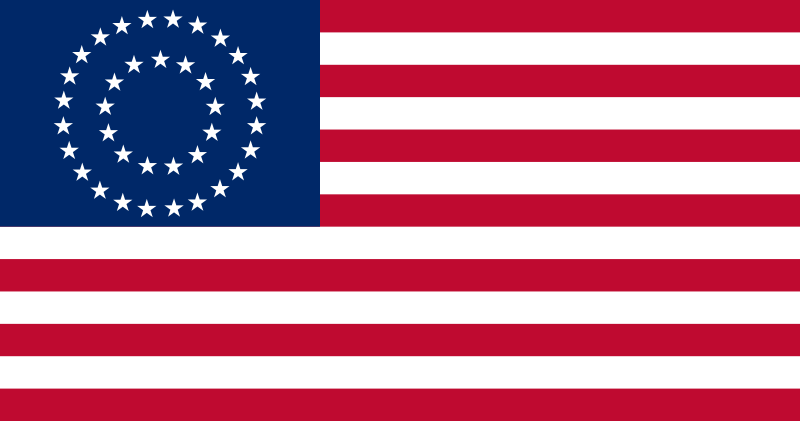
But every time a new state is added, the flag gets updated on the following 4th of July.  (Is that weird?  It means the US flag has gone through 28 variations.)

Well, here they all are (images all from here):

And finally, the flag as it has been since 1960, after the addition of Hawaii:

My blog looks so patriotic today!

Kinda weird that a lot of these designs were only in use for 1 or 2 years- there was a long time where the US was adding tons of states and had to keep updating.  Maybe the "# of stars = # of states" thing was a bad design.  Though right now it's fine because we've been at 50 for a long time.

Finally, I have a question for my readers: What is something important about the US, that would be good to put on a flag?  (Because, apparently the number of states that the country is divided into is REALLY important?  Gotta keep updating the flag.  Okay whatever.)

My answer would be something about diversity- the vast majority of Americans are descendants of people who moved to this continent in the last 300 or so years.  I think that's pretty unique, and it makes the US really diverse as far as culture/race/ethnicity.

I feel like the Statue of Liberty is a good symbol for that, because it (she?) welcomed the immigrants from Europe back in the day.

Give me your tired, your poor, your huddled masses yearning to breathe free. Image source.

Happy 4th of July everyone!

Moon landing in 1969.  This is the flag with 50 stars.  Image source.


Sources:
Wikipedia:
Flag of the United States
Grand Union Flag
Red Ensign
Timeline of the Flag of the United States
List of US States by date of statehood
Statue of Liberty

Monday, June 18, 2012

The color of money. No I mean literally, the color of money.

You know how sometimes people use the term "green" to refer to money?  Surely this is only an American thing, because other countries have bills that are different colors, right?  Actually, I bet people from other countries are surprised to find out all denominations of American money are green.  Seriously, ALL of them are green?  (And the same size?)  That's weird. 

Or is it?  Well let's find out.  Here are (what I estimate to be) the top 10 currencies (based on the countries with the largest populations, and the fact that the euro is used in a bunch of countries) and, more importantly, the color(s).

Chinese yuan (aka RMB)
1 USD = 6.37 CNY
Image source.


Indian rupee
1 USD = 55.8 INR
Image source.


Euro
1 USD = 0.80 EUR
Image source.


United States
1 USD = 1 USD, duh.
Since 2004, the newer designs have been less green.  But if you asked any American to draw you a picture of money, they'd totally color it green.  I stand by my previous statement about the unique greenness of American money.
Image source.


Indonesian rupiah
1 USD = 9416 IDR
Image source.


Brazilian real
1 USD = 2.06 BLR
Before 2010.  Image source.

Released in 2010.  Image source.


Pakistani rupee
1 USD = 94.5 PKR
Image source.


Nigerian naira
1 USD = 163 NGN
Image source.


Russian ruble
1 USD = 32.9 RUB
(I'm getting a lot of search results which are images of coins- perhaps Russia likes their coins more than other countries do?)
Image source.


Bangladeshi taka
1 USD = 82 BDT
Image source.


Conclusion:  Money is totally not green.

And here's my disclaimer:  I am very familiar with the US and Chinese money, but know absolutely nothing about all the other ones on my list, so it's totally likely that I misrepresented them.  What if I've included a picture of a bill that's technically in circulation, but no one really uses it, like the US $2 bill?  Or what if there's some subtle thing I missed because I expect other countries to work the same as the US?  Like, I never ever would have expected that paper bills could be used rather than coins for values under a "dollar", until they were handed to me in a bank in Beijing 2 years ago.  (Yes.  A paper bill for 50 "cents" (5 mao) or 10 "cents" (1 mao).  Wild.)

If you have any fun facts about some of the currencies listed here, please do tell.  ^_^

Sources:
Wikipedia pages:
Euro
List of circulating currencies
List of countries by population
United States dollar
Other:
Brazilian Real
Exchange rates
Currency Converter

AddThis

ShareThis