|
| Communion cracker and small cup of juice. Image source. |
I've been reading R. L. Stollar's book, "The Kingdom of Children." Here's a part of the book that talks about including children in communion. From pages 167-168:
|
| Communion cracker and small cup of juice. Image source. |
I've been reading R. L. Stollar's book, "The Kingdom of Children." Here's a part of the book that talks about including children in communion. From pages 167-168:
Links not related to the antichrist:
1. How a Buddha Got Its Sight Back (April 13) "The small circular cavities visible on their faces once held inlaid ceramic or glass pupils. These were fixed in place using a technique known as qianmu, in which the eyes were inserted into carved sockets. Over the centuries, as Yungang’s soft sandstone yielded to wind and rain, and later to war and theft, these fragile elements loosened, slipped free, and vanished."
2. Countdown Standard (April 13) From xkcd.
3. ‘Everything is gone’: Israel destroys entire villages in Lebanon (April 12, via) "The tactic of mass destruction of homes in Gaza, where Israel has been accused of committing genocide, was described as domicide by academics, a strategy that is used to systematically destroy and damage civilian housing to render entire areas uninhabitable."
4. “They Hopped” — Ken Ham’s Answer to Kangaroo Ark Migration Based on False Information (April 11) "The only placental mammals that appear to have reached Australia before human arrival are rats. And rats, as anyone who has studied dispersal biology knows, are perhaps the single most capable overwater dispersers among all mammals. The fact that only rats made it is actually powerful evidence for how difficult the crossing was, not evidence that a land bridge made it easy." (Similar to the video I wrote about here: Kangaroos and Creationist Fan Theories.)
5. 【可一儿歌】050 小燕子丨KeYi Children's Song丨【三淼儿童官方频道】 For those of you who are interested in what kind of Chinese songs my toddler is listening to.
6. Newcomb’s Paradox occurs in real life (April 17) "I’ve never heard anyone say, 'I’m a one-boxer if the second box contains $1M, but a two-boxer if the second box contains $1,001.'"
---
Links related to the antichrist:
1. ‘One of the good ones’ obscures a dangerous lie (April 9) "So this man who had fled a country where he had been beaten and imprisoned by military police for no reason encountered America’s militarized police who beat and imprisoned him for no reason."
2. And this take from the Onion (parody site, not actually true): Melania Trump Slams Baseless Reports Linking Her To Wrong Wealthy Pedophile (April 10, via)
3. The American Gulag (April 6, via) "Damas and Lunas Campos were among the roughly 73,000 people whom ICE currently holds in a tangle of detention camps sprawled across the country. And more centers are under construction. Many of them are former warehouses designed to function, as ICE acting director Todd Lyons put it last year, 'like Amazon Prime for human beings.'"
4. Trump's 'Praise Be to Allah' Easter Taunt Should Be Immediately Recognizable to U.S. Christians (April 7, via) "When the Roman state executed Jesus, according to John 19:19, it placed above his head a sign that read Iesus Nazarenus Rex Iudaeorum: Jesus of Nazareth, King of the Jews."
5. Conversion therapy is soul-crushing — and it doesn't work (April 2, via) "I know this because I lived it for eight years. The guidance I was given ranged from the practical — “Don’t watch gay porn” — to the outlandish — “By developing platonic relationships with other men, my sexual desires for them would disappear.” But what it truly does is try to disintegrate a person’s body, mind and spirit."
6. Hegseth leads Pentagon prayer service with faux Bible verse made famous by ‘Pulp Fiction’ (April 16)
7. ICE detains 86-year-old in US to marry long-lost love, family says (April 15)
Update on that: 85-year-old French widow detained by ICE returns to France (April 17)
8. Amid quarrel with pope, Trump strips Miami charity of funding to house migrant kids (April 15) "'It’s incredibly psychologically harmful to be moved,' sometimes as stressful as serious illness or a death in the family, Latham said. 'For little kids, moving repeatedly creates bonding issues and destroys the sense of both self and community. They don’t know who they are and where they will be' from day to day."
9. Minnesota has charged an ICE officer with assault for alleged actions during immigration surge (April 16) "One victim told state law enforcement the encounter led them to believe there was a "crazy person driving down the road aiming guns at people," the complaint says."
10. She Helped the Authorities Deport Her Abuser. Then They Deported Her Back to Him. (April 6) "Carmen’s lawsuit, ICWC v. Noem, accuses the Trump administration of ignoring deferred action status and removing survivors from the country anyway; the administration is also deporting people like Carmen who don’t yet have the status but may be eligible once USCIS reviews her application. The case was filed against ICE and USCIS and seeks to represent a wide class of survivors who applied for U visas, T visas, and other protections under the Violence Against Women Act."
Really rich that these MAGAs are claiming they're "protecting women" by being mean to trans people. Here's something that would actually protect women: Don't deport immigrants who are survivors of domestic abuse.
Links not related to the antichrist:
1. Overton (April 8) From xkcd.
2. 'We are bonded forever': Artemis II astronauts speak about completing their historic moon mission (April 12) This is so cool!
3. National puppetry group faces backlash for platforming anti-LGBTQ Christian puppetry group (April 10) So, there's apparently a Christian puppet group, which requires its members to sign a statement saying marriage is "a man and a woman" and being trans isn't a real thing. I feel like... this kind of thing is extremely normal for conservative Christian organizations- requiring employees to agree to some kind of "statement of faith" which includes anti-LGBTQ beliefs. (Or at least it was normal 10 years ago and then I stopped paying attention?)
For me it's a dealbreaker because I'm queer. And I think it's a good thing that there was backlash against this. But also, this is really normal within that conservative Christian subculture, and groups that have these anti-LGBTQ "statements of faith" do have good people in them, doing good things. The anti-queer beliefs are just background noise, something you're required to believe if you're in that space, but not the front-and-center message the group is promoting. But still, it's not okay that they are discriminating in this way.
Anyway, glad Hemant Mehta's post is getting the word out that these nice-sounding Christian groups often explicitly bar queer people from working for them.
---
Links related to the antichrist:
1. Birthright Citizenship: Supreme Court Could Create an Exploitable Noncitizen Class (March 30) "Trump’s bid to strip birthright citizenship from millions is a moral, administrative, and legal catastrophe that the Fourteenth Amendment was enacted to prevent. That’s why he’s pursuing it."
2. The ‘pedagogy of moral accommodation’ (April 7) "Belief in eternal hell deforms the moral imagination. It trains Christians to call evil good. It instructs them to bless what, under any other description, they would condemn as cruelty."
This is so spot-on, and it applies to a lot of things in evangelical Christian ideology. So many apologetics answers for why some horrific thing (genocide commanded by God in the bible, sending the majority of humans to suffer in hell forever, oppression of women and queer people, etc) is actually good, and how dare you question that.
3. Donald Trump Impeachment Backed by Most Americans: Poll (April 8) and Iran ceasefire fails to quash Dem calls for Trump's removal (April 7) via
4. Did Donald Trump threaten the Pope? Here is what we know (April 10) Fascinating how the pope's bland statements about how peace is good and war is bad, which is something popes say all the time, are being viewed as an extremely political statement against that felon.
Trump posts image of himself as Jesus after attacking Pope Leo (April 13) What on earth. That felon is really posting AI images of himself as Jesus.
5. Hungarian Prime Minister Orbán is ejected after 16 years in a European electoral earthquake (April 13, via) "It was a stunning blow for Orbán — a close ally of both U.S. President Donald Trump and Russian President Vladimir Putin — who quickly conceded defeat after what he called a ″painful″ election result."
6. Judge dismisses Trump's $10B lawsuit over the Wall Street Journal's Epstein reporting (April 13) "Trump filed the lawsuit in July, following up on a promise to sue the paper almost immediately after it put a new spotlight on his well-documented relationship with Epstein by publishing an article that described a sexually suggestive letter that the newspaper said bore Trump's signature and was included in a 2003 album compiled for Epstein's 50th birthday."
7. 2025 was one of most volatile years ever for U.S. naturalizations (April 13) "'What we see this administration doing is targeting even people who have followed all the rules. The administration is changing the rules on those folks,' said O'Herron, of the Brennan Center for Justice. 'That unpredictability creates a real sense of fear.'"
8. There's growing disquiet in the military. The Iran war made it worse (April 10) "'We've had a lot of calls from people who don't identify as nonviolent or pacifists,' says Woolford. 'They identify as everyday service members who are willing to defend the country but feel very unsettled and suspicious about the ways the military is being used now.'"
Links not related to the antichrist:
1. 9 different density layers (April 18) 44-second video. Wow this is really cool! It's a science experiment about liquids with different densities, settling in layers on top of each other, and then you drop objects into it to see how far they sink.
2. Failed Soviet Venus lander Kosmos 482 crashes to Earth after 53 years in orbit (May 10) "Kosmos 482 launched toward Earth's hellishly hot sister planet in 1972, but a problem with its rocket stranded the spacecraft in an elliptical orbit around Earth. For the next 53 years, atmospheric drag pulled the probe down slowly but surely, leading to today's dramatic denouement."
3. Sell All You Have and Give to the Poor (May 3) "When Jesus then tells them that, effectively, none of the other rich and powerful are going to be persuaded to join them either, what is perplexing the disciples is how the Jesus movement can now possibly succeed."
4. Should A Woman Be Forced To Carry A Dead Fetus For Weeks? South Carolina Says 'Yes!' (May 9) "In an update, Weber explained that she was told both by the doctors and by a lawyer that the way the South Carolina law works is that, if she were to have gone to an appointment where the doctor detected a “heartbeat” (not a heartbeat), and then gone to a second appointment where they didn’t detect one, she would have been able to get the D&C or abortion pills right away. However, if you go to your first appointment and they tell you there’s no heartbeat and the fetus has been dead for three weeks, as happened with her, you have to wait two weeks to get one. If you go to the emergency room and get a more comprehensive diagnosis, they’ll shorten the waiting period to 11 days. Does this make sense? No, of course not. But it’s what happens when you have people with no medical background, who don’t know what they’re talking about, writing laws based on their own personal feelings."
5. Why Hospital Policies Matter in States That Ban Abortion (May 7) "ProPublica has documented widespread differences in how hospitals across the country have translated abortion bans into policy. Some have supported doctors in treating active miscarriages and high-risk cases with procedures technically considered abortions; others have forbidden physicians from doing so, or left them on their own to decide, with no legal backing in case of arrest."
6. The FDA approves first U.S. at-home tool as a Pap-smear alternative (May 10) !!!!!! This is great news! Instead of going to a gynecologist to have a pap smear, you can use this tool to collect your own sample and send it off to get screened for cervical cancer. Very excited to hear this, as a person who used to have vaginismus and has had a lot of problems and trauma related to gynecological exams.
(But also, I had complicated feelings reading this article, when it describes pap smears as "a procedure generations of women have dreaded and often found painful." Really? Generations of women? Since when? Then why did everyone act like *I* was the one being unreasonable when I found it to be painful and traumatic? ... I guess this is sort of a #metoo thing- it turns out that a lot of us have experienced this trauma, and we were all pressured to downplay it, and treated like something was wrong with us if we weren't able to pretend everything was fine. But it turns out that this is actually a widespread problem, and it's time to speak up about it.)
7. Pascal's Law (May 9)
8. The Moderate Case Against Transgender Sports Bans (May 12) Good article. I think for a lot of people, when they hear about the debate over trans women playing in women's sports, they imagine that the pro-trans side is saying that any man can just decide "I identify as a woman" and then immediately compete in any women's sport- and that seems really wrong. Well, no, fortunately, it doesn't work that way. That is NOT what trans people are arguing for.
The guidelines should be different for different sports, and different for different levels (professional sports, high school teams, little kids just running around on a soccer field, etc). The sports organizations should be making their own rules based on what's reasonable and fair for their specific sport. That's not what these political trans bans are doing at all- they're just about hating trans people.
---
Links related to the antichrist:
1. Zero ships from China are bound for California’s top ports. Officials haven’t seen that since the pandemic (May 10)
But here's an update about that: US and China agree to slash tariffs for 90 days (May 12)
2. MAGA melts down over ‘WOKE MARXIST POPE’ who is a ‘Never Trumper liberal’ (May 8) A reminder that normal human decency will have MAGAs shrieking that you are a "WOKE MARXIST"- so like, don't try to contort yourself in an effort to present yourself in a way that will not lead to them saying that- it's not possible, they're going to say that anyway.
3. Rümeysa Öztürk, Tufts student held by Ice, vows to continue legal action after jail release (May 11)
4. First, do no harm—unless you're intersex or trans (May 6, via) "Lurie, however, kept its “pause” in place even then. New York Presbyterian/Weill Cornell removed references to gender-affirming care from its website—even striking puberty-pausing medication from its list of services—but still promotes surgery to reduce “enlarged” clitorises on intersex six-month-olds."5. Alliance Defending Freedom: Last Week Tonight with John Oliver (HBO) (May 12) !!!! Really glad to see John Oliver doing an episode on ADF. I grew up evangelical- my family got the newsletters from Focus on the Family and ADF (back when its name was Alliance Defense Fund). I read them all. They sent us the book "The Homosexual Agenda" and I read it. I really believed all their bullshit back then.
ADF wasn't just about opposing the legalization of same-sex marriage. They opposed any kind of legal protections for LGBT people at all. Seriously. It is not just about same-sex marriage. It's about queer people existing at all.
When I was in high school in the 2000's, there was this thing called "Day of Silence" when some students who were LGBT/allies would not talk for the entire day, as a way to call attention to the struggles that LGBT people face. ADF came up with a competing event called "Day of Truth," where students could go to their school and hand out literature about how gay people need to just repress themselves and follow God's law, and God will help free them from that "lifestyle" and become straight. That's the sort of thing ADF was into.
This is why I'm so angry, whenever I talk about what evangelicals think about queer issues- because I really did believe all their bullshit propaganda back then. Gay people are one-dimensional villains twirling their mustaches and plotting to destroy marriage because they hate God and they are into disgusting obscene sex stuff. Then eventually- because of the internet- I started reading what actual gay Christians had to say, and it turns out none of that was true.
I had believed ADF because... we were Christians, right? The leaders of ADF were good Christian role models, working so hard to follow God, to live the way God wanted us to live, to fight for what was right. Just like little teenage Perfect Number. And then to find out that all of it was bullshit, that their entire schtick is spreading hateful lies about a group of people. They know it's lies. They know. Is that what Jesus would want? This is why I'm so angry, as a queer Christian.
So yeah, nowadays, every lawsuit that Republicans are involved in, trying to ban abortion or be mean to queer people or generally force Christian symbols on all parts of government/schools/society- yeah, it's ADF lawyers doing it. Of course it is.
(One thing I will say about John Oliver's take, though- about the part where the conservative cake shop guy says he won't make a cake for a gay wedding, just like he won't make a pedophile cake- and John Oliver is astonished at how bizarre of a concept it is, a pedophile cake. Uh, that's one of the huge talking points from evangelical anti-gay groups- that homosexuality is adjacent to pedophilia. That gay people are more likely to be pedophiles and therefore shouldn't be allowed near kids. That if same-sex marriage is legal, there's no reason it shouldn't also be legal to sexually abuse children- there's no actual meaningful difference that would lead society to allow same-sex marriage but draw the line at child sexual abuse. This is an extremely common anti-gay talking point. I am 0% surprised this cake guy talks about being asked to make a pedophile cake as if that's the natural thing that would happen next if he made a cake for a gay wedding.)
Oh, and in case it's not obvious: They also believe trans people don't really exist.
7. Episcopal Church leader says helping Afrikaners over other refugees is 'unfathomable' (May 13) "And the idea that we would be somehow resettling Afrikaners at this point over other refugees, who have been vetted and waiting in camps for months or even years, is unfathomable to us."
8. Rabbi and Cantor Alums of Brown Write To the University: (April 17) "President Trump’s attack on Brown and other universities has nothing whatsoever to do with combatting antisemitism. It weaponizes antisemitism and could, ironically, evoke classical sentiments of resentment toward the Jewish community, whose name is being scapegoated as a conduit for an ulterior motive."
9. Trump administration's universal flu vaccine project puzzles scientists (May 13) At first I was like, "a universal flu vaccine? Hey, if it works, that would be great!" But then I read the whole article and now I'm like, "this sounds like a bad idea."
"'We're going back to technology that was used 40, 50 years ago or more. So this is a little surprising to me why you would go backwards to this technology? It's a very old technology,' Poland says. 'This is what influenza vaccines in the 40s, 50s and 60s looked like.'"
10. A matchmaking service with a twist: Connecting big givers to programs cut by USAID (May 13) "'I think it's clear that private philanthropy is not going to be able to fill all the gaps,' says Weiss. 'But what we can do is staunch the bleeding, keep projects functioning so that it's possible for local organizations or local governments to take them over.'"
 |
| Logo for the Hallow app. Image source. |
Apparently there's a prayer app called "Hallow." Amanda Marcotte writes about it here: An atheist's unnerving descent into Hallow, the prayer app beloved by MAGA celebrities. I want to highlight this part of her article, because it's very insightful:
Most of this material doesn't seem political, but it does encourage a form of small-minded narcissism, with the relentless focus on the self. The Jesus of the Hallow app isn't much concerned about social justice or caring for the downtrodden, but about being your good buddy who strokes your hair after a bad day at work. The "demonic" forces the believer is called upon to resist aren't grave evils like human rights abuses. Satan seems more interested in frustrating you with traffic than, say, installing a fascist leader in the White House to destroy democracy. It doesn't seem political, but the project of lulling users into not caring about anything outside their immediate self-interest suits the goals of the MAGA movement. And it's probably more persuasive to ordinary people than overt right-wing propaganda. This isn't the Christianity of the liberal Christians I know, who volunteer, donate money, and care very much about electing better leaders. This is a "don't worry your pretty head about all that stuff" kind of Christianity.
Wow. This is really a spot-on description of the evangelicalism I was raised in. ("Hallow" was made by Catholics, actually. But this description feels familiar to me, as an ex-evangelical.)
The way this article describes the Hallow app- about how it offers encouragement for little mundane issues like disagreements with one's coworkers, etc- how it's just about you and your own little world and God's place in it- all of this feels very normal and expected, to me. It's honestly a bit jarring how Marcotte seems to have expected a Christian prayer app to be about "social justice or caring for the downtrodden." Yeah sure, in my experience evangelicals kinda care about those things, but they are way far down the list- the most important thing is your own heart, your own attitude towards God, your own personal devotion to God, your habits around praying and reading the bible.
"don't worry your pretty head about all that stuff" is absolutely right. I really have heard evangelicals say the real-world results of our attempts to do good don't matter. The only thing that matters is that God sees that your heart is in the right place. Seriously. Evangelicals really say that the whole world belongs to God, and if God wants a thing to happen, it's going to happen- nothing we can do to change that- so the only thing we really have control over is our own attitude, and that's what God will judge us for.
Evangelicals *do* take action to help the world. Sure, yes, they do. There are evangelical charities. Plenty of churches have food pantries to help local people in need. But as I said, it's way far down the list. That's not what comes to mind, when evangelicals consider questions like "what does it mean to be a Christian?" or "what does God want us to do?" The answers to those are, read the bible more, pray more, work on your personal relationship with God.
I find I am 0% surprised that when conservative Christians made a "prayer app," it ended up being about nothing more than the little world inside your own head. The little God who closely tracks your feelings as indicators of how devoted you are, but does nothing about human rights abuses in the world.
---
See also, this post from the Slacktivist: Toddlers on a treadmill: Why evangelicals can’t even take baby steps toward justice
Related:
On believing that "prayer works"
Happy Easter!
---
Links not related to the antichrist:
1. Pope Francis, voice for the poor who transformed the Catholic Church, dies on Easter Monday (April 21)
2. How I developed a game (April 21) "If you’re just starting out as a hobbyist, your entry point is one or two tiers down from indie–a tier that you may have never played yourself."
3. Mississippi Supreme Court Allows Judge to Block Name Changes for Trans People Under 21 (April 23) "Name changes related to gender transition are singled out. Other name change requests—such as an 18-year-old woman who wants to take her husband’s last name—do not seem to be subjected to the same level of scrutiny."
4. ‘Chemistry Mahjong’ Aims to Make Science Fun (April 23) Cool!
5. Tennis Balls (April 23) From xkcd.
---
Links related to the antichrist:
A lot of links today. As always, you don't have to read all of them. There's no benefit to making sure your anxiety is up-to-date on every single bad thing going on. What actually does matter is that you do something. Do something. Protest, help immigrants, check on your trans friends, donate money, contact your Congress people.
1. Judge Blocks Passport Ban For Plaintiffs, Citing Government Animus And Equal Protection (April 19) "The judge ruled the policy was “arbitrary and capricious,” likely in violation of the Administrative Procedure Act, the Paperwork Reduction Act, and the equal protection clause of the U.S. Constitution. The judge also ruled that the decision was based in animus and discrimination towards transgender people. While the injunction currently applies only to the named plaintiffs, a broader ruling protecting all transgender Americans is expected in the coming weeks." This is very good news for trans people!
2. Hitchcock for Dummies (April 21) "Here you have the premise for a dozen different Hitchcock-style thrillers. How does your protagonist get tangled up in international conspiracies and espionage? Simple: They are mistakenly included on a group-chat amongst the conspirators."
3. Mahmoud Khalil misses son's birth after ICE official denies his request to be there (April 21)
4. Hegseth 2nd Signal chat cause for 'worry' about nation's security, says Rep. Jim Himes (April 21) "No, I can't imagine why his wife, his brother and his personal lawyer would need to know particular aircraft that are to be used in an upcoming attack."
5. A Chicago man was deported to an El Salvadoran prison, his family says (April 16) "Panicked, YD frantically searched online for more information on the whereabouts of her partner. That’s when she discovered a video, shared widely on social media, of U.S. Secretary of Homeland Security Kristi Noem touring the Terrorism Confinement Center, or CECOT, a maximum security prison in El Salvador."
6. CDC's cruise ship inspectors laid off amid bad year for outbreaks (April 10, via) "At least a dozen outbreaks have been documented so far this year on cruise ships, mostly from norovirus. Some of those outbreaks have made headlines for sickening dozens or even hundreds of people."
7. New images could change cancer diagnostics, but ICE detained the Harvard scientist who analyzes them (April 22, via) "When asked how many people in his lab could do all of that, he said simply: 'That was only her. It was only her.'"
8. Inside Trump’s Upstate NY migrant hunt: Border Patrol’s meaner tactics snare workers and families (April 17, via) "They have been charged with no crimes other than illegally entering the U.S. They are brothers, spouses and parents. They replace roofs, make tamales, mulch suburban gardens and pack apples. They work the day shift and the night shift. They buy houses, pay rent and taxes."
9. The courage to be decent (April 23) "What matters is that acts we once took for granted as virtuous, routine, and safe — telling the truth, representing those oppressed by the state, providing legal aid to the powerless, volunteering to work at a polling site, basic journalism — now carry some risk. They now require some courage. Maybe the government won’t send you to prison. At least not yet. But it can make your life really difficult."
10. Elon Musk's baby mama drama matters (April 21) "Musk has over a dozen kids, but doesn't seem to have a family."
11. Did the Supreme Court Just Grow a Spine? (April 22) "Trump was attempting to make an end run around the Supreme Court’s authority, and not only did the court tell him “no,” it told him “no” in the middle of the night, without even letting his lawyers or his Manchurian justices (Thomas and Alito) spit out their objections."
12. Funding cut for landmark study of women's health (April 23) "The study, begun in the 1990s, has produced a series of groundbreaking results and was continuing to gather valuable data about women's health."
These MAGAs claim they're "protecting women" by searching high and low, possibly inspecting everyone's genitals, to find 1 middle-school trans girl trying to play sports, so they can ban her. And at the same time, things that actually do help women, like this scientific study, are getting cancelled.
UPDATE: Good news, the funding has been un-cancelled: In a reversal, the Trump administration restores funding for women's health study (April 25)
13. NIH autism study will pull from private medical records (April 23) WTF!
14. How to find upcoming protests made EZ (April 21)
 |
| Book cover for "The Berenstain Bears: The Very First Easter." |
I got this book for my kids: The Berenstain Bears: The Very First Easter. Here's my review of it.
---
Summary
This is a book which gives a very basic outline of these events from the bible: Palm Sunday, the Last Supper, praying in the garden of Gethsemane, Judas's betrayal, Jesus being questioned by Pilate, the crucifixion, the angel at the tomb, and Jesus appearing to his disciples again after his resurrection. Each of these events is described pretty briefly, just a few sentences.
All the characters are depicted as bears because this is the Berenstain Bears universe.
---
My take on this book
My son is at the age where he's learning to read. My daughter is at the age where she likes to tear books with her fast little hands. This book is not for her, lol. It's paperback.
I'm starting to teach my son bible stories, but he doesn't know that many of them yet. We don't go to church, and yeah, you know from all my other blog posts that I have a lot of issues with how bible stories are typically presented to children. I want him to know the stories, but I want to avoid all the problematic messages I got from these stories when I was growing up evangelical.
For the Easter story specifically, my 2 main concerns in telling this story to kids are:
The Easter story, as told in the bible, is extremely violent. Jesus is beaten, flogged, a crown of thorns is stabbed onto his head, he is forced to carry his cross, his hands and feet are nailed to the cross, and then after he dies, a soldier stabs a spear into his side.
It's a lot!
In my experience, Christians are a little bit too enthusiastic about how graphically violent this all was. Making a big deal about how Jesus needed to die the worst death ever, to pay for all our sins. How it was so horrific but he chose to do it out of love for us, and we should feel really really bad about our sins that did this to him.
I don't view it this way any more. I've read stuff from black Christians and/or feminist Christians who do NOT see it as a good thing that Jesus [supposedly] suffered the maximum possible amount of suffering. In the book, "The Cross and the Lynching Tree," James Cone says that Jesus was lynched. American Christians should all read James Cone. I've read articles from feminist Christians about why it's harmful to portray Jesus' suffering as a good thing- this has direct consequences in the way that women are socialized to put up with bad behavior from men, and marginalized people are told to accept their oppression because suffering is good for them and God will reward them in the long run- like, hey, it's not cool to tell people that suffering is a good thing because it makes them like Jesus- how about instead, we make society better so that people don't have to suffer in the first place?
Okay but can we get back to talking about the Berenstain Bears? How does this book portray the violence of Jesus' death?
This book doesn't really show any of the violence at all- it just says Jesus was hung on a cross, and died, and the illustration shows the silhouettes of people on the three crosses, but it doesn't show any violence beyond that. No blood. Nothing at all about Jesus being beaten/flogged.
I think this approach is very good. I want my son to know the basic plot points of the story, but I don't think there's any need to show all the graphic violence to kids.
And for my second concern: Does this book say anything about "Jesus died for your sins"? Because I don't want to teach my kids that.
No, "The Berenstain Bears: The Very First Easter" doesn't say "Jesus died for your sins." It pretty much just gives a simple overview of the story, and doesn't get into any questions about why things happened or what they mean. It doesn't say anything at all about what Jesus' death and resurrection mean for us. Seriously. Nothing. It doesn't say anything about sin. There's no "so we need to believe in Jesus," nope, nothing like that at all. It's actually quite surprising.
I feel that it's really good to have a book like this, which simply tells the story without also presenting an interpretation from some particular brand of Christianity.
My son asked me a lot of "why" questions, while reading this. Why did Judas betray Jesus? Why did people want to kill Jesus? I told him a few different possible reasons, but said we don't really know for sure, and people have different interpretations.
---
In which I make a joke about Catholics
In the part about the Last Supper, the book says that Jesus said, "This bread and wine is like my body and my blood." I then remarked, "I guess this wasn't written by Catholics" and then my husband and son both said "what?" so I guess I shouldn't make any clever little remarks that reference obscure debates within Christianity like that. Turns out my household is not the right crowd for that.
(Catholics believe that when Christians have communion, the bread and wine *are* the body and blood of Jesus, rather than being *like* the body and blood of Jesus. I don't understand what that even means. I always went to churches that believed it was a symbol. Note that in the actual bible, Jesus says "this is my body" and "this is my blood"- referring to the bread and wine- so it's an interesting choice to add the word "like" when telling this version of the story.)
And I suppose I could make a lot of little observations about which details this book includes, and how it words things, and what that says about the brand of Christianity it's coming from. But I don't think that really matters- as I said above, my main concerns are the amount of violence, and whether it says we need to feel guilty about how our sin killed Jesus. This book is very good on those two points. It tells the basic story, it doesn't get into any graphically violent details, and it doesn't say anything at all about what it means for us.
I certainly have opinions on what Jesus' death and resurrection mean for us- I'm a Christian, of course I have opinions on that- but let's just teach kids the story first, before getting into that.
---
Conclusion
I like this book because it's simple, and therefore doesn't get into any of the problematic stuff that Christian children's books often get into. It gives a brief overview of the bible story of Jesus' death and resurrection. This is what I want; I want my son to know the story. It doesn't say anything at all about what Jesus' death and resurrection mean. I like that. For now I just want my son to know the story. There will be plenty of time in the future to think about what it means. Maybe I'll spend my whole life doing that.
---
Related:
Reviews of Christian Children's Books
"Text, Image, & Otherness in Children's Bibles" (I LOVE THIS BOOK SO MUCH)
Links not related to the antichrist:
1. Tuna Sold at Trader Joe’s, Costco, Walmart, and More Recalled Over Botulism Risk (February 10, via)
2. The Hardest Sudoku I've EVER Solved (February 6) Exactly what it says on the tin. 3-hour-30-minute sudoku solve video.
3. Gov. Pritzker signs 'Karina's bill' to remove guns from domestic violence situations (February 11) Good news here.
4. This is Arousal (February 4, via) 20-minute video. This is a video about the supposed "fact" that the most exciting part of playing a new board game is opening the box, and then you have to read the rulebook and your excitement plummets. (And therefore, board game designers are always trying to make the rulebook shorter.)
It's an interesting discussion of the phenomenon where people always repeat a supposed "fact" because there's a study that lends evidence to it, but the way that people understand the "fact" is SO FAR AWAY from what the actual study was about. The study discussed in this video was actually about families with children playing Hasbro board games- a completely different situation from the adult board game nerds who talk about this "fact." And what was measured was "arousal", not people's actual enjoyment of the games.
5. Risky heroics (February 16) "Our ethical assessment of any given action is determined by all possible outcomes, not just the actual outcome. After all, at the time that you make the decision, you do not know the actual outcome."
---
 |
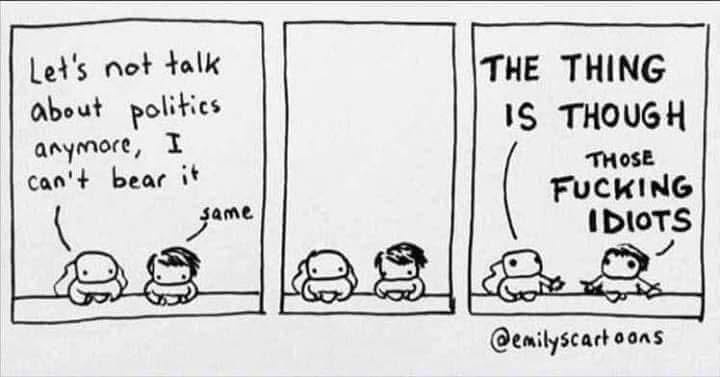
| A comic strip from @emilyscartoons. In the first panel, one person says, "Let's not talk about politics anymore, I can't bear it" and the second person says "same." In the second panel, they just sit there. In the third panel, they say, "THE THING IS THOUGH" and "THOSE FUCKING IDIOTS." Image source. |
Links related to the antichrist:
1. The ABA supports the rule of law (February 10) "There is much that Americans disagree on, but all of us expect our government to follow the rule of law, protect due process and treat individuals in a way that we would treat others in our homes and workplaces. The ABA does not oppose any administration. Instead, we remain steadfast in our support for the rule of law."
2. Theobro social Darwinism earns a papal smackdown (February 12) "I mean, jeez, that’s devastating. If Vance were an honest person, or if he were a person capable of shame, or if he were a person interested in what is true this would be an edifyingly humbling experience for him. Alas, he is immune to both humility and to edification because he is none of those things — not an honest person, nor a person capable of shame, nor a person interested in what is true."
Yeah you never want to be the person in a bible story asking, "But who is my neighbor?"
3. If you're not already giving monthly donations to a group that helps immigrants, please consider doing so. Many of them were receiving government funds but now those have been cut off. The reality is, they won't be able to do as much, with less funding. This is terrible- immigrants are under attack and we really need to do more to help immigrants, not less.
Find a local organization that helps immigrants. Or, donate to RAICES.
4. Microbiologists, hang your head in shame (or fight back!) (February 10) "The major scientific societies in Nazi Germany were quick to pander to Hitler, and they had the same kinds of arguments: they were patriots supporting their country, they had to fire all those Jewish professors to keep government support, etc., etc., all while they were looting conquered nations and doing secret work on nerve gasses and sieg heiling their way to bigger grants."
5. Pour one out for the CFPB (February 13) "So, if consumers can’t even see when an institution is being fair and honest, it’s a competitive disadvantage to even bother."
6. Park Service Goes Full Stalin, Literally Takes The 'T' Out Of sTonewall (February 14) "In an act of revisionist history Joseph Stalin might admire, the National Park Service disappeared all references to transgender and queer people from its main page for the Stonewall National Monument in New York City yesterday."
How will I explain this to my children?
 |
| Book cover for "The Scandal of the Evangelical Mind," 1995 edition. |
The Scandal of the Evangelical Mind, by Mark Noll, is a book that was published in 1995. (There's also a 2022 version which includes some updates about Trumpism.) I've seen this book mentioned by ex-evangelical blogs many times over the years, and I finally read it. Here is my review of it.
---
The overall thesis of the book
I had heard that this book was about anti-intellectual pressures in evangelical Christian culture. I had heard the quote, "The scandal of the evangelical mind is that there is not much of an evangelical mind."
And, growing up evangelical, I had experienced some of this anti-intellectualism. There are questions you're not allowed to ask in church. There is an attitude that "we know better than scientists and scholars because we have the bible." I was guessing that was the sort of thing this book would talk about.
But it mostly didn't. It was not about what it's like "on the ground" in evangelical culture. Noll is a historian, and the book traces the history of evangelical attitudes toward intellectual thought, over the past several hundred years, showing the movements that came and went, and how that led to where we are today. (Or rather, in 1995.) That's really useful to know about, but it wasn't what I was expecting, so at first I couldn't really understand what Noll's point was.
Here's his point: Evangelicals have not done the work of applying evangelical beliefs to high-level academic study. Catholics have universities which were founded out of the Catholic tradition and do good quality research in many many different fields, but evangelicals don't really have anything like that. Yes, there are evangelical seminaries and bible colleges, of course, but these aren't really known for their high-level research. We should be applying evangelical ideas to all fields of academic research- philosophy, art, politics, and so on, but evangelicals aren't doing that.
And, because of that, evangelicals are not obeying the command to "love God with your mind." They are not interested in learning about the world that God created. And because evangelical thinking is so shallow, they are not prepared to face new ideas or societal developments and respond to them in a way that's reasonable and consistent with evangelical Christian beliefs.
The first thing that came to mind for me was, well, what about creationism, that's an example of evangelicals applying their ideology to science and going really deep with it and inventing a whole field of """science""" that's completely different from "secular" science. But, then Noll mentioned creationism as an example of evangelical anti-intellectualism. So, no, that's not what he thinks evangelicals should be doing.
---
I have to admit I don't really get it
I'm having a really hard time grasping what it would mean for evangelicals to deeply apply evangelical thinking to big academic questions or societal problems.
The book talks about how Catholics have historically valued tradition and study, and major universities were started because of a Catholic drive to learn about the world and do excellent academic work. It's very hard for me to imagine evangelicals doing something similar, because, to be honest, when I was evangelical, that was one of the reasons we viewed Catholics as "fake." Yes, we were highly suspicious that Catholics were "fake Christians" because being Christian is about having a "personal relationship with God" (this is how evangelicals define "Christian"), and Catholics were not so big on that. Catholics were more into tradition and church hierarchy. Evangelicalism is about reading the bible yourself, experiencing God yourself, having spiritual experiences that mean a lot to you personally but are hard to explain to other people. We felt that Catholics had kind of missed the point- they followed their traditions and their church leaders and the pope, rather than going directly to the bible or directly to God. They were all caught up in listening to what other people said about God, rather than having a "personal relationship" with God. So, they were highly likely to be "fake Christians."
"The Scandal of the Evangelical Mind" talks a lot about this aspect of evangelicalism. Experiencing God and the bible in an "intuitive" and personal way, which is accessible to everyone- and how that causes evangelicals to not value advanced academic study.
Academia is all about building on the work that other people have done. Spending years learning about some very very niche problem and then advancing humanity's knowledge on it- and only people who have spent years studying in your same field can even understand what you're working on. To me, it feels very incompatible with the evangelical focus on how God is always right there with us and God knows everything, and we already have all the answers we need because we have the bible.
Yes, there are evangelicals in academia. Of course there are. I went to grad school, for engineering, and I was evangelical back then. What I'm saying is, I don't understand what it would even look like to meaningfully bring one's evangelical beliefs into one's academic work, unless you were studying theology or something very obviously religious like that. The evangelicals who study engineering, for example, keep their engineering work separate from their religious beliefs. Yes, sometimes there's an element of "I'm really stuck on this problem, I'm going to pray for God to help me figure it out" or "I can't take credit for figuring this out on my own- God gave me the ability to do it." But beyond that, I don't see how they can mix.
Okay, maybe because I'm thinking about my experience in STEM, that's why it doesn't make sense to bring religious beliefs into it. Maybe for fields about philosophy and morality, and art and meaning, and how we should live and how we should structure society, maybe in those areas it makes sense that evangelicals should bring their evangelical beliefs into their academic work. And Noll says there are evangelicals who do a good job of this, but mostly they work for secular or Catholic universities. There aren't evangelical institutions where people do this kind of work.
But I'm still having trouble understanding what Noll wants evangelicals to do, exactly. The examples in the book, of evangelicals doing this well, come across as not evangelical, to me.
I'm not sure how to explain how exactly this feels "not evangelical." It's something about... for evangelicals, being a Christian is about having an active, dynamic, emotional "personal relationship with God." It's a little wild, a little risky, full of big dramatic gestures about "laying down your life", and God suddenly "calling" you to go do some ridiculous thing. This is the polar opposite of good academic work, which is about spending years studying the minute details about what other researchers have done in your field, very careful, getting the citations right, making sure every claim you make is backed up by something that your readers could look up. Just years of normal and boring human work- no "you have to believe me because God randomly told me this."
And it feels really "not evangelical" to me, when considering the question "what does our Christian faith have to say about this or that issue?", to answer by citing sources built on years of human effort doing the necessary academic work. No, that's exactly what we're NOT supposed to do, right? We should address the question "what does our Christian faith have to say about this or that issue?" by praying about it and considering whether any thoughts which subsequently pop into your head may or may not be from God. And reading the bible and simplistically applying 1 bible verse to whatever the issue is.
The bible says "Trust in the Lord with all your heart, and lean not on your own understanding." And "leaning on your own understanding" sounds a lot like valuing a legacy of work done by academics over many years, right? "Trusting in the Lord with all your heart" would be believing whatever random thing "God told you" just now, right?
So, I mean, I understand that evangelicals can be in academia and do good work there, but the work itself does not read as "evangelical" to me. It's a separate thing from their religion. So I couldn't really understand what Noll would want this to look like, in an ideal world.
Keep in mind, this book was written in 1995, so things may be much different between then and when I was "on fire for God" sometime around 2010-ish. Also, my experience is as an average church member, who also read a lot of bible-study books because I'm a nerd. Whereas, Noll is a historian who studies evangelical culture in the US. He is an evangelical with much more of an academic background than I have. I've heard (mostly from the Slacktivist) that there is a disconnect between what pastors learn in seminary and what the average churchgoer believes. For example, scholars who have actually studied the story of the Exodus know that it didn't really happen. But even if the pastor knows this, no way they can say it out loud in church- to the average evangelical, it's very much NOT acceptable to believe the Exodus didn't really happen- that's an attack on the bible! So there's a disconnect between the anti-intellectualism of the average churchgoer, and the higher-level leaders who have more awareness that these commonly-required evangelical beliefs just aren't true.
So my point is, it's very likely there's a difference between my opinion and Noll's on what "feels evangelical."
---
Creationism and pre-millennial dispensationalism
The two main examples of anti-intellectualism that this book gives are young-earth creationism and pre-millennial dispensationalism [PMD]. Here, let me define them: Young-earth creationism is the belief that God created the whole universe in 6 days, like Genesis 1 says, and therefore the earth is only about 6000 years old. Pre-millennial dispensationalism is the belief that the world is going to end "soon", and Jesus will come and "rapture" all the Christians away, and then the anti-christ will come, etc, and therefore we should obsess over news stories about things happening in the Middle East, to look for clues that match up with the prophecies in the bible.
I used to believe in young-earth creationism. And as for pre-millennial dispensationalism, and the other popular Christian ideas about how the world will end "soon", I never got into that at all. I guess I believed it was true that the bible gave prophecies about when the world would end, and that Christians who paid attention would be able to pick up on the "signs" when it happened, as the PMDs claimed. But I felt there was a very low probability that any of it would happen in my lifetime, so I didn't see any point to doing that kind of obsessed analysis and "being ready" for when Jesus comes. I thought, we've had 2000 years of Christians believing Jesus would come back "soon", and all of them were wrong. Probably it won't happen in my lifetime either! So I very much refused to be part of any of the "Jesus is coming back SOON, we have to be READY" hype.
"The Scandal of the Evangelical Mind" points out that creationism is about refusing to learn about this amazing world that God made, if that knowledge might contradict your view of what "the bible says." And PMD ideology responds to news events in the Middle East (and/or the question of whether bar codes are "the mark of the beast") in an extremely shallow way- simply trying to match them up with bible verses, making claims about "here's what the bible says about this." Rather than actually learning about the history of the real-life groups involved, what they actually want, the reasons for conflict, etc.
---
Inerrancy
The book talks about the evangelical belief in biblical inerrancy. Noll describes this modern approach as taking a "scientific" view of the bible; in other words, viewing the bible as a list of ironclad true statements, and building on top of that. Developing ideas about biology/geology, as in young-earth creationism, or piecing bible verses together like a challenging puzzle, to find connections to modern news events, as in pre-millennial dispensationalism. Simply taking each verse as a true statement which can be 100% believed, and making logical deductions accordingly.
This is a very new view of the bible. (Noll says that Christians who argue for this reading of the bible aren't "defending the bible"; they're defending an interpretation that's less than 100 years old.) In contrast, one could read the bible with an awareness of ancient literary genres and the reasons that writers would have spun the stories in certain ways. The things they wrote to make sense of the world, not because they actually happened.
This is also a bit confusing to me- is Noll saying biblical inerrancy is an example of evangelical anti-intellectual sentiment, and therefore evangelicals should abandon it? This makes no sense to me. How can you BE evangelical and not believe in biblical inerrancy? Like, yes, I agree that evangelicals should abandon their belief in inerrancy, but by doing so, they would cease to be evangelical- yes, I believe they should abandon evangelicalism, actually. But obviously that's not what Noll is trying to say.
I don't recall if the book says inerrancy is a problem, or if it says this approach of "reading the bible scientifically" is a problem. From my point of view, those are the same thing. As I define it, inerrancy is this insistence that every single thing in the bible is true, actually true. Does Noll define inerrancy differently? Does Noll think you can believe "the bible is inerrant" and also believe that the creation story in Genesis 1 didn't actually happen at all, under any interpretation of the word "happen", but was just something they wrote back then to illustrate how they viewed the relationship between God, people, and the earth? That's not inerrancy- or at least, I would not call it inerrancy.
Again, this book was published in 1995. Surely things have changed since then. And Noll is coming from an academic background, whereas I just went to church A LOT. So... that's why I'm not quite understanding some of his points.
---
Some examples of my experiences of anti-intellectualism in church
In my experience in church, yes there were comments about how we already know the answers because we have the bible, and scientists don't know what they're talking about. I remember hearing a story that went something like this:
My 6-year old son was at school, and his teacher was telling the students that the Exodus didn't really happen the way the bible said. Moses didn't really part the Red Sea. The Israelites just walked across on a sand bridge where the water wasn't as deep. Just a few inches of water. Then my son raised his hand and said, "Wow, it's so amazing that the whole Egyptian army drowned in just a few inches of water!"
The point of this story is: Oh those public schools, trying to tell our kids that the bible isn't true! It's horrible, it's an attack on Christianity! This teacher talking about the Israelites walking through a shallow section of the Red Sea- lololololol! So ridiculous! Taking the big dramatic story about Moses parting the Red Sea, and turning it into this silly thing about simply wading through the water- that's so funny! Lolololol! And it doesn't even make any sense, because then how would the Egyptian army drown in that water? Even a child can see right through it! LOLOLOLOL! [whole congregation laughs]
(And don't even get me started on the uninformed jokes people at church make about evolution!)
I remember one of my history teachers in high school, saying something like "Religious people believe [some bible story]. And historians believe [some modified version of the bible story which doesn't have miracles]." I really didn't like the way she said it, like saying "people who are more realistic know that the things in the bible didn't really happen." I wondered if there were any historical scholars who were "on our side", ie, who believed a very simplistic, naive, "the bible is inerrant" ideology.
Another thing: I sometimes read articles talking about "People say Christians don't value science, but that's not true! There are scientists who are Christians! For example, Francis Collins." I don't know why, but it seemed that Francis Collins was always the one they pointed to. I heard about him many times, but I don't actually know what his scientific contributions were. I think something about medical research? [Oh okay I just googled him- he worked on the Human Genome Project.] Wow, that's very interesting, isn't it- evangelicals mention Francis Collins just to score points in a debate against an atheist who says "Christians are anti-intellectual", but do we know or care about what scientific things Collins actually worked on? Lol, no. We mentioned him not because we actually cared about science, but because we wanted our debate opponents to stop saying we didn't care about science.
And another thing I remember from when I was evangelical was this: Sometimes I would read about scientists who were Christians, and it was presented like "hooray, our beliefs aren't illogical, see, here are some smart people who believe in this." But sometimes I would dig deeper, and find more information about these role models, and I would find out that they didn't actually believe all the things that "real Christians" should believe. Their faith was much more nuanced than that. For example, they weren't creationists. They didn't believe Moses wrote the Pentateuch. Etc. So... they didn't meet the evangelical criteria to be "real Christians" actually. And so they couldn't really be used as evidence for "see, smart people believe these things." I remember being kinda concerned about that, back then.
---
Other writing which used "scandal" in the title
Because this is an important book related to the history of American evangelicalism, the title has inspired some other similar titles:
The Scandal of the Evangelical Heart, a 2013 post by Rachel Held Evans. It's about how she grew up always knowing all the apologetics answers- but the reason she began to question what she had been taught was because of her heart. This is very similar to my own reasons for leaving evangelicalism.
The Scandal of the Evangelical Conscience, a 2005 book by Ron Sider. I have not read this, but I know that Ron Sider was an evangelical who advocated for evangelicals to seriously follow the bible's teachings regarding helping poor people and other social-justice causes.
---
Conclusion
If you're always talking about evangelicalism, like I am, then you should read this book. Yes, definitely required reading if you are this specific type of person.
But, as I said, I feel like I didn't really *get* it. I don't even know what it would look like for evangelicals to seriously apply their beliefs in an academic sense. That would mean valuing tradition and history and the work that other people have done, long before us, and that comes across to me as not evangelical. Evangelicals are more about "I read this bible verse and here's how I felt about it" or "I was praying and a random thought popped into my head, maybe it's from God"- and treating these personal, emotional experiences as more real and truthful than whatever those stuffy arrogant scholars have to say. From that perspective, building on the academic work that people have been doing for hundreds of years is NOT a good thing- it means there have been hundreds of years during which that line of study could have gotten off-track, as sinful humans continue to develop it. Better to go directly to the source- directly to God, who is the Truth- ie, whatever random thoughts passed through your head while praying and/or reading the bible.
I honestly don't see any way you can be evangelical and believe that the way we advance our evangelical thinking is through work done by researchers rather than claims about "God told me this."
Well, I mean, I'm oversimplifying it a bit... In my experience, yes, evangelicals are interested in learning the meanings of ancient Greek and Hebrew words, to understand the bible better. Yes, evangelicals do believe that whatever the original Greek or Hebrew said is a better interpretation than whatever naive thought popped into your head when you read an English translation. Yes, we did believe we could get more insight into what the bible was saying if we learned about the culture it came from. And no, we didn't just believe that any thought that flittered across your mind while praying must be a message from God.
But... it wasn't like we were going to learn anything new from that kind of study. It was like, we already knew the answers, generally, and we looked up the meanings of ancient Greek words to kinda fill in some details.
And yes, we very much did believe that it was common for God to tell you something by just giving you some random thought out of the blue. A big source of evangelical anxiety is trying to figure out which random thoughts are from God and which aren't. (And some random thoughts might actually be from the devil! Watch out!)
I never realized how the "personal relationship with God" is so bound up with anti-intellectualism, so I'm glad I read this book.
(When I think of anti-intellectualism in Christian spaces, I think of someone saying "I'm having doubts about the existence of God" and then people shaming them for even saying that out loud. People telling them the point is to "have faith" with no evidence. And yeah that kind of thinking definitely exists in evangelical spaces, but there are also a lot of evangelicals pushing back against it, saying, "God really is real, therefore our beliefs are strong enough to handle any questions you have. Ask any questions you want. It's normal to doubt." I was one of the evangelicals advocating for the right to question and doubt back then. But still, there was always a limit to it- you could ask any question you wanted, but at the end of the day you had to come back to what we already know are the "correct" beliefs.)
In the book, Noll doesn't really come right out and say "the concept of a 'personal relationship with God' is inherently anti-intellectual." He talks about historical movements which have placed emphasis on each person being able to easily understand the bible and having an "intuitive" experience of God, and how that came along with de-prioritizing advanced academic work based on evangelical beliefs. I'm having a hard time understanding what he would want evangelicals to do instead, because to me this is sounding like "the concept of a 'personal relationship with God' is inherently anti-intellectual" but I don't think it's possible to be evangelical and not believe that the most critical aspect of Christian faith is having a personal relationship with God.
So, in summary: This is an important book if you're interested in the history of American evangelicalism. Evangelicals have emphasized having an individual, "intuitive" experience of God, and have not applied their beliefs in more advanced, academic ways. The result is a shallow ideology which isn't able to meaningfully address new societal issues. But, I don't understand what the book wants evangelicals to do instead. Respect for history, tradition, and the work that scholars have done feels not evangelical to me.
---
Related:
I used to be a young-earth creationist
A Bit Suspicious That "Heavenly Tourism" Confirms Everything We Already Believe
 |
| Graffiti on Focus on the Family HQ says "Their blood is on your hands. Five lives taken." Image source. |
1. How Asexuality Is the Quiet Queer Revolution (November 11) "What if we start decentering sex? This is the radical question we are forced to confront once we start recognising asexuality as a real identity deserving of space in this world – one that makes it queer for how it subverts normative sexuality, and dares to imagine a world where we free ourselves of its baggage entirely."
2. Rearranging deck chairs on the Titanic: Southern Baptists still arguing over women pastors (November 6) Kind of shocking to me, reading this, how openly these men just hate women pastors. I know I used to be in that culture, and I used to believe there was something to the concept of men being leaders more so than women, but now it just seems incomprehensible to me. And these men believe in a "this doesn't make sense but God wants us to do it anyway, and obedience to God is the most important thing" God, whereas I believe in a "you're gonna stand before Jesus someday and She's going to be like, 'what the hell were you thinking???'" God.
3. How the pandemic took the toxic out of my Turkey Day (November 23) "Thanksgiving was the one day of the year that I knew was going to suck. Not just for me, but for my son and husband too, the two most important people in my life. They rode out that horrible day with me every year."
4. The few, the loud: How ‘very online atheists’ differ from other atheists (November 21) "Most atheists are pretty quiet about it, but a few people drive most of the online discussion of atheism. This creates a potential mismatch between typical atheists and the most visible atheists, to the extent that there are predictable differences between the two groups."
5. Do the rich pay their fair share? (November 15) "Billionaires in the US pay a smaller tax rate than most teachers and retail workers. Thanks to a tax code that favors income from wealth over income from work—and a slew of tax-avoidance strategies—the richest among us end up paying a smaller percentage of their income to the federal government than most working families."
6. Stochastic terrorism and the Colorado Springs Club Q shooting (November 21) "In the US this weekend, Club Q in Colorado Springs joined a long list of places struck by concrete violence informed by a broader cultivation of hate. The term for this terrible outcome is 'stochastic terrorism': when an act of public violence is individually unpredictable (i.e. in terms of exact date, target, perpetrator), but also statistically predictable, based on a series of preceding factors, such as sustained hate-mongering from prominent media sources."
7. Catholic hospitals are wrecking reproductive health care (October 11) "But doctors at a Catholic hospital won’t do that. They will perform the C-section, sure, but that’s it. They are forbidden from tying a woman’s tubes thanks to Directive 53."
8. San Francisco launches new guaranteed income program for trans community (November 16) This seems very weird to me. A government chooses one specific marginalized group and picks some people in that group and gives them money. Yes, it's great for the people who receive the money- but it feels weird to me that a government would be doing that. Seems like the sort of thing a charity should do? A government is supposed to do things that benefit society as a whole.
I don't know, perhaps there are other examples where local governments have done this sort of thing, just focused on one specific disadvantaged group, and the result benefitted society overall, and now San Francisco is kind of modeling their plan on something like that?
And, please note, when I say a government is supposed to do things that "benefit society as a whole", I don't mean like, everyone should directly benefit from every government program, or some nonsense like that. If, for example, the government gives money to low-income people to lift them out of poverty, I do count that as "benefitting society as a whole" because a society which helps people get out of poverty is a better society than one that doesn't. But I'm not sure about just focusing on trans people, because there must be a lot of low-income cis people who are in need too. And this program is just giving them money, rather than addressing specific trans issues. (Addressing specific trans issues would also be an example of "benefitting society as a whole"! A society which helps people get transgender-related health care, for example, is a better society than one that doesn't.) This seems more like "here's a good thing that happened one time to a few specific trans people" but it doesn't go any farther than that.
But anyway, the important thing is to see the results of this program. It will definitely be a great thing for those people who receive the money, but my question is, does it make sense from the government's perspective to focus on them specifically?
9. "Anti-science" is a meaningless phrase (2021) "People honestly SHOULD be skeptical of any human-related science."
10. Here’s why vandals sprayed graffiti at Focus on the Family headquarters (November 27) When I heard that the Focus on the Family sign had been vandalized, I was like, "GOOD." I grew up reading and believing their propaganda, all their books that take the Lord's name in vain and bear false witness against their neighbors. I read "The Homosexual Agenda" and "Marriage Under Fire"- books about how "homosexuals" are trying to destroy marriage and destroy society and must be stopped. It was all lies. And now I'm queer, and I'm mad.
 |
| Arthur and Francine. Image source. |
Got A LOT of links for you all today:
1. Animation: Encanto and Gifts of Trauma (posted January 19) [content note: spoilers for "Encanto"] "I have a soft spot for Bruno in particular because my own trauma means I can often predict all the bad ways a situation will go, and it's vexing to be disbelieved as a cynic or as someone who 'wants' things to fail just because I've seen some shit."
2. An Arizona priest used one wrong word in baptisms for decades. They're all invalid (posted February 15) "During baptisms in both English and Spanish, Arango used the phrase 'we baptize you in the Name of the Father and of the Son and of the Holy Spirit.' He should have said 'I baptize,' the diocese explained." Omg, imagine believing that *some man* has the right to judge if your baptism is "valid" or not, LOLOLOL.
(I also like Hemant Mehta's take on it.)
In all seriousness though, it's extremely easy to make fun of this story, but I am actually curious about if there are articles written on this from a Catholic perspective, that don't make it sound COMPLETELY BONKERS. Like, when we make fun of this, are we misrepresenting their position, or is it truly and literally as bonkers as it sounds? Might be good to hear a different perspective before we go all in on the mocking?
I did some quick googling and didn't see anything that looked much different from the npr article I linked, but if anyone does have a source that explains this in a non-bonkers way, I would be interested to read it.
3. How ‘Arthur’ grew up: Inside the beloved TV show’s emotional finale (posted February 21) "After 25 seasons, 253 episodes and seven specials, the PBS mainstay 'Arthur' aired its final episode, 'All Grown Up,' on Monday." Awww, "Arthur" was my favorite show when I was a kid.
"And I say hey, what a wonderful kind of day..."
4. Oh remember how in December/January the city of Xi'an, China, had a really bad covid outbreak and there were all these news articles about how Xi'an is doing such a bad job of making sure all residents' basic needs are met while they're in lockdown? (That's true- Xi'an did a bad job of that.) Well here's a follow-up to that: On January 24, China's Xi'an clears high, medium-risk areas for COVID-19. This means there are no longer any "high risk" or "medium risk" areas in Xi'an- the entire city is now classified as "low risk." "Low risk" means as far as we know (and this is after A LOT of testing), 0 people have covid. (Or, technically, anyone who has tested positive for covid is in a hospital where they're not able to spread it to anyone else, and there has been A LOT of testing on all their known contacts.)
Just want to point this out to make it clear to all of you who are not in China. This is how it works here- there are occasional "covid outbreaks" (which are a few dozen or a few hundred cases- Xi'an's was the biggest since Wuhan, I think, with 2000ish cases over the course of 1-2 months). The pandemic workers come in and test thousands or millions of people, put thousands or millions of people in lockdown, and then a couple weeks later, it's done, now there are 0 covid cases, the lockdowns end, and it's back to normal life.
It works.
5. ‘Inerrancy’ and the 1611 Project (posted February 15) "You’d think such articles — there are many others like it in CT’s archives — would require some introductory disclaimer or explanation to contextualize them for contemporary readers. But then it’s hard to imagine what such disclaimers might say, given that no part of Ellis’ argument from 1957 can’t be found repeated in 2022 Christianity Today articles fretting about the supposed dangers that 'wokeness' or 'critical race theory' pose to the real, true gospel of biblical inerrancy."
This is really important. Back when I was in middle school and we learned about the civil rights movement, it was like, the white people who didn't want their kids to go to school with black kids were just one-dimensional racists who were clearly evil and wrong. But, the reality is, back then, white people were making these philosophical and nuanced arguments in favor of segregation- arguments that sound scarily similar to things you hear today. Arguments that even cited the bible, because they viewed the bible in the same way that I was taught to.
Yes, they were bad and wrong and racist- but also not so terribly different from things I have thought and believed and said. And if white people don't know that- if we are not teaching our kids- if we are saying "oh those people from history were all hateful and racist and not anything like us"- then how are we going to do better?
6. The grift goes all the way to the top (posted February 10) "In public, [Jerry Falwell Jr.] pretended that he was the fire-and-brimstone Bible-thumper his father’s audience believed him to be—even as, in private, he and his wife Becki jetted off to Miami to drink and dance the nights away, far from the prying eyes of his fellow Christians."
7. The Winter Olympics don't really represent the world: Costs, climate and quotas keep the majority off the podium (posted February 22) "No African nation has ever won a medal in the Winter Olympics."
8. Rogers Musical (Full Version) (posted December 24) This is the "Rogers" musical from the Marvel show "Hawkeye," and if you are a Marvel fan, it is INCREDIBLE.
9. Ahmad Arbery's 3 killers found guilty of federal hate crimes (posted February 22)
10. True crime (part 1) (posted February 20) [content note: domestic violence, murder] "The politics of crime never seems to include criminals like Scott Peterson or Barry Morphew (allegedly). Their stories aren’t part of the narrative of crime. They’re just presented as entertainment. (Even Fox News reports these cases this way, as sordid entertainment wholly unrelated to the propaganda network’s otherwise relentless efforts to use 'crime' to foster rabid white resentment.)"
And also True crime (part 2). "He notes Barry’s comment to a local TV reporter — 'Suzanne trusted the Lord, and if one person got saved from this, she would think it was worth it' — and sees it as a chilling indicator of the faith-based calculus his cousin may have used to rationalize murder[.]"
11. [content note: eating disorder] Well, um, this is horrifying: HealthyWage: Weight Loss Challenges + Cash Prizes. It's a website where you can set a weight loss goal for yourself, pick a deadline, and place a bet with ACTUAL MONEY, and then if you reach your goal before the deadline, you get money. (And of course, if you don't reach your goal, you lose money.)
My first thought is, holy shit, this looks like a way to make money off having an eating disorder.
To test it, I followed the steps on their website, where it guides you through putting in numbers and it will tell you how much money you will earn. I pretended I weighed 90 lbs and want to lose 30 lbs. At no point during the process did a red flag come up and say "holy crap, if you weigh 90 lbs you should NOT be trying to lose weight." Instead, the algorithm very helpfully guided me along, doing the math with the numbers I had put in.
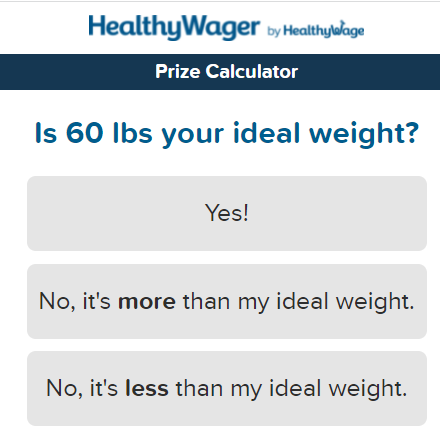 |
| Screenshot from "Healthy Wage." HOLY CRAP, it is very NOT COOL to suggest to AN ADULT that 60 lbs could be their "ideal weight." |
At one point, it even told me that I could totally lose 1-2 lbs per week, instead of 0.8 lbs (which was the result based on the numbers I had entered). Like, I saw this little warning symbol pop up, and I thought that's where the algorithm had flagged my hypothetical example as having a dangerous eating disorder, but NOPE, it was THE OPPOSITE:
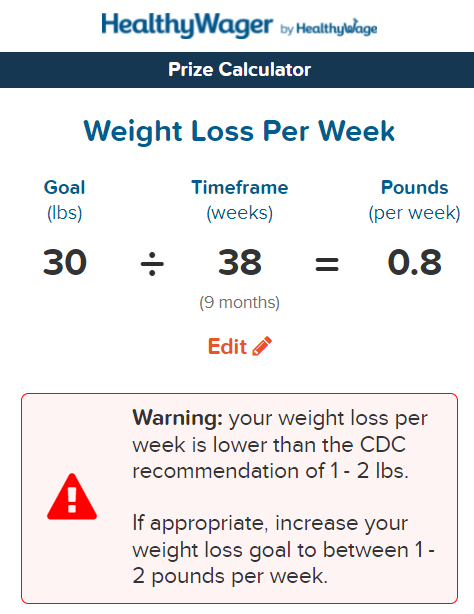 |
| Screenshot from "Healthy Wage" |
One, um, at-least-not-as-bad-as-it-could-be thing I noted was, in the FAQs, it says if you get pregnant after starting your "challenge", then you should notify them and they will "pause" your challenge until your doctor says you can start up the "challenge" again (um, instead of refunding your money...).
I didn't actually create an account- maybe if I created an account to do this for real, an actual human would have looked at my numbers and said "HOLY SHIT this person should NOT be doing a weight-loss challenge." But, um, seriously, they should have taught their website algorithm to do that anyway.
Still, the whole thing is very "get paid to have an eating disorder", even if you aren't as extreme as my "90 lbs" example. I'm not sure they can realistically set a threshold and say "oh, if your weight is above this number, then we are totally confident that you are using this 'challenge' thing in a healthy way, no worries." I just think... when you start getting money involved, you introduce the possibility that someone is forced to keep going with it even if they end up realizing that it's actually not healthy for them to be on a weight-loss plan. Like what if the money becomes more important than doing what's best for your physical and mental health.
Yikes.
12. Can’t Believe We Have To Say This But Yeah, Dr. King Got Arrested A Lot (posted February 17) "By this rationale, they could have cracked down on the Civil Rights Movement. They could have arrested Martin Luther King."