Showing posts with label statistics. Show all posts

Saturday, June 21, 2025

Blogaround

Links not related to the antichrist:

1. SCOTUS Allows For Trans Discrimination In Medical Care: A Full Analysis Of Today's Ruling (June 18) "The ruling effectively greenlights medical care bans across the country and may pave the way for broader restrictions, including for adults, while leaving lower court rulings on bathrooms, schools, sports, and employment remain intact—for now."

Really not good for trans kids. We have to keep doing what we can to support them.

And from Law Dork: Where is the outrage over Skrmetti? (June 20) "In its U.S. v. Skrmetti ruling, the Supreme Court’s Republican appointees shaved off the edges — if not more central parts — of the Fourteenth Amendment’s Equal Protection Clause in order to uphold laws that bar an exceptionally small number of teens from receiving a type of medical care that only one group of teens need."

The reasoning in this Supreme Court decision is about how the equal protection clause of the 14th amendment applies (or doesn't apply) to trans people. In her dissent, Justice Sotomayor draws comparisons with the Loving vs Virginia case, where the Supreme Court ruled that states could not ban interracial marriage. I guess in the Skrmetti case, the majority opinion said that both trans and cis children cannot get treatment for gender dysphoria, so it's not discrimination. And this is like how the argument to ban interracial marriage was that people of every race are equally not allowed to marry outside of their race, so it's not discrimination. And the Skrmetti decision is really opening the door to a skewed interpretation of the equal protection clause, which could lead to rights being eroded in so many other areas.

I'm literally in an interracial marriage, but I never thought about "hey my marriage is about the 14th amendment" or anything along those lines. Learning about Loving vs Virginia in high school, it felt like ancient history, like of course people can marry a partner of a different race, why would that be an issue, aren't we glad we don't have those racist laws like they did back then. When I got married, I didn't think about "some of my ancestors thought this shouldn't be legal" or anything like that- it never occurred to me that anyone would think there would be a legal issue. 

BUT ALSO I grew up evangelical and so back then I totally bought into all the anti-queer stuff, like we can't let gay people get married, we can't let trans people have rights, etc. We usually didn't talk about the details about how you turn that into an actual legal argument, but apparently one argument that was being used in court was "both straight and gay people aren't allowed to marry a same-sex partner, so it's not discrimination."

ANYWAY my point is, I should read more about the equal protection clause. It turns out to be related to a lot of things.

Also related to Skrmetti: After Getting The Ruling It Wanted, New York Times Publishes 6 Anti-Trans Articles (June 20) "In all, at least half a dozen articles have been published by the Times in the 24 hours following the ruling—ink still drying—spreading misinformation, shaming transgender people, and giving prominent space to voices that seek to strip us of our rights."

2. Baby of brain-dead Georgia woman on life support delivered via C-section (June 17) Not sure what to say about this- if I died and was pregnant, I would want them to continue the life support to save the baby. But the key thing is, it should be the family's choice. This case is horrific because it was forced on this family by faraway politicians and heartless laws.

3. The short history of global living conditions and why it matters that we know it (2016, via) "The result of a media — and education system — that fails to present quantitative information on long-run developments is that most people are very ignorant about global development and have little hope that progress against serious problems is even possible."

4. HIV prevention drug hailed as a 'breakthrough' gets FDA approval (June 18) 

5. The Meta AI App Lets You ‘Discover’ People’s Bizarrely Personal Chats (June 12, via) "It’s unclear whether the users of the app are aware that their conversations with Meta’s AI are public or which users are trolling the platform after news outlets began reporting on it. The conversations are not public by default; users have to choose to share them."

---

Links related to the antichrist:

1. Federal Judge Grants Class Status To Trans People In Passport Case In Massive Win (June 18) "According to preliminary conversations with expert attorneys, whether transgender people should submit a passport update request immediately depends on their risk tolerance and individual circumstances. A motion to stay the ruling could come within days. Those most likely to benefit from applying immediately are individuals with incorrect gender markers, those seeking their first passport, or those with expired documents who need to travel soon. Expedited processing may increase the likelihood of receiving a passport before any potential appellate or Supreme Court intervention."

2. FULL SPEECH: Sen. Padilla speaks on Senate floor after removal from DHS press conference (June 18) 14-minute video. "If that is what the administration is willing to do to a United States senator for having the authority to simply ask a question, imagine what they'll do to any American who dares to speak up."

3. Trump administration cuts specialized suicide prevention service for LGBTQ+ youth (June 18) "'This is devastating, to say the least,' Jaymes Black, CEO of The Trevor Project, said in a statement. The Trevor Project is one of several nonprofits administering the services. 'The administration's decision to remove a bipartisan, evidence-based service that has effectively supported a high-risk group of young people through their darkest moments is incomprehensible.'"

So, now would be a good time to donate to The Trevor Project.

4. Trump administration actions contradict MAHA rhetoric on toxic chemicals (June 18) Oh, so it turns out, when RFK said we have to reduce the amount of toxic chemicals in the environment that are harmful to children, he didn't mean it like 'let's actually fund the scientists who are doing good work studying which chemicals are harmful.' He meant it like 'here are some words that we will use as an excuse to be mean to autistic children.'

5. The ABA Declares War (June 18, via) "The American Bar Association (ABA) just dropped a massive federal lawsuit against the White House. And it’s not messing around. The lead counsel filing suit on behalf of the ABA is Susman Godfrey, one of the firms Trump targeted. The complaint names the Office of the President, but for good measure, it also names each and every high level government department along with every cabinet official."

6. Federal immigration agents asked to leave Dodger Stadium parking lot, team says (June 20) "Dozens of federal agents with their faces covered arrived in SUVs and cargo vans to a lot near the stadium’s Gate E entrance. A group of protesters carrying signs against U.S. Immigration and Customs Enforcement started amassing shortly after, local media reported."

7. ‘Code Adam’ (June 19) "That video shows Villareal, wearing his blue Walmart vest, approaching the agents and asking them questions. That video shows the agents mobbing him, throwing him to the ground, and hauling him away."

Monday, February 17, 2025

Blogaround

 Links not related to the antichrist:

1. Tuna Sold at Trader Joe’s, Costco, Walmart, and More Recalled Over Botulism Risk (February 10, via)

2. The Hardest Sudoku I've EVER Solved (February 6) Exactly what it says on the tin. 3-hour-30-minute sudoku solve video.

3. Gov. Pritzker signs 'Karina's bill' to remove guns from domestic violence situations (February 11) Good news here.

4. This is Arousal (February 4, via) 20-minute video. This is a video about the supposed "fact" that the most exciting part of playing a new board game is opening the box, and then you have to read the rulebook and your excitement plummets. (And therefore, board game designers are always trying to make the rulebook shorter.) 

It's an interesting discussion of the phenomenon where people always repeat a supposed "fact" because there's a study that lends evidence to it, but the way that people understand the "fact" is SO FAR AWAY from what the actual study was about. The study discussed in this video was actually about families with children playing Hasbro board games- a completely different situation from the adult board game nerds who talk about this "fact." And what was measured was "arousal", not people's actual enjoyment of the games.

5. Risky heroics (February 16) "Our ethical assessment of any given action is determined by all possible outcomes, not just the actual outcome. After all, at the time that you make the decision, you do not know the actual outcome."

---

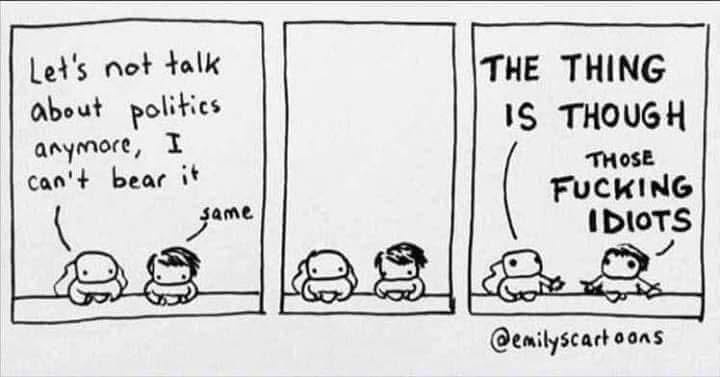
A comic strip from @emilyscartoons. In the first panel, one person says, "Let's not talk about politics anymore, I can't bear it" and the second person says "same." In the second panel, they just sit there. In the third panel, they say, "THE THING IS THOUGH" and "THOSE FUCKING IDIOTS." Image source.

Links related to the antichrist:

1. The ABA supports the rule of law (February 10) "There is much that Americans disagree on, but all of us expect our government to follow the rule of law, protect due process and treat individuals in a way that we would treat others in our homes and workplaces. The ABA does not oppose any administration. Instead, we remain steadfast in our support for the rule of law."

2. Theobro social Darwinism earns a papal smackdown (February 12) "I mean, jeez, that’s devastating. If Vance were an honest person, or if he were a person capable of shame, or if he were a person interested in what is true this would be an edifyingly humbling experience for him. Alas, he is immune to both humility and to edification because he is none of those things — not an honest person, nor a person capable of shame, nor a person interested in what is true."

Yeah you never want to be the person in a bible story asking, "But who is my neighbor?"

3. If you're not already giving monthly donations to a group that helps immigrants, please consider doing so. Many of them were receiving government funds but now those have been cut off. The reality is, they won't be able to do as much, with less funding. This is terrible- immigrants are under attack and we really need to do more to help immigrants, not less.

Find a local organization that helps immigrants. Or, donate to RAICES.

4. Microbiologists, hang your head in shame (or fight back!) (February 10) "The major scientific societies in Nazi Germany were quick to pander to Hitler, and they had the same kinds of arguments: they were patriots supporting their country, they had to fire all those Jewish professors to keep government support, etc., etc., all while they were looting conquered nations and doing secret work on nerve gasses and sieg heiling their way to bigger grants."

5. Pour one out for the CFPB (February 13) "So, if consumers can’t even see when an institution is being fair and honest, it’s a competitive disadvantage to even bother."

6. Park Service Goes Full Stalin, Literally Takes The 'T' Out Of sTonewall (February 14) "In an act of revisionist history Joseph Stalin might admire, the National Park Service disappeared all references to transgender and queer people from its main page for the Stonewall National Monument in New York City yesterday." 

How will I explain this to my children?

Saturday, February 15, 2025

This 93% Stat About Dads is Totally Made-Up

A pie chart with sections labelled "Lies", "Wrong", "Guesses", and "Who knows?" Image source.

I'm late to the party on this, but I want to talk about this great post from Sheila Wray Gregoire: PODCAST: The 93% Myth That Fathers Matter More than Mothers

There's a statistic that I've heard in conservative Christian spaces. It goes like this:

When dad comes to Christ first, 93% of families will follow.

When mom comes to Christ first, 17% of families will follow.

When kids come to Christ first, 3.5% of families will follow.

("come to Christ" is Christian jargon meaning "converting to [the correct type of] Christianity")

This statistic is used by conservative Christians to make the point that it's SO IMPORTANT for churches to try to reach men. Some churches even use this statistic to justify prioritizing men's ministry higher than women's ministry, or getting rid of women's ministry altogether.

In the podcast I linked, Gregoire talks with Miranda Zapor Cruz (who wrote a post in 2022 showing that no actual research can be found to support this stat) and Beth Allison Barr. Basically, it's about how this statistic is totally made up- and also, it doesn't really "ring true" with most people's experiences- if you ask people who had the biggest influence on their religious beliefs, they often say their mother had a bigger influence than their father.

I liked this quote from Beth Allison Barr:

Beth: I actually had known about the statistic before.  Back when my husband and I were still at the church before he got fired a long time ago and we were really starting to question what the church was teaching about male and female roles, and my husband came to me.  And he said, “Hey, the pastor gave me this statistic this morning.  He said that there’s been this study that shows this.  Do you know anything about this?”  And as an academic, I looked at it, and I was like, “How would they even know that from this?  I mean it’s such a weird thing.”  And to say that 93% of families will go to church if the father is the first one to attend. And, of course, all the questions in my head were like, “Well, what church are they talking about?  How did they get the numbers on this?  Did they follow people across 10 or 20 years or something to try to figure out when,”—I mean it was just all of those questions.  And so I was just like that sounds made up.  I was like, “Where did you get it from?”  And he didn’t know where it came from.  And I just kind of wrote it off.  

Yes! How would they even know this? How would you design a study that could show this? You can't just ask all your church members "who was the first person in your family to become a Christian?"- that's not the data this stat is getting at. You would have to find a bunch of families (how do you define family, exactly? Do the parents have to be married? Are we only looking at families with minor children?) where all members are non-Christians, and then track them (for how long? Barr says 10 or 20 years, that seems about right). You would then check if any of the individuals in these families converted to Christianity (what does that mean, exactly- who defines what "convert to Christianity" means? Do they have to be active in a church for it to count?). And then you check what happened after that- in the families where the dad was the first person to convert, did the mom and kids convert? What about when the mom was first? What about when a kid was first? Do you only track 2 outcomes- "entire family converts" vs "there still exist some immediate family members who are non-Christians"? Wouldn't it be more useful to track how many individual family members converted, rather than only "counting" it if it's the whole family?

And even if you did that, and the result was that "when the dad converts first, 93% of the time the wife and kids convert too", that still doesn't mean churches should prioritize men. Because we don't know anything about how common it is for a man to convert first, compared to a woman converting first. What if it's 100 times more common for a woman to convert first (or, 100 times easier in terms of the amount of resources a church needs to spend, however that's measured)- then, even though there's a lower chance the rest of the family will convert, overall you will get better results if you allocate the resources toward reaching women. If you spend those resources on reaching men, but you don't end up reaching any men (and the statistic says nothing about how easy or hard that would be), then that doesn't help.

The other thing I want to say about this is... about the evangelical attitude toward statistics. People hear this statistic, and it fits with what they believe about how men are naturally the leaders of their families, so they believe the statistic, even though it's hard to imagine an actual study existing that would show this. 

I mean, people are like this in general, though. Let's not act like this is just an evangelical problem. Plenty of people who are "on our side" (whatever that means) are quick to believe and spread statistics that aren't right. 

Let's be on the lookout for this kind of bias in our own thinking. Wanting to use science and logic to win arguments, rather than to actually find out which things you're wrong about, so you can change your own beliefs. Repeating a statistic just because it is consistent with things you already believe, not because it actually makes sense as a thing that can be measured.

---

Related:

Wow This Headline Gets the Statistics COMPLETELY WRONG 

The Great Sex Rescue: The 72-Hour Rule

WTF, CNN? 

Here's an article about evangelical women and sex

Monday, August 5, 2024

"Expecting Better": Asking the Right Questions About Pregnancy

Book cover for "Expecting Better." 

I recently announced the birth of my little baby girl. When I was pregnant this time, I read the book Expecting Better: Why the Conventional Pregnancy Wisdom Is Wrong--and What You Really Need to Know [affiliate link] by Emily Oster. (I have the 2021 edition.) I like this book and I recommend it, but with a few caveats. 

Overall, I like the way Oster thinks. She is a math person like me, and when she got pregnant and was informed about all the "rules" that pregnant people are supposed to follow, she noticed that many of them didn't really make sense. And when she had to make decisions during the pregnancy, and asked for the data that one would clearly need to make those decisions, that data wasn't readily available. Instead, doctors were only able to give her one-size-fits-all advice. She wanted to look at the risks and benefits herself and make a decision based on her own individual situation- this is obviously what people should do, right? So why wasn't that data available?

---

The pregnancy rules

Let's talk about the pregnancy "rules." Wow, when you get pregnant, there are so many things you're not allowed to eat. You're not allowed to have sushi, or deli meats, or precut fruit, or alcohol, or fish that are high in mercury, or rare steak, and so on and so on. SO MANY RULES. During my first pregnancy, I read the book "What to Expect When You're Expecting," and basically the whole book is like, "Is it okay to do xyz during pregnancy? Well, studies show there could be a slight risk, so, better not. Oh, but what if you already did it? Well don't worry, it's probably fine!" and I just felt like that didn't really make sense. 

Oster also feels like these "rules" don't make sense. For example, many of these foods are off-limits because of the risk of food poisoning (sushi, rare steak, deli meat, precut fruit, etc). But, Oster asks, if I was eating sushi all the time before I got pregnant, and never got food poisoning, why is it suddenly a problem now? And, shouldn't everyone avoid bad sushi that gives you food poisoning, not just pregnant people? And, if I do get food poisoning, well obviously that's bad, nobody has a fun time with food poisoning, but is it actually any worse when I'm pregnant than when I'm not?

This is great! These are the questions that we absolutely should be asking! But instead, these "rules" are presented to pregnant people like they are ironclad rules, like if you eat precut fruit, it's BAD for your baby, OH NO!!! I've seen the amount of stress and anxiety this puts on pregnant people- because, it's seen as, yeah it's tough to give these things up during pregnancy, but it's for YOUR BABY, and you'd DO ANYTHING for YOUR BABY, right? Emotionally making it very high-stakes, when actually the reality is that these things are normally not a problem at all- the only problem would be if you happen to eat one that's contaminated with bacteria that causes food poisoning, and also if it happens to be a type of bacteria that is particularly harmful to the unborn baby (like listeria), and also if it ends up being serious enough to harm the baby.

I've seen women on pregnancy forums in a panic like "I ate sushi yesterday, I didn't know I wasn't supposed to!" and other women are telling them "don't worry, it's fine." I even saw one post that said "I really really want a sub from Jimmy John's but I know I can't eat cold cut meats during pregnancy" and people were replying to tell her it's fine to eat it, and she replied, "no, I had a miscarriage before, so this time I'm going to do everything I can to keep this baby safe" ... and I just... this makes me sad, because miscarriage isn't related to following these rules. (I suppose maybe in some of those rare cases where you eat the "bad" food and, unluckily, you do get food poisoning, there might be a risk of miscarriage.) And women are putting so much stress on themselves trying to be perfect, taking these rules super-seriously, when the actual data doesn't support that at all.

In my first pregnancy, I completely gave up on following the "rules", somewhere around 12 weeks. Because I could see that I was going to have depression. I had such bad nausea all the time, all food was repulsive, and when I finally thought of something I wanted to eat, guess what, it's something that I'm "not allowed" to eat. It was so bad. But up until 12 weeks, I had the mindset "I have to do this for my baby" until I couldn't anymore; I had to give up on following any of those "rules", because it was going to give me depression. It's like every damn day I had to dig myself out of the hole of figuring out what I can bear to eat, every day, 3 times a day, and actually more often than that because I need to eat snacks frequently or else I'll throw up. It often felt easier to just throw up instead, rather than try to figure out what food I can eat that's not completely repulsive to me.

Anyway. In the book, Oster looks at actual data about which kinds of food poisoning are actually more harmful during pregnancy, and which kinds of foods were involved in recent outbreaks of food poisoning. (Note that her data on that is from the US, so if you are in a different country, you may have different food safety risks. I'm in China, but I already ignore all these rules, so whatever.) She narrows it down to just a few foods that are worth avoiding, and advises readers to just ignore the rules about the others. (And then there's another section about evaluating the rules about fish that are high in mercury- this is a separate issue from the food poisoning.)

Yes, that whole section is great. (And in my first pregnancy, maybe if I had had a more realistic view of which rules actually mattered, and how to keep them in perspective, maybe I wouldn't have had to just completely give up on all of the rules.)

Another thing the book talks about is drinking alcohol during pregnancy. Personally, I don't drink alcohol at all because I don't like the taste, so this is not an issue for me, but apparently a lot of people really hate the fact that they're not allowed to drink alcohol during pregnancy. And this is a "pregnancy rule" that's much more serious than the ones about sushi or whatever. Everybody knows pregnant people aren't allowed to drink alcohol. I've heard all kinds of warnings from "What to Expect When You're Expecting" and other pregnancy resources that "there is NO amount of alcohol that's been shown to be safe during pregnancy."

But, Oster found that it's common in European countries for people to have a glass of wine with dinner, even during pregnancy. And, her doctor told her it's okay to drink a little, just don't overdo it. So, which is it? If any amount of alcohol really is harmful to the baby, then her doctor shouldn't be saying that. But if it is okay to drink a little bit, then this shouldn't be treated as such an ABSOLUTE RULE. (Oster says it's like women aren't trusted to make good decisions, so all we get is these simplistic absolute rules instead.)

She looked at a bunch of scientific studies about alcohol and pregnancy. (The difficult thing, though, is it's not ethical to randomly assign pregnant people to drink alcohol- so pretty much the only studies you can find are about asking people after the fact "did you drink alcohol during pregnancy?" and there could be all kinds of other characteristics that that subgroup of people might also have, which would affect the results. For example, she found one study where many of the people who drank alcohol also used cocaine, and their babies had worse outcomes. Well, maybe don't do cocaine during pregnancy.) Her conclusion, after presenting several studies, was that it is okay to have a small amount of alcohol during pregnancy (and she gave specific guidelines about the amounts- which turned out to be different depending on which trimester you're in). This is apparently a reason why there is controversy surrounding this book- because Oster says that it's NOT true that you have to totally avoid alcohol during pregnancy. Like I said, I don't drink at all, so it doesn't matter to me, but apparently there are people who strongly criticize this book for this reason.

---

My concerns about some of her conclusions

I like her intuition in this book. But, I have some hesitation about accepting all of her conclusions. Her background is in economics, not medicine, so there may be some key pieces of information on health/pregnancy that she is missing, which might lead her to draw conclusions that are incorrect. What I mean is, if your doctor tells you "xyz is a bad idea during pregnancy" and then you go read a scientific paper that shows the reality is more complicated than that, and you draw the conclusion that "xyz is NOT bad"- well, what if there's something you missed? What if there's some other piece of information which is obvious to your doctor, but you didn't know about, which causes you to misinterpret the academic paper you read?

She should definitely run her conclusions by a doctor, before publishing them in her book. And, to some extent she did- her "Acknowledgements" section says that the book had a medical editor (Emily L. Seet) who is a doctor, and the "Foreword" of the book is written by a doctor (Nathan Fox) who says her conclusions are right. So... okay that's good, but it doesn't really give me confidence that every single thing was thoroughly fact-checked by someone with actual experience in the field of healthcare/pregnancy. It's not clear to me whether these doctors really checked and agreed with everything the book said.

I like her intuition, and she gives reasons to support her conclusions which seem to make a lot of sense, but since her training is not in this field, how do I know whether there's something she's missing?

I have a few examples:

There's a section in the book about the claim that "women's fertility declines after age 35." Typically in mainstream culture, the way people understand this is, you HAVE TO have kids before you're 35, otherwise you won't be able to! But Oster felt that this couldn't possibly be right- it can't possibly be the case that there's such an abrupt cutoff. When she asked her doctor about if she should be concerned about her fertility decreasing, her doctor totally dismissed it- "don't worry, you're not 35 yet!" As if it's like, a magical cutoff. Oster didn't buy that, and went looking for better data on it. And yeah, women SHOULD have access to better data on this! You want to plan your life, but there's this idea floating around that you need to have a baby before age 35 even if it doesn't really fit your life plan, because otherwise you'll NEVER be able to have a baby. Since that can be such a huge factor in long-term decision-making, we absolutely SHOULD have better data on it.

So, Oster went looking for better data. She found a study from the 1800s, that showed women's age of marriage and age when their first child was born. Based on this, she could calculate stats like: if you got married (and presumably started having unprotected sex) at age 20-25, what's the probability you have a baby, and so on for other age ranges. Her conclusion is that fertility does decline with age, but there's not a hard cutoff at age 35, and if you start trying to have a baby after age 35, odds are you WILL be able to have a baby.

So, yes, sure, this makes sense, intuitively. This is certainly a better answer than the common rhetoric that implies 35 is a magical cutoff for women's fertility. But- the study was from the 1800s. There could be SO MANY WAYS that people's fertility now is different than back then. We can't just accept the numbers from Oster's calculations and assume they're true for us now. Yes, they're certainly more accurate than fearmongering about "you have to have a baby before age 35 or you'll lose your chance forever!" but that doesn't mean they're necessarily correct.

So this is what I mean about some things in the book making sense intuitively, but I have concerns about whether the conclusions are correct- it is quite possible that there are other important factors she doesn't know about.

Another example: If you're trying to get pregnant, the "two-week wait" is a time of great anxiety. This is the 2-week span of time between when you have sex and when it's possible to detect a pregnancy with a pregnancy test (or, the time between when you have sex and when you get your period/ when you *miss* your period). During this time, you might be pregnant! Or you might not! Who knows! So here's a question: During the "two-week wait," should you follow the pregnancy rules? (For example, don't drink alcohol, just in case you're pregnant but don't know it yet.)

This is a very good question! (And, for a different twist: If you just found out you were pregnant, but you did things that pregnant people aren't supposed to do, before you even missed a period- is that bad for the baby?)

Oster answers it this way: During the two-week wait, if the egg has been fertilized and you are going to be pregnant, the embryo is still in the phase where all of its cells are identical. It's simply dividing the cells; it's not actually growing different body parts yet. So, she reasons, if breaking the "pregnancy rules" harms the embryo by causing some cells to die, well, either few enough cells die that it doesn't make a difference (and the remaining cells are identical to the ones that died, so it's not like your baby lost something), or enough cells die that the whole embryo dies and you never end up getting a positive pregnancy test anyway. 

So, basically, probably don't need to worry about following the pregnancy rules during the two-week wait.

Throughout this whole line of reasoning, there were no studies cited or anything. I was SHOCKED at that. Oster just starts with the fact that all the cells in the embryo are identical at that stage of development, and reasons from there. And, yeah sure, maybe she's right. Her reasoning more or less makes sense. But there could be all sorts of other factors that play into this. I am not a doctor so I don't know- and Oster is not a doctor either. (For example, the idea that breaking the pregnancy rules will simply kill or not kill some number of cells- is that really how it works, or could there be more complicated effects than that? What about something affecting the pregnant person's body, which would then end up affecting the baby later, when it's no longer in the embryo stage? Also, I've heard that it's important to start taking prenatal vitamins before you even know you're pregnant, because that DOES affect some early development stuff!) 

Like, yes, it absolutely makes sense to ask the question "does it matter if I follow the pregnancy rules during the time period when it's too early to know if I'm pregnant or not?" It's very logical to be concerned about that. (Also I love this part: "One friend admitted to compensating by getting drunk the day her period arrived every month.") But Oster's answer to this is, I would say, not based on reliable information. It's just speculation. It's the sort of thing that I might float as an idea in a blog post (hoping that maybe some commenters are more knowledgeable than me and can correct where I'm wrong), not the sort of thing I'd be confident enough to publish in a book.

Really what you need here is a scientific study of people who were having unprotected hetero sex and then some of them *did* follow the pregnancy rules during the two-week wait and some did *not*, and then you compare their results. (Did they get a positive pregnancy test or not, were there any problems during the pregnancy, etc.) But there's nothing like that at all in that section of the book. 

One more example: Women in the later stages of pregnancy, who are told they have "low amniotic fluid" and it's suddenly a huge emergency and the doctor says they MUST induce labor right away, or else the baby is in DANGER! Yeah, this is totally a thing. Doctors telling you that you have "low amniotic fluid" and there's no time for you to ask questions and gather information about what's going on and what the risks are, so you can make an informed decision- no, you're in a panic because your baby [supposedly] might DIE if it's not born immediately, and you just do whatever the doctor tells you.

Oster says that studies show that low amniotic fluid is not as big of an emergency as it's made out to be. Yes, it can cause problems for the unborn baby, but usually there would be other indications of those dangers- if the only "problem" is low amniotic fluid, that's not necessarily a problem just by itself. Also, she found that amniotic fluid measurements were influenced by how much water the pregnant person drank before doing the ultrasound to measure.

So, her advice is to drink a lot of water before your ultrasound, so it will be less likely that they find you have "low amniotic fluid" and create a big panic about it.

Ummmmm. So my feeling on this is: Yes, she is correctly observing that something is off about the way doctors typically handle this. The data shows that inducing labor early because of "low amniotic fluid" doesn't really result in better outcomes than not doing that. And the measurement is affected by how much water you drink, but they don't tell you you're supposed to drink some standard amount- and then if you have a low measurement just because you happened to not drink water beforehand, they act like it's a BIG EMERGENCY. Something is off here. 

BUT I'm not sure that the solution is to game the measurement by drinking a lot of water beforehand. They are measuring something that actually matters. But this advice treats it like the actual amount of amniotic fluid you have is fine whatever it is, and the important thing is just to get a measurement number high enough that your doctor doesn't start telling you wild stories about how your baby could die if they don't induce labor immediately. 

(To be fair, there are some disclaimers in the book about how the level of amniotic fluid does matter, and could actually be a problem sometimes. But I'm not sure how to reconcile that with her overall approach in that section.)

My point is, overall I think Oster's intuition is very good when she points out things that don't make sense about pregnancy advice or the way doctors treat pregnant patients. Yes, she does correctly identify many illogical things, and pregnant people deserve to have better information about these things. But when Oster offers her own answers to those questions that she raises, I'm not sure her answers are right either. Since she's not a doctor, it's quite likely that she's missing some key insights, and possibly coming to wrong conclusions. 

---

Places where the book is spot-on

Even though there were a bunch of places where I felt her conclusions weren't reliable, there were also a lot of places where her conclusions and insights were spot-on.

For example, the section about prenatal testing. During pregnancy, there are tests they can do to screen for Down Syndrome and other genetic conditions. First, there's the "noninvasive prenatal screening" where blood is taken from the pregnant person and tested (because some of the unborn baby's chromosomes are floating around in the pregnant person's blood). 

If the test comes back positive, there's a chance that it's a false positive, and there are other procedures that doctors can do to get a more accurate result: CVS (chorionic villus sampling) or amniocentesis. Both of these involve a big needle going into the uterus, so, uh, that's scary, and there's a risk that it could cause a miscarriage.

Oster wanted to know the exact probabilities that we're dealing with: Based on the pregnant person's age, what is the probability that the baby will have a genetic disorder? What is the rate of false positives or false negatives for these different tests? What is the probability of miscarriage for CVS/amniocentesis?

Yeah, very much makes sense that pregnant people would want to have that data, to make a decision about what tests to do!

Basically, the recommendation from the doctor was this: It's standard that everyone does the "noninvasive" blood test, and if that comes back negative, then you don't worry about it. If it's positive, then you do the CVS or amniocentesis. Also, the risk that CVS/amniocentesis would lead to a miscarriage is [supposedly] 1 in 200, so if the probability that your baby has a genetic disorder is greater than 1 in 200, it's recommended to do the CVS/amniocentesis test.

Oster wanted more detailed numbers than that, but the doctor didn't have data for her. And also, it turns out that the "1 in 200 chance" of a miscarriage is based on data from the 1970s, and now medical technology has improved and the risk is much lower.

And also she says, the recommendation to do the invasive test if the chance of having a baby with a disorder is greater than the chance of miscarriage only makes sense if both outcomes (miscarriage, or having a baby with a genetic disorder) are equally bad. !!!! Yes, good point! She says, shouldn't people base their decision on their own personal opinion about which one is worse, and how many times worse?

Yes, spot-on.

Another section that I thought was spot-on was the "am I going to be pregnant forever?" section. In the third trimester, pregnant people start worrying about preterm labor- so, it would be good to know the week-by-week probabilities of going into labor too early- because you DON'T want that to happen. But then, around 38-40 weeks when the baby is full-term and it's the right time for the baby to be born, it can feel like it's too long to wait, and you're just so exhausted from being pregnant, and just ready to be DONE, and you feel like you're going to be pregnant FOREVER. Yes, relatable.

Oster found statistics about when people go into labor, and made a chart with probabilities along the lines of "If you are pregnant at the beginning of week N, what's the probability you will give birth before the start of week N+1?"

Yes! Love this! See these are the numbers that pregnant people really need to know, because wow it's such a pain being pregnant. Just want to be done.

---

Zofran and "if she really felt like she needed it"

One more thing that I want to point out, because it stood out to me. There's a chapter in the book about first-trimester nausea, and examining what kinds of medicines are safe for treating it. (Zofran is one of the medicines discussed in the book.) I personally had SUCH BAD nausea throughout the whole first trimester, both times I was pregnant, omg it was so bad, just spent the entire day trying not to throw up, and/or throwing up. Oh it was so bad. But I never considered taking any medicine for it, because I thought pregnancy is supposed to be that way- it's the baby's way of FORCING me to constantly eat protein.

Here's the bit from page 95 of the book that I want to point out:

Dwyer, the friend with the terrible nausea, was told that she could take Zofran if she "really felt like she needed it." Maybe her doctor didn't intend for this to have a chilling effect, but it did: she came away thinking it was dangerous for her baby, but if she cared only about herself she could take it. Who would be comfortable taking anything at that point?

Oh my goodness, this is so real.

This is what pregnancy is like. All these things that you may or may not be allowed to do, because they may or may not be "safe" for the baby, and... for all you know, your baby's life may be at stake. It's easy to feel like you have to just accept any amount of burdensome rules- even though you would NEVER let people boss you around like that if you weren't pregnant, and you would NEVER accept that kind of suffering if you weren't pregnant- because it's FOR YOUR BABY, you need to do it FOR YOUR BABY. (And this burden and anxiety is even bigger for people who have struggled with infertility or have had miscarriages, and they want to do everything they possibly can to finally have a baby.)

In feminism we talk about "bodily autonomy" a lot. And I'm pro-choice, which is also about bodily autonomy. "Pro-choice" is typically viewed in an oversimplified way, like it means "you can have an abortion if you choose to" and nothing else beyond that. I personally see it as much more: to be truly pro-choice would mean creating a society where people have access to contraception if they want that, where people have access to prenatal health care and other resources for having a baby if they want that, and safe abortion if they want that. It has to be about having ALL of the choices available, not just abortion.

Pregnancy is complicated, ethically, because there is a conflict between the bodily autonomy of the pregnant person and the fetus/embryo/unborn baby. (That's why I'm pro-choice: because it's complicated, nobody else knows the situation well enough to make a decision on it, other than the pregnant person.) One key thing is that pregnant people should be given realistic information about the "pregnancy rules" and what the actual risks are, not just a list of "here are all the things you're not allowed to do now, because you're pregnant." Not just accepting that any amount of burdensome rules is justified because it's FOR YOUR BABY, and if you LOVE YOUR BABY you will sacrifice yourself to follow all the rules, and if you don't then you are SELFISH. (Like I said, I was teetering on the edge of having depression during my first pregnancy, because of this mindset.) I want to have a conversation about bodily autonomy- in a wanted pregnancy- that is more nuanced than that.

This anecdote from the book- about being told it's okay to take anti-nausea medicine if you "feel like you really need it"- I mean, yeah, it very much comes across as "this might be dangerous to your baby, but if you value your own comfort more than your baby's life, then you can take it." (Which, by the way, is NOT the real situation- Oster presents data that shows Zofran is safe during pregnancy. And maybe the doctor didn't mean it that way.) The emotions around pregnancy, and the judgment on being a "good mom"- it makes it that much more difficult to actually get the real data and make informed decisions.

---

Conclusion

I like this book, and I recommend it- though I don't think you should accept all of Oster's conclusions. She is good at identifying places where mainstream pregnancy advice doesn't make sense, but in some parts of the book, I'm not sure that her conclusions are correct either.

Also, this book shouldn't be the only book you read during pregnancy. You also should read a more standard pregnancy resource like "What to Expect When You're Expecting" (or just the What to Expect website). "What to Expect" has information on how the baby is developing at every week of pregnancy, what symptoms you can expect to have, what kinds of tests your doctor would do at different points during the pregnancy, possible complications, etc. It gives an overview of the whole thing. "Expecting Better" doesn't do that- it only focuses on the points where Oster believes that conventional advice is bad, or that more data should be provided to pregnant people to help them make decisions.

(I also have criticisms of "What to Expect When You're Expecting" though, for the way it presents the pregnancy rules, and also it's so extremely heteronormative and cisnormative.)

Overall, I relate to a lot of what Oster says in this book. I'm a math person and she is too. And there are so many things that you are told during pregnancy that don't really make sense- I'm glad to see a book pointing this out! I recommend this book to pregnant people who want to read a bunch of statistics.

---

Related:

Pregnancy and Depression

What Pregnancy Taught Me About Being Pro-Choice 

I Had Pre-Eclampsia

Friday, March 29, 2024

What Does God Do When You Pray For An Anonymized Patient By Bed Number?

Hospital bed. Image source.

I read this article from Rebecca Watson, Study: Prayer Doesn’t Cure COVID. Jury Still Out on “Thoughts”. Those of you who have read my blog for a long time may know that I am SO FASCINATED by questions like: How would it even work, if God really did act in response to prayer? What kind of data would we expect to see, if that were true? What would be the most effective way to harness this phenomenon in order to benefit society? (Some of the posts I have written on this: Prayer Rates Don't Correlate With Actual RiskI Would Love to Know If God Intervened to Stop Covid From Spreading in ChurchesOn believing that "prayer works")

I very much do NOT believe that God acts in response to prayer- because if you actually spend any time thinking about the implications of it (or worse, if you're evangelical and you twist yourself in knots trying to make sure you're doing everything right so God will answer your prayers), it leads to a lot of very bad implications about God's nature.

I am a Christian though, so I'm coming at this from a different angle than Watson is; she is an atheist and is writing for an atheist audience, so she takes it as obvious that prayer doesn't cause "God" to do anything. For me, it wasn't obvious. I had to think through a lot of things. Most Christians do pray, and do believe "prayer works", but I don't.

Watson is discussing a study on "remote intercessory prayer" - researchers had participants pray for strangers in the hospital who had COVID.

The study was conducted in Brazil, with only 199 patients instead of 300, a few weeks’ duration instead of six months, the exact prayers weren’t specifically scripted out, and the protocols changed halfway through the study when data protection laws changed and the people who were praying could no longer know the initials of the people they were praying for, so they switched to bed numbers.

The result was still the same as every other halfway sane study on intercessory prayer: no difference between the control group and the people who were prayed for, in terms of death, ventilation, hospital time, or anything else. So what did we learn? Nothing. Nothing at all.

!!!! Oh man, that mention of patients' initials vs bed numbers is FASCINATING to me! Does God handle it differently depending on which way you anonymize the study? What if there are multiple patients with the same initials- would it be like, the researchers assign Prayer Volunteer 1 to pray for patient C. D., and there is another patient C. D. in the control group not getting prayed for (different person but same initials) and God uses Their omniscient knowledge of the researchers' methods to figure out which is which and make sure the prayers get allocated correctly? Or would the researchers need to add an additional indicator to pass along to the prayer volunteer, to pass along to God, to make sure God knew who they were talking about?

Or would God hear the prayer from Prayer Volunteer 1 and apply it to both patients with initials C. D.? Would the prayer then only be half as effective for each individual patient? What if there's another patient in the hospital also with initials C. D. but they aren't part of the study, does God allocate some of the prayer power (???) to them too?

Since the prayer volunteer doesn't know the patient personally anyway, how much does it matter who the specific patient is? Maybe God just averages their prayer out over all patients in a similar situation- which would be all patients in the study, including the control group- which would explain why the results found no difference between the control group and test group.

What if the researchers made a mistake, and got a patient's initials wrong? What if the researchers told a prayer volunteer to pray for patient C. B. but actually that's wrong and the patient's actual initials are C. D.? Would God be like "I have no idea who you're talking about" and just do nothing with that prayer? Would God check the researchers' notes and find out who the correct patient is? (What if the researchers told the prayer volunteer the correct initials, but the prayer volunteer is the one who made a mistake and prayed for the wrong initials- would God handle that differently than if it was the researchers' mistake? What if the prayer volunteer prays for the wrong initials on purpose???)

Do the researchers even need to tell the prayer volunteers any identifiers about the patients they are praying for? Surely the researchers can just write up a document on who is praying for whom, and then not show it to anybody, and the prayer volunteers can just pray "God please help whoever it is I'm assigned to pray for, I don't know who, but you know", that should work just the same as if they used initials or bed numbers, right? But what if there's a miscommunication between the researchers and actually 2 completely different versions of this document exist- which one does God use to look up whom your prayers are for?

Maybe they should do a study where they intentionally make 2 different versions of the who-is-praying-for-whom assignments, and the results from the study can be used to figure out which version God was working from!

All of this is, uh, ridiculous, and like I said, I don't believe prayer actually causes God to do anything. So I'm not asking these questions because I think there are actual answers- it's because I'm just so fascinated by imagining how this magical prayer system would even work. (Call it worldbuilding.)

But the biggest reason I don't believe "prayer works" is expressed very well in this bit of Watson's article:

Who will be convinced by this? No one. Every rational person on the planet who thinks about this issue for more than a few minutes already understands that if an omniscient, benevolent god exists, she’s not just watching a child die of leukemia because she’s waiting for you to ask her directly for her intervention.

YES! This! Exactly!

This should be obvious, right? It makes no sense that God, who is apparently all-loving and wants to heal people, refuses to intervene unless someone prays in a very specific, correct way. I say it should be obvious, but when I was evangelical, that's literally what I believed. I believed God was so powerful, God was so near, God could do anything, God could immediately heal any sickness or solve any problem, God could do it and it wouldn't be difficult at all- but *I* was the problem because I wasn't praying in the right way. Yes, when prayer doesn't "work", Christians have all sorts of reasons to explain why it's because you didn't pray correctly. Maybe you didn't have enough faith. Maybe you prayed for the wrong reasons. Maybe you have some sin in your life that you need to repent of, before God will listen to your prayers. Maybe you prayed for something that wasn't "in God's will."

It's ridiculous, the belief that God has all this incredible power, and They love people SO MUCH and They want to help SO MUCH, but They're being held back by these little technicalities. They're being held back because even though I tried as hard as I could to pray in the exact right way, with the right motives, trusting God, and so on, somehow I still got it slightly wrong, and therefore God just does nothing.

(Maybe Christians shouldn't say "prayer works" if what they actually mean is "prayer works if you do it in the exact correct way, which the vast majority of people aren't able to do, the vast majority of the time, so basically how it shakes out is that prayer overwhelmingly doesn't do anything at all.")

And, related to that, Watson lists these possible explanations that religious people might give, to explain why a study found no evidence that prayer made a difference:

  1. My deity doesn’t like to be tested and so he purposely did nothing, because proving He exists makes faith pointless
  2. My deity will only listen if the plea is made by someone who knows and loves the patient, not from a stranger hoping to prove something to scientists
  3. Protestant?? PROTESTANT???? You’re lucky my Catholic god didn’t smite everyone in the treatment group. He’s like that, you know.
  4. It’s part of god’s plan for the people in that treatment group to die.
  5. What exact words were in the prayers? My deity needs certain magic words, like “in the name of the father,” “amen,” and also “please.”

Her wording here is kinda snarky, but these are actually very real... like, people will really legitimately give reasons just like these to explain why prayer didn't "work."

And this has me thinking about back when I believed that "prayer works," and I read articles about studies which found no difference in outcomes for people who were prayed for or not prayed for. How did I explain that to myself, back then?

Well, basically, I believed there were a whole lot of conditions that you needed to satisfy, in order for your prayers to "work." You had to be a Christian- and not just that, but a real Christian- because evangelicals totally believe that most people who "claim" to be Christian aren't "real" Christians. You had to pray with the right faith and the right motives. And, honestly, these criteria were impossible to fully define- honestly, I would have given anything to know what the exact criteria were, because I prayed desperately for SO MANY things, and I wanted so bad to know what I needed to do to get my prayers to "work." *I* don't even know how to get my prayers to work- the idea that researchers can simply set up an experimental group of people who are praying "correctly" was unbelievable to me.

So when I heard about studies that found that prayer made no difference, I imagined it went something like this: In the test group (the group of patients who are being prayed for by the prayer volunteers) most of the prayers are worthless because the prayer volunteers aren't the correct kind of Christian, or don't have the right motivations or trust in God when they are praying. And, on top of that, let's talk about the control group- the patients who are not being prayed for. How do we know they're not being prayed for? We just know that the participants in the study are not praying for them- but it's likely that other people are praying for them. Maybe their relatives, maybe some random overeager college student who's like "God, please help everyone who's in the hospital" and God takes that to mean all patients in all hospitals in the entire world. The amount of *noise* that's constantly occurring on communication channels between humans and God... It's likely that the amount of *effective* (however that's defined) prayer received by the control group is not meaningfully different from the amount of effective prayer received by the treatment group. And that's why the results of the study don't show a difference.

(Okay now I'm fascinated by that too- if that is the reason that studies on prayer don't find any difference, then how would one go about designing a study which would avoid those problems? Maybe the control group could only consist of patients who did not tell any of their family/friends they were sick? And maybe they have such an obscure problem that no random stranger in the world is going to accidentally say a prayer that includes them? [I guess it shouldn't be about praying for them to be healed from sickness, then- it should be something much more unusual than that.] Any more suggestions? Leave them in the comments section!)

For what it's worth, the explanation that says a study didn't find any difference because "you're not supposed to test God" never made any sense to me, even when I was evangelical. It assumes there's a very clear distinction between situations where we can collect data that we can analyze with statistics, and situations where we can't- and that God behaves differently in these 2 different types of situations- and I just could not believe that it was possible to really make such a distinction. Christians would say we "know" prayer works because we've experienced it (and I also believed that, back then) but apparently we can only "know" it in a vibes-based way, not from actual data. This makes no sense; if the phenomenon is real and we're really experiencing it all the time, then surely there must be plenty of cases where someone can easily come in after the fact and do some investigating and write down some concrete numbers which can then be analyzed. Even if it wasn't a formal study being done in real time, the data exists and there must be cases where somebody can do some investigative work and get that data.

Anyway. I just want to know how it would even work, if it's true that "God answers prayer." If you're praying for someone you don't even know personally, how does God handle that? (This happens when participating in research studies on prayer, but there are plenty of other situations where it happens too. Christians who have a relative who is sick, and they share this prayer request with as many other Christians as possible- so you end up with a lot of people praying for something even though they know very few actual details about the situation.) How does God determine the specific person that your prayers should be applied to? Or do They kind of average the prayers out over every person who generally fits the description you gave in your prayer? What if your prayer request is based on misinformation- does God make corrections to it Themself so They can interpret your prayer in a way that would make sense? What if you pray for something that's not even wrong? How does it work? I mean, I don't believe any of this, but these are the things I think about.

---

The questions in this post are mainly about the little logistical details about prayer- it's hypothetically possible that there are answers to all of these questions, and God *does* have a system that's fair and logical for prayer. (Romans 8:26 comes to mind- we may not know how to pray for things that actually make sense, but God interprets our prayers in a way that makes sense.) My other posts on prayer, though, are more serious and ask much more uncomfortable questions about prayer, which don't go anywhere good no matter how you answer them...

Related:

Prayer Rates Don't Correlate With Actual Risk

I Would Love to Know If God Intervened to Stop Covid From Spreading in Churches

On believing that "prayer works"

I'm SO HAPPY I Won't Be Praying During Childbirth 

An Invisible Virus and an Omniscient God 

Also I've linked to this study before, but here it is again, because the questions it asks in the "Discussion" section are THE BEST questions, like, these are the things we really need to know, if it's true that "prayer works": Prayer and healing: A medical and scientific perspective on randomized controlled trials

Monday, November 27, 2023

The Great Sex Rescue: The 72-Hour Rule

An egg timer. Image source.

Links to all posts in this series can be found here: Blog series on "The Great Sex Rescue"

---

We are now in the second half of chapter 7 of The Great Sex Rescue: The Lies You've Been Taught and How to Recover What God Intended [affiliate link], pages 130-138. 

This section starts out by speaking out against the concept of "the 72-hour rule." Apparently, a lot of Christian leaders are teaching women that they need to make sure to have sex with their husbands once every 72 hours, because men need it. And this is presented like it's just a biological fact, like if a man doesn't have an orgasm every 72 hours, his sperm will build up and he'll explode or something (???). Here's a quote from the book "The Act of Marriage":

A normal and healthy man has a semen build-up every 48 to 72 hours that produces a pressure that needs to be released.

(I never heard about "the 72-hour rule" when I was in purity culture/ reading Christian marriage books, but it sounds EXACTLY like the kind of thing that you would hear from that ideology. Yep, totally checks out.)

The authors of "The Great Sex Rescue" point out that this is ridiculous. Every person is different, and you should TALK TO EACH OTHER about how often you want to have sex, rather than initiate sex every 72 hours just because your husband is a man.

Then there are some anecdotes about women who followed this teaching:

When Janet married Chris, she went into her honeymoon confident that she knew how to keep him happy. Every three days, on the dot, she'd get naked and get busy because that's how she was supposed to satisfy her unquenchable man. But after a few months, she realized she was the only one initiating and started to feel miffed. "What, am I not attractive enough or something?" So she confronted Chris and asked, "Why don't you ever initiate?" Perplexed, he said, "Well, I've just been trying to keep up with you."

As they discussed it, they each realized they had incorrectly assumed the other had the higher libido. In fact, both were quite happy with sex once or twice a week (and for them, less-frequent sex actually led to better quality because it allowed desire to build). Chris originally thought this was funny until he realized that part of his wife's motivation to initiate was out of a fear that if she didn't, he would be vulnerable to sexual sin. He assured his wife that he was fine, and they could just go with what felt right.

Charlotte recounted an almost identical story. After initiating every seventy-two hours for almost twenty years, her husband was horrified to learn that the reason for this frequency was so that Charlotte could help keep him from sin.

This is so real. The wife working so hard to follow the marriage rules that the church taught her, and the husband having no idea- because this "72-hour rule" is something the church is teaching women, not men. The man often has NO IDEA that his wife has been taught that he'll cheat on her if she's not having sex with him enough- and when men find this out, they are horrified. Horrified at how the wife has had to live with that fear for so long, and insulted by how low of a view of men is being promoted by the church. 

Men are better than that. Men are fully capable of keeping their marriage vows, not cheating on their wives, communicating like an adult if they feel dissatisfied with something about the relationship, etc. But most Christian marriage resources will tell you the exact opposite. Yes, Christian marriage resources explicitly teach that a husband will likely cheat if his wife isn't having sex with him enough- and usually they throw in a caveat like "we're not blaming the wife, it's his own fault for choosing to cheat, but also, you have to know all men are like this, it's not realistic to expect men to be better than that, so actually it kinda is the wife's fault."

Men are better than that. Yes, some men are trash- if you meet a man who is trash, you need to NOT MARRY HIM. Don't marry a man who's trash just because the church told you that it's not possible to find a non-trash man. They exist!

Oh, and another gross thing I want to say about this 72-hour rule: The same Christian marriage resources that say wives need to have sex with their husbands or else the husbands will cheat, also say that men aren't really capable of understanding their own emotions and communicating about them. Supposedly, women do that emotional stuff, and men don't. And therefore, if a husband reassures his wife that he's not going to cheat, and he doesn't want her to have sex she doesn't want, etc, it's quite possible that she won't believe him. Because, even though he says that's how he feels, she's heard lots of good Christian role models telling her that a man can't possibly feel that way, and also that men can't be relied on to accurately say how they actually feel. (It's far more likely that she'll conclude she's not attractive enough, to explain why her husband isn't constantly trying to have sex with her every time she gets out of the shower or whatever, like men are "supposed to.") So. Yeah. I believe communication is the most important factor for having a healthy relationship- and Christian marriage books are literally undermining that. "If your husband says he's not a sex-crazed monster, don't believe him. We know what men are like, he doesn't." [my paraphrase]

So I'm glad to see "The Great Sex Rescue" pointing out how wrong and harmful this teaching is. (And on their website, Bare Marriage, I've even seen women sharing stories about how immediately after giving birth, they had sex with their husbands, because "men need it every 72 hours" omg, that's horrible. For those of you who aren't familiar with childbirth, let me tell you: the vagina needs time to recover, usually you have stitches because it tears down there when you push the baby out [or if it's a C-section, you're recovering from major surgery], everything hurts, you can barely even stand up or walk, right after you give birth you have basically the biggest menstrual period of your life- doctors recommend waiting 6 weeks to have sex.)

The writers of "The Great Sex Rescue" tried to find a source for this idea that "men will explode if they don't have an orgasm every 72 hours." They couldn't find any academic research that says this. They eventually concluded that James Dobson just made it up and wrote it in a book in 1977, and since then, all the other Christian marriage teachers have just been repeating it. Yeah, not cool.

Moving along, the next section of the book says that normally, in a healthy marriage, libido differences aren't that big a deal. They kind of just work themselves out naturally. Both spouses prioritize caring for each other- wanting to give each other pleasure during sex, and also not wanting to push their spouse into sex they don't want. There's kind of a give-and-take. And so even if their sex drives aren't exactly the same, it's not really a problem. 

The book says that when mismatched sex drives are a problem, it's often because of some deeper issues going on- for example, one spouse doesn't care at all about if the other spouse is enjoying sex. Or, one spouse is stressed out about life in general, and so they don't want to have sex that much. If you're not getting your basic physical/emotional needs met, it will decrease your sex drive because sex is no longer that high of a priority if other needs aren't being met.

As an asexual, I can't really tell you if this part if accurate or not. I've heard people saying things like this, about how sex drive can increase or decrease because of your feelings about your partner/ your life, but as an asexual, I don't understand it. People seem to talk about sex drive like each person has some natural level of it, which is the correct level for them, and if it decreases, then that's bad. But, why is that bad?

I'm in some social media groups for women partnered with men, and I've even seen women in these groups saying things like, "When I was with my ex, my sex drive was really low and I didn't enjoy sex- I actually started to think I was asexual. But now I am with my current partner, and he's great, he cares about if sex feels good for me, so it turns out I have a high sex drive and I really do like sex." I don't know what to make of this. When they thought they were asexual, what did that mean to them? It seems like they're portraying it as a mistake, or a bad thing... Personally, I hope that people benefit from being in the ace community, for any amount of time, even if it turns out they were "wrong" and they weren't really ace. It's totally fine with me if you think you're ace and then later decide you're not- it's good that you're getting closer to understanding yourself, and I believe many people can benefit from the ideas that are discussed in ace spaces, regardless of whether they're ace. But... I don't know, it seems like instead, the women who post these things are saying that it wasn't good when they thought they were asexual, because it meant they weren't able to recognize that they really did want sex but their partner was just really bad at it and they deserved better.

So I don't really get it. And I worry that this sounds too close to the concept of "you're not really asexual, you just haven't ever had good sex, you just haven't met the right person" which is one of the common things that people say when they don't believe asexuality is a real thing. But, I can't judge other people's experiences- I can't swoop in and say "well you're understanding asexuality wrong if you think it means you should *stop* exploring yourself and learning what you want."

Yeah, I don't know what to make of it. And, in general, I don't really understand anything people say about sex drive.

So, to sum up the second half of chapter 7 of "The Great Sex Rescue": The "72-hour rule" is absurd; instead, you should just TALK TO EACH OTHER to figure out how often each of you want to have sex. And, the book says, in a healthy marriage, libido differences aren't really a big deal- "when you work on marital satisfaction, reducing stress, and making sex feel pleasurable and passionate, libido differences usually take care of themselves." Personally I can't say if that's true or not, I'm asexual and the entire concept of libido doesn't make sense to me, but okay.

They end with, "But usually doesn't mean always. And we turn there next." So stay tuned for the next chapter, about why it's not okay to have a sexless marriage, because wow it's a doozy.

---

Links to all posts in this series can be found here: Blog series on "The Great Sex Rescue"

Related:

Reasons 

If A Wife Is Required To Have Sex, That's Not "Intimacy"

Thursday, October 6, 2022

I Would Love to Know If God Intervened to Stop Covid From Spreading in Churches

People wearing masks at a church service. Image source.

So I saw this article from Christianity Today, The Curious Case of Coronavirus Contagion in Church, about a research study on whether or not people in the US who attended church during "lockdowns" were more likely to get covid. As an ex-evangelical math nerd, I was ALL OVER IT. Like, you guys, this is THE EXACT THING I am interested in. 

Christians always say "prayer works"- which I take to mean "prayer [if done correctly, feel free to add all kinds of criteria here about how to do it correctly] will cause God to take actual real actions in the world [not just psychological stuff in the pray-er's own mind, but affecting reality in ways external to the pray-er] to cause things to happen- or at least to change the probabilities that things will happen", for example, if you get a bunch of people to pray that a sick person will get better, then there is a higher probability that they will get better, compared to if people weren't praying for them. I am very interested in the question "what kinds of statistics and overall trends in the world would we be likely to see, if it is indeed true that 'prayer works'?"

Back in 2016, I wrote Prayer Rates Don't Correlate With Actual Risk, where I said that, if it's really true that "prayer works", then we need to harness that power by figuring out what the biggest dangers are in people's lives, and specifically praying against those things. As a first step, I looked up the stats on causes of death and found that heart disease is the biggest killer, with 23.53% of deaths- so, let's spend 23.53% of our prayer time praying against heart disease. And so on, building a model from there for how to pray most effectively. But Christians don't actually pray about the things that truly pose the biggest danger; we pray about things that we happen to be worried about. It's about our feelings, not about which things are truly harmful in reality (and we can know which things are truly harmful in reality by looking at statistics). 

Inexplicably, my post did not go viral and cause Christians all over the world to say "this blogger is absolutely right! I need to make sure in my church, we pray that people don't get into car accidents driving home from the grocery store 100 times more often than we pray for people to have a safe flight!" Or, alternatively, to say "wow if we follow this 'prayer works' logic then it leads to the conclusion that we are safest when we are constantly imagining what kind of horrible tragedies might happen to our families and praying against them, and I can't believe in a God who would want to destroy people's emotional health in that way, therefore I refuse to believe 'prayer works.'" (Which is the conclusion that I myself hold. I don't believe "prayer works" because I can't follow a God who decides whether to heal you based on whether you prayed "correctly.")

And in 2020 I wrote An Invisible Virus and an Omniscient God, where I said that, if it's really true that some Christians can have a "personal relationship with God" so strong that they become good at "discernment" and listening to God, then we should see extremely devout Christians getting infected with covid at lower rates than the general population, because God will warn them to avoid places where covid outbreaks are taking place, invisible to everyone except God. I very much doubt that this is the case, but I would love to see some statistics on it, and I thought perhaps this study in the Christianity Today article would be those very statistics.

And also, I have linked to this paper before: Prayer and healing: A medical and scientific perspective on randomized controlled trials (2009). The "Discussion" section at the end is EXTREMELY GOOD. It asks a lot of questions that people definitely should be asking if it's really true that "prayer works."

All this is to say, oh man, I am SUPER INTERESTED in the idea that perhaps God protected Their most devoted followers from getting covid, to an extent that's statistically significant. I don't believe it, but on some level, I still want to find statistical evidence of it. When I was evangelical I always wanted that, and bizarrely, no one else seemed to care. If they really believe it, then they should care, and that's why I'm still looking.

So let's take a look at Christianity Today's article. It's paywalled, but actually all the information is in the "article preview" and the only thing behind the paywall is one infographic, so don't worry if you don't have a CT subscription. And anyway, the study itself, which the article links to, is what we're really interested in.

CT titled their article "The Curious Case of Coronavirus Contagion in Church", and the subhead is "Pandemic impact was not as predictable as expected, sociological study finds." My first thought, upon reading this title and subhead, was that perhaps a study had found that, even though people who went to church in person during the pandemic were more likely to get covid than people who didn't go anywhere, they were less likely to get covid than people who went to non-churchy places in person. For example, imagine 2 hypothetical indoor gatherings of 50 people who are mostly wearing masks- one gathering is a church service, one gathering is something else- perhaps by some miracle, the people at the church service were less likely to get covid there than the people at the non-religious event. 

That was my first thought, on reading the title. Could it be that God intervened at church services to make it less likely for covid to spread there, compared to other in-person events with similar levels of social distancing, mask-wearing, etc? I am SUPER-INTERESTED to hear about any data on that.

(This probably says something about my own brain and where my thinking is, in terms of being evangelical vs ex-evangelical...)

Okay, so, no, that's not what the study said. Here's Christianity Today's summary:

People who went to church during the height of the COVID-19 lockdowns were generally more likely to catch COVID-19. This is fairly straightforward. Yet look a little closer, and the facts get a bit more perplexing.

The “association between attending in-person worship during lockdown and later testing positive for COVID-19 was limited primarily to those who were not previously frequent worship attendees,” according to a study published in the American Sociological Association journal Socius.

[The study specifically looked at May to August 2020. In the US.]

Oooh, fascinating! So if you were already regularly attending church, and you continued to regularly attend church throughout the "lockdowns" (I put "lockdowns" in scare-quotes because I lived through the Shanghai lockdown) (some of you have never set your alarm for 6:55 so you can button-mash on a grocery app at exactly 7:00 am for the slim chance to buy vegetables, and it shows), the church attendance didn't really increase your chance of getting covid. But if you didn't attend church much before, and then you just started attending during the "lockdowns", then there is an increased chance of you getting covid.

Wow! I am so interested in this data! On reading CT's article, my mind comes up with all kinds of explanations for this. Maybe people who just started attending church are not as strong Christians as those who were already regular attenders, and so God miraculously protected the strong Christians better than the weak Christians. Maybe for those Christians who defied government orders and kept having church, standing up against "persecution" [note: those of us who live in reality recognize that it was a public health emergency, not "persecution"], God supernaturally protected them from covid, just like Daniel in the lions' den. Maybe long-time church members have the experience and familiarity with how their church runs and are already connected to the church's social groups and communication channels, and therefore it's easier for them to adapt to whatever new policies get put in place to stop covid from spreading, but new people don't know what's going on at all so they can't follow the new anti-covid rules well. Maybe there's something about the sort of people who would suddenly start attending in-person church in a pandemic... who would do that?

(To be clear: All of that is my own speculation. CT's article doesn't say anything about that. I don't want to misrepresent what the CT article said. It simply said "here are the results of the study; how interesting that the increased chance of getting covid was only for the new attenders" but didn't give any speculation about the reasons why.)

And honestly, I really wanted it to be "God miraculously protected the strong Christians better than the new Christians." I went and read the whole paper (full text is here). The researchers who wrote the paper give this as a possible explanation:

However, interactions indicate that this increase was limited primarily to those who were not regular attenders previously. The results suggest that worship attendance during lockdown substantially increased COVID-19 infections for the minority who attended possibly as a form of protest.

And:

How do we interpret this latter finding? Contrary to what we might expect from the 2021 BRS or 2020 CES data showing an association between general worship attendance and COVID-19 infection, it does not seem to be the case that deeply devout Americans disregarded stay-at-home orders, attended worship gatherings frequently during lockdown, and then got infected and tested positive for COVID-19. Rather, our data suggest that some Americans who were relatively disconnected from faith communities (they rarely or never attended) reported attending in-person worship gatherings more frequently during late April or early May 2020, and it was these Americans who later tested positive for COVID-19. This suggests that their reported in-person worship attendance at the height of lockdown restrictions did not reflect their stronger commitment to religious community but that their very attendance may have been an act of defiance or protest against the restrictions. Persons who would have otherwise stayed at home (as they usually did in 2019) suddenly felt compelled to attend in-person worship when they were advised or demanded not to and then were more likely to test positive for coronavirus. Another possibility is that in-person worship would have been among the limited opportunities for even irreligious Americans to actually interact socially at the height of lockdown, though the strength of this explanation is mitigated somewhat by controlling for other kinds of gathering frequency.

Oooh! I had not thought of this explanation: that people who suddenly started attending church during "lockdown" did so as a political statement against the idea of government policies to stop covid, and in particular, restrictions on religious gatherings. I guess if that's their motivation, they're not going to be like "let's try to keep having church but with reasonable precautions to stop covid" like existing members would probably say. Instead, it's more of a "look at us, not following the rules! You can't stop us!"

And, continuing along those lines: Initially I was imagining that in any given church, you have some long-time members and some new people, and the new people are more likely to get covid than the long-time members, perhaps because God miraculously protects the long-time members because they are very good faithful Christians. [No, I don't actually believe that- I am just considering it as a statistical model.] But wait, what if it's not about specific individuals in a church, but about the overall congregation? What sorts of churches would have the most new members during "lockdowns"? Probably churches that were making big public statements about how they're not going to follow the anti-covid rules. Whereas, on the other side, I've heard of churches that required people to sign up beforehand if they wanted to attend the in-person services. Churches that had online services for a long time, and were very very careful about starting up in-person services again. That kind of caution and hoops to jump through will deter newcomers from casually dropping by to check out your church. Those reasonable and careful churches probably had very very few new people.

So- and this is just me hypothesizing; the actual data says nothing about this- maybe the question to ask is "what kind of church is most likely to have a covid outbreak?" And a church that takes the pandemic seriously and sets up a bunch of new policies- and is therefore more difficult for new people to attend- will be much less likely to have a covid outbreak than a church that proudly breaks the rules and attracts new people who attend just to make a political statement.

To be clear: the researchers' explanation (that new church attenders were more likely to get covid because they were just attending church to make a political statement) is just their attempt to explain their findings; it's not something that's supported by the data itself. It seems intuitively true to me, but do remember that it's just an idea and not something we have the actual stats to support. Same thing with my idea about churches that openly break the rules (and therefore have covid outbreaks) being more attractive to people who suddenly want to start going to church in a pandemic. It seems to make sense, but we don't have data on it, so don't believe it just yet.

But anyway, so, yeah, turns out this study doesn't show that God miraculously protects devout Christians from getting covid. The explanation offered by the researchers makes much more sense. At least I'm glad to see that long-time church members who continued to go to in-person church did not have an increased risk of getting covid (probably because most of them took it seriously and set up precautions to stop the spread, rather than treating it like an us-vs-them political issue). That's good news. But if we want statistical evidence that "God answers prayer" and/or supernaturally protects Their most devoted followers, we'll have to keep looking.

---

Related:

Prayer Rates Don't Correlate With Actual Risk

An Invisible Virus and an Omniscient God 

I'm SO HAPPY I Won't Be Praying During Childbirth

AddThis

ShareThis