Showing posts with label math. Show all posts

Saturday, April 18, 2026

Blogaround

Links not related to the antichrist:

1. How a Buddha Got Its Sight Back (April 13) "The small circular cavities visible on their faces once held inlaid ceramic or glass pupils. These were fixed in place using a technique known as qianmu, in which the eyes were inserted into carved sockets. Over the centuries, as Yungang’s soft sandstone yielded to wind and rain, and later to war and theft, these fragile elements loosened, slipped free, and vanished."

2. Countdown Standard (April 13) From xkcd.

3. ‘Everything is gone’: Israel destroys entire villages in Lebanon (April 12, via) "The tactic of mass destruction of homes in Gaza, where Israel has been accused of committing genocide, was described as domicide by academics, a strategy that is used to systematically destroy and damage civilian housing to render entire areas uninhabitable."

4. “They Hopped” — Ken Ham’s Answer to Kangaroo Ark Migration Based on False Information (April 11) "The only placental mammals that appear to have reached Australia before human arrival are rats. And rats, as anyone who has studied dispersal biology knows, are perhaps the single most capable overwater dispersers among all mammals. The fact that only rats made it is actually powerful evidence for how difficult the crossing was, not evidence that a land bridge made it easy." (Similar to the video I wrote about here: Kangaroos and Creationist Fan Theories.)

5. 【可一儿歌】050 小燕子丨KeYi Children's Song丨【三淼儿童官方频道】 For those of you who are interested in what kind of Chinese songs my toddler is listening to.

6. Newcomb’s Paradox occurs in real life (April 17) "I’ve never heard anyone say, 'I’m a one-boxer if the second box contains $1M, but a two-boxer if the second box contains $1,001.'"

---

Links related to the antichrist:

1. ‘One of the good ones’ obscures a dangerous lie (April 9) "So this man who had fled a country where he had been beaten and imprisoned by military police for no reason encountered America’s militarized police who beat and imprisoned him for no reason."

2. And this take from the Onion (parody site, not actually true): Melania Trump Slams Baseless Reports Linking Her To Wrong Wealthy Pedophile (April 10, via

3. The American Gulag (April 6, via) "Damas and Lunas Campos were among the roughly 73,000 people whom ICE currently holds in a tangle of detention camps sprawled across the country. And more centers are under construction. Many of them are former warehouses designed to function, as ICE acting director Todd Lyons put it last year, 'like Amazon Prime for human beings.'"

4. Trump's 'Praise Be to Allah' Easter Taunt Should Be Immediately Recognizable to U.S. Christians (April 7, via) "When the Roman state executed Jesus, according to John 19:19, it placed above his head a sign that read Iesus Nazarenus Rex Iudaeorum: Jesus of Nazareth, King of the Jews."

5. Conversion therapy is soul-crushing — and it doesn't work (April 2, via) "I know this because I lived it for eight years. The guidance I was given ranged from the practical — “Don’t watch gay porn” — to the outlandish — “By developing platonic relationships with other men, my sexual desires for them would disappear.” But what it truly does is try to disintegrate a person’s body, mind and spirit."

6. Hegseth leads Pentagon prayer service with faux Bible verse made famous by ‘Pulp Fiction’ (April 16)

7. ICE detains 86-year-old in US to marry long-lost love, family says (April 15)

Update on that: 85-year-old French widow detained by ICE returns to France (April 17)

8. Amid quarrel with pope, Trump strips Miami charity of funding to house migrant kids (April 15) "'It’s incredibly psychologically harmful to be moved,' sometimes as stressful as serious illness or a death in the family, Latham said. 'For little kids, moving repeatedly creates bonding issues and destroys the sense of both self and community. They don’t know who they are and where they will be' from day to day."

9. Minnesota has charged an ICE officer with assault for alleged actions during immigration surge (April 16) "One victim told state law enforcement the encounter led them to believe there was a "crazy person driving down the road aiming guns at people," the complaint says."

10. She Helped the Authorities Deport Her Abuser. Then They Deported Her Back to Him. (April 6) "Carmen’s lawsuit, ICWC v. Noem, accuses the Trump administration of ignoring deferred action status and removing survivors from the country anyway; the administration is also deporting people like Carmen who don’t yet have the status but may be eligible once USCIS reviews her application. The case was filed against ICE and USCIS and seeks to represent a wide class of survivors who applied for U visas, T visas, and other protections under the Violence Against Women Act."

Really rich that these MAGAs are claiming they're "protecting women" by being mean to trans people. Here's something that would actually protect women: Don't deport immigrants who are survivors of domestic abuse.

Tuesday, September 16, 2025

Blogaround

Links not related to the antichrist:

1. California considers allowing doctors to prescribe abortion drugs anonymously (September 10) "Now, as legal attacks against telehealth providers put shield laws to the test, some states have moved to strengthen the laws by allowing providers to prescribe anonymously, reducing their risk of legal or individual harassment."

2. This. Sudoku. Is. Insane. (September 11) 1-hour-35-minute sudoku solve video. This is one of those puzzles where you have to think about number theory for a while before you can place one single digit in the grid- my favorite kind! Also it has one giant arrow that squiggles around to every square- I have never seen an arrow like this.

3. America’s "Nones" aren’t as godless as you think (September 4) "While a lot of this isn’t surprising to those of us who have followed these surveys over the years, it still shows how U.S. Nones are not a cohesive bloc of secular thinkers but rather a fragmented coalition, many of whom still cling to spiritual or supernatural ideas."

Also from Friendly Atheist: Oklahoma's meaningless "America First" teacher test is just a PragerU ad campaign (September 3) "Here’s the thing about this “test”: It doesn’t matter what you answer. You’re literally unable to fail it. If you’re wrong on a question, you’re forced to keep guessing until you pick the answer they want you to pick."

4. Edelweiss from The Sound of Music (Official HD Video) My little toddler loves this song. She makes a little flower shape with her hands when she wants me to sing it. It's the sweetest thing.

---

Links related to the antichrist:

1. Senior Democrat says Pentagon didn’t present conclusive evidence alleged drug smugglers killed in strike were gang members (September 12) I've posted links about this before, but here's another one. This is really serious. So the US government can just claim that anybody is a "drug smuggler" without evidence, and murder them, that's what we're doing now?

2. SCOTUS conservatives OK Trump admin's racial profiling of Latinos in low-wage jobs (September 9) "Kavanaugh’s opinion, concurring with the order granting the stay, continues like that throughout its 10 pages. It was at varying points racist, ignorant, privileged, lawless, or some combination of the four."

3. RFK Jr.'s MAHA report on children's health leaves something out: nicotine (September 14)

4. DOJ Reportedly Uses Anti-Trans Slur In Call To Disarm Trans Americans (September 9) "A Department of Justice official said they were considering “banning guns for transgenders” and used an anti-trans slur."

Also from Erin in the Morning: We Must Not Posthumously Sanitize Charlie Kirk's Hateful Life (September 12) "Quickly, political figures and pundits rushed to denounce the killing, as they should. But some went further, valorizing and lionizing a man who built his career on contempt of people he viewed as lesser."

And: Boston Children’s Fights Back For Trans Kids: Judge Quashes Trump Subpoena (September 14) "In fact, Joun found, federal officials failed to provide 'any support' at all that the information sought pertained to allegations of fraud 'as opposed to the Government’s stated goal of ending GAC.'"

Thursday, August 7, 2025

Blogaround

Links not related to the antichrist:

1. Help Chris and (her dog) Chloe Save Their Home - I don't know this person, but I've seen her in the Slacktivist comment section before, and I hope she is able to raise the money she needs.

2. Canon (August 1) From xkcd.

3. Phistomefel's New Sudoku! (August 3) 1-hour-11-minute sudoku solve video.

4. NSFW and defensibility (August 5) "Just sayin’, there’s a certain irony in LGBTQ games leading the charge."

5. In Gaza, mounting evidence of famine and widespread starvation (July 29, via) "'This is not a warning, this is a call to action. This is unlike anything we have seen in this century,' he told journalists in Geneva."

How To Stop Gazans From Dying of Starvation Right Now (July 30) "The solution is tragically simple. First, open all viable land crossings—not for hours and not with caveats, but at scale, with fast screening and consistency, to flood Gaza with aid immediately. We know that in the ceasefire months of January and February this year, the flow of humanitarian and commercial goods made a difference immediately.  Second, ensure unimpeded access for humanitarian organizations to reach children and their families—from Rafah to northern Gaza. Third, the political track still matters.  A ceasefire remains vital. Without an end to hostilities, no humanitarian corridor can function safely, Palestinian civilians cannot be reached at scale and the hostages will not return home."

---

Links related to the antichrist:

1. Adapting to Decline (August 4) "In other words, the fired BLS head will be replaced by someone who will cook the books for Trump."

2. Corporation for Public Broadcasting to close after US funding cut (August 1)

3. Confederate statue toppled during Black Lives Matter protests will be reinstalled (August 5) "'The decision to honor Albert Pike by reinstalling the Pike statue is as odd and indefensible as it is morally objectionable,' Norton said. 'He resigned in disgrace after committing a war crime and dishonoring even his own Confederate military service. Even those who want Confederate statues to remain standing would have to justify awarding Pike any honor, considering his history.'"

4. Their husbands were deported to Laos. Now they’re picking up the pieces together (August 5) "Cassie, who is Laotian-American, said her husband was born in a refugee camp in Thailand. 'They left when he was one, so he pretty much knows nothing of it,' Cassie said. 'So he’s never stepped foot in Laos until now.'"

Saturday, August 2, 2025

Blogaround

Links not related to the antichrist:

1. How Star Trek’s Federation Actually Abandons Its Ideals (July 30) 43-minute video from Steve Shives.

2. TobyMac - Made To Love (Live from Alive & Transported) (2009) Christian music from a decade or so ago. I've always liked this song.

3. France, U.K., others plan to recognize a Palestinian state. What does that change? (August 1)

4. Debating Fascists (July 25) "This was a major topic of conversation in the early 2000s amongst scientists, who worried over whether it was worthwhile to debate “the other side” on issues like climate change and evolution."

5. An Amazing Truth About ALL Sudokus That We DIDN'T Know (July 27) 1-hour-23-minute sudoku solve video.

6. An Ohio couple welcomes a baby boy from a nearly 31-year-old frozen embryo (August 2) Cool, I'm happy for them. It's interesting how people's feelings and beliefs about frozen embryos had such a big influence on this whole process, all the paperwork, transporting the embryos, etc. Would have gone completely differently if the people involved had different beliefs about frozen embryos. Anyway, congrats to them~

7. YouTube will identify and restrict minors’ accounts with AI (July 30, via) Uh what? This seems like a terrible idea, because the algorithm is going to get it wrong sometimes. Of course it will get it wrong sometimes. You're never going to get an accuracy rate close enough to 100%.

8. Holocaust Memory in a Time of Genocide (July 31, via) "At this point, the fracture between the “universal” and the “particular-Jewish” components of Holocaust memory became an unbridgeable chasm: the “pro-Jewish” sentiment, which morphed into unconditional support for Israel and its murderous war following October 7, was completely severed from the universal sentiment of human rights."

9. Zootopia 2 | Trailer (July 30) Cool!

---

Links related to the antichrist:

1. Jon Stewart Reacts to Colbert's Cancellation & Trump's "Bawdy" Epstein Doodles | The Daily Show (July 22) "And if you believe, as corporations or as networks, you can make yourselves so innocuous, that you can serve a gruel so flavorless that you will never again be on the boy king's radar, A, why will anyone watch you? And you are ****ing wrong."

2. Trump push to ban birthright citizenship unconstitutional, US court rules (July 23, via) "The three-judge ruling panel in the 9th US circuit court of appeals echoed a district court in New Hampshire that blocked the executive order earlier this month."

3. Innocence, identity, and blood libel (part 1) (July 28) and Innocence, identity, and blood libel (part 2) 

4. Federal judge delays expiration of TPS for Hondurans, Nicaraguans and Nepalese (July 31) "It affects about 60,000 immigrants whose temporary protected status was set to expire. The protections for the Nepalese were set to terminate on Aug. 5. The protections for Nicaraguans and Hondurans would have ended Sept. 8. Most of them have been living in the U.S. for more than 20 years." This is just wild to me, that the MAGAs are arguing that people who've been in the US for over 20 years should just leave- like why? Why should they leave? Just because the MAGAs hate immigrants, not any actual reality-based reason.

Friday, July 18, 2025

Blogaround

Links not related to the antichrist:

1. Sting in the Tail: Life’s No Fairy Tale for Mermaid Dancers (July 11) "To make matters worse, to save on costs, many aquariums refuse to assign professional safety personnel to guard performers, and lack proper emergency response protocols. 'In scuba diving, we follow the buddy system — no one goes in the water alone,' Lin says. 'Why is such a critical safety rule suddenly ignored when the dive is a performance?'"

Also from Sixth Tone: The Promise and Pitfalls of China’s AI Sign Language Interpreters (July 9) "Deaf people reported having difficulty accurately understanding the signing regardless of whether they watched the video directly or read the transcribed records. On closer inspection, the movements of the avatars differed considerably from everyday sign language in terms of hand shape, position, direction, and movement."

2. Scientists find Uranus is surprisingly warm, heating up the case for a new planetary mission (July 14, via) Cool!

3. The Best 4x4 Sudoku Ever Made. (June 9) 1-hour-11-minute sudoku solve video. This sudoku is based on that genre of logic puzzles where one person says "I don't know the answer" and then another person says "I don't know the answer" and then the first person says "well now I know the entire answer." Love this.

---

Links related to the antichrist:

1. ‘Perversion of Justice’ revisited (July 14) For those of us (like me) who haven't been following all the details about this Epstein thing since 2018, the Slacktivist has a timeline with links.

And: Trump doesn’t realize why MAGA needs the Epstein files (July 15) "For Trump, this has to be bewildering. His supporters do not treat sexual violence like it’s a bad thing. So why do they care about Jeffrey Epstein’s crimes, or the identities of his alleged co-conspirators?"

2. Will the Government Ever Do Right by Mahmoud Khalil? (July 15) "In a just country, Khalil would be entitled to legal recourse and monetary recompense for his unlawful arrest and imprisonment."

Wednesday, July 9, 2025

On Skipping My Daily $5 Starbucks

Starbucks cup. Image source.

I recently published my review of the book "Portfolios of the Poor." Here's the follow-up post.

---

I want to talk about the different ways that people think about the math involved in a household's budget. I have some possible models here; none of these models can account for everything. Some are useful in some situations, others are useful in other situations. It all depends on whether the factors that are omitted from a particular model are a big deal or not in your own situation.

I have here 6 different models for how to mathematically conceptualize the way people make choices about spending their money. This isn't "here's 6 different ways to plan your budget- pick which one works for you" because they're not all aimed at addressing the question of how to plan one's budget. They're not all about the same thing. But they're all related to how to think mathematically about the choices people make with their money.

---

Model 1: Skipping your daily $5 Starbucks

Here's some financial advice I've heard many times: "It's not hard to save for retirement! Just stop spending $5 every day buying Starbucks! If you save $5 a day, multiplied by x number of years, [insert some math here], then you'll have a million dollars!"

This has always struck me as a bit ridiculous, because why on earth are they assuming everyone spends $5 at Starbucks every day? Hey, actually I already never go to Starbucks- oh my goodness, that means I am therefore a millionaire? You know, before Starbucks was founded, everyone was a millionaire.

This financial advice assumes a budget model like this: You have a certain income each month, and certain expenses, and they are very precisely calibrated to match exactly. When you make this one little change- you quit going to Starbucks- nothing else in your life will change. Therefore, the result will be that the $5 each day accumulates in your bank account, eventually adding up to thousands of dollars.

The big problem here is the assumption that nothing else will change. If you don't spend the 5 bucks at Starbucks, maybe you'll end up spending it somewhere else. This won't *feel* like a conscious choice- you won't feel like "well I didn't spend $5 on Starbucks today, therefore I will spend $5 on something else"- but who knows how the chaotic pile of experiences and thoughts you have every day will shift when you stop going to Starbucks? Who knows how that is going to shake out and the effect it will have on the amount of money you spend that day? 

Honestly, I don't think people have a fixed plan of what they spend money on, where if they change 1 thing, nothing else will change. I think people don't really have a plan, but they have a vague awareness of how much money is in their bank account, and a belief about what sort of lifestyle is a match to that, and which things are "too expensive." (This model I am calling "vibes", see below.) If you stop spending money on Starbucks, and the money starts accumulating in your account, you'll end up thinking "oh yeah, sure, we can go out for a fancy dinner, I have enough money" and you won't even be thinking about "no, I can't spend that, that is the I-don't-go-to-Starbucks-anymore money."

There's so much variation in a person's spending, from one day to the next, one week to the next- it's hard to say how to even measure the difference that $5 here and there would make. (I'm really interested to know if anyone has done a randomized controlled trial of some kind.)

No, to make this "skip your daily $5 Starbucks" advice useful, you have to say it like this: "Stop spending $5 at Starbucks every day, and instead, put that money in a separate bank account that you don't touch." Or, why do we even need to mention Starbucks, why not just say to regularly transfer small amounts of money into a separate account? Or, hey, this would work too: "You can spend $5 at Starbucks every day, and also put another $5 in a separate account every day."

Why even mention the Starbucks? The Starbucks is a red herring! The actual key here is to have that money saved in a separate account, an account that is explicitly dedicated to long-term savings, and you're not going to spend it on everyday stuff just because you have a vague feeling that you can afford to do so.

(And, okay, actually, some variations of the Starbucks advice go like this: "If you stop spending $5 at Starbucks every day, and you put that in a retirement account which earns 10% interest per year, then [insert math here] and you'll be a millionaire." So yes, sometimes it does mention the idea of putting it in a separate account- but it's framed like the reason to put it in a separate account is to earn interest on it. Rather than to keep it separate from the money you spend on everyday stuff.)

I guess it would make sense if the logic is like this:

"You should transfer $5 a day into a savings account."

"$5 a day? No way, that's too much, I can't spare $5 a day."

"Well, stop going to Starbucks every day and put that money in a savings account instead."

But this still doesn't make sense. If someone genuinely believes they can't come up with $5 a day, then would that person really be going to Starbucks every single day? 

---

Model 2: Vibes

I mentioned the "vibes" model above, so I want to elaborate on it here. 

I'm really curious about this, actually. Do people make decisions about spending money based on a general feeling about how much money is in their account and what sort of price range feels right for them? I think they do. Realistically, I don't think people make their purchasing decisions by consulting a carefully-planned-out budget. I mean, I think about math all the time, and I don't even base my everyday spending choices on an explicitly-planned budget. I just go on vibes. Like, yeah I can spend x amount of money on something, because it's basically in the range of what I usually spend. And when I look at my bank account, it's never a dangerously low number, so that means I'm doing fine.

To be a little more mathematical in how we define the "vibes" budgeting model, it's like this: For each type of thing you might buy, you have a *feeling* about what a normal price should be, and a *feeling* about how frequently you should buy it. When faced with a choice about buying something, you check if the price matches your feeling about what a good price would be for that thing, and you search your memory for the last time you bought it. (For example, when thinking about buying a new computer, you think "I've had my old computer for 5 years already, so it makes sense to buy a new one." When thinking about going out to eat, you think "we've already gone out to restaurants 3 times this week, we can't go again.") That's all. And every now and then, you look at your bank account balance. If it's reasonably high, then no need to do anything. If it's way lower than you expected, then you temporarily change your behavior and put off buying stuff as much as you can, until the next time you get paid and your bank account is normal again.

I feel like, this is basically what my parents did when I was growing up. There wasn't a big overarching household budget, but if I asked my mom for fruit roll-ups at the grocery store, they were "too expensive." Like, it wasn't precisely defined anywhere, but we just had a sense of what's a reasonable amount of money to pay for things, and what's "too expensive." I don't mean we literally didn't have money to afford fruit roll-ups. I mean that we had a strongly-held belief that it's just not right to pay x amount of dollars and all you get is fruit roll-ups. That is- in some absolute, objective way- not worth the money, and therefore it just feels wrong.

And sometimes something is "too expensive" but then you come up with a reason to buy it anyway, like "we're on vacation."

(My parents also had savings accounts for various long-term things, and followed all the standard good financial advice- it wasn't all "vibes." But the day-to-day stuff, the feeling of things being "too expensive" but never defining what that means- that's vibes.)

And honestly, if you aren't going to do the work of planning an actual budget, a general aversion to spending money on things that are "too expensive" probably will serve you well. Yeah, I feel like this is the strategy I internalized about money, and overall it has been a positive thing for me, though there are things I don't like about it.

But also, for some people, vibes-based budgeting is more like, "I feel like it's fine to spend money on this thing because I have more money than that in my bank account." I don't think this is good- just because you have money available to you doesn't mean it's a good idea to spend it. You should do some long-term planning and then reach a conclusion about how much money it's okay to spend on stuff you don't exactly need. Or, if you don't want to do that much work, set up an automatic transfer to move 10% of your income to a separate account every month. That's a good start.

And for my husband and I, our current strategy for the big picture is based on the envelope method (described below), but for day-to-day stuff, I just use vibes. I feel like, it's fine to spend x amount of money on dinner, because I often spend x amount of money on dinner, that's just the lifestyle I have, and it's working fine for me.

There are a few problems with "vibes" though: First of all, it doesn't apply to long-term savings goals. It's just about your feelings about your current situation, your current bank account balance, and the potential purchase that's right in front of you. People don't really have a feeling about the fact that, in order to be on track for their kid's college savings account, they need to have some certain amount saved when the kid is 5, or when the kid is 10, and so on- that's not a feeling, that's something you actually have to do the math on.

Also, the vibes model has no mechanism to match your income to your expenses. It's just about what "feels" like the right amount of money to spend on things- but in reality, there is no "absolute truth" about the right amount of money to spend on things. It should be based on how much income you have. If you're using vibes and your feelings are miscalibrated and you're always spending too much and then panicking when you look at your bank account, well that's not good- that could be avoided if you planned things out better. And if you're using vibes and you're very frugal, you won't need to panic about your bank account being low, but you're missing out on things that your extra money could be used for (investment, charity, buying nice stuff that makes you happy), if you had a more clear plan about it.

Another problem: The "vibes" strategy is extremely vulnerable to lifestyle creep. You say "oh I can't buy that, it's too expensive" and then at some point later you say "well just this one time it's fine" and gradually your feelings about what's "too expensive" completely change.

Another problem with vibes is you're not able to figure out which things give you better value for your money. For example, let's say you often spend $20 for dinner, and you often spend $20 to buy a bunch of snacks at the grocery store, and you often spend $20 for whatever other things. In the vibes model, all of those feel about the same, because all of them are within the normal range of what you spend money on. But there may be a huge difference in how much benefit you're getting out of them. Maybe the $20 is just 1 dinner, but if you spend the $20 on snacks from the grocery store instead, you can get a huge amount, and that will last you for weeks- a way better use of money than just 1 meal at a restaurant.

I think it would be really useful to have a budgeting strategy which could help you pinpoint which things you're spending money on but aren't really giving you much value- and then you can eliminate those and it will make a big difference. I don't know of any budgeting strategy that does a good job at this- you would have to assign some kind of score to every single thing you buy, it would be an incredible amount of work, and I can't even imagine how one would come up with a standardized scale for that- but surely the vibes model is the worst one if that's your goal.

And another thing about vibes: Have you ever heard "people spend less when they pay for things with cash instead of a credit card"? There are some financial advice people really walking around saying "you should NEVER use a credit card, you should pay cash for EVERYTHING" because of this supposed "fact." I have my doubts about this- I haven't tracked down whatever scientific study this supposedly comes from, but I feel like it would depend on a lot of things, and it just doesn't make sense to claim that this is true about *everyone*. 

But anyway, this idea that people spend more when they are using a credit card than with cash, this makes sense in a "vibes" model. Having access to as much money as you want, via your credit card, is a different "vibe" than having access to only the limited amount of cash in your wallet.

If someone follows a "monthly limits" or "envelope" model (both described below), and they do just fine with planning their budget in that way, then the "use cash instead of a credit card" tactic won't make any difference to them. It only really makes sense in a "vibes" model.

---

Model 3: Monthly limits

In the "monthly limits" model, you have a bunch of categories of things to spend money on, and for each one, you set a limit of how much you can spend on it each month.

This is similar to the "skip your daily $5 Starbucks" model. The difference is, "skip your daily $5 Starbucks" assumes everyone has this kind of "monthly limits" model going on subconsciously in the background, whereas the "monthly limits" model as I'm describing it here means you actually made a detailed plan about how each category is defined and how much money you can spend per month.

For example, each month you can spend up to w dollars on rent, x dollars on car insurance, y dollars on clothes, z dollars on groceries, etc. When you add up all the limits, it must be less than or equal to your income. You make a plan which sets these limits for yourself. Every month, ideally you should be under the limit in each category. If you go over the limit in some categories, that means you're not sticking to your budget. That's bad.

Note that this is a different thing than if you asked someone to describe their monthly budget and they said "I spend w dollars on rent, x dollars on car insurance" and so on. They're just telling you what the averages are. That's different from the "monthly limits" budgeting strategy, because in the "monthly limits" budgeting strategy, it's not about averages, it's about making rules for yourself, and if you break those rules sometimes, this model doesn't really have any way to deal with that.

This is what I always thought it meant, when people said "you should have a budget." And at various times in my life, I tried this, but I find it really doesn't work well for me, for the following reasons:

First of all, every month I'm all over the place in terms of which categories I was under the limit, and which categories I was over the limit. And then the next month, I'm again all over the place, but in a different way. So how do I judge whether I'm doing okay or not? Obviously if you're always under the limit in every single category, then you're not in danger of running out of money (at least in the short term). But if you're over the limit in some categories, and under the limit in others, well, that seems like it should also be fine, right? But how do you quantify that? Well you could just add them all up and see if it's a positive or negative number. But then what was the point of breaking things down into separate categories?

(I mean, one possible benefit of breaking things down into categories is that you will realize if you spend more than you expected to in some categories. Like "oh crap, every month I'm spending xyz dollars on taxis? Wow, I don't think it makes sense to spend that much, let's stop doing that." Maybe when you figure out in which categories the reality is very different from the plan, that can help you know how to change your behavior to spend money on the things you actually feel are worth it.)

A second drawback of the "monthly limits" strategy is that it doesn't have a mechanism for long-term planning. In a given month, you spend however much you spend, and then the slate is wiped clean for the next month. But you could modify this strategy to add long-term planning in this way: Maybe one of your budget categories is something you're saving up for, like your kid's college education, and you set some "monthly limit" for it, and every month you "spend" that money (equal to the monthly limit) by transferring it to a dedicated account for your kid's college education. (This would then be a hybrid between the "monthly limit" model and "envelope" model, which I describe below.)

And a third issue is, let's say you're really good at sticking to your plan, and every month you are under the limit in every category. So, as a result, your bank account is always accumulating more and more money (equal to the difference between the limit and how much you actually spent). And then, what? How much savings do you have, and what are you doing with it? This budgeting model can't address those questions at all.

Really, it doesn't make sense to say that you're always supposed to be under the limit in every single category. Then you'll always be accumulating the extra, and not doing anything with it. Wouldn't it make more sense to have a plan for what to do with that extra? Rather than just wiping the slate clean every month. That money still exists in your bank account, but your budget strategy is not keeping track of it anywhere.

---

Model 4: Envelope

The envelope model might, at first, look the same as the monthly limits model. In both models, you have a bunch of categories, and you decide how much money should be spent for each category every month. 

The difference is this: In the "monthly limits" model, the number for each category represents the maximum that you feel you should spend for that category. It's sort of a goal, a hypothetical. In reality, your spending might end up being less than that number, or more, but this result isn't really used for anything, except making yourself feel worried if it goes over the limit. 

But in the "envelope" model, you decide how much money goes to each category, and then the money *is* in that category. In your bank account, every dollar is allocated to one of the categories. "Every dollar has a job," is how I've heard the envelope budgeting method described. And then when the next month begins, whatever unspent money remains in each category simply rolls over to the next month. 

This is the budgeting strategy that I have set up for me and my husband. We have a few big categories, and I've calculated the expected cost per year for each one, and divided it by 12 to get the average for each month, and then every month we allocate our salary money to the categories. 

The great thing about this is it doesn't make any kind of distinction between short-term and long-term budgeting. You have short-term stuff, like "how much do we pay for daycare every month?" and longer-term stuff like "how much do we spend on Christmas gifts every year, divide that by 12" and really long-term stuff like "let's save up for both of our kids to go to college." It doesn't matter at what frequency you will actually *spend* the money from each category- they're all treated the same. For each one, calculate how much it works out to on average per month. (For example, for the kids' college savings, it's like "if we want to save x dollars before the kid is 18, how much do we need to save every month?")

When I first heard about the envelope model, and how "every dollar has a job", I thought it meant you have to spend every dollar, every month. I thought "wow that sounds like a bad idea, what about savings?" But it's not about spending, it's about allocating. And then when it comes time to spend, whenever that may be, whether it's now or 18 years in the future, you withdraw from the applicable category.

(See also: Here's How We Do Our Budget, where I wrote about the monthly limits model and the envelope model.)

---

Model 5: Priority list

In the "priority list" model, you always have a list of urgent expenses, and when you get paid, you use the money to pay for the items on the list, sorted by which is the most urgent. The sorting is necessary because this model would be used by people whose income is not really high enough to actually pay for everything they need. So there will always be things that they have to say no to, because they just don't have the money for it.

(Disclaimer, I don't have any experience with this myself, so I may be missing some key factors about what it's really like.)

A long time ago I read an article about being poor, which mentioned something like this- "There are sitcoms about families that are supposedly poor, but they're not realistic at all. In one episode, someone made a huge scratch in their wall, and in the next episode, it was gone. It was fixed. That's so not what it's like when you grow up in a poor household. That scratch would have stayed there forever, because you never have the money available to fix it." This fits with the idea of the "priority list"- you never have enough money for all the things you want/need, so you might have things which languish on the list forever, never a high enough priority to actually get paid for.

Similarly, people talk about how, when you're poor, smaller problems can snowball into bigger problems because you don't have the money to fix them right away. For example, maybe something is wrong with your car, and you should get it fixed, so this is on your list but there are always other things which have a higher priority. Until the car problem gets worse, and the car is so bad you can't even drive it any more, and so it moves way up to the top of the list, but it costs a huge amount of money to fix it, much more than if you had just gotten it fixed at the beginning. Same thing for health problems- spending a little money on preventative health care can save a huge amount of money in the long run, but there are always other things which are more urgent, so you keep putting off the health care.

Another example: If you loan someone money, as a friend, it's likely that they'll be more slow to pay you back, compared to how fast they pay back their loans from a bank. Because you're their friend, it feels less urgent. And so if they don't have enough money for everything on their priority list, it's likely they will put off repaying you. Actually, in "Portfolios of the Poor," it said some people actually prefer to take loans which require them to pay interest, because this pushes them to pay it back faster. Yeah, under the "priority list" model, it might actually make sense to artificially increase the urgency of a potential expense, in order to force it to actually get done.

I once read something on the internet about buying paper towels in bulk, and now it lives in my head rent-free, as the kids are saying. It was about how it's so difficult to save money by buying in bulk if your income is low. And maybe you get a group of friends to all pitch in on the bulk paper towels purchase- that could work! But the risk is, what if your friends flake out, and you have paid for the whole huge package of paper towels yourself?

I read that and it didn't make any sense to me, because I was imagining a "monthly limits" model. I imagined that this internet person had a line item in their budget for how much they spend on paper towels every month, and even though their friends didn't come through and pay their share, it's okay because then this buyer gets to keep all the paper towels, so then next month they will continue to use them, and save the money that was in the "paper towels" budget category. And every month thereafter, they can accumulate the money budgeted for paper towels, and then buy in bulk again when they need more- they're off to a great start in getting their whole financial situation turned around, through their bulk paper towel savings. I couldn't understand why this person on the internet was saying it's a problem to buy the whole bulk package.

But, no, how about this: It's a priority list. If they are out of paper towels, then paper towels are on the list. If they have a good supply of paper towels, then they're not even thinking about that at all, because they have much more urgent money problems to deal with. There is no budget line item for paper towels. There is no "wow I'm spending so much less than expected on paper towels." It's nice that they don't have to worry about buying more paper towels, but they have so many other things that they're worried about because they can't afford them- they don't really have the bandwidth to realize "wow it's so nice that I don't need to buy more paper towels."

For people whose incomes are too low to afford all the things that they need to have a decent lifestyle, they're pretty much forced to use the priority list budgeting method. You can't judge them for that.

And then, every once in a while, they get paid and they don't really have an extremely urgent thing on their priority list. So finally, FINALLY, they can buy something nice for themself.

There will definitely be people who would judge them for that, and say "you're always struggling because you don't have enough money, and now you finally have some- you should put it in a savings account, to be ready for the next emergency. It's irresponsible to use it to buy something you don't need." But... when you're forced to live with this priority list model, I can imagine that when you happen to have money and don't have anything urgent you need to use it for, it probably feels like "the future will be full of financial emergencies, regardless of whether I put this money in a savings account or not. But right now, I finally have a chance to take a break from that, and just buy something nice that I can enjoy." We shouldn't judge them for that.

However, there are people who use a "priority list" model when they really shouldn't- their income is high enough that if they planned it better, they *would* be able to afford everything needed to have a decent lifestyle. But they get paid and they feel that their priority list doesn't have anything urgent (you can also view this as using the vibes model), so they decide "let's go out and party" and then a week later when the rent is due, it comes as a TOTAL SHOCK, and they're like "where did my money go?" Yeah, not cool to think you can just spend your money on whatever, just because you don't have any bills due at that exact moment. Maybe plan better!

(Or maybe we could say, this hypothetical bad planner can still use the priority list model, but the first priority on the list should be putting aside the money they will need for rent/ bills/ normal expenses that month.)

It's not good to be using a priority list budget model, because it means you're not really making intentional choices about what you're spending money on- you just spend money on whatever's most urgent, until you run out of money, and for the remaining things, however urgent they may be, well, too bad. It's not good, and you should avoid it if you can, but if your income isn't enough to realistically live on, then you're forced into this.

Here's another example: Let's say that you're giving money to someone (maybe a family member) for some expense coming up in the future. You give them the money, tell them to use it for this specific thing in the future, and then time passes, and then it's time for them to pay for that thing, and they tell you they don't have money. So you're like "What? I gave you money for this. You spent it? How could you be so irresponsible?" You're imagining it like an envelope model, where it's clearly stated that this money is for this thing, and so obviously it doesn't get spent on anything else. But maybe they are using a priority list model, and they feel like you are being really unrealistic for expecting a big sum of money to just sit there untouched for a few months. So really the ideal thing to do here would be give them the money at the point in time they need it to pay for the thing- at that specific point in time, that thing is the most urgent on the priority list.

And there are other variations that you could conceptualize as a priority list, though they're a little different than what I've been describing so far. For example, I've heard of Christians saying "when you get paid, the first thing you should do is set aside 10% to give to the church. And then live on the rest. Our responsibility to tithe should be our first priority, not something we do at the end if we have money left over." This advice seems to assume a "priority list" model- because in the "monthly limits" and "envelope" budgeting strategies, it's not really meaningful to say which category is "first"- you make a plan that includes all the categories, and tweak all of them until the plan fits your income. (Or you could say that this advice falls under the vibes model; one of the inputs to the vibes model is the amount of money you have in your bank account, so you remove that money from your bank account immediately, so your "vibes" don't make you feel like it's okay to spend it.)

Or, you could even conceptualize the envelope model as a priority list model, like "when I get paid, first I allocate x dollars to this category, then I allocate y dollars to this category..." But since the order doesn't change, and you have enough money that you don't run out partway down the list, I feel the "priority list" model is not the ideal way to view it.

See, that's the thing with models- the same situation can be described using several different models. No model is going to be ideal for every situation. Each model emphasizes certain things, and has certain assumptions about your income and about human behavior. It's not that a model is "true" or "not true" of a particular situation, it's that a model may be more or less helpful in understanding someone's choices in a given situation.

---

Model 6: Giving your neighbors a feast

I read this blog post a while ago, Collections: Bread, How Did They Make It? Part I: Farmers! (by Bret Devereaux). It's about subsistence farmers throughout history, and the strategies they used to not starve to death if they occasionally had a bad harvest or other problems which affected their ability to farm. Check out this part:

The answer was often to invest in relationships rather than in money. ...

The most immediate of these are the horizontal relationships: friends, family, marriage ties and neighbors. While some high-risk disasters are likely to strike an entire village at once (like a large raid or a general drought), most of the disasters that might befall one farming family (an essential worker being conscripted, harvest failure, robbery and so on) would just strike that one household. So farmers tended to build these reciprocal relationships with each other: I help you when things are bad for you, so you help me when things are bad for me. But those relationships don’t stop merely when there is a disaster, because – for the relationship to work – both parties need to spend the good times signalling their commitment to the relationship, so that they can trust that the social safety net will be there when they need it.

So what do our farmers do during a good harvest to prepare for a bad one? They banquet their neighbors, contribute to village festivals, marry off their sons and daughters with the best dowry they can manage, and try to pay back any favors they called in from friends recently. I stress these not merely because they are survival strategies (though they are) but because these sorts of activities end up (along with market days and the seasonal cycles) defining a great deal of life in these villages. But these events also built that social capital which can be ‘cashed out’ in an emergency. And they are a good survival strategy. Grain rots and money can be stolen, but your neighbor is far likelier to still be your neighbor in a year, especially because these relationships are (if maintained) almost always heritable and apply to entire households rather than individuals, making them able to endure deaths and the cycles of generations.

The farmers described here used this kind of strategy: When you have a good harvest, you should have a feast and invite your neighbors. This way, you are investing in relationships with your neighbors, and if you have hard times later, they will help you.

I think there are likely people today who are in a similar kind of situation- where the best way to protect yourself from financial hardship is not necessarily to save your money in an individual savings account, but to spend it on social connections, with people you can rely on to come through if you ever need help.

Related to this, here's what Jesus said in Luke 14:12-14,

Then Jesus said to his host, “When you give a luncheon or dinner, do not invite your friends, your brothers or sisters, your relatives, or your rich neighbors; if you do, they may invite you back and so you will be repaid. But when you give a banquet, invite the poor, the crippled, the lame, the blind, and you will be blessed. Although they cannot repay you, you will be repaid at the resurrection of the righteous.”

As an American, I had always read this passage and found it confusing- what does Jesus mean about being "repaid"? When I invite people to go somewhere, it just means I'm inviting them to go somewhere- there's not really more to it than that. I don't really think about being "repaid."

But now that I've read Bret Devereaux's article about giving a banquet to one's neighbors, I'm thinking maybe Jesus was speaking to a culture that had this sort of perspective: When you invite people to a feast, that creates very real social obligations. One of the key reasons to hold such a feast is so that your guests will be obligated to help you in the future. But Jesus is saying here, you should invite "the poor, the crippled, the lame, the blind" because they aren't able to repay you in that way. You invite them solely as a way to be kind to them.

And even in Chinese culture, we have this to some extent. If someone gives you a hongbao (a red envelope full of cash) as a gift, you're obligated to give them an equivalent hongbao at some point in the future. Chinese people really keep track of these things. I've heard people say, "We didn't want to have a big wedding, but my parents said we needed to, so they could get back all the hongbaos they've given to people over the years- we invited all my parents' friends, and my parents kept all the hongbaos that people gave us at the wedding."

My husband (who is Chinese) finds it very uncomfortable to have that kind of obligation to people- he tries to avoid it as much as possible. When our first child was 100 days old, and traditionally you would have a party to celebrate, he only invited a couple relatives, and took them out to eat dinner. He didn't want to invite a ton of people, because then they would all give us hongbaos, and we would have to keep track of it, and find some occasion in the future to give them equivalent hongbaos, like maybe for their kid's birthday. Sounds exhausting.

Related to this, it's common that if people come from a poor background and then get a good education and well-paying job, they will be obligated to send some of their money to help their family members. Especially family members who made sacrifices in order to help them pay for their education. The financial advice I always heard assumes you're just an individual, and you're able to freely make choices about what to spend your money on- but that's not true for everyone. For some people, it would be wrong to not send money to help their poorer family members who need it, because those family members helped them get to where they are.

---

In this post, I've described 6 different models for how people decide what to spend their money on. Each model is incomplete, and is based on certain background assumptions- therefore this can't be a "one size fits all" thing- it depends on your own specific circumstances. I grew up around a lot of Republicans who had the opinion that "you should be responsible, save your money, have a 6-month emergency fund, if you're not doing all of that, then it's your own fault that you're poor (and you should stop going to Starbucks so much)." But actually, it's more complicated than that. 

---

Related:

Here's How We Do Our Budget

Tuesday, July 8, 2025

Blogaround

Links not related to the antichrist:

1. How Classic Star Trek Actually Missed the Point About Racism (June 25, 43-minute video) "Captain Kirk never felt it was necessary to pull McCoy aside and say, 'Hey, man, next time you disagree with Spock, maybe try not to mention what color his blood is.'"

2. Israel kills over 300 Palestinians in 48 hours as Gaza runs out of graves (July 3, via)

Also from Gaza: Knives, bullets and thieves: the quest for food in Gaza (July 6) "At the distribution site, I pushed people aside and grabbed whatever food I found tossed on the ground under torn cardboard boxes: cooking oil, biscuits, a bag of rice that had been torn open and was mixed with sand from the ground. I didn't care. It's food. I can wash it."

The destruction of Palestine is breaking the world (July 6, via) "This collapse began with the liberal world’s lack of resolve to rein in Israel’s war in Gaza. It escalated when no one lifted a finger to stop hospitals being bombed. It expanded when mass starvation became a weapon of war. And it is peaking at a time when total war is no longer viewed as a human abhorrence but is instead the deliberate policy of the state of Israel."

3. AI chatbots oversimplify scientific studies and gloss over critical details — the newest models are especially guilty (July 5, via

I've started using Deepseek at work, asking it for help with programming tasks. There are some things it's good at, but also, sometimes it just has no idea what it's talking about, and it's not immediately obvious when those times are. Its output reads as equally authoritative and confident regardless. One trick I've figured out is, if I read Deepseek's output and I feel like "I didn't quite understand this, let me read it again more carefully"- that's a red flag, it's likely that reading more carefully is just going to be a waste of time.

See, normally when you encounter text that sounds like it knows what it's talking about, but you can't quite understand it, it DOES help to spend more time reading it carefully. Because a person wrote it, and they had an idea of what they wanted to say, and they made decisions about what details to include. If it turns out their answer is not useful for you, that might be because they were working on a different thing than what you are doing, or they were wrong about it, or they made typos when writing. But for an AI-generated text, the concepts of having an idea it's trying to communicate, and being right or wrong about it- these concepts don't have any meaning when we're talking about AI-generated text. The LLM simply generates something that comes across as the sort of thing that would be an answer to your question. That's it. 

I've found that it's especially misleading when you're trying to write code to do something, which could be done in several different ways, with different groups of functions applying to each way (and some of them are deprecated, and some of them only work with certain versions of certain software packages, etc)- the LLM will sort of combine these seamlessly so you don't *at all* get the understanding that, if you use *this* function, you need to also be using *this other* function, but not *that other* one.

Like this one time Deepseek gave me some code to use that had 2 different functions in it, and then later as I continued to debug, Deepseek brought up the point that if I'm using this one approach, I shouldn't use this other approach, and I'm like "you literally gave me code that said to do it that way" and Deepseek is all like "you're right to point that out!" and then I got mad at it, but there's nothing to be gained from arguing with Deepseek, so don't do that. It's never going to actually understand what it did wrong and do better.

Anyway, sometimes it's really helpful. But when it's not helpful, it's very deceptive, because the output text is so friendly and easy to read and makes you feel like you're just 1 step away from solving your problem. This is the sort of thing that I think we as a society need to spend more time really thinking through what the use-case is, and what strategies we should use so it's actually effective and useful. Education about best practices.

Because right now, people are treating LLMs like the output they give you is the answer to your question, and oh yikes, no, that's not what it is. The output is the sort of thing that we might imagine someone might say in response to your question, but that has an tenuous connection to what's actually true and/or makes sense.

4. The ultra-selfish gene (2024) Really interesting article about how gene editing can be used to wipe out the subspecies of mosquito which carries malaria- which could potentially save hundreds of thousands of people's lives every year. But, releasing an edited gene into the wild, to wipe out a whole subspecies- uh, better think carefully about if you really want to do that. A lot of unexpected things could go wrong. This article takes those risks seriously and talks about strategies to reduce the risk. There is a lot of potential for this technology to be used for good.

5. A Rough Ride: ‘Dirty’ Workers Stand Up to Subway Stares (July 4) "This leaves manual workers who need to commute in dusty clothes in a bind: they can either take a seat and potentially face the ire of fellow passengers, sit on the floor and risk injury, or stay on their weary feet throughout the journey."

6. I released my game (July 5) This is a cool game if you like math~

---

Links related to the antichrist:

1. 4 things to know about the vaccine ingredient thimerosal (July 6) "Fiscus, from the Association of Immunization Managers, says the committee's decision to only recommend single-dose flu shots without thimerosal shows that it is willing to make a decision without following protocol and considering the scientific evidence. 'Is this now going to be the standard?' she says. 'That's very concerning if that's where this is heading.'"

2. Arlington woman detained by ICE after her honeymoon speaks publicly for the first time (July 3) "'I did lose five months of my life because I was criminalized for being stateless,' she said. 'Something that I absolutely have no control over. I didn't choose to be stateless, I didn't do a crime that made me stateless. I had no choice.'"

3. Abrego Garcia says he was severely beaten in Salvadoran prison (July 3)

4. UPenn updates swimming records to settle with feds on transgender athletes case (July 2) "The University of Pennsylvania on Tuesday modified a trio of school records set by transgender swimmer Lia Thomas and said it would apologize to female athletes "disadvantaged" by her participation on the women's swimming team, part of a resolution of a federal civil rights case." They're really going to a lot of effort just to be mean to Lia Thomas specifically. 

5. All the children of the world (July 7) "That committee also organized our annual Missions Conference, which began each year with young people from our church parading through the sanctuary carrying the flags of every nation our missionaries served. “World Missions” was an integral part of that church’s identity and the faith taught, learned, and lived there."

6. Projected Mortality Impacts of the Budget Reconciliation Bill (June 3, via) "Including that impact, the researchers project that these changes will result in over 51,000 preventable deaths."

7. Bombshell report alleges El Salvador disclaimed responsibility for those U.S. sent to CECOT (July 8) "El Salvador, per the U.N. working group’s report attached to the filing, acknowledged that it had 'facilitated the use of the Salvadoran prison infrastructure' by the U.S. — but also stated that, '[i]n this context, the jurisdiction and legal responsibility for these persons lie exclusively with the' U.S."

Monday, February 17, 2025

Blogaround

 Links not related to the antichrist:

1. Tuna Sold at Trader Joe’s, Costco, Walmart, and More Recalled Over Botulism Risk (February 10, via)

2. The Hardest Sudoku I've EVER Solved (February 6) Exactly what it says on the tin. 3-hour-30-minute sudoku solve video.

3. Gov. Pritzker signs 'Karina's bill' to remove guns from domestic violence situations (February 11) Good news here.

4. This is Arousal (February 4, via) 20-minute video. This is a video about the supposed "fact" that the most exciting part of playing a new board game is opening the box, and then you have to read the rulebook and your excitement plummets. (And therefore, board game designers are always trying to make the rulebook shorter.) 

It's an interesting discussion of the phenomenon where people always repeat a supposed "fact" because there's a study that lends evidence to it, but the way that people understand the "fact" is SO FAR AWAY from what the actual study was about. The study discussed in this video was actually about families with children playing Hasbro board games- a completely different situation from the adult board game nerds who talk about this "fact." And what was measured was "arousal", not people's actual enjoyment of the games.

5. Risky heroics (February 16) "Our ethical assessment of any given action is determined by all possible outcomes, not just the actual outcome. After all, at the time that you make the decision, you do not know the actual outcome."

---

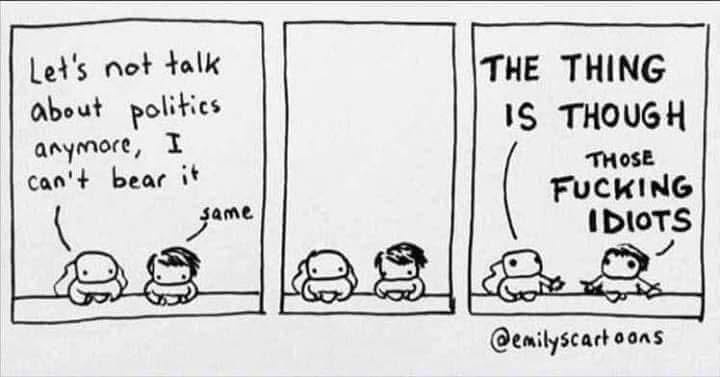
A comic strip from @emilyscartoons. In the first panel, one person says, "Let's not talk about politics anymore, I can't bear it" and the second person says "same." In the second panel, they just sit there. In the third panel, they say, "THE THING IS THOUGH" and "THOSE FUCKING IDIOTS." Image source.

Links related to the antichrist:

1. The ABA supports the rule of law (February 10) "There is much that Americans disagree on, but all of us expect our government to follow the rule of law, protect due process and treat individuals in a way that we would treat others in our homes and workplaces. The ABA does not oppose any administration. Instead, we remain steadfast in our support for the rule of law."

2. Theobro social Darwinism earns a papal smackdown (February 12) "I mean, jeez, that’s devastating. If Vance were an honest person, or if he were a person capable of shame, or if he were a person interested in what is true this would be an edifyingly humbling experience for him. Alas, he is immune to both humility and to edification because he is none of those things — not an honest person, nor a person capable of shame, nor a person interested in what is true."

Yeah you never want to be the person in a bible story asking, "But who is my neighbor?"

3. If you're not already giving monthly donations to a group that helps immigrants, please consider doing so. Many of them were receiving government funds but now those have been cut off. The reality is, they won't be able to do as much, with less funding. This is terrible- immigrants are under attack and we really need to do more to help immigrants, not less.

Find a local organization that helps immigrants. Or, donate to RAICES.

4. Microbiologists, hang your head in shame (or fight back!) (February 10) "The major scientific societies in Nazi Germany were quick to pander to Hitler, and they had the same kinds of arguments: they were patriots supporting their country, they had to fire all those Jewish professors to keep government support, etc., etc., all while they were looting conquered nations and doing secret work on nerve gasses and sieg heiling their way to bigger grants."

5. Pour one out for the CFPB (February 13) "So, if consumers can’t even see when an institution is being fair and honest, it’s a competitive disadvantage to even bother."

6. Park Service Goes Full Stalin, Literally Takes The 'T' Out Of sTonewall (February 14) "In an act of revisionist history Joseph Stalin might admire, the National Park Service disappeared all references to transgender and queer people from its main page for the Stonewall National Monument in New York City yesterday." 

How will I explain this to my children?

Saturday, February 15, 2025

This 93% Stat About Dads is Totally Made-Up

A pie chart with sections labelled "Lies", "Wrong", "Guesses", and "Who knows?" Image source.

I'm late to the party on this, but I want to talk about this great post from Sheila Wray Gregoire: PODCAST: The 93% Myth That Fathers Matter More than Mothers

There's a statistic that I've heard in conservative Christian spaces. It goes like this:

When dad comes to Christ first, 93% of families will follow.

When mom comes to Christ first, 17% of families will follow.

When kids come to Christ first, 3.5% of families will follow.

("come to Christ" is Christian jargon meaning "converting to [the correct type of] Christianity")

This statistic is used by conservative Christians to make the point that it's SO IMPORTANT for churches to try to reach men. Some churches even use this statistic to justify prioritizing men's ministry higher than women's ministry, or getting rid of women's ministry altogether.

In the podcast I linked, Gregoire talks with Miranda Zapor Cruz (who wrote a post in 2022 showing that no actual research can be found to support this stat) and Beth Allison Barr. Basically, it's about how this statistic is totally made up- and also, it doesn't really "ring true" with most people's experiences- if you ask people who had the biggest influence on their religious beliefs, they often say their mother had a bigger influence than their father.

I liked this quote from Beth Allison Barr:

Beth: I actually had known about the statistic before.  Back when my husband and I were still at the church before he got fired a long time ago and we were really starting to question what the church was teaching about male and female roles, and my husband came to me.  And he said, “Hey, the pastor gave me this statistic this morning.  He said that there’s been this study that shows this.  Do you know anything about this?”  And as an academic, I looked at it, and I was like, “How would they even know that from this?  I mean it’s such a weird thing.”  And to say that 93% of families will go to church if the father is the first one to attend. And, of course, all the questions in my head were like, “Well, what church are they talking about?  How did they get the numbers on this?  Did they follow people across 10 or 20 years or something to try to figure out when,”—I mean it was just all of those questions.  And so I was just like that sounds made up.  I was like, “Where did you get it from?”  And he didn’t know where it came from.  And I just kind of wrote it off.  

Yes! How would they even know this? How would you design a study that could show this? You can't just ask all your church members "who was the first person in your family to become a Christian?"- that's not the data this stat is getting at. You would have to find a bunch of families (how do you define family, exactly? Do the parents have to be married? Are we only looking at families with minor children?) where all members are non-Christians, and then track them (for how long? Barr says 10 or 20 years, that seems about right). You would then check if any of the individuals in these families converted to Christianity (what does that mean, exactly- who defines what "convert to Christianity" means? Do they have to be active in a church for it to count?). And then you check what happened after that- in the families where the dad was the first person to convert, did the mom and kids convert? What about when the mom was first? What about when a kid was first? Do you only track 2 outcomes- "entire family converts" vs "there still exist some immediate family members who are non-Christians"? Wouldn't it be more useful to track how many individual family members converted, rather than only "counting" it if it's the whole family?

And even if you did that, and the result was that "when the dad converts first, 93% of the time the wife and kids convert too", that still doesn't mean churches should prioritize men. Because we don't know anything about how common it is for a man to convert first, compared to a woman converting first. What if it's 100 times more common for a woman to convert first (or, 100 times easier in terms of the amount of resources a church needs to spend, however that's measured)- then, even though there's a lower chance the rest of the family will convert, overall you will get better results if you allocate the resources toward reaching women. If you spend those resources on reaching men, but you don't end up reaching any men (and the statistic says nothing about how easy or hard that would be), then that doesn't help.

The other thing I want to say about this is... about the evangelical attitude toward statistics. People hear this statistic, and it fits with what they believe about how men are naturally the leaders of their families, so they believe the statistic, even though it's hard to imagine an actual study existing that would show this. 

I mean, people are like this in general, though. Let's not act like this is just an evangelical problem. Plenty of people who are "on our side" (whatever that means) are quick to believe and spread statistics that aren't right. 

Let's be on the lookout for this kind of bias in our own thinking. Wanting to use science and logic to win arguments, rather than to actually find out which things you're wrong about, so you can change your own beliefs. Repeating a statistic just because it is consistent with things you already believe, not because it actually makes sense as a thing that can be measured.

---

Related:

Wow This Headline Gets the Statistics COMPLETELY WRONG 

The Great Sex Rescue: The 72-Hour Rule

WTF, CNN? 

Here's an article about evangelical women and sex

Wednesday, November 27, 2024

Blogaround

1. RIP Tony Campolo (1935-2024) (November 20) "It’s Friday, but Sunday’s coming."

2. Journal Club: The Bedroom and the Laboratory (November 20) "This chapter discusses some of the problems with the methodologies used in sex therapy, and the clinical study of sexuality." This was really eye-opening to me. I had always assumed sexology was about getting to the bottom of the grand mystery of why people like to have their partner do things to their genitals. Turns out it's not. Turns out it's the same confusing concepts of "how do I increase my sex drive" etc.

3. D&D Combinatorics (November 22) Love this xkcd.

4. House passes bill that would allow Treasury to strip nonprofits of tax-exempt status (November 21, via) "The U.S. House passed a bill Thursday that would authorize the treasury secretary to designate nonprofit organizations as supporters of terrorism and strip them of tax-exempt status." This is worrying.

5. The Adult Vaccine Assessment Tool (via) The CDC has a little interactive tool which can recommend vaccines you may need. Cool!

6. Sarah McBride And The Terrible, Horrible, No-Good, Very Bad Criticism (November 24) "If McBride is caving in fear (and Yr Wonkette does not think she is), that’s not McBride’s fault. That’s the fault of 200 House Dems and 200 million Americans who oppose anti-trans bullying and could choose to step up (or step up more) but don’t."

So the story here is that Sarah McBride is the first trans person to be elected to Congress, and the Republican members of Congress are being weird about it and making rules that she can't use the women's bathrooms because she counts as a man. McBride responded by saying she will follow the rules; her intention is not to get involved in that drama but to do the work that her constituents elected her for.

Some trans people and allies have criticized McBride for not fighting back. (See this post from Erin Reed.) The post I'm linking here is from Crip Dyke, who says it's NOT COOL that people are criticising McBride for this.

Yes- she is the first trans Congress person, she is going to have to deal with a lot of this kind of bigotry, and you can't expect her to respond in whatever way *you* think a perfect activist would respond. She's just 1 person. It's not fair to put all that on her. Really, this is a moment where allies need to step up and take a stand against the bigots, rather than expecting McBride to do that all by herself.

Also, initially when I read McBride's statement that she would "follow the rules as outlined", I took that to mean she would use the men's bathroom (and maybe this would be a form of protest- everyone would see how ridiculous it was that she is forced to use the men's bathroom). But then after reading Erin Reed's article, I thought maybe trans people don't really consider that a real option because of the worry of being harassed in the bathroom, and actually this means McBride is gonna have to walk all the way to wherever the gender-neutral bathroom is, and it will be a huge inconvenience for her and won't affect the Republican bigots at all. But then Crip Dyke's article talked about getting a bunch of trans people together to protest by using the bathroom the bigots apparently want them to use. So. It could go either way I guess.

7. The Sanitary Pad Scandal Causing Uproar on Chinese Social Media (November 26) "In one clip, an influencer measures the lengths of the absorbent pads inside products made by leading Chinese brands including ABC, Sofy, and Space 7, and compares them with the product sizes listed on the packaging, which refer to the total pad lengths." 

Here's something really interesting about China: The lengths of pads (in cm or mm) are very explicitly advertised. Like it will be right there as part of the product name on the packaging. Zero effort is required to see "oh these pads are 25 cm, these pads are 29 cm" and so on. When you buy pads in the US... in the US I never thought about the length in inches or cm. (Assuming nothing has changed since I bought pads in the US a decade ago.) You have "long" or "super long", or you have "day" vs "night" with "night" being designed to go much farther in the back- but does anyone ever think about "well how many inches is that?" I'm sure you could find it in the fine print on the packaging in the US, but it's not big and obvious like in China.

Thursday, November 14, 2024

Blogaround

1. Do not obey in advance (November 9) Yes, good advice. I think right now people are feeling like, the orange antichrist won and he'll have the power to actually implement all the bad ideas he campaigned on. And, yes, maybe, but he'll have to do a lot of work to get there- maybe his people will be incompetent. Let's hope for that. Don't act like he's already done it. Don't help him along.

2. Links to donate to help Palestine: Palestine Children's Relief Fund and American Near East Refugee Aid 

3. This Was Always Going To Be A Generational Fight For Transgender People (November 7) "To those who feel hopeless—don’t. The story didn’t end in 2004. Obama would eventually go on to champion gay rights, and public opinion shifted significantly over the next decade. Allies stood by gay people and grew in number, helping to foster broader acceptance. Anti-gay policy platforms slowly but surely became positions held only by the most fundamentalist religious politicians."

4. Number Shortage (November 8) Lolllll

5. We Fell For The Oldest Lie On The Internet (October 29, 13-minute video from Kurzgesagt) Love this! It's a video about tracking down the source for the "science fun fact" that the total length of all blood vessels in a person's body is 100,000 km.

6. She Helped a Survivor. Now She Is One. (October 25) "One thing that struck me repeatedly in this is that some level of fact-checking would have debunked some of these claims much earlier, if someone had had the presence of mind to attend to them (I dearly wish Abby had simply taken a medicine vial out of the trash and photographed the label — Abby does too). But these claims weren’t fact-checked, because to investigate the belief that someone you love isn’t telling you the truth is incredibly frightening. They weren’t fact-checked because the people who knew the facts were exhausted, caring for a newborn, toddler, and adult. They weren’t sleeping. They were largely isolated from others and had been pressured by someone they cared about deeply not to tell anyone what was happening in their home. They didn’t just do it out of fear of the next blow-up, and exhaustion. They did it out of love. They wanted this woman who they cared about to be happy and safe."

Very long post from Laura Robinson about Hannah-Kate Williams (a survivor of child abuse) and Abby Osborne, who opened her home to Williams and helped her with medical care and paid thousands and thousands of dollars for Williams' expenses- Abby has now come forward to say that Williams was dishonest and manipulative and all of this has been very harmful to Abby and her family. 

It's important to be honest about stories like this. Simplistically, we want Williams to be on the "good" side because she's an abuse survivor and she's involved in legal advocacy to hold the Southern Baptist Convention accountable for that. And so, we feel like we're not "supposed" to say anything bad about her. That's messed up.

7. Human Nature, Hope & Ice Cream (November 9, 11-minute video) A video from Pop Culture Detective making the case that it's NOT true that human nature is basically evil.

8. Two kinds of LLM hallucinations (November 13) "It’s not just about models saying something wrong, it’s about the way they say it. People are used to expressing some degree of uncertainty when they feel uncertain, and used to picking up uncertainty in other people. AI models often lack these signs of uncertainty, and this can be a problem in natural conversation. However, this subject is not discussed at all in the review, and so it appears not to be a major research area."

9. The US Is a Civic Desert. To Survive, the Democratic Party Needs to Transform Itself. (November 11) Posting this here because wow I've never heard of anything like this before. Imagine a world where a political party is manifested as a local group of real-life people who meet up and get to know each other, and support each other.

10. How Originalism Ate the Law (May 8, via) "They understand intuitively that while public opinion favors reproductive freedom and sensible gun regulations and the right to vote, the MAGA faction of the Supreme Court has found a doctrinal party trick to ensure that nobody can have any of those things because they weren’t protected at the founding or at the time of the Reconstruction Amendments, or whichever point of history the high court deems relevant (it varies)."

And I'm noticing some interesting parallels between "originalism" and how evangelicals read the bible.

AddThis

ShareThis