Showing posts with label learn Mandarin. Show all posts

Thursday, October 16, 2025

"Ayi" vs "Aunt"

This has been bothering me for years. Dictionaries and Chinese teachers should not be going around telling people that 阿姨 [ā yí] means "aunt" in English. It does sometimes- but usually not!

I have made this venn diagram which explains the meanings of "ayi" and "aunt" and the small overlap they have:

Venn diagram with one circle labelled "ayi" and one circle labelled "aunt." The "ayi" circle contains "friendly term of address for any woman you meet who is your parents' age" and "woman who works as a cleaner/ nanny/ domestic worker." The "aunt" circle contains "dad's sister" and "mom or dad's sister-in-law." The overlap area contains "mom's sister."

Hope this clears it up!

There were LOTS of things people told me early on, when I was learning Chinese, that *this* word translates to *this* other word, and I believed them, and then later found out that was not true, in ways which seemed very huge and important to me. I don't think it's their fault though- I think in many cases they didn't speak English at a deep enough level to understand that the English word they were using did not mean exactly what they thought it meant. (Oh man, don't get me started on the differences between 已经 and "already.") They had a lot of awareness of the important things to consider when one is coming from a totally-Chinese background and learning English, but going in the other direction has a whole different set of important considerations. (And there were times when I was listening to another native English speaker speaking Chinese, and their mistakes made perfect sense to me and I totally knew what they were trying to say, but our Chinese friends whose second language was English couldn't follow at all.)

Or, a dictionary might say some word is the translation of some other word, because if you *had* to choose 1 word, that's the one you would choose, but there actually aren't any English words that truly are the translation of that Chinese word- the way to translate it totally depends on the situation.

Translation is hard! But anyway, the important thing is, "ayi" usually does not mean "aunt."

Monday, May 18, 2015

Blogaround

Image source.

1. The Prophecy of Amos, Revised (posted May 8) "You go to church wearing clothes made by sweat shop workers / And drink coffee grown and picked by enslaved children."

2. John Oliver Slams America’s Mother’s Day Hypocrisy: Not Providing Paid Leave for New Moms (posted May 11) "You can’t go on and on about how much you support mothers and then fail to support legislation that makes life easier for them."

3. Black Magic! Phono-Semantic Chinese Characters (posted February 3) Chinese is easier than one might expect. ^_^ (But I totally don't buy the claim that this applies to "90-95%" of Chinese characters.)

4. Every Part Of The Trinity Is “She Who Is:” Resisting Roger Olson’s Boxes For God (posted May 11) "Though the Bible is fine with addressing God as “Our Rock” and “Our Strong Tower,” addressing the first person of the Trinity as “Mother” is apparently taking it too far. Inanimate objects are appropriate. Feminine names? Not so much."

5. Art As Protest? Rihanna's "American Oxygen" (posted May 11) Worth watching.

6. 11 recurring mistakes in the debate over the “historical Adam.” (posted May 11) "Literalism is a hermeneutical decision (even if implicit) as much as any other approach, and so needs to be defended as much as any other. Literalism is not the default godly way to read the Bible that preserves biblical authority. It is not the “normal” way of reading the Bible that gets a free pass while all others must face the bar of judgment."

7. Star Trek Fan Turns Basement Into The Starship Enterprise ! (posted May 14) Cool!

8. Reading the Bible with a Red Pen (posted May 15) "I swore then that I would never ever be a part of anything—not a religion, not a culture, not a club—that would teach, even accidentally, that certain kinds of people were people that God would want to punish."

9. Jason Chu on Asian Privilege and Freddie Gray (posted May 15) "A new spoken word music video, "THEY WON'T SHOOT ME (I am not #FreddieGray)," by Los Angeles-based Asian American hip-hop artist Jason Chu about the death of Freddie Gray while in Baltimore police custody highlights the educational and economic privilege of some Asian Americans and calls on Asian Americans to choose to use that privilege to build solidarity with other less privileged communities."

10. The God of the Lesser Things: Denny Burk is Wrong About "The Least of These" (posted May 15) "It is interesting that the least of those to whom we are supposed to lend our hand are those refusing to extend their hands to others. It is even more interesting that the position creating a false dichotomy between LGBT people and the church has somehow become 'gospel.'"

11. Tsarnaev Sentenced to Death in Boston Bombing Trial (posted May 15)

12. teaching virginity is anti-Christian (posted May 15) "You start out “clean,” and either you make it to marriage or you’re sullied."

13. Harriet Tubman stole from the rich and gave to the poor (posted May 13) "Putting Harriet Tubman on the $20 bill is appealing because it addresses four different problems at the same time: 1) Andrew Jackson was a murderous jerk who contemptuously violated his oath to defend the Constitution and he shouldn’t be honored with a place on our currency; 2) no American bills have women on them; 3) no American bills have people of color on them; and 4) Harriet Tubman was just incredibly awesome and we can’t say that often enough."

Thursday, February 19, 2015

Happy Year of the Sheep/Goat!

Image souce.

Happy Chinese New Year, everyone! It is now officially the year of the sheep. (Or goat. More on this later.) Last night (February 18) was the big night. China only has one timezone, even though it’s the size of like four timezones- so the whole country rang in the new year at the same moment.

This year, 2015, is the year of the 羊[yáng]. Now, what kind of animal is a 羊[yáng]? Sometimes you’ll see it translated as “year of the sheep”, sometimes it’s “year of the goat”, and sometimes, perhaps even less accurately, “year of the ram.”

Basically 羊[yáng] is a type of animal which includes sheep and goats. All of them are 羊[yáng]. 

See the little horns on top? Like a sheep or goat, right? (Though in this image, they're way curlier than the way we normally write it.) Image source.

Wait, so Chinese doesn’t have different words for “sheep” and “goat”?

No no no no, that’s not what I said. “Sheep” is 绵羊 [mián yáng], “goat” is 山羊 [shān yáng]. See, they are different types of 羊[yáng]. If you really want to specify if you’re talking about sheep or goats, you can use those words. But seriously, when you tell a story about something a sheep did, is it really that important that it was specifically a sheep, rather than a goat? Yeah, usually not very important. So just say 羊[yáng].

For more clarification on what a 羊[yáng] is, we can try an image search. Here are the results:

Baidu image search for 羊.
Yeah, some are sheep, some are goats.

However, in my opinion, most of the Chinese New Year decorations this year look more like goats than sheep. Like this stuffed animal hanging up in the mall:


(But I also saw some toy llamas in a display. Apparently they are also a kind of羊[yáng], or at least they have 羊[yáng] in their name. I don’t know what to tell you.)

Anyway, for more information about Chinese New Year, read my post from last year, the year of the horse. Right now, however, the most pressing question is: what kind of puns can we make about 羊[yáng]? Chinese culture loves puns.

This year the big pun is 三羊开泰 [sān yáng kāi tài]. It comes from an old saying 三阳开泰 [sān yáng kāi tài], whose pronunciation is the same, but look, we replaced the 阳[yáng] (sun) with 羊[yáng]. So clever. Seems that no one is able to give me a straight answer on what 三羊开泰 [sān yáng kāi tài] actually means, all we know is it’s about 羊[yáng] and it’s something about being prosperous. Think of it this way:

1. Get 3 sheep.

2. ????

3. Profit!

This painting helpfully illustrates the concept of 三羊开泰 [sān yáng kāi tài]. Image source.

And finally, I’ll leave you guys with some links to videos of the performances from last night’s 春晚[chūn wǎn] (the Chinese “New Year’s Rockin’ Eve”). There were songs, dances, skits, lots of fun stuff. Here are a few that don’t require you to understand any Chinese. (I'm including links to both youtube and iqiyi, a Chinese site. The Chinese site has way better video quality, but I don't know how well it will load outside of China.)

Crazy-skilled acrobats. iqiyi link. Youtube link.

Belly dancing, Russian dancing, and other styles from around the world. iqiyi link. Youtube link.
Kung fu routine which involved a lot of dancing with chairs. iqiyi link. Youtube link.

Happy new year, everyone! 新年快乐 [xīn nián kuài lè]! Best wishes for success and health in the new year! Now go eat some dumplings.

Friday, February 13, 2015

Image Search as a Tool for Language Learning

Sometimes, when learning a foreign language, you run into words that don't have an exact counterpart in English/ your first language. For example, some nouns which refer to a whole category of things, and you're not sure what all gets included in that category.

I hear a lot of mistakes from my students (Chinese people studying English) in terms of what a T-shirt is. When they talk to me in English, they totally refer to any shirt I'm wearing as "your t-shirt", even though, dude, this is my job, I'm wearing nice professional-looking clothes, I am not wearing a t-shirt. Clearly, whatever Chinese word they are translating as "t-shirt" doesn't mean that at all.

I had the same problem when, in Chinese class, I was taught that 衬衫 [chèn shān] means "shirt." I then proceeded to use it in daily conversations when I was referring to shirts, and I was ALWAYS wrong. It does not mean "shirt"; it means like a nice, professional, button-up dress shirt.

Anyway, I've got a tip for dealing with this kind of situation: image searches. Go to a search engine- preferably one made by the native speakers of your target language- and search whatever unclear word you want to understand. The results should give you an idea of the range of things that count as that word.

Examples:

(I used Baidu, the Chinese equivalent to Google.)

Let's have a look at these 衬衫 [chèn shān] shirts and see what they really are, shall we?

衬衫 [chèn shān]

Image search results. Click image to view large version.

Another example: When I got my cat and showed pictures of him to everyone, my Chinese friends kept saying he was a cute little 花猫 [huā māo], whatever that means. 花[huā] means "flower" and 猫[māo] means "cat", so... what?

Turns out 花[huā] can also be used to describe something with a pattern, or an animal with multiple colors. A 花猫 [huā māo] is a multicolored cat.

花猫 [huā māo]

Image search results. Click image to view large version.

Same deal with dogs.

花狗 [huā gǒu] 

Image search results. Click image to view large version.

This is also very good for when you have some western thing and you look up the Chinese name for it in a dictionary. Once you have the name, though, you don't know if the average Chinese person would understand that term to mean whatever foreign thing you mean it as, or at least as an equivalent Chinese item which is the same in all the important ways.

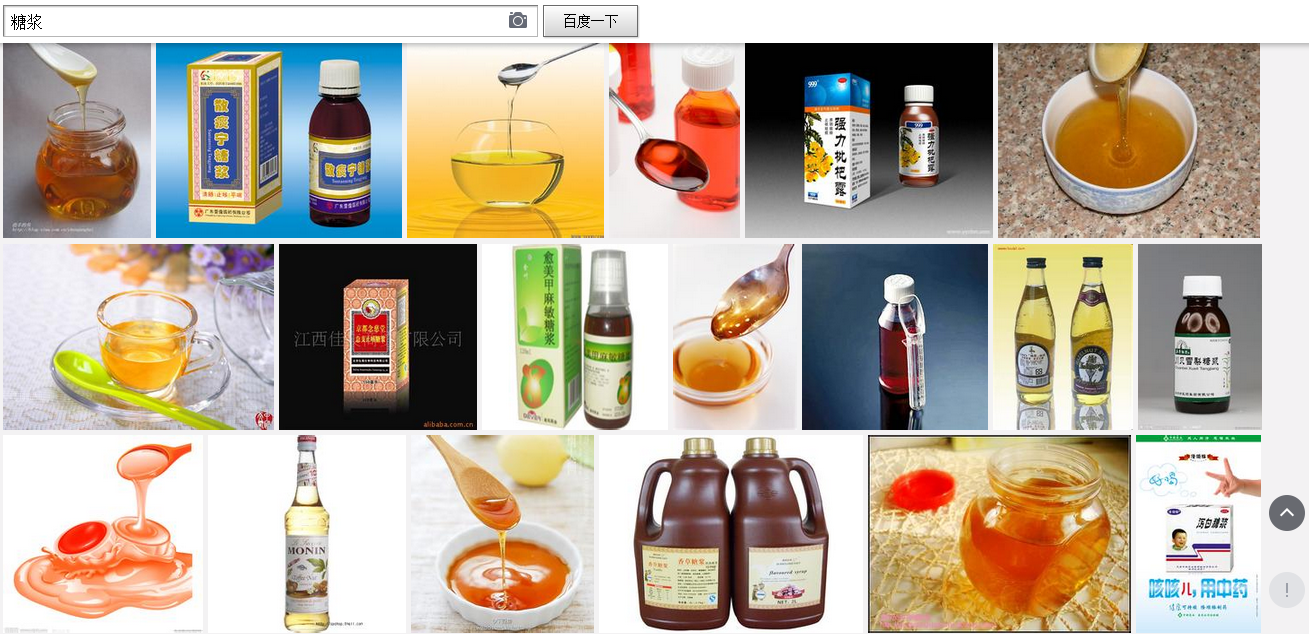
Perhaps you read my post about pancake syrup and how hard it is to find in China. Let's take a look at the supposed Chinese translation of "syrup" and find out if it's really the same thing:

糖浆 [táng jiāng]

Ohhh. Check out the pictures. It generally means liquid medicine. Chinese culture has no pancake syrup.

Image search results. Click image to view large version.

Another example: I asked a friend how to say "cookie" in Chinese, and she said "饼干 [bǐng gān]." THIS IS WRONG.

饼干 [bǐng gān] 

Image search results. Click image to view large version.

Looks to me like 饼干 [bǐng gān] usually refers to crackers. Cookies would also be a type of 饼干 [bǐng gān] because they're not a super-important thing in Chinese culture so they just get lumped in with the crackers.

(And there's more confusion because for some reason, British people think cookies are "biscuits" and then the Chinese students get taught that. It's a mess, huh?)

I've also heard the term 曲奇 [qū qí] used for "cookie." Let's have a look at that one.

曲奇 [qū qí] 

Ah, yes, this is a WAY better translation for "cookie." But you'll notice most of the 曲奇 [qū qí] are those shortbread-type cookies, which are sweet enough that they definitely meet the minimum requirements to be a cookie, but not much else. You won't easily find delicious sugary cookies packed with sweet wonderful chocolately goodness (ie, what Americans usually think of when they hear the term "cookie") in China.

Image search results. Click image to view large version.

(Dang I miss American food.)

Here's a fun one. 面包 [miàn bāo] means bread (just the kind baked with yeast, not like a pita or flatbread). In America, if you say you're going to buy bread, most people assume you mean sliced bread to make sandwiches. But when you say it in China, they assume it means some kind of pastry-type bakery items, because sandwiches and sliced bread are not so popular in China.

Both the sliced bread and pastry-type bakery items can correctly be called "bread" or "面包 [miàn bāo]". But the assumptions people make about which type of bread you mean are very different in different cultures.

The image searches show you not just the range of things that can be referred to by that name, but also which are most common.

Bread (google search in English this time)

Image search results. Click image to view large version.

面包 [miàn bāo] 

Image search results. Click image to view large version.

I also use this method when I'm teaching English and a question comes up about some obscure color, like turquoise. It's a kind of blue, but it's... hard to describe, right? Go search it and the students can see what color it is.

Use search engines to help with your studying. You'll get a ton of examples, and have a much better idea of what you've actually talking about.

Monday, December 22, 2014

Blogaround

Image source.

1. This delightful video: All About That Space.


2. Australians Just Showed the World Exactly How to Respond to Terrorism With #IllRideWithYou (posted December 15) "If you wear religious attire, & need to get from #Adelaide's west suburbs to the city on Tues but don't want to travel alone #illridewithyou"

3. Cleveland police say they’re opposed to justice, find it offensive. These boys are in the wrong line of work. Fire them all. (posted December 15) "'Justice for Tamir Rice and John Crawford' is not an insult directed at the Cleveland police. It is a summary of their job description."

4. Browns Player Offers Thoughtful Rebuke After Police Union Slams T-Shirt Protest (posted December 15) "And the No. 1 reason for me wearing the T-shirt was the thought of what happened to Tamir Rice happening to my little Austin scares the living hell out of me."

5. well, at least the Old Testament has one thing going for it (posted December 16) "But a key dimension of Israel’s tradition is the observation that the 'rules of the game' that God insists on can’t be counted on."

6. Five things we should demand from the Cleveland Police Department regarding Tamir Rice (posted December 15) "We demand to get basic answers for these clear and obvious lies that do not match up at all with the video from the community center."

7. The Slaughter of the Innocents of Sandy Hook (posted December 12) "God did not enter the world of our nostalgic silent-night, snow-blanketed peace-on-earth sugar cookie suspended-reality of Christmas. God slipped into the vulnerability of skin and entered a world as violent and disturbing as our own. Here in this Christmas story, the story of Herod, there simply is no mistletoe and reindeer."

8. 美国想打谁就打谁 (America hits whoever it wants): versatile Chinese question words (posted 2013) To say "whoever" in Chinese, you use the word for "who" and set up the sentence in a way that really reminds me of algebra. Cool stuff.

9. ‘God Loves Women Who Have Abortions': The Religious Abortion Advocates That History Forgot (posted December 16) "Knox said that many of his colleagues decided to get involved with RCRC after witnessing 'a complete lack of compassion' in today’s conversations about abortion among people of faith." Well, yeah.

10. 3D-printed legs make disabled dog learn joy of running (VIDEO) (posted December 21) Adorable.

11. In case you were wondering, this is how you gift wrap a cat. (posted December 19) So useful!

12.  North Korea: Not Funny (posted December 18) "It serves to buffer and obscure the sheer evil of a regime that enslaves children and sentences entire families to death for crimes of thought, while building ski resorts, dolphinariums, and other luxury escapes for elites with funds that could feed its malnourished people for several years."

Monday, September 29, 2014

Blogaround

Image source.

1. Essential Chengyu: To play the lute for a cow (posted 2011) A Chinese idiom.

2. A Christian perspective on transgender people (posted June 16) "It’s not your business or mine what she looks like under her clothes, and gender is way more complicated than that anyway. All you need to know is that she is a human being, created and beloved by God."

3. Hogwarts School of Prayer and Miracles. A "Christian Harry Potter" fan fiction that's so over-the-top it's delightful. Don't know if it's a Poe or not. "There is a man named Voldemort who wants to destroy all that we stand for. He is pushing an agenda in congress which will stop us from practicing our faith freely."

Wednesday, May 21, 2014

To say paper in Chinese, you have to understand paper in China

Image source.

One day, I was walking around a mall with a friend, and I told him I had to use the bathroom. So we found a bathroom, and then he said to me, "Do you have paper?" and I said yes, don't worry, I'm fine.

Back up. You may be thinking, "umm what?" Let me explain.

So I was in China, and my friend is Chinese- but he talks to me in English. And here's what you have to know about China: There's probably no toilet paper in the public restrooms. (Probably no soap either, which scares me to death...) You have to bring your own toilet paper. Except, not really. People bring little packs of kleenex to use as toilet paper.

The confusing part is that, in Chinese, all of the following are referred to as 纸 (zhǐ): paper, toilet paper, napkins, kleenex, paper towels. So native Chinese speakers, when they speak English, refer to all of them as "paper." (Yes there are more specific names to differentiate between the types of 纸 (zhǐ), but Chinese people don't use them in regular everyday conversation.)

Oh, another thing: We don't really buy napkins and paper towels in China. Napkins, you can get one at a restaurant when you buy food. Yeah. One. Maybe they'll give you two, maybe. And there's no napkin dispenser where they're giving out free ones. And paper towels, well it's been months since I've seen a paper towel.

So instead, people just use kleenexes as napkins and paper towels. As an American, at first I thought that was REALLY WEIRD. Because napkins are VERY DIFFERENT from kleenexes, right? But now I've gotten used to it, so, whatever.

(Culture shock is a helluva drug, I guess.)

Recently I went to a restaurant with one of my students. We ordered the food up at the counter, then sat down. I was asking him a question about Chinese, and he was telling me how to say a word, and then he suddenly says, "Do you need paper?"

My brain is like, no I got it, I don't need to write it down. Or you know, I could just use my phone, type it in to see exactly how the characters look.

But I stopped myself and realized what he actually meant was, "Do you want a napkin?"

Or, from an American point of view, "Do you want a kleenex that you can use as a napkin?"

And he went up to the little kleenex box at the front counter and got us two kleenexes, which we later used as napkins.

Yeah.

Image source.

Basically, little things like this mean that in China, a whole separate dialect of English has been created. Where people refer to toilet paper as "paper" and everyone's fine with it- even the foreign teachers- because it's such a common mistake that it hardly even counts as a mistake anymore. Everyone who's spent a bit of time in China can understand what they mean.

As a teacher, I don't know if I should even try to correct it or not. The point of language is to communicate with other people, and if you're speaking English with someone who already knows the situation regarding toilet paper and napkins and kleenexes in China, then they'll understand if a Chinese person just refers to something as "paper." If you want to travel to America, where the average person has strong opinions about the difference between napkins and kleenexes, well you better learn the American way to say it.

And my job is to teach English- not necessarily to teach American English.

So I guess I'll let that one go, maybe because it's too hard to correct that error anyway, in a culture where toilet paper, napkins, and kleenex are all used interchangeably.

(But man, when someone comes up to me after class and says, "You left your clothes in the classroom"- an error whose cause is very similar to this one, and makes it sound like I'm walking around the school in my bra- I feel like I gotta correct that one. What they actually meant was, "You left your jacket in the classroom." But that's a whole other post.)

Image source.

Tuesday, February 11, 2014

Did God do it? (plus a Chinese lesson!)

Image source.
In Psalm 88, the psalmist is crying out to God for help, but, strangely enough, also saying it was God who caused bad things to happen to him.

Take a look:

"You have put me in the lowest pit,
    in the darkest depths.
Your wrath lies heavily on me;
    you have overwhelmed me with all your waves.
You have taken from me my closest friends
    and have made me repulsive to them."

Well that's... odd. God did those bad things to him? Really? What does the writer mean by that?

Here's the thing: I highly suspect that, as this was written thousands of years ago, in another language and in the context of a culture completely foreign to me, I can't just take this "God did it" idea and run with it. When an American Christian says God did something, I'm willing to bet that has a different meaning than an ancient middle-eastern person saying God did something.

So there's no point in speculating and analyzing this until we know more about the culture.

Here's another example: 2 Samuel 24:1 says, "Again the anger of the Lord burned against Israel, and he incited David against them, saying, 'Go and take a census of Israel and Judah.'"

But when the same story is recorded in 1 Chronicles 21, it says, "Satan rose up against Israel and incited David to take a census of Israel." So which is it? God or satan?

And how about when Moses was confronting Pharaoh about the "let my people go" thing? Sometimes it says God hardened Pharaoh's heart (Exodus 7:3, 9:12, 10:1, 10:20, 10:27, 11:10, 14:4, 14:8), sometimes it says Pharaoh hardened his own heart (Exodus 8:15, 8:32, 9:34), and sometimes it sounds like it just happens on its own (Exodus 7:13, 7:22, 8:19). So which is it? (And isn't it kind of messed-up for God to punish Pharaoh for something God did?)

Who did it? Who caused it? I bet this confusion is because the biblical writers had a different understanding about what it means to say God caused something.

So unfortunately, I can't start to make a big deal out of "oh my gosh, God caused that?" Because I don't know their culture and what they meant by that.

Image source.
Here's an example from Chinese. Suppose you went on vacation, but unfortunately there was a typhoon while you were there. In English we say, "There was a typhoon." Chinese people would say, "我遇到了台风 (wǒ yù dào le táifēng)" which literally means "I met a typhoon."

(And this is why, even though I can speak Chinese, I structure my sentences differently than a native speaker. My brain's OS is English.)

To me, as a native speaker of American English, "there was" has a slightly different feel than "I met." Maybe Chinese people would say it does too. But that's not something I can really understand until I spend a lot more time studying Chinese.

At any rate, it wouldn't make any sense for me to say "wow this translation says 'I met', that is super interesting, it puts the focus of the sentence on the person who's telling the story, I wonder why." Umm, no, that's just a very normal thing to say if you're speaking Chinese. There's no magical hidden meaning. It's just a different language.

Same thing with Psalm 88 and how it says God made bad things happen to the psalmist. How would the original audience have understood it? I don't know. Maybe it's a big deal, maybe it presents a crazy view of God that we need to wrestle with- or maybe not. We can't know without knowing their culture.

-------------------

This post is part of a link-up on the topic of Psalm 88. To read other people's posts, click here: Depression is Biblical.

Monday, July 29, 2013

Blogaround

1. Just Because He Breathes: Learning to Truly Love Our Gay Son (posted July 1) "We stopped praying for him to never have a boyfriend. We started praying that someday we might actually get to know his boyfriend."

2. Comprehensive Onomatopoeia List (posted July 24) Sweet! Chinese onomatopeia.

3. My husband is not my soul mate. (posted July 22) "But when my daughters come home starry-eyed from camp announcing that they can’t wait till the day they meet the man God has for them, I will probably pop their bubble and remind them that God doesn’t have a husband stored away somewhere for them."

4. What are the “weightier matters of the law”? (Matthew 23:23) (posted July 9) "So here’s an honest question: do you believe that Jesus is a historical figure who can only be known through the words we have received about Him in a book or a living God who is speaking to us today? If you try to wriggle out of answering this by saying that Jesus wouldn’t say anything today that he hasn’t already said in His book, then what you’re saying is He’s not allowed to, because then you would lose control of His rules."

5. Evangelical gatekeepers and conservative holiness (posted July 25) "This idea of holiness-as-non-contamination is profoundly un-Christlike. Nothing in the life or teaching of Jesus Christ suggests that avoiding contamination has anything to do with holiness."

Saturday, March 16, 2013

Cover The Box (Why Languages Are Different)

Suppose this box represents all the possible things you might ever want to communicate:

Pictured: All there is to talk about. Image sources: 1, 2, 3, 4, 5, 6, 7, 8, 9, 10, 11, 12.

Every language uses specific words, phrases, and grammatical structures to cover the entire box of possible meanings. It covers the whole box, so that all meanings within the box can be expressed in that language. But here's the thing: The covering is different.

Suppose this next diagram represents English. Each little region represents an English word/expression/grammar structure:

Each "circle" represents an English word/expression/grammar structure.

And then this one is Chinese:

Each "circle" represents a Chinese word/expression/grammar structure.

All the same meanings can be expressed (well, more or less... I have yet to find anyone who can tell me in English what 空心菜 is...) but there's not a direct correspondence between the little subsections on the English diagram and the Chinese one.

In other words, for every Chinese word, the English "translation" may or may not mean quite the same thing.

For some words, it is quite literally the exact same thing. Inchworm is 尺蠖 (chǐhuò), and guess what- a 尺蠖 (chǐhuò) and an inchworm are really EXACTLY the same thing.

Fun fact: 尺 (chǐ) is a unit of measure sort of analogous to the English foot. Image source.

But what about 睡觉 (shuìjiào), which, supposedly, means "sleep"?

Sometimes it is used the same way as the English word "sleep." Like if someone asks "What did you do this weekend?" and you say "sleep", the correct Chinese word would be 睡觉 (shuìjiào). Sometimes, it means "sleep."

But quite often, the correct translation for 睡觉 (shuìjiào) is "go to sleep."

Let's look at the English word "sleep." If you ask someone, "When did you sleep?" perhaps they will answer "From 11 pm to 7 am." "Sleep" is something that takes place for an extended period of time.

But if you ask "你什么时候睡觉?" (nǐ shénme shíhou shuìjiào)- basically "when did you 睡觉 (shuìjiào)?" the 睡觉 (shuìjiào) here should be translated "go to sleep" or "go to bed." The answer to this question would be, perhaps, "At 11 pm." "Sleep" is something that happens over a period of time- from the time you go to bed to the time you wake up. "睡觉 (shuìjiào)" happens at one specific time- the time you go to bed.

And the fact that "sleep" and "睡觉 (shuìjiào)" are not the same seems to be something not immediately obvious to the average Chinese and English speaker. I've heard Chinese and Chinese-Americans use terms like "sleep early" because they were doing a word-for-word translation from Chinese, and incorrectly translated "睡觉 (shuìjiào)" as "sleep". I was confused- what in the world does "sleep early" mean? The only thing I could imagine is shifting the entire 8-hour sleeping period forward- go to bed an hour early, get up an hour early. Sleep early. (??? Seems like a strange concept to express...)

But what they really meant was "go to bed early."

And then you get the term "sleep late", which, because of the difference between "sleep" and "睡觉 (shuìjiào)" ends up expressing the exact opposite of what they were trying to express. In correct English, "sleep late" means "get up late." Get a lot more sleep than usual.

But the average English-speaking Chinese person who says "sleep late" is really trying to say "go to bed late." Get less sleep than usual.

I have heard people say completely backwards things like "I slept late so I'm really tired today."

So anyway, now you know. "Sleep" is not "睡觉 (shuìjiào)". They're similar, but it's often the case that when you translate from one language to another, you're not going to find a word that means the exact same thing, used in the exact same situations.

But you know what? That's awesome. Don't read this and think "wow, learning languages is way too hard." No, this is why learning languages is AWESOME! I totally never would have imagined that other people could view the distinction between "sleep" and "go to sleep" differently than I do, as a native English speaker.

So cool! And that's just the beginning. Chinese and English are so completely different, and it's great.

Click here for more posts about learning Mandarin.

Saturday, December 15, 2012

The Best Way to Learn Chinese is in Chinese

This was the turning point that totally accelerated my study of Chinese: When I knew enough phrases to start learning Chinese in Chinese. In other words, yeah, I'd been meeting up with a few of my Chinese friends every week, practicing with them, and when I could do that without speaking English at all, that's when things really took off.

Image source.

Three reasons for this:
  1. My goal is to speak Chinese, right? Maybe a good method to do that is, you know, by speaking Chinese.
  2. If I asked in Chinese, they replied in Chinese, which helped me become familiar with some conversational vocabulary that I wouldn't have thought to ask.
  3. Do you know how it feels to realize "wow, I just had an entire conversation with no English"? I want to help you feel that. It's awesome.
So, I've made a list of "all" the words you need to know in order to learn Chinese in Chinese. And if you're studying any other language, I recommend finding the corresponding phrases in that language- you will learn so much faster if you find a conversation partner and quit speaking English.

Also: Even if you don't have any intention of learning Chinese, I recommend taking a look at how I've translated phrases and the literal meanings of each word. You'll be surprised and fascinated. Chinese grammar is completely different from English.

Since this list is quite long, I've (somewhat arbitrarily) divided it into different levels. Don't worry about learning the whole list right now- just learn one level at a time. Also, I've used ___ and ~~~ as placeholders- in real life you would fill those in with whatever vocabulary you're asking about.

(And OF COURSE there are variations on the wording of all of these. I'm just giving you one way to say them.)

Without further ado:

Level 1:

___怎么说? (zěnme shuō) = "How do you say ___?" 
(or just 怎么说? (zěnme shuō) = "How do you say it?")
怎么 (zěnme) = "how"
说 (shuō) = "say"

你说什么? (nǐ shuō shénme) = "What did you say?"
你 (nǐ) = "you"
说 (shuō) = "say"
什么 (shénme) = "what"

___什么意思? (shénme yìsi) = "What does ___ mean?"
(or just 什么意思? (shénme yìsi) = "What does that mean?")
什么 (shénme) = "what"
意思 (yìsi) = "meaning"

这个 (zhège) = "this" or "this one"
Several of the phrases I'm giving you have blanks where you would fill in the word you're asking about. Or just point and say "这个 (zhège)".

怎么写? (zěnme xiě) = "How do you write it?"
(or ___怎么写? (zěnme xiě) = "How do you write ___?")
怎么 (zěnme) = "how"
写 (xiě) = "write"

Level 2:

什么? (shénme) = "What?"

说得对吗? (shuō de duì ma) = "Did I say it right?"
说 (shuō) = "say"
得 (de) = [this word comes after a verb when you want to modify it with an adverb]
对 (duì) = "right"
吗 (ma) = [you throw this on the end of a statement to turn it into a question]

写得对吗? (xiě de duì ma) "Did I write it right?"
写 (xiě) = "write"
得 (de) = [this word comes after a verb when you want to modify it with an adverb]
对 (duì) = "right"
吗 (ma) = [you throw this on the end of a statement to turn it into a question]

怎么发音? (zěnme fāyīn) = "How do you pronounce that?"
怎么 (zěnme) = "how"
发音 (fāyīn) = "pronounce"

怎么用? (zěnme yòng) = "How do you use it?"
(or ___怎么用? (zěnme yòng) ="How do you use ___?")
怎么 (zěnme) = "how"
用 (yòng) = "use"

Level 3:

可以说___吗? (kěyǐ shuō ___ ma) = "Can I say ___?"
(when you want to check if you're understanding the word right, and you make an example sentence)
可以 (kěyǐ) = "can"
说 (shuō) = "say"
吗 (ma) = [you throw this on the end of a statement to turn it into a question]

___的~~~ (de) = "~~~ as in ___"
Okay, this is unique to Chinese and REALLY REALLY important. So, Chinese has a lot of words which are completely different words (different characters) but pronounced the same. So if someone tells you a character that's pronounced zi, you wonder which zi they're talking about. If it's this one 自, they might answer "自己的自 (zìjǐ de zì)" which means "zi as in zi ji." The idea is to give an example of a word containing the character in question.
(自己 (zìjǐ) means "self", if you were wondering.)

发音得对吗? (fāyīn de duì ma) = "Did I pronounce it right?"
发音 (fāyīn) = "pronounce"
得 (de) = [this word comes after a verb when you want to modify it with an adverb]
对 (duì) = "right"
吗 (ma) = [you throw this on the end of a statement to turn it into a question]

几声? (jǐ shēng) = "Which tone?"
In Chinese, each character has one of the four tones as part of its pronunciation.
几 (jǐ) = "which number"
声 (shēng) = "tone"

拼音是什么? (pīnyīn shì shénme) = "What's the pinyin for that?"
Pinyin is the pronunciation, written in "English letters". For example, the pinyin for "对" is "duì".
拼音 (pīnyīn) = "pinyin"
是 (shì) = "is"
什么 (shénme) = "what"

Level 4:

比如 (bǐrú) = "for example"
You can even use this as a question.

跟___一样吗? (gēn ___ yīyàng ma) = "Is it the same as ___?"
跟 (gēn) = "with"/"and"
一样 (yīyàng) = "the same"
吗 (ma) = [you throw this on the end of a statement to turn it into a question]

___和~~~什么不一样? (___ hé ~~~ shénme bù yīyàng) = "What's the difference between ___ and ~~~?"
和 (hé) = "and"
什么 (shénme) = "what"
不一样 (bù yīyàng) = "different"

再说一遍 (zài shuō yībiàn) = "Can you say it again?"
再 (zài) = "again"
说 (shuō) = "say"
一遍 (yībiàn) = "one time"

如果 (rúguǒ) = "if"
This is useful when describing possible scenarios in which you would use certain words.

Bonus: 

不明白 (bù míngbái) = "I don't get it."
不 (bù) = "no"/"not"
明白 (míngbái) = "understand"

加油! (jiāyóu) It means "keep at it", "good luck", "you got this", things to that effect. (Oh, but the literal translation is "add oil.") Image source.
如果你不说英文,中文也会学得更快!(rúguǒ nǐ bù shuō yīngwén, zhōngwén yě huì xué de gèng kuài)

If you don't speak English, you can learn Chinese even faster!

Click here for more posts about learning Mandarin.

Saturday, September 29, 2012

Measure words are totally not that bad

We now come to reason #471 that Mandarin is impossible to learn: measure words.

What are measure words?

You can think of measure words as putting units on the nouns you're talking about. English uses them sometimes too- for example, you have a bowl of soup, a pair of pants, a slab of concrete, a cup of coffee, a piece of paper, a bouquet of flowers.

But the difference is that in Chinese, every noun has a measure word that's supposed to go with it.

Here are the common ones I can think of offhand:

个 (gè) - The most common measure word (absolutely no question about this). I would guess that 70% of the time you use a measure word, you use 个.
本 (běn) - for books
只 (zhǐ) - for many kinds of animals- dogs, cats, lions, monkeys, etc etc.
张 (zhāng) - for large, flat things- a piece of paper, a photo, a table, a bed
条 (tiáo) - for long things- pants, fish, roads

All of these things are measured in 条. Images from: here, here, and here.

But actually, you don't need measure words as much as you might think.

Chinese grammar is incredibly different than English grammar. The best way I can describe it is this: In Chinese you need way less words than you'd think.

Chinese doesn't have a direct translation for "the" and "a". A lot of times you don't need to put a "the" or "a" in front of a noun- you just say the noun. It's simple.

I learned the word 书 (shū), which means book, pretty early in my Chinese 101 class. We did not learn the measure word for books, 本 (běn), until maybe a year later. Why? Because you can totally talk about books in a way that's grammatically correct without ever needing the measure word.

Seriously. Chinese is easy. Or incredibly confusing. Take your pick.

Okay, when DO I use measure words then?

You definitely need them if you're counting. You can ask someone how many 本 (běn) of books they have, and they would answer 1 本 (běn), 2 本 (běn), etc. (Which just means 1 book, 2 books, etc.)

Or if you point at something and say "this one" and "that one", the word "one" gets translated as the measure word for that object. Again, with the books example and the most literal translation possible, someone could say "Bring me my Chinese book" (no 本 (běn) required in this sentence) and the other person could ask "Is it this 本 (běn)?" (Meaning, "Is it this one?")

(I'm sorry if this is incredibly convoluted and confusing. Please ask for clarification! I feel like I have a really unique perspective on this, since my first language is English, and I hope it means I can explain Chinese grammar to English-speaking people effectively. But sometimes I don't remember what it's like to not know any Chinese.)

Sometimes it's very very important to get the measure word right.

Now you might be thinking, "Okay, if 1 本 (běn) of books just means 1 book... basically every measure word just means you have 1 of those things, whatever the thing may be, so what does it matter? They all mean the same thing."

Yes, this is true. Most of them don't have a super-special meaning which requires you to pick out the correct measure word. That's why you can always use 个 (gè), if you don't know the "right" measure word, and it'll be fine. It's not grammatically right, but everyone knows what you're saying. See, the measure words are not such a huge obstacle.

However, sometimes the measure word does have a certain meaning, or a certain subtle "feel" to it.

For example, you'd normally use 个 (gè) when talking about people. There are 3 个 (gè) of people in my lab. (Meaning, there are 3 people in my lab.)

But if you are being a little bit more formal/polite, you use 位 (wèi). When you arrive at a restaurant, the waiter might ask you how many 位 (wèi) of people are in your group. (Meaning, how many people are in your group?)

And if you're asking someone about their family, you often ask how many 口 (kǒu) of people are in their family. 口 (kǒu) literally means mouth. (Yes, it is a box. It looks like a mouth. Chinese characters really do make a lot of sense.) In other words, how many mouths to feed?

And sometimes, using different measure words gives a slightly different meaning. For example, 课 (kè) means class. There are 2 different measure words associated with 课 (kè), and they have different meanings. One 节课 (jié kè) is one class session. One 门课 (mén kè) is the course itself, which lasts for the whole semester. So you might ask someone how many 节课 (jié kè) they have on a particular day, and how many 门课 (mén kè) they have in a particular semester. Your question will be interpreted slightly differently depending on which measure word you use.

And sometimes the measure word has a very specific, concrete meaning- it literally is the units on the noun. For example, a 分钟 (fēn zhōng) is a minute, and a 秒钟 (miǎo zhōng) is a second. 分 (fēn) and 秒 (miǎo) are both measure words (钟 (zhōng) means... uh... clock? Something related to time? It's hard to translate...), and they both translate perfectly into the English words "minute" and "second".

(Though I need to throw in the caveat that 分 (fēn) has some other meanings too... Translation is hard, guys.)

Conclusion

Measure words are nothing to be scared of. You actually don't need them as much as one might imagine, because Chinese grammar is simpler than English. Also, when in doubt, just use 个 (gè) and everyone understands what you mean, no problem.

But when you start to learn the nuances of the different measure words, the slight (or big) differences in meaning, it's fascinating. Measure words are not a barrier towards speaking and understanding Chinese- they are just one of many eye-opening ways that Chinese is different than English. As a beginner, you can use 个 (gè) and there's no barrier in understanding, but as you learn more and more, it will feel more natural to use the correct measure words.

I love how different languages have wildly different structures, different ways of thinking, different feelings. It's awesome and mind-blowing that Chinese grammar can be so completely different from English. The differences do not make foreign languages impossible- they make them irresistible.

Click here for more posts about learning Mandarin.

Friday, August 10, 2012

Chinese doesn't have verb conjugation!

I can't believe how well-kept this secret is- the fact that Chinese doesn't have verb conjugation, and so it works in the most straightforward way possible. You just take your subject, take your verb, and you're done. Chinese is easy.

Example: Let's look at the verb 看(pronounced kàn) which means to see or to read. So let's suppose you want to read books- that would be 看书 (kàn shū). Here's how to say it (for present tense):

我看书 (wǒ kàn shū) I read
你看书 (nǐ kàn shū) you read
他看书 (tā kàn shū) he reads
我们看书 (wǒmen kàn shū) we read

(Although I feel like these aren't necessarily sentences on their own- if you just want to say "I'm reading a book" and that's the whole sentence, you'd better say 我在看书 (wǒ zài kàn shū), the 在 shows that you're doing it right now.)

(But I stand by my point about Chinese being easy because of lack of verb conjugation.)

Seriously, it is that easy. And if you're saying "I like to read" or whatever, you use the same 看, without some kind of infinitive verb "to read"- nope, it's the same. There really is no verb conjugation.

In case you didn't get it, here's another example: In English we have "to be" and then you say "I am", "you are", "it is", "they are", see there's all these different conjugations of "be", depending on who the subject is. Mandarin Chinese doesn't have that. You use the same freaking word for all of them.

While we're here, let's learn Chinese pronouns, because they are quite easy.

First of all, you use the same word whether it's a subject or an object. 我 (wǒ) means both "I" and "me". And they're ALL like that. So simple.

我 (wǒ) I/me
你 (nǐ) you (singular)
他 (tā) he/him
她 (tā) she/her
它 (tā) it

You may have noticed that "he", "she", and "it" all have the same pronunciation in Chinese. Different characters- so they actually ARE different words- but the same pronunciation. You may have noticed a common mistake that Chinese people make while speaking English- they get "he" and "she" mixed up. Yes, they do know the difference between "he" and "she", but it's easy to make that mistake because it's not a distinction they normally think about while speaking.

And the plural pronouns:

我们 (wǒ men) we/us
你们 (nǐ men) you (plural)
他们 (tā men) they/them (masculine or mixed-gender group)
她们 (tā men) they/them (feminine)
它们 (tā men) they/them (objects)

Yeah, you just take the singular form and put 们 on the end. It really is that easy.

And sometimes this 们 is used to make other nouns plural. In general, in Chinese there isn't a singular and plural form of a noun, it's just the same. (In English, to make a noun plural you usually add "s". In Chinese, eh, no difference between singular and plural.) For example, 朋友 (péng yǒu) means "friend" but it also means "friends". Sometimes if you want to make sure everyone knows it's plural, you say 朋友们 (péng yǒu men). But I've only ever seen 们 used like this for plural groups of people, not objects. And using 们 like that isn't necessary- you're better off not doing it if you're not sure.

And something I want to say about 它 and 它们 (meaning "it" and "they", referring to objects or animals): These words don't get used that much. I'm actually not sure if I've EVER heard 它们 used. Usually instead of saying "it" in Chinese you just use the actual name of the object.

And here's a mistake I make when speaking Chinese (you know, to go along with the anecdote about Chinese people mixing up "he" and "she"): So you know how in English, if you're talking about somebody but you don't know if they're male or female, you just say "they"? It's not really grammatically correct but it's what we do.

So in Chinese I find myself saying 他们, the literal translation of "they". But that's totally wrong- dude, the words for "he" and "she" are both pronounced "tā", so this is TOTALLY NOT AN ISSUE when speaking Chinese. Just say "tā" and it could mean either "he" or "she". But, you know, my first language is English, so this is a mistake I tend to make.

Speaking Chinese is just so freaking fascinating.

---------------------

Click here for other posts on learning Mandarin. 

Friday, July 20, 2012

The Four Tones Are Totally Not That Bad

I remember a time I got annoyed at someone for referring to a certain holiday in November as THANKSgiving, rather than ThanksGIVing.

And if you understand the difference between saying THANKSgiving and ThanksGIVing, well congratulations, you are capable of understanding the different tones in Mandarin Chinese.

You may have heard that "Chinese is a tonal language." And you may have concluded that, obviously you had no idea what that meant and clearly learning Chinese is impossible. And I'm here to tell you it's NOT impossible. (source: I'm white and I speak Chinese.)

What is a tonal language?

"Tone" is the pitch of your voice while pronouncing a word. In a tonal language, the tone is actually really really important- if you pronounce it with a different tone, you're actually saying a different word.

Here is a diagram of the 4 tones in Mandarin Chinese. The top of the image would be a high pitch, the bottom is a low pitch. You know, like in music.

Image source.
(Oh, also- you see those numbers on the side from 1 to 5? Don't worry about them- no one's measuring whether your voice started at a 2 or 3. The important thing is just to go up or down correctly.)

You really have to hear them to get it, so here is a youtube video. Just listen for like 30 seconds- beyond that, she goes on to talk about other things. (You know, other things related to the fact that Chinese is totally not that hard.)

So you have nī, ní, nǐ, and nì. (And actually there's also a "5th tone" or "no tone", which is when you say it so fast that nobody can tell what tone it was.)

But Perfect Number! I listened to that youtube video like 5 times and they all sounded the same! I can never learn Chinese!

Yes, at first they do all sound the same. That's because in English it totally doesn't matter, so you're not used to paying attention to it.

(They all sounded the same for me too at the beginning. But guess what? After practicing it a billion times, they don't sound the same at all.)

Let me tell you a secret: Chinese people can't tell you offhand what tone a word is either. Maybe someone tells me "apple is píng guǒ" and as I'm writing it down, I ask what tone to put on the "ping".

And then I hear him quietly say to himself "ping ping ping ping" and then he tells me "second." He says it all 4 ways and then picks the one that matches.

And the moral of this story: Chinese people are not thinking about the tones as they talk. So don't worry, once you have enough practice, you don't have to either.

They know how to pronounce it with the right tone because that's the only way they've ever heard people say it. Not because they're thinking "okay this syllable needs the first tone, this next syllable needs the third tone..."

It would just sound weird to use the wrong tone.

When you speak English, no one ever asks you "was that a long or short A", right?

Not even the grammar police. Their only concerned with weather your using the right kind of "there." Image source.

So on one hand, the tones are totally not a big deal. With enough practice, it'll just come naturally, because you pronounce it the way you've heard it pronounced. (Personally, I don't think about the tones at all when I speak Chinese, unless it's a word that I'm unfamiliar with and I'm trying really hard to get the pronunciation right.) Also, if you get a few wrong, people can still figure out what you're saying, usually.

But on the other hand, it is really important because if you say them all wrong, no one will understand you. This is why it's SUPER SUPER important to have a Chinese person to practice with. Then they'll correct you. Easy. I think the tones would only be super-hard if you were trying to learn it completely on your own, with no audio samples of what it SHOULD sound like, and no feedback about whether or not you're close enough.

In summary: If you want to go learn Chinese, don't let anyone tell you it's too hard. I mean, it's hard- you're learning another language, what did you expect? But it's not impossible. When I started studying Chinese, I really thought it might be impossible for white people to speak Chinese, since I always heard Americans give reasons for why Chinese is "hard." Lies.

And the four tones? Totally not a big deal.

-----------------------

A quick note on the difference between the terms "Chinese" and "Mandarin." When people talk about "speaking Chinese" they almost always mean Mandarin, but there are actually many Chinese languages. As far as I can tell, everyone in China can speak Mandarin, but most of them also know a "local dialect" which is really another language. I speak Mandarin- I don't know any other Chinese languages. Most people (myself included) seem to use the terms "Chinese" and "Mandarin" interchangeably.

Click here for more posts on learning Mandarin. 

AddThis

ShareThis