Thursday, August 10, 2023

Blogaround

"A man carries a child through a flooded street in Beijing, Aug. 1, 2023. Thomas Peter/Reuters via IC" Image and caption source.

1. There has been really bad flooding in Beijing recently because of Typhoon Doksuri. Here are some links from Sixth Tone about it:

After the Rains, Beijing Residents Begin Counting Their Losses (August 2)
China Floods: What Is the Cause and Why Has Rescue Been So Difficult? (August 3)
Collage: Floods in Beijing and Hebei (August 2)
Tales of Survival From Submerged Beijing, Hebei (August 3) [video]

Also from Sixth Tone: 

In China’s Dance Schools, a Dangerous Obsession With Weight Loss (August 3) "Most children applying to art schools now need to have legs not 12 cm, but 17-19 cm longer than their torsos, said Xue Ping, one of the teachers at Feeling Dance. They’re also dieting harder than ever."

Hangzhou To Pay Parents 25,000 Yuan For Third Child From September (August 8) China is very concerned about the low birth rate, and is inventing all kinds of incentives to get people to have more kids. "A mother in Hangzhou with one child told Sixth Tone that the new policy does not change her mind about not having another child, citing the high cost of education." Well, yeah.

2. Introducing Jetpack AI Assistant in WordPress.com (June 6, via) Oh geez, Wordpress has some new feature that will use AI to write an entire blog post for you. :/

3. On Orientation as a Compatibility Gate (August 1) "This view of orientation as a compatibility gate is a part of why I do not identify with orientation types other than sexual orientation. It’s not that I’m endlessly compatible with all people on all other fronts — certainly not — but my compatibility constraints around socializing, partnership, and touch do not follow the kind of patterns that lend themselves to this kind of shorthand."

4. Breaking Down the Controversy Over Florida's New Slavery Curriculum (July 28) "In a statement to TIME, the College Board said: 'We resolutely disagree with the notion that enslavement was in any way a beneficial, productive, or useful experience for African Americans. Unequivocally, slavery was an atrocity that cannot be justified by examples of African Americans’ agency and resistance during their enslavement.'"

5. The Trans Good Doctor Episode (June 28) 54-minute video. This is about the trans episode of the show "The Good Doctor." ("The Good Doctor" is a show about an autistic doctor, and I've never watched an episode but I've seen a few clips and I am not really a fan of how it portrays autism...) I have seen people on Twitter mocking the show's assumption that an autistic person would be totally unable to understand anything that doesn't fit into the gender binary... like... umm, in reality there is a HUGE overlap between the autistic community and the trans community. Autistic people are all about pointing out when societal expectations simply make no sense- and indeed, it makes no sense that society expects people's interests/abilities/personality/clothing/appearance to be determined by what kind of genitals they have.

Anyway, though, in this video, Youtuber Lily Simpson goes through the entire plot of this episode, and actually it turns out to be pretty good in terms of how it handles trans issues. 

6. A Weird and WONDERFUL Ruleset (August 5) 1-hour-12-minute sudoku solve video.

7. Overworked and Underpaid, VFX Workers Vote to Unionize at Marvel (August 7, via) "While fellow below-the-line workers in such divisions as costumes and wardrobe; hair and makeup; lighting, props and paint; and script supervision have been historically championed by IATSE, underappreciated VFX professionals have been unable to claim benefits such as paid overtime and health care, and have been at the mercy of pronounced labor shortages and managers’ unrealistic deadlines — despite the workers’ increasing indispensability within popular culture."

Wednesday, August 9, 2023

"Sodom and Gomorrah" is a story about living in a "bad neighborhood"

Broken window. Image source.

A few days ago I wrote Sodom, a little fanfic about the biblical story (in Genesis 19) where God destroys Sodom and Gomorrah. My purpose is to critique the story as it's presented in the bible and the way that Christians tell it.

The story goes like this: Sodom and Gomorrah were really evil cities. Really bad. Definitely really bad. So God planned to destroy these 2 cities, because they deserved it. Abraham's relative Lot lived in Sodom- the one righteous man in the whole evil city- so God sent 2 angels to get him and his family out of the city before it was destroyed. (On the way out, Lot's wife looked back, so she was turned into a pillar of salt, but at least Lot and his two daughters got out. Then they lived in a cave and the two daughters *somehow* got pregnant but the biblical writer is very sure that Lot was innocent. Uh yeah okay.)

So, I have this to say: Really? The cities of Sodom and Gomorrah were so evil that everyone in the entire city deserved to die? Really? Everyone? Everyone? Weren't there at least, like, innocent babies or anything? Everyone?

Really? Seriously? God says, "The outcry against Sodom and Gomorrah is so great and their sin so grievous"- but who is doing this "outcrying"? Doesn't it seem like, realistically, some people in Sodom and Gomorrah are being cruel to some other people in Sodom and Gomorrah? How on earth could anyone think that just killing everyone would be the solution to that problem?

Some people in Sodom and Gomorrah are doing bad things- so where are the victims of these bad things? Wouldn't they also have to be in Sodom and Gomorrah, just for practical geographical reasons? (Or, I guess if you don't believe that, then you have to argue that "the sin of Sodom" was that they would go out to other places and attack people there??? And that, apparently, everyone in Sodom and Gomorrah supported these attacks? Seriously?)

And yes, I know the bible addresses this exact question in Genesis 18, where Abraham tells God it would be wrong to destroy Sodom if 50 righteous people live there, and God agrees. And Abraham negotiates it down to 10- God agrees not to destroy Sodom if there are 10 righteous people there, because it would be wrong to kill innocent people along with the evildoers. But, apparently there are not even 10 righteous people, so God destroys Sodom anyway. 

Yes, I know the bible says that, but I simply don't buy it. I just simply do not believe there could exist a city where literally everyone (except possibly 1-9 people?) is so evil they deserve to die. (Like, isn't that the kind of argument that people make when they commit genocide?) I just do not believe it- even though the bible says it- and I think the world would be a better place if everyone always rejected out of hand any claims that "this entire city/ this entire village/ this entire ethnic group needs to be killed."

No, here's the way it works in the real world: Powerful people hurt and oppress poor/marginalized people. Who all live in the same society. 

And God's justice looks like what Mary said in Luke 1:52-53, "He has brought down rulers from their thrones but has lifted up the humble. He has filled the hungry with good things but has sent the rich away empty." (I refer to this as "the biblical definition of justice.") Stop those who are doing wrong, and help the victims. Create a better world, free of injustice.

Can you believe we really bought this "everyone in Sodom was evil and deserved to die" crap? Can you believe we really bought it when the bible said that killing everyone in the entire city was the right response?

(Probably the main issue is the difference between modern and ancient views of morality and sin. I am viewing it in very individual terms, but in the culture of the writers of the bible, sin was more of a collective thing. "Punishing children for the sins of their fathers" and all that- though do note that there are places in the bible that say no, you should not punish children for the sins of their fathers. My view on this is that, yes, it's true that there are sins that can affect a whole society, even people who are innocent of those sins. In practical terms, that is what happens, but I believe that is not what should happen.)

And, here's something even more ridiculous: We have conservative Christians trying to argue that the sin of Sodom was homosexuality. So... they want us to believe that everyone in the city was gay. Just think about that. The entire city. Was gay. The entire city. What about the women, were they all lesbians? How do people reproduce in Sodom? (Or maybe some are bisexual? Or straight allies?) This fan theory makes no sense.

And queer Christians have done a good job making the case that what we see in Genesis 19 is an attempted gang rape, which has nothing to do with the question of whether or not the bible/God/Christians can accept gay people. They point to Ezekiel 16:49, "Now this was the sin of your sister Sodom: She and her daughters were arrogant, overfed and unconcerned; they did not help the poor and needy." Okay, sure, I'm with you so far, but I have one question: What city did these "poor and needy" live in? Yes, sure, that was "the sin of Sodom", but how on earth would it make sense to kill everyone in the city in order address it?

(I'm really not a fan of progressive/queer Christians arguing "no no, the sin of Sodom wasn't homosexuality, it was exploiting the poor" as if that would be a valid justification for destroying a whole city. No. There IS NO valid justification for destroying a whole city.)

Yes, I understand that it makes sense to say that certain places might be characterized by certain sins- but what that really means is that the powerful people in those places are committing those sins against the weak who also live there. It does NOT mean that everyone there is evil and deserves to die- like, what on earth? That's so absurd; how could anyone ever think that?

(Honestly, what probably actually happened was Sodom was destroyed by a natural disaster- which God had nothing to do with- and then the writer of Genesis wanted to come up with a reason to explain it, and to work in a morality lesson too.)

In Genesis 19, we see that there is a gang of rapists in Sodom. (The bible says it was "all the men from every part of the city of Sodom-- both young and old" but I don't buy that. #NotAllMen or whatever.) Don't you think that this was just a small subset of the population, and most of the residents of Sodom did not want to live in a city that had a powerful gang of rapists? And yet all the modern Christian interpretations of Genesis 19 would have us believe that these violent men were basically representative of all Sodomites.

It's a story about stereotypes. God buys into the stereotypes too- killing the entire city just because a small and powerful group of men is terrorizing the streets. God kills them and their victims. God sees no difference.

It's a story about living in a "bad neighborhood." Places with higher rates of poverty and crime- do you think anyone says "yes, I want to live in a place like that"? People want to feel safe. People want to give their children the best life they can. But society sees people living in a "bad neighborhood" and thinks everyone there is dangerous. And a lot of this has to do with racism- white people assuming that anywhere with a large black population is automatically a "bad neighborhood." White people thinking that all the black people in the "bad neighborhood" are dangerous- just like God did when he looked at Sodom- when in reality, most people are just trying to live their lives, and they don't want to be in a "bad neighborhood" either.

The people of Sodom- they knew they were in a "bad neighborhood." Maybe they asked themselves "should we leave or stay?" Maybe they didn't have the resources to leave. Maybe they didn't have any place to go. Maybe the risks of leaving seemed to be greater than the risks of staying- look what happened to Lot's family.

It's a story about making the choice between leaving and staying. It reminds me of the videos about Afghans being evacuated on planes when the US military withdrew from Afghanistan in 2021. I imagine there was so much fear and uncertainty, weighing the risks of leaving and staying.

It's a story about refugees, like Lot's family. And about people who stayed, rather than take on all the risks that come with being a refugee. In Genesis 19:16, Lot hesitates, and the two angels literally grab all 4 of them by the hands to bring them out of Sodom. I have always heard pastors say it was bad that Lot hesitated; it showed that he loved the sinful lifestyle of Sodom. It was bad and wrong of him to not be willing to leave immediately. But... really? Imagine it. Imagine having to leave behind your home and flee. That's not a decision anyone can take lightly.

It reminds me of my own situation in China at the beginning of the pandemic, when the US government was recommending that all US citizens leave China. I didn't. I stayed. There was a lot of discussion in the WeChat groups for international moms- do we leave or stay? Should we leave now, in case all flights are cancelled in the future? And for those of us married to Chinese men, China counts our children as Chinese citizens and does not recognize their foreign citizenship (they do *have* foreign citizenship, but China doesn't *recognize* it), so there was a lot of worry that if, say, the US government sent planes to evacuate US citizens, my son would not be allowed to evacuate. There actually was a situation where something like this happened to a British family trying to get on one of the evacuation flights out of Wuhan. We were all asking, "should we leave now on a normal commercial flight, so that we don't end up in that situation?" Fortunately things got better in China (and unfortunately things got much worse in the rest of the world) so I guess it was the right decision to stay.

So maybe I know about the uncertainty, trying to predict the future of the place that you're in, trying to decide if the danger is big enough that you should uproot your whole life and flee.

The story of Sodom also reminds me of Muslims who flee terrorism in their home countries. They come to another country looking for safety, and people treat them as if they're the ones who are dangerous, just because they are Muslim and the terrorists they are fleeing are also Muslim. Worldwide, the majority of victims of Islamic terrorism are Muslims. But people in non-Muslim countries don't recognize that, just like God thought all Sodomites were bad.

Don't you think that also would have happened to residents of Sodom, if they had left? People would view them as violent and dangerous, because they heard that Sodom was a violent and dangerous place.

And it reminds me of the modern Christians who think this story has something to say about gay people. They see the violent rapists in the story, and they say that's what being gay is about, just like God saw those violent rapists and said they were representative of everyone in Sodom.

And the left-leaning people I see on Twitter, who want nothing to do with anyone from a "red state." When there's a natural disaster in a "red state", I see tweets saying "let's not help them, they voted not to help when other states had natural disasters." When "red-state" politicians vote for laws restricting people's rights, I see comments on Twitter like "ugh why don't they just secede and make their own theocracy and leave the rest of us alone?" When red states have bad policies for health care, for unemployment, for helping people in poverty, etc, people say "well that's their own fault for voting Republican." As if everyone who lives in a "red state" is bad and deserves to be punished for the sins of their Republican politicians. 

No, the reality is that those Republican policies affect the residents of "red states" first. The marginalized people who live in "red states" are the ones who suffer first. "They voted for them"- well no, in some places, laws make it so difficult for poor/black/marginalized people to vote. People on the left who want some kind of "easy answer" just want to reject entire states. But it's more complicated than that. 

The book "The New Jim Crow" (which I recommend) talked about the question of why some black people in high-crime areas would want more police, even though police unjustly brutalize and arrest black people. Actually, what they want is for police to come and put a stop to the violent crime. But what happens instead is that police treat everyone living there like they're probably criminals. So what do you do, if you worry about your children's safety, but instead of protecting your children, the police arrest your children for minor drug crimes? It reminds me of the people of Sodom, crying out to God for help, and the only solution God can come up with is to destroy the entire city. As if all of them are criminals.

The story of Sodom and Gomorrah is about living in a bad place- and you know it's bad, you know it's not safe, but what are your options? And the truth is that it's a small group of powerful people who made it so bad and unsafe, but outsiders stereotype all of you together, as if it's your fault and you deserve to be punished. They don't see that the people who live there are the ones who suffer most for the sins of their leaders. They think you are all the same.

---

Related:

Sodom

The Bible Lied About Lot's Daughters 

Everyone Else's Nadab and Abihu Fanfics

"Life's Work" (read this book and become even more pro-choice) 

Yes, I Want Justice (A post about white evangelicals and #BlackLivesMatter)

Monday, August 7, 2023

Sodom

A painting showing the confrontation between the two angels and the men of Sodom. Image source.

[content note: rape, genocide]

A mother looked out the window
Seeing the streets that were getting dark as the sun set
She didn't let her children play in the streets
It wasn't safe, even in the day.
She wished she could give them a better home
A place to run and play
"Who will help us?" she prayed.
A mother, and her three children.
One, two, three, four.

A young girl waited at home while her father arranged her marriage
He said she was growing up now, and the men of the city would soon notice her
He said she needed to be married, to be protected
If they saw that she didn't belong to any man, they would think they could have her.
She had seen her friend married off in the same way.
Forced to grow up too fast.
She wondered what would happen to her little sister
And her little brother- who would he grow up to be?
Would he be one of the violent men in the streets?
Would he be the desperate father helpless to protect his daughter?
Would he be the husband, seeing a vulnerable girl as an opportunity for himself?
"Who will help us?" she prayed.
A young girl, her father, her friend, her sister, and her brother.
Five, six, seven, eight, nine.

A man walked home alone, hoping no one would notice him
He didn't want to hear their mocking
They said he was weak
They said he was unmanly
The way he walked, the way he talked, the way he dressed
Then one day, they held him down and raped him
Since then, he has just tried to hide
"Who will help us?" he prayed.
Ten.

"Who will help us?"
The outcry against Sodom reached the ears of God.

Two angels came down and entered the city
That night, the gang of rapists found them at Lot's house
As they tried to break down the door, the angels struck them with blindness
And they stumbled away in the dark.

The sun rose on a city without a gang in the streets
For the first time in years
A mother felt hope
A young girl felt hope
A man felt hope.

But then God rained down fire and destroyed the city.

---

Follow-up post: "Sodom and Gomorrah" is a story about living in a "bad neighborhood"

Other bible fanfics:

Mary's Choice
Strange Fire
Love Wins (an Ezra fanfic)
Noah's Evangelism

Friday, August 4, 2023

Getting the Power Dynamics Backwards

A woman in a beautiful dress stands on the red carpet, while a huge group of photographers takes photos of her. Image source.

[content note: abusive dating relationships, "Fifty Shades of Grey"]

So for some reason, "Fifty Shades of Grey" has been on my mind. (Maybe because I watched some videos about why "Twilight" is about an extremely unhealthy relationship.) I never read the book, but I watched the movie a few years ago, and wrote a post about it: How would we even know 'Fifty Shades' isn't normal? Basically, I was so EXTREMELY CREEPED OUT by how much that guy (Christian Grey) used language about "choice" and "consent" as if it was a healthy relationship, while also stalking and manipulating her. It SCARED me, imagining a girl like me, with a purity-culture background and barely any sex-ed or teaching on what a healthy relationship looks like... if she walks away from purity culture and then immediately finds Christian Grey, she will see ZERO RED FLAGS. She has no ability to recognize that the way he treats her is shady as hell.

Thinking about being extremely naive, and how easy it would be to get caught up in a bad situation like that. And that's what I want to talk about in this post too.

The point I want to make is, I can easily imagine how a naive girl [like me] would see this situation and see a power dynamic in it, which is actually exactly backwards from the power dynamic that exists in reality.

He buys her all kinds of expensive gifts. He tells her he's so attracted to her that he can't control himself. He stalks her.

And she might interpret it this way: Wow, I'm such an attractive/beautiful/interesting person, that I've got this rich guy wrapped around my finger. He wants me so much, he's so desperate, that I could ask him for anything and he'd give it to me. I have so much power here.

But if you know a little more about how the real world works, you see it's actually like this: He has enough money that he's able to maintain a habit of impulsively buying whatever he wants. If some shiny toy catches his attention, he can buy it, it's no big deal. Currently, this girl is the "shiny toy" that he wants. He spends money on her because he always spends money on things; it's no big deal to him. But he never risks anything that he actually values. He has years of experience being a rich businessman, of course he knows how to calculate where the line is between "having fun doing whatever I want" and "throwing away things that are actually of value to me, which are going to affect me." He's not going to throw away everything on a whim, just because he's attracted to someone.

All that stuff about "not being able to control himself"? That's bullshit. He can certainly control himself enough to avoid, say, making a scene in front of his colleagues/ business partners. Because that's something that actually matters to him. But apparently he "can't control himself" when he's cornering a girl in an elevator, because it's a situation where there won't be any consequences for him.

So I can easily imagine that she thinks he's so infatuated with her, that he would do anything for her, and she's the one with power. But that's completely backwards. In reality, he manipulates her, while not allowing any risk to the things that actually matter to him.

(For example: Does he introduce her to his friends? Does he talk to her about what's important to him, and value her perspective on it? Does he want to share his life with her, as an equal? Idk, maybe in the sequel, the relationship develops a bit more. At the beginning, though, he sees her as an object rather than a person.)

And actually, her naivete may be one of the reasons that he is drawn to her. He doesn't do these romantic gestures for her because she's so beautiful and kind and intelligent and interesting, and he's just in awe of what a wonderful person she is- he does this because she's inexperienced and will be easy for him to manipulate.

I have another example of having the power dynamics backwards. It's about modesty culture.

So, in Christian purity culture, girls are taught that we have to dress "modestly" because boys just can't think straight when they're in the presence of an attractive girl, the poor dears. The boys are so weak, and need the girls to help them.

I used to imagine it like this: Wow, as a girl, I possess in me this amazingly potent feminine power to control boys, but I must never use it. Oh, but if I did use it- if I let a bra strap show- if I wore a tight shirt- I could get the boys to do whatever I wanted. I would have a line of boys following me around while I teased them. They would stand at a respectful distance and look at me with hearts in their eyes, awed at just being in my presence. They would beg- beg me for a date, a kiss, etc- and I would say no, and they would never violate that "no." All they could do would be continue to beg, or maybe bring me gifts, etc. I would have so much power.

But it's not like that, it's actually opposite. Sexual harassment... women getting catcalled by men on the street... A creepy guy notices a girl, and it can be a scary thing for her, because she doesn't know what he'll do if she rejects him. Maybe he'll call her names, maybe he'll attack her or rape her.

There are people who think that sexual harassment is "a compliment" and don't understand why women complain about it. I think the reason for this misconception is that they imagine a power dynamic completely different than what's actually going on. They imagine a more equal power dynamic, where one person says "you're sexy/beautiful/whatever" and the other person says "thank you" and then they part ways and nothing else happens. In reality, though, it's not "a compliment." In reality, the person who's being "complimented" may fear- "what does this guy want from me? if I say no, is he going to become dangerous? would I be able to get away from him?"

"Modesty" was supposedly about how women are so powerful and men are so weak, but the reality is that powerful men who rape women often get away with it, and people defend rapists by asking about the victim's modesty. "What was she wearing?" Modesty is a way to control women. As a naive teenage girl, I had the power dynamics totally backwards.

(I specifically mentioned "men who rape women" there, because it relates to my point about "modesty", but obviously rapists can be any gender, and victims can be any gender, and it's a PROBLEM that society doesn't take it seriously when a man is raped.)

And, actually, in my fantasy about boys following me around and respecting my boundaries, well, that kind of sounds like celebrities with their fans and paparazzi. But here's the key thing: Celebrities hire bodyguards for exactly that reason. If you have obsessive fans stalking you, they don't stop just because you say "no", they stop if someone (your bodyguard) has the power to stop them. They stop if they are going to face consequences that actually matter to them.

Naively, one might think that it's about attraction. It's about if Person A is so incredibly attracted to Person B, that Person B therefore has the power to make Person A do anything they want. But no, in reality it's not about that at all. It's about who has power, in the real world, not in a sexy/romantic way. Who has the power to do whatever they want and get away with it. Who has the power to stop the other person.

Now, the exception to this is extreme romantic infatuation which drives a person to make unwise decisions as they pursue the person they're infatuated with. A person falls in love and then wants to make sacrifices and give up things they've worked hard for, just for the chance of being with the person they're infatuated with. And perhaps this is what Ana thinks Christian's situation is, in "Fifty Shades of Grey." She thinks he's so in love with her, that it drives him to act reckless. No. He's not actually being "reckless"- he's identifying situations where he won't face any consequences for his behavior, and specifically when he's in those situations, he takes whatever he wants.

In my own experiences being young and naive, I can understand how a very naive person would think that attraction necessarily means romantic infatuation. But... after the second time you fall in love, you understand that just because you feel something, doesn't mean it's true. Doesn't mean it's a good idea. People who actually have practical experience in the real world know that there's more to life than romantic feelings. After experiencing crushes a few times, we learn to keep them in perspective. So just because someone is attracted to you, and they're performing romantic gestures for you, doesn't mean that they're overtaken with obsession for you, and you hold all the power over them. Maybe that's how it works for a teenager having their first crush, but that's not how it works as an adult in the real world.

When I was young and naive, I wish I had been taught how to take a step back and see the actual power dynamics at work. It's not about the strength of one's attraction, it's about how far you can go before someone's able to put meaningful consequences on you.

---

Another excellent example of getting the power dynamics backwards is the idea that "women make men do things" which Dr. Laura Robinson describes here:

Do Women Make Men Do Things? Part 1

Do Women Make Men Do Things? 1A, "Feminizing the Church"

Do Women Make Men Do Things? Part 2

---

Related:

How would we even know 'Fifty Shades' isn't normal?

"Boys Can't Stop" 

8th item in this May 25, 2022 Blogaround

The Story of Me and Modesty

Wednesday, August 2, 2023

Blogaround

1. Opinion: 6 Groups Fighting Human Trafficking Better Than Operation Underground Railroad (July 22) "And OUR’s highly publicized 'jump' raids may do little to help actual victims and may even harm them."

2. ‘White savior complex’: Malaysia’s LGBTQ community slams The 1975’s Matty Healy’s onstage kiss (July 25) "The 1975’s concert, which was the headline performance in Kuala Lumpur’s Good Vibes Festival, has sparked a wave of criticism and dismay from the community, who say Healy’s stunt may have done more harm than good to a vulnerable group already under threat in Malaysia’s repressive, conservative society."

3. A blog series from Laura Robinson about Operation Underground Railroad, the group behind the new movie "Sound of Freedom"- and the common misconceptions about what "human trafficking" is:

The Horrible True Story that Inspired Sound of Freedom Is Probably Our Fault, Part 1 (July 16)
The Horrible True Story that Inspired Sound of Freedom is Probably Our Fault, Part 2 (July 16)
Cabal Goggles: OUR and Sound of Freedom, Part 3 (July 19) 
Cabal Goggles Off: Sound of Freedom/OUR, Part 4 (July 23)
What We Talk About When We Talk About Trafficking: Sound of Freedom/OUR Part 5 (July 28)

4. How Hollywood Corrupts Trans Stories (July 15) 1-hour-23-minute video from Jessie Gender. This is about how the trans themes in movies like "Across the Spiderverse" and "Nimona" were very deep and complex and central to the entire plot of the movie, but most movie reviews talked about very shallow aspects, like "there's a trans flag!"

5. Main suspect in the 1982 Chicago Tylenol Murders dies (July 11)

6. ‘The lowest I’ve ever been’: how playing Jar Jar Binks led to abuse, near death – and saving Baby Yoda (July 28, via) [content note: suicide attempt] "It tells the story of Ahmed Best, who played what was meant to be one of Star Wars’ most exciting new characters, only to end up being the first ever recipient of a torrent of online abuse that spilled over into worldwide press coverage."

Tuesday, July 25, 2023

Blogaround

Hi readers, my blogging has been very slow recently because I have a bunch of things going on. My next post on "The Great Sex Rescue" will be delayed too. Don't worry, I'll try to get back on track soon.

Anyway here are some links:

1. The TRUTH About Woody’s Holster | Toy Story Pixar Film Theory (January 14) Asking the real questions: Why does Woody have a holster but no gun?

2. Submission Saved My Marriage! The Tragic Irony of Christian Complementarianism (July 15) "Let the reader understand the irony of this statement. The wife initiated submission in her marriage, but the husband is praised for his leadership. The greatest racket of conservative white evangelism is that the husband is praised for being a 'leader' when he responds with love to his wife’s submission."

3. Joe Biden Used One Weird Trick To Cancel Student Debt For Me And 804,000 Other Americans (July 19) "The loan adjustment was announced last year, and will provide debt relief to borrowers who were, to put it bluntly, ripped off by incompetent or downright fraudulent mismanagement of the government’s Income-Driven Repayment (IDR) program."

4. Do Women Make Men Do Things? Part 1 (June 1) "This was one of the most common justifications of male leadership I remember hearing growing up in church. If men see women leading worship or music, or teaching Sunday school, they will not want to participate. They will sit back and not act, and won’t take the role they are supposed to have in the church. Because women caused it."

Wednesday, July 19, 2023

Blogaround

1. Facing the Forgotten Martyrs (The Ones We Killed) (July 11) "Our own heroes have killed countless faithful people because of their different cultures, beliefs, practices, and religions. The fact that we consider them heroes for doing so betrays a lot about our ideals."

2. Nepal becomes first South Asian country to allow same-sex marriage (July 11)

3. Shannon Harris has written a book called The Woman They Wanted: Shattering the Illusion of the Good Christian Wife. Shannon is the ex-wife of Joshua Harris, who wrote the most influential purity culture book, "I Kissed Dating Goodbye," and other books about how if you perfectly follow all of God's rules, and stay pure, and don't even kiss, and don't date unless you're really really really serious about marrying that person, and be really jumpy and scared about being "too emotionally attached" to your boyfriend or girlfriend, and worry about every little thing because maybe it will ruin your chances to ever have a good marriage... if you do all of those things perfectly, then you'll never experience heartbreak and God will give you a perfect marriage. Anyway, a few years ago, Josh announced that he had abandoned a lot of those beliefs, and then later announced that he and his wife were separating. Now we have a book that has Shannon's side of the story. I'm really interested in this.

Some of my posts about Josh Harris:
So I Watched Josh Harris's Documentary (2018)
Wishing the Best to Josh Harris and His Ex (2019)

4. We Can End AIDS, if We Follow the Path of Progress (July 14) "Worldwide, several countries are on track to end HIV/AIDS. Botswana, Eswatini, Rwanda, the United Republic of Tanzania, and Zimbabwe have already achieved the 95-95-95 target, meaning 95% of people living with HIV know their HIV status, 95% of people who know their status are receiving treatment, and 95% of people receiving treatment have a suppressed viral load, reducing the likelihood of their infection being passed on. Another 16 countries are close to doing so, while China has achieved an impressive 84-93-97 ratio."

Also from Sixth Tone: Plea for Marriage Rules Reform Sparks Debate on Parental Consent (July 13) "As per the existing regulations, couples intending to marry are required to notify their household owners, typically their parents, in order to obtain the necessary document. While this step may be straightforward for many individuals, it can pose challenges when either set of parents disagrees with the marriage."

Thursday, July 13, 2023

The Great Sex Rescue: Wives Are the Ones Being "Deprived"

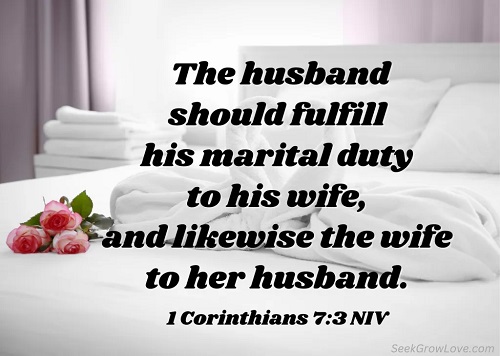
Image shows some roses and white towels on a bed, with the text "The husband should fulfill his marital duty to his wife, and likewise the wife to her husband. 1 Corinthians 7:3 NIV". This is a very cringey verse to put on a pretty background, like an inspirational meme, but I found LOTS of people on Google image search who have done just that. Uh, okay. Image source.

Links to all posts in this series can be found here: Blog series on "The Great Sex Rescue"

---

So, now we're in the second part of chapter 3 of The Great Sex Rescue: The Lies You've Been Taught and How to Recover What God Intended [affiliate link] (p 50-60).

This section starts out talking about 1 Corinthians 7, which has that line about "The husband should fulfill his marital duty to his wife, and likewise the wife to her husband." ("Marital duty" means sex.) Some bible translations say the husband and wife should not "deprive" each other, so that's why this section of the book uses the term "deprive."

Anyway, the point is, the bible says the husband should not deprive the wife, and the wife should not deprive the husband. It's equal. It's symmetric. But you wouldn't know it from popular evangelical teachings on marriage, which always talk about how the wife needs to have sex even when she doesn't want to, otherwise she's "depriving" him, which would be just terrible- and then nothing is mentioned about the husband's responsibility toward the wife's sexual needs. (Typically, those kinds of evangelical marriage resources will say the husband has to care for the wife's emotional needs, or something along those lines.)

Gregoire and her co-authors are making the point here that if a married woman is having sex regularly but not having orgasms, then she is the one being "deprived." Interpreting this 1 Corinthians 7 passage to say it's not just about making sure your spouse gets *sex* but it's about *sex that feels good for them* and/or *orgasms*.

This is HUGE. This is GROUNDBREAKING. I'm, seriously, this is blowing my mind.

See, the way I always heard this passage interpreted was, yeah, it says the husband owes the wife sex, and the wife owes the husband sex, but actually in practical terms, women don't really want sex, so in real life you're not really going to have a situation where the "husband owes the wife sex" aspect would be important. In practical terms, we only really care about the part where the wife owes the husband sex.

But, wow, viewing it as "each spouse has a responsibility to give the other spouse sex that feels good" instead of just "sex", that is a GAME CHANGER. Like, !!! I cannot even begin to describe how much of a big deal this is.

But, wait, let me stop for a second to add this: So, I'm writing this blog series specifically from an ace perspective, so I do have to point out the idea that you're required to have sex with your spouse... is not really great for aces. I'm not sure that making it symmetric really helps. In my case, I am a sex-favorable ace, so I do want to have sex, but for aces who are sex-indifferent or sex-repulsed, this would play out differently.

Anyway. So the point of this section is, suppose you have a husband and wife, and they've been married for years and the wife has never had an orgasm, but she makes sure to have sex with her husband a few times a week, so he won't be "deprived", and he has an orgasm every time- in this situation, there is so much concern over whether or not the husband is "deprived", but actually, IT'S THE WIFE WHO IS "DEPRIVED."

!!!!!

YES!

Because it's not just about *sex*; it's about *sex that feels good*. Which is a COMPLETELY DIFFERENT THING.

Here's an idea I've been thinking about: Sex is not just one thing... it doesn't exactly make sense to say you "like sex." It depends hugely on the extent to which your partner cares about listening to you and making it a good experience for you.

Some examples:

Example 1: There's a short film called "Ace and Anxious" (video is here, via this blog post), where an asexual woman does some research about the health benefits of sex, and decides that she should try sex to help with her anxiety issues. She posts an ad on Craigslist and starts interviewing men who respond to it. Now, here's my main issue with this: The sex that one might have with strange men who respond to a Craigslist ad is very much NOT... like... how to say this... it's not the ideal of what sex is supposed to be. When she read medical papers about the health benefits of sex, that doesn't mean all sex is good for you- it would only apply to sex that is consensual, enjoyable, feels good, you know what you're getting into, etc.

I have my doubts about whether random men from Craigslist would come into this with the expectation that their priority is to make it a good experience for her.

Example 2: Let's say there's a female sex worker and a male customer. People describe this situation as the man "paying for sex" but I think there's something a bit off about that. He's not paying for "sex" in the general sense of what sex is, he's paying for the experience of having someone have sex with him in a way that makes it all about him, and he doesn't have any responsibility to care about if it feels good for her.

(And honestly, this is basically the view of sex I internalized from Christian marriage advice. Like, a wife doesn't really like sex, but she does it for transactional reasons- she gets a lot of benefits from the marriage, and the sex is the price she pays for those benefits.)

Example 3: Two people choose to have sex with each other, and their main motivation is that they really like to have sex. In this situation, of course they will each have the expectation that it's going to feel good for them, and that they need to make sure it feels good for their partner. They are equals, and there aren't any external "transactional" aspects of it, therefore they know that the sex itself is meant to be a good experience for them and for their partner.

Example 4: It occurs to me that, in an earlier section of "The Great Sex Rescue", when it mentioned the problem of husbands having a mindset that's influenced by porn, maybe this is what it's talking about. I think (?) in porn videos, sex is portrayed like every single part of it is enjoyable- if the viewer doesn't enjoy watching it, they can skip that part, or change to a different video. It doesn't really give a realistic sense of "you need to care about what your partner wants, and sometimes it's going to be something that feels boring or inconvenient for you." So then you have men who think their wife is asking for something completely unreasonable and abnormal when she wants him to do things that feel good for her, if they're things he's not really interested in himself. He expects that sex is just going to be what he wants, and she will also automatically love all those same things.

(Hmm, I've heard A LOT of evangelical warnings about how porn is the worst thing ever... I thought it was because having knowledge of a wide range of extreme ways to have sex/ BDSM/ etc might make your own partner seem "boring"... or something about being able to see what naked people look like, and then comparing your partner to them... Okay but this explanation, about how porn doesn't give a realistic depiction of the extent to which you should listen to what your partner wants, this explanation makes the most sense to me.)

So, there are my 4 examples. My point is, there could be huge variations in people's thinking about the extent to which sex is about their own pleasure, and the extent to which it's about making it a good experience for their partner- and those will yield COMPLETELY different results. So the idea of "sex" as a concept that one can make generalizations about doesn't really make sense, because the experience is so dependent on one's partner's attitude. Perhaps if someone "likes sex" we should take that to mean "I am able to get pleasure from it even if my partner only puts a little bit of effort into making it feel good for me", or perhaps it means "I'm very good about setting boundaries about only having sex with people who make my pleasure a priority" (and they are able to attract enough potential partners that even after this screening process, they still have plenty of opportunities to have sex).

(Or, wait, lol, something else just occurred to me- usually when people say they "like sex" that means they have a high sex drive. I feel very ace right now.) 

(Another thing I wonder about is, how many people do you have to have sex with to get enough data to make generalizations about how you feel about "sex" as an abstract concept? If you've only had sex with 1 person, I don't think you really know anything about how you feel about "sex" in general, you only know how you feel about "sex with this specific person." Please note that I have no interest in gathering such data for myself, so I will just never know how I feel about "sex as an abstract concept.")

This is all speculation... I don't know if this really makes sense to anyone else- maybe I'm missing something important. I just want to write it here because I haven't seen people talking about sex in this way, but this is how I think about it.

And, honestly, straight women have it the worst in terms of how likely we are to have a partner who believes there's some "default" way to have sex, and doesn't believe he needs to care about whether that works for her, surely it will work for her because that's what sex *is*, and then this "default" way doesn't work for her and she doesn't even realize she could demand better. I worry about the straights.

So. The point is. 1 Corinthians 7. It's not just about giving your partner "sex", it's about giving them sex *that feels good for them*. And that is a HUGE difference.

(Full disclosure: "The Great Sex Rescue" is targeting an evangelical audience that takes bible verses very seriously, with the mindset that if we read something in the bible, and we interpret it as the author and/or God intended, it's true and we should live our lives in accordance with it. I do not believe that. I do not believe the bible is inerrant. So I love this book's interpretation of 1 Corinthians 7, but at the end of the day, 1 Corinthians 7 does not have any power over my life. See: It Doesn’t Actually Matter What Jesus Said About Divorce and "The Author of Leviticus Would Have Been Cool With It".)

The next section of "The Great Sex Rescue" is about how a lot of Christian marriage books say that women's sexual pleasure is important, but they actually mean it's important that the husband thinks the wife is having a good time, so the husband feels like he is good at sex. (Specifically, the books "For Women Only" and "The Act of Marriage" are mentioned here.) In other words, these Christian marriage books- which "The Great Sex Rescue" is criticizing- say that not only is a wife required to regularly have sex with her husband, she is also required to pretend she loves it. Otherwise it would destroy her husband's manly self-confidence, or something.

Yeah, even when conservative Christians talk about women enjoying sex, they still need to make it all about men.

Gregoire and her co-authors say this:

We find it problematic to tell a woman she must enjoy something without also telling her that she can expect him to make it enjoyable.

Dayyyyyyaaammm. Good point.

This kind of teaching would make a woman very hesitant to speak up during sex if she doesn't like something, or if something is painful. Yes, I've been there. Like, trying to come up with the most polite way to say "I don't like that" because I've internalized the idea that if a man feels "rejected", that would be the WORST THING EVER. Ughhh, let me tell you, it just doesn't work. The only way to figure out how to have sex that feels good for both of you is HONEST COMMUNICATION. But sex advice from conservative Christians says wives shouldn't be honest if they're unhappy about something during sex, because men are so fragile and can't handle it, or whatever. (See: If A Wife Is Required To Have Sex, That's Not "Intimacy".)

Then Gregoire and her co-authors give us these useful guidelines:

Rules about Speaking Up during Intercourse

How to speak up:

  1. If it hurts, say something-- even if you're just "a little uncomfortable." You deserve pain-free sex.
  2. If something is keeping you from getting aroused (more on how to "get there" in the next chapter), say, "Let's stop for a moment and try something else."
  3. Want more of something-- or less of something? Tell your spouse when something is feeling good (even if it's just by moaning). If something isn't feeling good, take your spouse's hand and put it where you'd like it to be.
  4. Don't fake it-- orgasm, arousal, anything.

How to help your spouse speak up:

  1. When you're not sure if your spouse is ready for penetrative sex yet, ask!
  2. If you sense your spouse is not enjoying things, stop and go back to kissing and touching for a while.
  3. Watch your spouse's cues. If it's obviously not enjoyable, be the one to pull back and say, "Let's take a rain check." Show your spouse sex can stop without you getting angry.

When I read this, I'm like YES! This is so good! Christians should all be talking about these rules, instead of telling women "yeah sometimes sex hurts, but it doesn't take very long, so just do it- men really need it." [This is not a quote from anywhere, this is my paraphrase- but yes, that's what they say.]

But on the other hand, I read these guidelines from Gregoire et al, and I'm like, THE BAR IS ON THE FLOOR. If something hurts, of course you should say "stop." Isn't that obvious? Why do we even need to tell people this?

But unfortunately, yes, Christian women do need books that tell us "You deserve pain-free sex" because we have been told the EXACT OPPOSITE, many many times. The first time I ever believed that I had the right to COMPLETELY REFUSE to have painful sex was when I was pregnant, because the information I read about pregnancy said that if sex is painful, that could be a sign that something is wrong and could harm the baby. That was the first time I ever felt I had a "good enough reason" to draw the line there and absolutely refuse to have painful sex. Before this, I tried to get out of having painful sex, but I was always weighing my feelings against this idea that "men need it" and trying to find what level of pain I could tolerate that could satisfy his "needs." I hate how badly I've internalized that. 

In my experience, I've found that secular sex-ed resources are pretty good about emphasizing the importance of honest communication during sex, to give each other feedback on what works and what doesn't. I've read many secular sex-ed resources that emphasize how each person's body works differently, so there's not really any specific sexual technique that will always "work"- the only way to figure it out is to listen to your partner when they tell you what works for them.

Also that bit about "Show your spouse sex can stop without you getting angry", the bar is IN HELL, you guys. But, YES, it definitely is necessary for Gregoire to say this, because in conservative Christian culture, if a wife withdraws consent, she is "depriving" her husband, and of course you can understand that a good godly Christian man would be angry about that, right?

In my experience reading secular sex-ed materials, however, they are good about emphasizing that consent can be withdrawn at any time, and if somebody gets mad about that and acts like you owe them sex, that is a forest of red flags.

Later in this section, Gregoire and her co-authors say this:

And that pain matters. Having someone derive pleasure from something that causes you pain compounds the hurt.

This is huge. This is so important. This is completely the opposite of what I was taught that marriage is supposed to be.

I always heard Christians talk about how marriage is hard. Marriage is about self-sacrifice. Marriage is about giving up what you want, because you have to consider your spouse first. Marriage isn't about making us happy, it's about making us holy. Kids these days don't want to get married because they're selfish and don't want to give up their self-centered lifestyle. Marriage is about dying to self. Sacrificial love. It's hard but it's so worth it.

The example that comes to mind is that wives are required to endure pain during sex, to satisfy their husband's "needs." I was taught that this follows the basic characteristic of what marriage is- it's normal to suffer in order to please your spouse, that's just what marriage is. You're willing to go through pain because you love your husband.

I remember I heard one Christian speaker give another example once- she said that sometimes in the middle of the night, if she wants to drink water, she asks her husband to get out of bed and go get her some water. And, she said, he has to do it, because the bible says husbands have to love their wives as Christ loved the church and sacrificed his life for her. (LOL, if I tried that on my husband, he would say "go get it yourself." Unless there was like, a real reason that I couldn't get up and get it, like if I was sick, pregnant, etc.)

Captain Cassidy has also written a lot about the Christian expectation that you should "die to self" in marriage. And about how, when she was with her ex-husband, he seemed to have an attitude like "last time I went somewhere with you that I didn't want to go, so now this time you have to go to church with me even though you don't want to." (I can't find the specific post of hers that talked about that- if anyone has the link, please share in the comments.)

Basically, the idea that marriage is about forcing your spouse to do things they don't want. And being forced to do things you don't want, for their sake. There's totally a cultural phenomenon where Christian girls, age 21ish, married for less than a year, make posts on social media to say "marriage is so HARD and sometimes I hate my husband because he is so annoying, but God has been teaching me so much about how to love my husband, I'm so lucky to be his wife, marriage is hard but it's SO WORTH IT" just dropping red flags EVERYWHERE, but they think this is normal. Like this is what marriage is.

When I was in college, our campus Christian group brought in a married couple to talk to us about marriage- the wife talked to the girls, and the husband talked to the boys- and she just kept saying the important thing in marriage was "dying to self" which meant "you have to have sex even if you don't want to." And I thought that was totally normal, back then. You do it because you love your husband so much, so the pain is worth it if it makes him happy. Now, years later, the more I think about it, the more disturbing it is. This was the role model couple that came to teach us. Teaching us that marriage is about doing things that make you unhappy. Forcing yourself to have sex that you don't want.

I remember about a year or so after Hendrix and I got married, I was thinking about how surprised I was that our marriage is so fun and I still love him. Like, every day, I get to live with him, I get to see his cute face, and it's just wonderful. It was totally unexpected that I would feel this good, when Christians always told me "marriage is hard."

So no, I don't believe "marriage is hard." I think life can be hard, and the thing about marriage is that when your spouse is going through a hard time, their problems become your problems. But the marriage should be a source of safety and support to help you get through life's problems. It shouldn't be that the marriage itself is the source of the problems.

It's harmful to teach kids that "marriage is hard" because then if they get into a bad marriage, they won't realize that it shouldn't be that way. 

(See: "Marriage Is Hard" and What My Marriage Is Actually About (It's Not Sex And It's Not Jesus))

And... even now, as I'm thinking about this, it feels a little surprising to me as I consider the idea, "Wait, so, in a healthy marriage, would there ever be any times that you're forced to do something you hate, for your spouse's pleasure? ... No? I can't think of any?" It's shocking to me to actually ask this question and realize the answer should be "NO", because that was such an essential part of what I was taught marriage is. That's the definition of marriage, I thought. That's what it means. Being forced to do things you don't want. Having someone derive pleasure from your pain. Being willing to do that because you love them so much.

(Like I said, I worry about the straights...)

Yes, in marriage, there will be some times that your spouse gets sick and throws up, and you have to clean it up, for example, and obviously nobody likes doing that, but that's a very practical thing, and like, a very normal way of showing compassion, to take care of someone who's sick, which could apply in a lot of relationships, not just marriage. I'm not talking about that- I'm talking about when Spouse A wants to do something that Spouse B hates, and Spouse B believes they need to force themself to do it, because that's what marriage is about.

No. Eww, no. WTF?

The last thing I want to talk about in this chapter of "The Great Sex Rescue" is the section about how society cares about men's sexual medical issues more than women's. First, there's this about medical papers in a secular context:

While PubMed (the National Institutes of Health online database for scientific journal articles) has 41,473 articles for the keywords "erectile dysfunction," it only has 4,809 for "dyspareunia" (aka painful sex). Similarly, there were 1,796 studies on "premature ejaculation" but only 401 for "vaginismus." 

And then this, about the conservative Christian world:

It's long been known in medical circles that conservative religious women experience more pain with sex than the general population. Yet if scholars are doing poorly on this topic, the church is doing worse. Both The Gospel Coalition and Focus on the Family have online articles on erectile dysfunction while failing to provide any information on vaginismus, sexual pain, or post-partum pain.

Well... I mean... I have heard lots of Christians talking about women's sexual pain- talking about it like it's normal, and wives need to continue to have sex with their husbands anyway, and that's just the way it is. I don't think I've ever heard it talked about like it's a medical issue, or that you can DO SOMETHING ABOUT IT so that you don't have to have painful sex any more.

Then there's this:

Intended for Pleasure acknowledges the problem [vaginismus] but then totally bungs things up with this claim: "Vaginismus can usually be eliminated in about one week with the following procedure." The book then describes the use of dilators.

LOLOLOLOLOL.

LOLOLOLOLOLOLOLOLOLOLOL.

LOLOLOLOLOLOLOL. ONE WEEK! WAS THIS WRITTEN BY A MAN?

I (Sheila) had severe vaginismus, and I tried that. Did it by the book; got the T-shirt. Recovery still took years. And that's not unusual, because research shows that vaginismus can be very resistant to treatment.

I also had vaginismus, and that's one of the reasons I was interested in "The Great Sex Rescue"- because it talks about vaginismus, and how women with this kind of conservative Christian background are more at risk for vaginismus. I think the next chapter of the book talks about this more.

I can't speak to the use of dilators as treatment for vaginismus, because I was never actually diagnosed, never had any doctors do anything helpful, even when I told them "sex is painful"- and actually, I'm glad I had to figure it out myself, instead of viewing doctors as the authority to tell me how my own body is supposed to work, and what I need to do to change my body to be good enough for a man. I'm glad I found out about asexuality, instead of that.

Anyway, the point is, these are real medical conditions, and conservative Christian teaching about sex doesn't do anything to actually help, but instead tells women they just need to have sex anyway, because men need it.

But, here's something that ace readers will want to note, in the section about medical issues related to sexual dysfunction: There is a list of such issues, here in this chapter, and one of the ones listed is:

Hypoactive sexual desire disorder: A clinically low libido.

I point this out because a lot of aces argue that viewing HSDD as a medical problem that needs to be solved is basically saying that there's something wrong with being asexual, and that asexuals need to get treatment and stop being asexual. (Similar to "reparative therapy" for homosexuality.) We don't like this. (See these blog posts from other aces: Journal Club: Why is absent/low sexual desire a mental disorder? and Drug Watch: New Addyi Marketing Campaign, “Find My Spark” and a brief primer on hsdd & flibanserin)

Later chapters of this book talk more about HSDD. I'll be interested to see what they say, and whether aces fit into it. 

Okay, so to sum up this section of "The Great Sex Rescue": If wives are required to have sex that doesn't feel good, then wives are the ones being "deprived." My mind is blown by this, seriously. Also, it's messed-up to require wives to act like they are enjoying sex, without requiring husbands to actually do anything to make sex enjoyable. Not cool! Instead of faking it, in order to protect your husband's fragile manly confidence, you should speak up if you don't like something. Communicate! And if you're in pain, definitely speak up! It's really NOT OKAY that conservative Christians say wives are required to have sex even if it's painful. Pain is a sign that something is very wrong, and you shouldn't tolerate that.

So, overall, wow, yes, I'll say I agree with what Gregoire and her co-authors are saying in this section of the book. They make some extremely good points here. And they make some points which are like, bare-minimum-of-human-decency level, but yes, unfortunately those things need to be said too, because conservative teaching on sex and marriage really is that bad.

---

Links to all posts in this series can be found here: Blog series on "The Great Sex Rescue"

Related:

If A Wife Is Required To Have Sex, That's Not "Intimacy"

6 Ways Purity Culture Did NOT Teach Me About Consent 

"Marriage Is Hard" 

Vaginismus Is Not A Problem, In And Of Itself

Tuesday, July 11, 2023

Blogaround

1. Trip.com Offers Employees 50,000 Yuan Subsidy for Each Child Born (June 30) "China is grappling with a significant decline in its birth rate and the subsequent challenges posed by an aging population."

2. Don't use AI detectors for anything important (June 30) "All these AI versions are rated as more likely human-written than my original unaltered text."

3. Amos and Acts (June 30) "The fascinating thing about the passage Brueggemann highlights here is that the book of Amos was written a very long time before the book of Exodus was. Amos 9:7 presents one side in an argument about the meaning of the Exodus, showing us that both sides of this argument existed centuries before the book of Exodus itself was written. Amos is one of the oldest books in the Bible — possibly the oldest — so the tension between the two sides of this argument date back to the very beginning."

4. The Supreme Court Has Killed Affirmative Action. Mediocre Whites Can Rest Easier. (June 29) "Obviously, my parents were horrified. Obviously, they pulled me out of that school the next year and put me into a predominately Black public school. Obviously, I learned that not everything white people say is true. But Thomas is the guy who never learned: He never figured out how to disregard what white people say about us. Learning how to ignore white folks and their stupid racial theories while living your full life is pretty much the final test towards emancipation, and it’s one that Thomas seems to have flunked for his entire professional life."

5. Death of Coco Lee Triggers Public Discussion on Depression in China (July 7) [content note: suicide]

6. Rating Articles About Twitter Alternatives (July 8) "Rating: written for the kind of person who'd be shocked to learn about the concept of a fursona"

7. The universe is humming with gravitational waves. Here's why scientists are so excited about the discovery (July 3, via) Cool!

8. Let's Talk Emotional Labour of Birth Control (July 10) Wow, is this really a thing, a man claiming that he doesn't want to wear a condom, so he expects his partner to take birth control pills which cause a lot of problems for her? I guess this makes me glad I'm asexual- I do have sex, but if I had to take birth control pills in order to do it, I would NOT, it is NOT worth that trouble. (Though I'm guessing a lot of this is women being coerced by societal expectations- it's not about women feeling like "I really really want to have vaginal sex, I want it so much that it's worth taking birth control pills that change my body.")

Monday, July 10, 2023

An Ex-Evangelical Mom Review of "When God Made The World"

Book cover for "When God Made The World."

I bought the book When God Made The World [affiliate link] for my son, because I'm a Christian and I want him to learn about some Christian things. The difficult thing, though, is I'm ex-evangelical, and a lot of Christian children's books have harmful evangelical ideology. You know, stuff like "you deserve to go to hell." If you wanna say that to my son, you have to fight me first. (I've written about this issue before: Not Sure I Want My Kid Reading the Bible and 2 Wrong Ways to Write Bible Stories For Kids)

So, the question of how to find acceptable Christian children's books is an important issue to me. (Also, I'm in China, and while there are plenty of English books for kids available on Chinese shopping apps like Taobao and Jingdong, they don't always have the specific book I'm looking for, and often there is very limited information about the actual content of the book.)

I'm not trying to find books that 100% agree with what I believe. I'm not like, checking every sentence in every kids' book to see if they're "right." That would be totally the wrong approach. Kids should be aware that different people have different beliefs. (One of the reasons I'm glad my husband is not a Christian! Our son will see that it's fine for people to believe different things, without me even needing to tell him.) I just want to find books that don't have extremely harmful teaching, the sort of extremely harmful teaching which is so normal within evangelical culture that they don't even notice how messed-up it is.

Anyway, I'm featuring this one here on my blog because I like it. Yes, in my ex-evangelical queer Christian feminist opinion, this is a good book for kids.

Overall summary

It's about all the beautiful things we see in the world, and it says that God made them. The book has a lot of detail- listing things like:

God made comets that fly
with tails through the sky
and asteroids and meteors that sometimes zoom by.

and

God made tropics and plateaus,
glaciers and meadows,
marshes and tundras,
and erupting volcanos.

and 

Swordfish and trout, 
fish sleek and fish stout,
and whales that God made to breathe through a spout.

Lots of details describing the things found in nature- from stars, to geographic features, to plants, to animals, to people. Overall, it's really beautiful imagery about how amazing the natural world is.

And, the book encourages kids to enjoy nature:

Run barefoot through grass,
pick a flower or two or a bouquet, perhaps.

Find a tree you can climb, or with a seat and some twine,
build your very own swing or a backyard zip line.

It also tells kids to use their unique talents that God gave them to make the world better, and to protect the environment:

Save a whale, hug a tree, protect every bee.
Recycle, repurpose, reject apathy.

So overall, yes, I recommend it. It's a nice story about God and about the mind-blowing beauty of nature.

My son is preschool age. On Amazon, it says this book is for children 3-7 years old, and that sounds right to me.

Other books in this series are: What is God Like?, When God Made You, When God Made Light, and When I Pray For You [affiliate links].

---

Okay, the rest of this post is little minutiae that I'm pointing out because it may be relevant to people who are ex-evangelical like me, and are EXTREMELY AWARE of all the evangelical culture wars. I would not mention any of these things to my son while reading the book, because they are very much NOT what the book is about.

Basically, if you just want to give your kid a nice book about God, go ahead and give them this one. You can stop reading the review here. The rest of this post is just little details that may be important to someone who has, um, ex-evangelical PTSD.

Author

The book is written by Matthew Paul Turner. I remember I used to read Matthew Paul Turner's blog way back in the day, when I started blogging. It seems that he has since moved his blogging to substack, and has come out as gay. Good for him!

Inside the front cover, it says, "In memory of Rachel Held Evans. The world is better because of your love, life, and words." There are actually several books in this series, and at least one is co-authored by Turner and Rachel Held Evans. If you know Rachel Held Evans, that should give you an idea of what kind of Christianity this book is about. (Evans died in 2019. She had a huge influence on me, and really on the whole ex-evangelical movement.)

In other words, knowing this book is associated with her, it indicates to me that this is likely to present a Christian view that I can accept.

Days of creation

In the bible, the creation story in Genesis 1 says that God made the world in 6 days, with different themes on each day.

This book does not mention the days of creation at all, but it loosely follows them. (Loosely. Genesis 1 has light made on day 1, and the sun, moon, and stars made on day 4, and I'm not really sure how that works- so this book does not follow that part.) Mainly the thing that sticks out and made me realize that it follows the days of creation is the fact that, when it gets to the part about God creating animals, it has 2 pages exclusively about birds, and then 4 pages about fish and other water creatures, then 2 pages mentioning animals that sorta live between water and land (like frogs), then 4 pages on land animals. 

Genesis 1 says God made birds and water animals on day 5, and land animals and people on day 6. The fact that "When God Made The World" divides the animals up like this, feels very "Genesis 1" to me. (This is also an interesting choice because in reality, reptiles evolved before birds.)

Which is fine, I'm not saying this is a bad thing. But I used to be a young-earth creationist, and I think this is information that former creationists would want to know before buying this book.

Detailed scientifically-accurate descriptions vs the creation-myth feel of the book

This book lists lots and lots of natural phenomena that the writer of Genesis 1 knew nothing about. For example: galaxies, planets, north and south pole, glaciers, geysers, grapefruits, limes, eels, flying fish, otters, kangaroos, giraffes, rhinos, and so on. It even says God made the earth and "designed it to orbit the sun once a year."

So... is this book basically Genesis 1? Or is it a modern-science-based description of cool things that exist in nature? Does it feel a bit weird to take a creation myth as the overall structure and tone of the book (I say the "tone" is like a creation myth because it just says God made this, God made that, but gives no details about *how* God made things), and then fill it in with things that we know about now but people in the ancient Near East would not have known about?

If you're trying to figure out how "literally" you're supposed to take this story, this makes it difficult.

Personally, I don't think this is a problem at all. Personally, I think it's pretty cool that they took a "creation myth" sort of style, and then put in a lot of really interesting details (that we only know about thanks to modern science). I like that.

But I'm just mentioning it here because I can understand if someone used to be a creationist, they may be very very sensitive about what's intended to be taken "literally" and what's not. 

Little kids definitely don't care about that- kids' books are full of talking cars and such, and the kid doesn't actually believe cars can talk. So I don't think this is an issue.

God's pronouns

This book does not use any pronouns for God. Hooray! I love that!

It just says "God" over and over. For example, there's one line that says, "give thanks to God for all that God made." No pronoun for God. I love it!!!! God is not a man!

Diverse kids

The illustrations in the book show a group of kids experiencing the wonders of nature on almost every page. It's basically the same group of kids all throughout the book. And it's a diverse group- I love that. Different races, and one kid is in a wheelchair.

Image from "When God Made The World", showing a diverse bunch of kids.

Interestingly, though, in the part of the book about how God made people, it describes the range of human diversity like this:

Each of our faces, bodies, and traits,
our skin tones, our features-- God did create.

God made some people shy and some people loud
and some who thrive in the midst of a crowd.

Some make music, and some like math,
and some are prone to blaze their own path.

So it's mostly about different personality types, rather than "identity politics" sorts of things. ("Skin tones" are mentioned 1 time. It doesn't even mention gender- even though Genesis 1 in the bible mentions humans were created "male and female.") Personally I think that's good- the pictures show a racially diverse group of kids, a mix of boys and girls, one is in a wheelchair, but the text doesn't call attention to that sort of diversity. Like it's just normal and doesn't need to be remarked on. The actual text of the book is about personality types, which is probably more practical and useful for little kids learning to interact with people.

"Evolve"

So, there are a few lines of the book that may or may not be interpreted as taking a position on the creationism/ intelligent design/ evolution debate:

[bold emphasis added by me]

all kinds of trees with leaves God designed

and

So God filled the sky, perhaps over time,
with birds and more birds, and most learned how to fly.

and

Yes, all living creatures from whales to snails,
from those covered with feathers to those covered with scales,
each God designed with a home in mind,
to develop and evolve if needed over time.

Luckily for me, I'm far enough removed from the creation/evolution debate that I don't really care about what position this cute children's book is taking. It's just a cute story. Let's not overanalyze it to figure out if this book is telling us the earth is 6000 years old or whatever.

But also, I do recognize that the author put the word "evolve" in there, which is very likely to get this book banned from evangelical-land. Good for him! That feels very bold to me, as an ex-evangelical. (This is the kind of thing that evangelicals would make a big huge deal about, even though the kids in the target audience won't notice or care.)

God made you for a purpose?

But always remember, 'cause this much is true,
God had a purpose for making you YOU.

I do not believe that, myself. But, it's fine, I don't need every book I read to my son to agree with me 100%. That would be ridiculous. It's good to let him learn about different ideas. I just draw a line at harmful ideas like "Jesus died because of you" etc.

Seeing god in people and nature

In the last few pages of the book, it says "With nature, God gives us a glimpse of divine" and "how we live, how we love, tells God's story too." I LOVE that. That is one of the key things I believe in now. God is alive, everywhere, in the world, in nature, and in human beings.

---

In summary: I'm really glad I bought this book for my son. It's positive, it's about God, and it doesn't have any problematic evangelical ideology. (Though everyone's definition of "problematic evangelical ideology" will be different- that's why I went into details in this post.)

---

Related:

Not Sure I Want My Kid Reading the Bible 

If God Metaphorically Made the World in 6 Days, What Does That Even Mean?

2 Wrong Ways to Write Bible Stories For Kids

Taking My Kid To Church: God Loves My Son

AddThis

ShareThis