Tuesday, December 13, 2022

Blogaround

1. Millions on brink of starvation under Taliban rule (December 2)

2. Why are Lyft and Uber letting Christian drivers preach at passengers? (December 3) This is really interesting to me because I used to be on the other side of it, so to say. I was really into evangelism and always looking for opportunities to manipulate people into having conversations about "the gospel." (Yeah, not cool.) It's interesting to me that the things I was worried about when doing evangelism (I won't be able to convince this person to change religions, this will damage our friendship) are different than the concerns in this post (religious harassment, feeling uncomfortable in the conversation but with no way to end it without risking the evangelist getting angry at you).

But yes, if someone (probably most people!) is uncomfortable talking about religion with a random stranger, their right to not talk about religion with a random stranger should be protected.

3. Not Only is the Right Unapologetic For Violent Anti-LGBTQ+ Rhetoric-- It's Doubling Down (November 28) "The functional lack of concern over the mass shooting—that his son murdered five people—and the relief that his son isn’t gay is the attitude that begets this kind of violence. This is dehumanization: killing gay people is not a cause for concern, being gay is."

4. Perspective (December 6) "Luther was neither a New Testament scholar nor a historian. He was an Augustinian monk dealing with a European church that was calcified and, in many ways, corrupt. And thus Luther read Paul as though Paul were also an Augustinian monk struggling against corrupt medieval Catholic bishops."

5. A paper used capital T’s instead of error bars. But wait, there’s more! (December 5) 

6. Without giving details, disgraced pastor Matt Chandler returns to pulpit (December 6) This whole thing is so confusing. Matt Chandler apparently sent "inappropriate" instagram DMs to a woman, but they weren't "sexual or romantic", but that was bad apparently and he had to step down. And now, 3 months later, he's back, and his church is so happy. Like............... what? 

I like Mehta's take here:

If this was innocent banter that crossed a line, then it’s a matter that could’ve been handled privately. There was no need for public shaming or temporary banishment.

If it was something more serious—and it clearly seemed to be—then the church had an obligation to tell the congregation what the hell he did. Why are these people so damn secretive about everything? When has that approach ever worked for them?!

Also I stand by what I said back in September:

A. Maybe this church just really really really believes "men and women can never be friends" (which is a logical conclusion of evangelicals' teaching about sex and lust and temptation and the differences between genders) so any time a man and woman are sending friendly direct messages online, it's automatically seen as sinful. I don't think this is the right explanation though, because it doesn't seem realistic to me that a church would literally hold a leader to such a high standard, going so far as to hire a law firm, over something that everyone outside the church sees as no big deal. So there has to be more to it than this.

B. Maybe Chandler is telling us it wasn't "sexual or romantic", but that's a lie. Maybe in a few months we're going to hear a very very different version of this story, which this church is currently covering up.

C. Maybe there is some other very big issue here, something that's not sexual or romantic, but is still very bad (possibly abusive or illegal?). Chandler says the sin was that he was too "familiar" and there was "coarse and foolish joking" but perhaps that's a very misleading and inaccurate description of the actual situation. Perhaps there is some huge other problem that is not being mentioned.

So in other words, I'm not buying it. 

Links 7, 8, and 9 are all from the same blog- I just discovered this blog and read a lot of posts:

7.  If Professional Investors Missed This... (November 16) "Normally a crypto exchange going bust isn't something I'd pay that much attention to, aside from sympathy for its customers, but its Future Fund was one of the largest funders in effective altruism (EA)."

8. Bets, Bonds, and Kindergarteners (2021) "I wanted to go to a park, but Lily (6y) didn't want to go to that park because the last time we had been there there'd been lots of bees. I remembered that had been a summer with unusually many bees, and it no longer being that summer or, in fact, summer at all, I was not worried. Since I was so confident, I offered my $1 to her $0.10 that we would not run into bees at the park. This seemed fair to her, and when there were no bees she was happy to pay up."

9. Counterfactual Trust (2014) This is really interesting as it related to organizations that "match" donations to charity. I guess it can be explained like this: If an organization says "any amount of donations to charity X up to $Y we will match" then the "trust" aspect is you believe that they really will donate- for example if you donate $10 then the organization will also donate $10 to the charity. But the "counterfactual trust" aspect is that you believe that if you do not donate, then the organization will not donate. But! Often the way this works in reality is if the donations don't reach the whole amount ($Y in this case), the organization donates $Y anyway- which people may find deceptive.

Sunday, December 11, 2022

Zero-Covid is Over

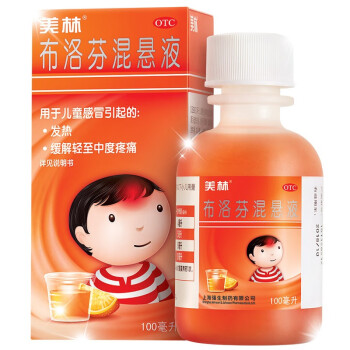
Children's Motrin (美林 in Chinese). This is one of the medicines that everyone is panic-buying now. Image source.

Complete list is here: Index of Posts About the March 2022 Shanghai Covid Outbreak 

---

HUGE news in China this week: There have been a TON of policy changes, which effectively mean we are not doing zero-covid at all any more. People with asymptomatic or mild covid cases can now quarantine at home. No more checking if you have a negative covid test every time you want to enter a public place. No more locking down entire communities. The government is telling people to try to take care of themselves at home if they get covid, to avoid overwhelming the medical system.

Wowwww this is big! This is exciting! This is, in my opinion, a good thing, but also whoaaa now we have to think about how to avoid getting covid, for the first time.

All right- the policies have been changing so fast- so I think I'll link a bunch of articles from SHINE here, to serve as a timeline. (Remember, of course, that we hate SHINE, because of all the bullshit they published from the government during the Shanghai lockdown. Never forget. But I do share a lot of links from them when I talk about the situation regarding covid in China. SHINE tells you what the Chinese government wants you to believe- so in the case of "here is the new policy the Chinese government just announced", SHINE will report that accurately.)

[Note: "PCR" means "polymerase chain reaction" which is a type of covid test. We also call them "nucleic acid tests." 核酸 in Chinese.]

COVID-19 emergency phase closer to end despite Omicron transmission: WHO (December 3) This is an article about how omicron is not that bad compared to the original covid virus. Since we all know that SHINE is a propaganda rag that publishes only want the Chinese government wants you to think, it's a BIG DEAL that they're publishing this. This is a huge sign that things are changing.

Shanghai relaxes COVID-19 testing requirements for public transport, parks (December 4) "Citizens will no longer be required to show a negative polymerase chain reaction (PCR) test report from Monday morning to take Metro, buses, ferries and other in-city public transportation, Shanghai's COVID-19 prevention and control authority said on Sunday. Local parks, scenic spots and other outdoor public venues will also stop checking PCR test report at the entrances." So, for public transportation and parks, you no longer have to have a negative covid test, but you still have to scan the venue code and show that you have a green health code.

Shanghai scraps PCR checks at more public places (December 5) "From Tuesday, a negative polymerase chain reaction (PCR) test report will be only required at elderly care institutions, child welfare institutions, medical institutions, schools (including kindergartens), indoor entertainment venues (including KTV, poker and chess rooms, room escape and live action role-play games and Internet bars), catering services (including bars) as well as other places with special COVID prevention requirements." But people who have entered Shanghai within the past 5 days still can't go places. But also, here's another change: even if you haven't had a nucleic acid test for 7 days, your health code will not turn yellow- it will stay green. 

Should elderly people be vaccinated against COVID-19? (December 5) There are some fears around vaccines in Chinese culture- a lot of people seem to have the idea that only healthy people should get vaccines, because the vaccine itself has a little bit of "risk" so it's better if elderly people/ people with other medical conditions don't get the vaccine, just to be safe. The Chinese government keeps putting out more and more statements saying "okay, YES, old people should get vaccinated." Hope it works.

Beijing cancels COVID test requirements for public places (December 6)

Home quarantine allowed for asymptomatic, mild COVID cases (December 7) This is huge. This is the turning point right here. But note that there are still some rules- "if their apartments can meet quarantine requirements" and "Close contacts of infected persons are also allowed to quarantine at home for five days rather than spend a week in central quarantine as was previously required." (Or, it says you can choose to go to centralized quarantine if you're into that.) So it implies there's still some level of the government checking up on you to make sure you're doing your quarantine according to the rules. Who knows what this will actually look like in reality... honestly my guess is that you're basically on your own and no one will be enforcing this.

China approves 4 new COVID vaccines for emergency use (December 7) 

Medical experts take hammer to online trolls' COVID red herrings (December 7) LOLOLOLOL OMG YOU GUYS, this article is HILARIOUS. Unintentionally hilarious. My favorite part is "Meanwhile a small number of online trolls, either out of ignorance or for the sake of inflating clicks, are churning out sensational stuff dramatizing the agonies, or the so called after-effects of COVID-19 infections." I'm old enough to remember when SHINE was churning out sensational stuff about how bad covid is. It's quite a whiplash going from "we need to lock down entire cities for months" to "this is basically just the flu, don't worry everyone."

Shanghai relaxes COVID rules for travelers, close contacts (December 7) People arriving in Shanghai from other cities are no longer required to get covid-tested on arrival. Also, there is no longer a rule that you can't go places for 5 days after arriving in Shanghai. (One of my coworkers was like "oh I didn't even have time to sign up for the white list and they've already ended the policy"- she lives outside of Shanghai and commutes every day. The city of Shanghai was making a white list for commuters so they wouldn't be affected by the 5-day restriction- but now the whole thing is cancelled so never mind.)

What to do after being infected with COVID-19? (December 8) Another unintentionally hilarious article! Actually, everything in the article is good advice- the hilarious part is how they've spent 3 years telling us how bad covid is, and now suddenly "don't worry it's fine."

No PCR result checks for restaurants, indoor entertainment sites (December 8) This article lists the 10 new policy changes that were just announced. 

From central quarantine facilities to COVID hospitals with enhanced treatment (December 9) This article is about how the policies for the hospital system are changing to deal with the fact that there's going to be covid everywhere now.

China keeps optimizing control measures to effectively deal with epidemic uncertainties (December 9) Here's some propaganda about how China has done such a good job with everything related to the pandemic for the past 3 years.

Entertainment venues and tourist spots free of PCR and code checks (December 9)

So, wow, yeah.

In a lot of ways, it's like wow we totally don't have any rules any more! Whatever! But let me point out a few key areas where there are still rules:

Schools: Students and teachers are getting tested every day now. It's unclear to me what the plan is for schools- I assume it's something along the lines of "if a student tests positive, then their whole class (around 20-30 kids) has to stay home from school for 5 days." But... it seems like that would cause constant interruptions to the school year, right? Like, A LOT of people are going to be getting covid now, and I don't think it's realistic to think they'll be able to keep it out of the schools.

Also, kids don't wear masks at school. Are they going to start requiring kids to wear masks at school? Is that really realistic, to have little kids wear masks for the entire day?

The government is still involved in nucleic acid testing: So, if you test positive on a nucleic acid test, the government has that data. Is the government going to send someone to check and make sure you're doing your home quarantine? To make sure your apartment "meets quarantine requirements" (I assume this means you're not sharing a kitchen/bathroom with other families, like some old-style Shanghai apartments)? And make sure you get tested on the 6th and 7th days? Are there going to be sensors on people's doors (which was one of the common ways they did home quarantine before) or is it just like, you're on your own?

My opinion is, now that they're not doing zero-covid, checking up on people in home quarantine will be a very very low priority. Probably you're just on your own and no one is going to enforce these rules. Maybe the government will just send you a text message to tell you you tested positive, and that's it.

Are they really going to keep tracking close contacts, or not? If you do a self-test and you're positive, and you don't report it anywhere, that's fine, right?

A lot of uncertainty in how this is going to actually work. Probably it will take some time for things to shake out and adapt. No one really knows yet.

"High risk areas": So, the new policies still mention "high risk areas" (see here for example), saying that high risk areas have to be just a single floor of a building and can't be expanded to be like a whole apartment complex, high risk areas have to be released from lockdown if there are no new cases in 5 days, etc. So... so there are still going to be small lockdowns? There are still going to be "high risk areas"? That doesn't really make sense to me- soon so many people will be getting covid, how can the government possibly keep track of which specific places all these people live? And, why would the government spend time and resources on that anyway, now that we're not doing zero-covid?

Probably this is just an example of the policies changing very fast, and during this transition period there are some aspects of the policies which are not really logically consistent- but that will all get worked out after a few weeks.

International travelers: No changes have been announced related to people entering China. But rumor has it that soon there will be changes. Right now the policy is you have to do 8 days of quarantine when you enter China- obviously that doesn't make sense if zero-covid is over, though. Also, China hasn't been issuing tourist visas for a long time- but maybe that will change.

---

About not getting covid

So, we live in a completely different society now. Before, we lived in a zero-covid society, where you can basically do whatever, with your mask off, and the only thing to worry about is tedious rules about how often you have to get tested and whether or not you're allowed to travel to different cities. I mean, also lockdown was really bad... but my point is, we never really had to face the risk of actually getting covid. 

That has completely changed now. We live in a different world than we did 1 week ago. Now covid could be anywhere. It's coming. It will come in a huge wave. We're going to see a lot of our friends get infected- and hopefully it's not that bad, but... I mean, gosh, you definitely don't want to catch it during the first wave, when society hasn't really figured out how to handle it in those numbers yet.

So, because we live in this new world, there are some very big, glaring issues that need to change. Giant areas of risk. Currently, people wear masks when they're in public places with a bunch of strangers- like on the subway, at a mall, etc- but don't wear masks with people they know (friends, coworkers). And don't wear masks at restaurants. These are the masking habits we've developed over these 3 years, and they were good masking habits for a zero-covid society. But they have to change now- these habits are not adequate for a society where covid could be anywhere.

So, on Thursday and Friday, I wore a mask at the office. I think I was the only one wearing a mask. It's like, people don't recognize that we live in a different society now, a society where people can get covid at work. (My coworkers are Chinese, btw.)

Also, my husband and I decided not to eat at restaurants for now. Also, when I went out with friends (international people) yesterday, I wore a mask even though nobody else did. Also, we are concerned about Square Root not wearing a mask at school- that is the biggest vulnerability in our lives right now.

Yes, on WeChat tons of people are sharing lists of "here are the medicines you should buy and keep at home, for treating covid." I've seen articles shared about how to protect yourself from getting infected (masks, social distancing, obvious things like that). So, people who have a lot of anxiety and use social media a lot are definitely aware of the fact that we live in a different society now, and the task of protecting us from covid has fallen to us now- the government is not doing it any more. (And, arguably, we don't want the government doing it anyway.)

And, also here's an important point: There is a big difference in how international people and Chinese people are viewing this news. International people know tons of friends and family members outside of China who have had covid and were fine, and often have the attitude "China needs to stop all these lockdowns and just move on like the rest of the world." Whereas Chinese people only know what they've seen in the news about covid, but don't know anyone personally who has actually had it. In the international WeChat groups I'm in, everyone is happy and relieved- but my husband is in some Chinese groups where everyone is panicking.

But it seems that most people aren't ... really changing anything. Maybe they're buying a bunch of medicine just in case, but they're not taking a careful look at their mask-wearing habits and reevaluating them in light of the new society we now live in.

I barely ever wore a mask at work before, or when I went out with friends. Because there was basically 0 risk of getting covid. Now it's different, and I'm concerned that the general population hasn't really reckoned with that fact.

Like why isn't anyone talking about "flatten the curve"?

---

Reports of covid cases

I've seen some anecdotes on WeChat- about people who have covid with a really high fever but just have to stay at home because the hospitals are overwhelmed. And I saw a photo of a fever clinic in Beijing that was totally crowded. (Stuff like that hasn't happened in Shanghai yet- but it's a matter of time.) Now, seeing a few anecdotes on social media don't really tell you anything about the overall situation, obviously- but yeah, I think we'll see more of that in the near future. About how covid can still be bad, even though you're vaccinated and not going to die from it.

---

About single tubes

So, the way the mass testing works is this: You get your throat swabbed, and they put 10 people's swabs in 1 tube, because it's expected that all 10 people are covid-negative. Put them all in 1 tube to save resources. If you have a fever, or some kind of reason to think there's actually a chance you could have covid, then you can get a single tube for yourself.

If the tube tests positive, then they contact those 10 people and test them all individually.

So, how is this going to work now, now that there's actually a chance that people will have covid, and also now that healthy people will get tested much less frequently because it's mostly not required any more? Seems like soon they'll have to switch to giving everyone their own tube (or maybe 1 tube per household). And maybe also charging money for it? We'll see.

---

Comparison to 2020

In a lot of ways, I feel like we're at the point now in China where a lot of other countries were in early 2020. We know about covid; we know it's out there, and it's coming, but we haven't experienced it yet.

But the important thing is, we're vaccinated now. And this is omicron, which is less deadly than the original strain. And now we have a lot more knowledge about how to treat it than we did in 2020. And the manufacturers of masks and medicine have had plenty of time to increase production.

So we're in a much better position than we were in 2020. But still, it's going to happen, it's going to spread through the whole population- and China has never experienced that before. I saw a comment on WeChat that said "this is going to be the first omicron outbreak in a society that hasn't really had covid outbreaks before." Yeah.

We'll see what happens. I personally am going to try really hard not to get covid. 

I gotta say, though, I'm really happy about this. Maybe for selfish reasons... it's a lot of stress, living in a zero-covid society, with the threat of lockdown always in the background, and not being able to see my family for 3 years. We'll see what happens.

---

Links

Sixth Tone

China Further Eases COVID Curbs, Allows Home Isolation for Mild Cases (December 7)

After 3 Years of COVID, China’s Gen-Z Are Mourning Their Lost Future (December 6)

Thursday, December 8, 2022

"The Guardians of the Galaxy Holiday Special" is About Being an Immigrant

Mantis, wearing a Christmas sweater and Christmas tree headband. Image source.

[content note: spoilers for Marvel's "The Guardians of the Galaxy Holiday Special"]

I got a bunch of immigrant feelings from watching "The Guardians of the Galaxy Holiday Special." It's about Mantis and Drax (2 members of the Guardians of the Galaxy) trying to put on a Christmas celebration for Peter Quill (aka Star-Lord, also one of the Guardians of the Galaxy). Peter is from Earth, and he misses Christmas. All of his friends are aliens, with no real understanding of Christmas traditions, but they want to do something to make it special for Peter, because it's important to him.

Mantis and Drax go to Earth and kidnap Kevin Bacon, and also buy/steal a ton of Christmas decorations. Peter is amazed when he sees all the Christmas decorations they've brought back to their planet. Fake snow, strings of Christmas lights everywhere, Christmas sweaters, and more. (He is horrified when he finds out they've kidnapped Kevin Bacon.)

And, I mean, wow, I'm an immigrant in China, and I know how this feels.

Christmas in China is basically just a commercialized thing, not something that actually has meaning to Chinese people. So they know what Christmas trees and Santa look like, but it doesn't go any deeper than that. There are Christmas decorations set up in all the malls right now, but that's just because the stores want to sell you stuff, not because Chinese people actually care about Christmas.

So it's hard for me, being here, and missing out on the real Christmas traditions. Because of the pandemic, the last time I was in the US with my family for Christmas was 2019.

I think it's nice, when Chinese people ask me about Christmas because they know it's important to me. At the same time, though, it's kind of hard to talk to them about it... I tell them "here's how this or that tradition works" but I can't really make them understand the feeling of being so far away from my culture and missing out on these things. How it's a part of me that is just missing, because I'm in China for Christmas.

My husband is Chinese, and it's great how he cares about what I want and what would make Christmas meaningful to me. Christmas doesn't matter to him- he says before we met, he had never gotten a Christmas gift- but he cares about me so he does Christmas stuff.

So I know how Star-Lord felt, seeing those Christmas lights, seeing his friends dressed in red and green sweaters, seeing the pile of gifts wrapped up. Having friends who don't really have any idea about your holidays, but they want to do this for you. And they get it wrong, in some ways, inevitably, but you can't get stuck on that; you should just enjoy it.

"The Guardians of the Galaxy Holiday Special" is about culture, and being an immigrant, and being so far away from your home, and being with friends who love you and are trying their best.

---

Also, here's a good review from The Mary Sue: ‘The Guardians of the Galaxy Holiday Special’ Finally Gives Mantis the Respect She Deserves

---

Related:

I Didn't Know I Had a Culture Until I Lost It

On Telling My Chinese Husband What I Want For Christmas

It Was Beautiful When Star-Lord Rejected the Gospel

If Thanos Tells You To Build An Ark, You Say No

Sunday, December 4, 2022

About the Protests, and About Zero-Covid

Protestors in China hold up blank pieces of paper, to protest censorship. Image source.

Complete list is here: Index of Posts About the March 2022 Shanghai Covid Outbreak 

---

So. I'm in China, and this week the protests in China have been front-page news in western news media. They are very much NOT in the news here- it's all being censored. 

I have seen little bits here and there on WeChat (the social media app that everyone in China uses). Basically rumors. And it's just impossible to fact-check any rumors I read on WeChat about the protests, because the actual reality is being censored. I hate that I can't fact-check it. Like, something is going on, but I don't have reliable information on what exactly it is. Maybe half of the rumors will turn out to be totally untrue, who knows. But at least I can sort of tell you what I've heard.

So yeah, consider this a big disclaimer. I'm not directly connected to anyone involved with the protests, so I have no reliable information. Basically what I can tell you is people's general attitudes about it in China. And I feel it's important for me to at least write about that, because no I don't think western news media is giving an accurate picture of what's going on here. AT ALL.

---

Okay let's start with some links from western news media:

CNN: How a deadly fire ignited dissent over China’s zero-Covid policy (December 3) This is a good article. This one I have the least complaints about.

CNN: China’s lockdown protests: What you need to know (November 29)

BBC: China protests: Dramatic photos from across the country (November 29)

NBC News: China vows to accelerate Covid vaccinations while cracking down on protests (November 29)

The Guardian: Zero-Covid protests are spreading across China – but a violent crackdown will follow (November 28)

The Guardian: Clashes in Shanghai as protests over zero-Covid policy grip China (November 27)

Things that are true in these articles: Yes, there are protests going on. Like, a shockingly high number of protests. This typically doesn't happen in China. This is a big deal. Also, I'm sure at some of these protests, there were indeed people calling for President Xi to resign.

Things that I take issue with: Okay, it feels very weird that all these news articles report that protestors want President Xi to resign, as if that's like, the main issue. That seems a bit ridiculous to me? Like, in China we are all mad about the lockdowns- we're mad about the government not doing enough to make sure people can get medical care even in lockdown, we're mad about the difficulties in getting food and other very basic essentials while in lockdown, we're mad about the conditions at the makeshift hospitals where covid-patients get sent if the system is overrun, we're mad about not having income if we're not able to work while in lockdown, we're mad about people getting literally locked in their homes with metal fences, we're mad about lockdowns that last for an indefinite amount of time with unclear rules about when the lockdown is supposed to end, and we're mad about the censorship on social media, when people post the truth about what's happening and it get mysteriously deleted.

And then this gets reported in western media as "they want Xi Jinping to resign"...??? That doesn't really ... That's not the point.

Most Chinese people are not involved in the protests, but there is still this general attitude about being mad about these things. And, I would say, most Chinese people probably generally agree with the idea of zero-covid, but want it to be implemented in a non-****ed-up way.

Like I feel like the western media views anything about China through this lens of "the Chinese Communist Party is evil, therefore the way to solve all the problems is if the Communist Party no longer has power" and then sees a few protestors saying something along those lines, and is so happy to take that and run with it, even though that's not really what the general sentiment is here.

I saw a post on WeChat about the demands that the protestors have, and they were things like "transparency about the number of people who have died due to lockdowns" and "ending aggressive lockdowns" and "freedom of speech." Now, this is just 1 post so I can't say if it represents the views of most protestors or not- but it made a lot more sense to me than this "the communist party is the root of all evil" that western news organizations are reporting.

---

So let's talk about bias

So like I said, I see a lot of bias in the western news reporting on this. But I see a lot of bias in other places too.

I've heard some Chinese people say "These protests are caused by foreign influence- if you watch the videos, you can hear the protestors speaking Mandarin with a Hong Kong accent- these aren't even local people who are protesting." Perhaps that's true about some of the videos? I don't know, can't fact-check it. (Everything is censored! But if you are very online, you will end up seeing these videos before the powers-that-be get to them.) But I think this view wayyyy oversimplifies the situation. (I saw a comment online that said "was the Guizhou bus crash caused by foreign influence?" [This is referring to the bus crash where 27 people died on a bus taking them to quarantine in the middle of the night.] Yeah, good point there.)

And then there's the view that zero-covid is the right policy, and the problem is how the local-level governments are carrying it out. For example, it's illegal to bolt people's doors so they literally can't get out- but that is happening in some places- so the idea is that the blame for that is all on the lower-level officials who are actually doing it. The higher-level government said it's illegal, so it's not their fault. Another example: For situations where someone has a medical emergency and the hospital refuses to let them in because they don't have the right kind of covid test or whatever- well, the higher-level government said you have to still give people medical care if it's an emergency, even if they don't have the right covid test- so the blame is all on that specific hospital for not following the policy correctly.

This seems like a common problem in China- the national-level government makes the policies, and the city-level (or lower) governments are the ones who actually carry those policies out in practical terms. This is the thing about China- it's so big, so many different cities and towns with their own ways of doing things. (It's very very common to have bureaucracy headaches where you need to apply for some legal document and a friend says "oh here is the paperwork I needed to bring to apply for it" but then you find out that in your situation, when you apply for the document in a different city than your friend, the process is totally different.) And I feel there's quite a bit of distance between the official rules that the national government sets, and how those things actually work in practical terms on the ground. And the national government may or may not care if the local governments are doing shady things.

I feel like the "it's not the national government's fault that the local government did something bad" view is also not really right. Sure, the national government has a policy which says you can't do this or that inhumane thing in pursuit of your zero-covid target... but the national government also very much incentivizes local governments to get creative and cut corners and break rules. In the background there's this threat, like "if you don't get your city to zero-covid by x date, you'll lose your job"- something to that effect. 

And also, if the local government does a bad thing, and people call the higher-ups and report it, will the higher-ups actually do anything? I remember during the Shanghai lockdown, some people had their doors literally blocked with metal fences, and the residents called the fire department to report it, or called the police- and sometimes the powers-that-be stepped in to get the apartment management officials in trouble for doing that, and sometimes the powers-that-be didn't care. Like if the national-level government says "it's illegal to block people's doors" but then some security guard blocks your door with a fence and a padlock, well, does it actually make any difference that it's apparently "illegal" to do that?

And one more example of bias... so this week, I've gotten a few messages from friends in the US, like "we've been reading the news about the protests in China- stay safe!" and I'm like "... we are fine here? Nothing is going on? I am on the subway going to work, just like a normal day..." Perhaps my claim that the western news media is biased and not giving an accurate picture of what's going on in China actually shows that the censoring is working. Like, this is what they want me to think! So... yeah I mean, it's true that I don't know the details about the protests. It's kind of a weird situation, where the protests are a big deal and yet the average person here doesn't really know what's going on- we just hear rumors on WeChat, and we see videos which are later mysteriously not available to watch anymore... If there's a protest but nobody hears about it, does it matter? (Well I guess that's the view that the Chinese government takes...) Just makes me feel like it's not accurate how the western news sites are acting like the whole country is in disarray, while in reality the only way Chinese people would know anything's going on is if they spend lots of time on social media.

---

But now there are big changes in the zero-covid rules

Yes, BIG changes. A bunch of Chinese cities have ended some of the covid restrictions, in ways that make it look like we're on the path to ending zero-covid. For example, in some places, it's no longer required to show a negative nucleic acid result when entering public places. Also I have heard that some covid patients are allowed to quarantine at home instead of going to the hospitals.

Some links from western news sites (also biased but these are the links I have):

MSN: Beijing, Shenzhen loosen more COVID curbs as China fine-tunes policy (December 3)

CBC: China eases 'zero Covid' rules following protests — but Xi may have painted himself into a corner (December 3)

Belfast Telegraph:  China further eases Covid curbs following protests (December 3)

The Guardian: China’s easing of Covid curbs does not solve Xi Jinping’s dilemma (December 3)

OKAY LOL, I started writing this post yesterday (haven't published yet), and I had a whole paragraph about how Shanghai hasn't announced any changes like that, and the situation in Shanghai is different than other cities, etc etc etc, and now today the city of Shanghai has announced that it is no longer required to have a negative covid result when using public transportation or entering outdoor public locations like parks. So lol turns out Shanghai is following what the other cities are doing.

SHINE: Shanghai to lift PCR checks for Metro, buses, parks (December 4)

So...

WHAT IS GOING ON?

A few useful graphs:

Shanghai:

Here's the situation as reported on December 4: COVID-19 in Shanghai: 486 local infections, 53 imported cases. The part that should scare us is this: "The first seven patients tested positive in routine PCR screenings. The eighth to 11th patients visited hospitals after feeling unwell and tested positive." (And similar stats later in the article for "asymptomatic" cases.) These are people who weren't in quarantine. This means covid is out there, in Shanghai- it is NOT contained in the current small lockdowns/quarantines that Shanghai is doing right now. (The article uses the term "community transmission" for this.)

Shouldn't we be, like, concerned about that?

Here's the graph:


Yes, it's true that the vast majority of new covid cases in Shanghai are people who just arrived from other Chinese provinces. But... it's not going to stay that way, if they don't up their game on the mass testing. Like, are we ending zero-covid? Because this is what you do if you're planning to end zero-covid.

People who test positive are still taken to quarantine. Close contacts are still being quarantined. Apartment buildings are still being locked down if someone who lives there tested positive. So, the procedure for dealing with actual known covid cases hasn't changed; what's changed is the rules about how often the average person has to prove that they're covid-negative.

What is going on???

China:

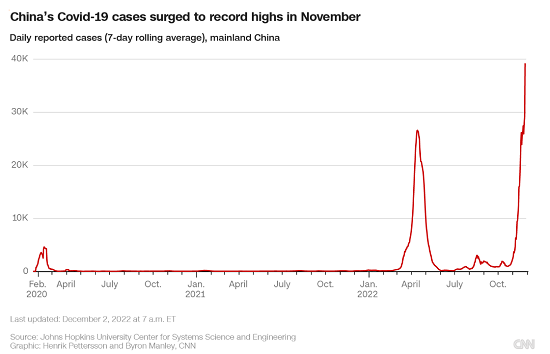
And here's the graph of covid cases in China:

Graph of covid cases in China, from 2020 til now. Image source.

That hump at the beginning (February 2020) is the Wuhan lockdown. That spike in the middle (April 2022) is the Shanghai lockdown. That big ramp up at the end is all the different cities now that are in lockdown.

During the Shanghai lockdown, we wondered if the powers-that-be were going to end zero-covid. The lockdown was so bad, we thought that surely we were near the point where we just couldn't keep this up any more. But, really, it was just Shanghai. Most other Chinese cities were fine- with covid case numbers at approximately 0. 

But now it's different. Now things are going badly all over the country.

Now, I think, we're moving in the direction of ending zero-covid. Because we just can't take it any more.

I would say, the protests have made a difference. 

Also, here's something suspicious: Recently there have been a bunch of articles from Chinese news sources that say "omicron is not as bad as the original strain of covid." Which... is true... but why are we suddenly talking about it now? Are they trying to pave the way for a "wow look at China's success in fighting the pandemic- and now we're all done because omicron isn't that bad. So we can stop covid-zero and everyone can agree it was a big success and China is the best."

For example: 

Bloomberg: China Official Behind Strict Covid Lockdowns Softens Stance (December 1) I don't have a link to a Chinese news site with an "omicron is not that bad" article, but this Bloomberg article correctly reports that such statements are being published by the powers-that-be in China.

Xinhua: COVID-19 emergency phase closer to end despite Omicron transmission: WHO (December 3)

---

And one more link:

Sixth Tone: China to Boost COVID Vaccination for the Elderly Amid Outbreak (November 30) Every few months, China makes a big deal about "okay, we should REALLY get the old people vaccinated now." Vaccination rates are still a bit low for the elderly population in China. "As of Wednesday, around 86% of those aged 60 and above had received a two-dose regimen, and 66% of those over 80 had completed the same course."

Saturday, December 3, 2022

Blogaround

1. Not Your Mom’s Trans 101 (2010) "'Cisgender' is the term for people who have no issue with the gender that they were assigned at birth. For whatever reason, they are able to live somewhat comfortably within the gender in which they have been cast. No one really knows why so many people are capable of fitting into such arbitrary categories."

2. “The sub is the one who’s really in control” (2016) "And in this style of response, instead of affirming that not being in charge is okay and delving into the ethics of hierarchy, the approach is to bizarrely abandon D/s practitioners’ habitual language (in which dramatic power-loss is fine and okay and also sexy) to, suddenly, define the sub as a dom, which makes it okay because it’s understood that being a dom is best."

Reminds me of Christians who say "I don't have enough faith to be an atheist"- like, uh just a minute ago weren't you talking about faith like it's a good thing? And now suddenly you're saying atheists have more faith than you but that's bad?

3. ‘No Way Out’: Why China’s Mortgage Strikers Refuse to Back Down (November 29) This is wild to me- buyers paying mortgages on apartments that are still under construction, and then the building company stops construction, with no timeline on when the apartments will actually be built, so the buyers stop paying their mortgages, and then the financial system acts like the buyers are the bad guy here?

4. New era begins with China’s launch of crewed mission to its space station (November 30) Cool!

5. Jiang Zemin: Former Chinese leader dies aged 96 (December 1)

6. The Svalbard seed vault: A survival bunker for civilization (December 1) "What if we wanted to reconstruct the entire planet as a unified survival village, rather than a jostling sprawl of rivalrous nations? How would we re-engineer civilization to be resilient against catastrophe?"

7. The longtermism that works—and the kind that doesn’t (November 25) "The problems begin when we presume that what imaginary future people, along with people elsewhere in the world today, really need is someone else to make decisions for them."

And this, linked in that article: Best intentions: When disaster relief brings anything but relief (2017) "There was no time for disaster workers to sort and clean old clothes. So the contributions just sat and rotted."

8. Cryptocurrency's Dirty Secret: Energy Consumption (May 4) "Perhaps even more concerning, some companies in the U.S. are now bringing retired power plants back online in order to cash in on crypto."

9. Senate passes bill to protect same-sex and interracial marriage in landmark vote (November 30) "While the bill would not set a national requirement that all states must legalize same-sex marriage, it would require individual states to recognize another state’s legal marriage. So, in the event the Supreme Court might overturn its 2015 Obergefell v. Hodges decision that legalized same-sex marriage, a state could still pass a law to ban same-sex marriage, but that state would be required to recognize a same-sex marriage from another state."

Also interesting how this bill is called the Respect for Marriage Act, but laws that stopped same-sex couples from getting married have also had similar names (for example, the Defense of Marriage Act). So, here's a question: Do you respect/defend/protect marriage by limiting it or expanding it? 

And, on the topic of limiting it- I also think there are certain situations where a couple should not legally be allowed to marry (for example, an underage girl getting married to an older man)- but I don't think of that as "protecting marriage" in some big abstract sense. 

Friday, December 2, 2022

Square Root's Advent Calendar

Advent calendar that looks like a 2D Christmas tree with 24 pockets under it. Image source.

So my little son is preschool-age now. He's old enough to actually have whole conversations, and so I decided I should do some more Christmas traditions with him now. He's old enough to actually talk about and understand Christmas traditions and the Christmas story. 

So I bought this Advent calendar which has 24 empty pockets, and I printed off bible verses, and I bought a little puzzle and put a few pieces in each pocket. The bible verses are from here: Bible Verse Advent Countdown for Kids – FREE Printable! It has 24 little cards, with extremely simplified bible verses that tell the story of Jesus' birth. And the puzzle is a Nativity scene.

Super excited for this Advent calendar! Every day my son can open the next pocket and we'll read the bible verse and he can add more pieces to the puzzle.

So that's my plan- but you know how little kids are... they may or may not go along with the plan. They care 0% about how much effort you put into it or how important it is to you.

Anyway, yesterday we opened pocket #1. Square Root was very interested in the puzzle pieces (there were 3 pieces the first day). While he was trying to put them together, I read him the bible verse: "God sent the angel Gabriel to a girl named Mary," and then asked him, "Do you remember who Mary is?" but he totally ignored me, and then the puzzle pieces reminded him that he has a dinosaur puzzle, so he asked me to get it for him. 

So that's how that's going.

Anyway, I'm curious about how much he'll understand about the Christmas story, and what he'll think about it. He has a few books about baby Jesus, and he has a toy nativity set, so he's at least vaguely familiar with the characters in the story. I plan to blog about this again later, to let you all know Square Root's thoughts on it. (Edit: here's the update.)

That's all~ Very excited for Advent~


---

Related:

Taking My Kid To Church (Blog Series)

Taking My Kid To Church: God Loves My Son

Not Sure I Want My Kid Reading the Bible

Monday, November 28, 2022

Blogaround

Graffiti on Focus on the Family HQ says "Their blood is on your hands. Five lives taken." Image source.

1. How Asexuality Is the Quiet Queer Revolution (November 11) "What if we start decentering sex? This is the radical question we are forced to confront once we start recognising asexuality as a real identity deserving of space in this world – one that makes it queer for how it subverts normative sexuality, and dares to imagine a world where we free ourselves of its baggage entirely."

2. Rearranging deck chairs on the Titanic: Southern Baptists still arguing over women pastors (November 6) Kind of shocking to me, reading this, how openly these men just hate women pastors. I know I used to be in that culture, and I used to believe there was something to the concept of men being leaders more so than women, but now it just seems incomprehensible to me. And these men believe in a "this doesn't make sense but God wants us to do it anyway, and obedience to God is the most important thing" God, whereas I believe in a "you're gonna stand before Jesus someday and She's going to be like, 'what the hell were you thinking???'" God.

3. How the pandemic took the toxic out of my Turkey Day (November 23) "Thanksgiving was the one day of the year that I knew was going to suck. Not just for me, but for my son and husband too, the two most important people in my life. They rode out that horrible day with me every year."

4. The few, the loud: How ‘very online atheists’ differ from other atheists (November 21) "Most atheists are pretty quiet about it, but a few people drive most of the online discussion of atheism. This creates a potential mismatch between typical atheists and the most visible atheists, to the extent that there are predictable differences between the two groups."

5. Do the rich pay their fair share? (November 15) "Billionaires in the US pay a smaller tax rate than most teachers and retail workers. Thanks to a tax code that favors income from wealth over income from work—and a slew of tax-avoidance strategies—the richest among us end up paying a smaller percentage of their income to the federal government than most working families."

6. Stochastic terrorism and the Colorado Springs Club Q shooting (November 21) "In the US this weekend, Club Q in Colorado Springs joined a long list of places struck by concrete violence informed by a broader cultivation of hate. The term for this terrible outcome is 'stochastic terrorism': when an act of public violence is individually unpredictable (i.e. in terms of exact date, target, perpetrator), but also statistically predictable, based on a series of preceding factors, such as sustained hate-mongering from prominent media sources."

7. Catholic hospitals are wrecking reproductive health care (October 11) "But doctors at a Catholic hospital won’t do that. They will perform the C-section, sure, but that’s it. They are forbidden from tying a woman’s tubes thanks to Directive 53."

8. San Francisco launches new guaranteed income program for trans community (November 16) This seems very weird to me. A government chooses one specific marginalized group and picks some people in that group and gives them money. Yes, it's great for the people who receive the money- but it feels weird to me that a government would be doing that. Seems like the sort of thing a charity should do? A government is supposed to do things that benefit society as a whole.

I don't know, perhaps there are other examples where local governments have done this sort of thing, just focused on one specific disadvantaged group, and the result benefitted society overall, and now San Francisco is kind of modeling their plan on something like that?

And, please note, when I say a government is supposed to do things that "benefit society as a whole", I don't mean like, everyone should directly benefit from every government program, or some nonsense like that. If, for example, the government gives money to low-income people to lift them out of poverty, I do count that as "benefitting society as a whole" because a society which helps people get out of poverty is a better society than one that doesn't. But I'm not sure about just focusing on trans people, because there must be a lot of low-income cis people who are in need too. And this program is just giving them money, rather than addressing specific trans issues. (Addressing specific trans issues would also be an example of "benefitting society as a whole"! A society which helps people get transgender-related health care, for example, is a better society than one that doesn't.) This seems more like "here's a good thing that happened one time to a few specific trans people" but it doesn't go any farther than that.

But anyway, the important thing is to see the results of this program. It will definitely be a great thing for those people who receive the money, but my question is, does it make sense from the government's perspective to focus on them specifically?

9. "Anti-science" is a meaningless phrase (2021) "People honestly SHOULD be skeptical of any human-related science."

10. Here’s why vandals sprayed graffiti at Focus on the Family headquarters (November 27) When I heard that the Focus on the Family sign had been vandalized, I was like, "GOOD." I grew up reading and believing their propaganda, all their books that take the Lord's name in vain and bear false witness against their neighbors. I read "The Homosexual Agenda" and "Marriage Under Fire"- books about how "homosexuals" are trying to destroy marriage and destroy society and must be stopped. It was all lies. And now I'm queer, and I'm mad.

Sunday, November 27, 2022

Zero-Covid

Protestors in Shanghai hold a candlelight vigil for the victims of the Urumqi fire. Image source.

Complete list is here: Index of Posts About the March 2022 Shanghai Covid Outbreak 

---

Well, let me start out by saying Shanghai is doing fine, ie, we don't have any large-scale lockdowns going on right now. (Though I'm sure there are individual buildings or apartment complexes in lockdown in Shanghai at the moment.)

But there's a lot of ****ed-up stuff going on elsewhere in China, and today I just feel really exhausted and overwhelmed, hearing about it all. 

I feel like, I'm not able to give you readers a totally accurate overview of everything (ie, how many cities are currently having lockdowns) because it's too emotionally hard searching all that information out and trying to figure out what's really going on. But anyway, I'll write down what I know in this blog post.

---

Shanghai

First of all, here's the graph of recent covid case numbers in Shanghai:

Graph that shows number of daily local covid cases in Shanghai. Recently the number has been increasing, and 130 cases were reported on November 26. Image source.

Uh, the way that graph increases is kinda scary. As far as I know, though, the vast majority of the local covid cases in Shanghai recently are people who just entered Shanghai from other Chinese cities.

So, last time I talked about the policy changes announced by the Chinese national government, which scaled back the restrictions that we all have to live with due to zero-covid. Because of these changes, our apartment complex cancelled the "mandatory" mass testing, and the schools are only testing the kids on Monday, Wednesday, and Friday, instead of every school day.

Ah, but then in Shanghai, a totally new rule was announced: If you have entered Shanghai within the past 5 days, you are not allowed to go out to restaurants/ malls/ those kind of fun entertainment places. You are allowed to go to your job, take the subway, and go to boring places like banks.

Some links about it, from SHINE:

Public venue ban for travelers to city but transport, banks exempt (November 22)

White list planned for frequent cross-provincial commuters (November 24)

Blue code introduced in Hunan's health code system (November 25) This article is about Hunan province, which has a policy similar to the one Shanghai has. In Hunan, if you've been there less than 5 days, your health code will be blue.

The way this works is, if you've been in Shanghai less than 5 days, your health code will still be green, but it will have the words “来沪返沪不满5天” ["Less than 5 days since entering Shanghai"] under it. And so, when entering a mall or restaurant, there should be a security guard there checking everyone's health codes, and they won't let you in if it says you've been in Shanghai less than 5 days.

Oh, and then they announced there will be a "white list" for people who frequently travel in and out of Shanghai, so this rule won't apply to them. For example, there are people who live outside of Shanghai but commute in for work every day.

My feeling about this is, it seems like less of a "zero covid" rule and more of a "living with covid" rule, for the following reasons:

  • How is this going to be enforced? The security guards at the malls / the waiters at restaurants are gonna enforce it? Like, of all the people who are supposed to be enforcing the zero-covid rules, it's the mall security guards who care the least. Most times, customers can just walk in and vaguely point their phone screen in the security guard's general direction, but it's not like the security guard is actually taking the time to make sure you really scanned the location code and that's really your health code and not a screenshot from someone else. (Probably there are lots of people walking around Shanghai with a screenshot of a green health code that they took in June, and no one has noticed.) Perhaps the idea isn't that it's really possible to keep newly-arriving people out of malls- perhaps it's just to let everyone know that if you do sneak into a mall when you're not supposed to (which is really quite easy), and then you turn out to be covid-positive, you're going to get arrested for that. 
    Anyway, since it can't really be enforced, it doesn't feel like a "zero covid" rule to me.
  • It's only the "fun" sorts of places that are being restricted. People who just arrived in Shanghai are still allowed to take public transportation, go to work, etc. My feeling about this is, those "fun" places are where it's more likely to be crowded, where people will not be wearing masks, and so contact tracing is difficult... I've heard of situations where some covid-positive person went to a few bars, and thousands of people were then labelled "close contacts" just because they had been to those same bars on that day. Whereas, if you go to work in an office, it's just your colleagues who are there. It's not hundreds of people coming and going throughout the entire day. And on public transportation, everyone wears masks and doesn't talk to each other, so probably covid won't spread there.
    So this new rule is specifically targeting places which are non-essential, and where there's the most potential for covid to spread. It's not trying to make the spread 0 (to make it 0, you would have to keep the newly-arriving people in quarantine in hotels or at home for 5 days), but it's trying to stop it from happening in places where it could potentially cause a big outbreak/ a contact-tracing nightmare.

Anyway, I think the reason for this new rule is that A LOT of other cities in China are having bad outbreaks/lockdowns right now, and Shanghai is not. So Shanghai is trying to stop that from happening here. And actually, I have heard this past week that a bunch of cities in China now have policies like this- if you've arrived within the past 3-5 days, you're not allowed to go to malls/restaurants/etc.

But. What about the US consulate?

Ah, see, here's the thing. The US consulate in Shanghai is inside a mall. (Westgate Mall, near West Nanjing Road.) There's like, some office space in the top floors of this mall, and that's where the US consulate is. 

So it seems like the consulate is in the category of places you should still be allowed to go to, even if you've been in Shanghai less than 5 days. But, are the mall security guards on the first floor going to let you in?

My feeling on it is, if you walk around to the different entrances of the mall, surely you can find a security guard who's not really paying attention, and you can get in that way. Or, yeah, just use a screenshot of a health code that doesn't have the "less than 5 days" message. (But you might go to jail for that if you turn out to be covid-positive. If you're covid-negative then you're fine.) Or, perhaps if you show them paperwork that proves you really have things you need to get done at the consulate, they will let you in anyway.

The US consulate itself has been, um, not all that helpful during the pandemic. Their general attitude is, "Hey, if you're an American in China, we want to let you know, China is setting up all these restrictions because of covid, and that's not any of our business, but just want to let you know we probably can't help you if you're having a problem related to that." Like, I'm on their email list, and every few months they send out an email that says that. [Perhaps what I've written here is a slight paraphrase.] 

And then, a few days ago, they sent out an email that says, "Yeah, so Shanghai now has this rule about you can't go to malls if you've been here less than 5 days, and the US consulate is in a mall, so they might not let you in, and that's not any of our business, but hey if you do manage to make it up to the 9th floor, we are open!" [Slight paraphrase.]

Yeah, not that helpful. 

Better to put your faith in the underpaid mall security guards who don't care about their job, rather than the US consulate. 

---

Shijiazhuang

On November 14, Shijiazhuang 石家庄 (a city near Beijing) announced that the free nucleic-acid testing locations would be closed, and people would no longer be required to show a negative test result in order to enter public places. This happened even though there were something like 500 covid cases reported in Shijiazhuang the previous day. 

This was all over Chinese social media. People were saying that this is a sign that zero-covid is ending- that Shijiazhuang is no longer doing zero-covid, and soon the rest of the country will follow. I heard that people in Shijiazuang were all scared to go out, they're buying all the medicine from the pharmacies, they're all keeping their kids home from school, etc. (That's what I heard on WeChat, but I have no way to fact-check it, so we don't really know what the situation is there.)

A day or so later, some of this was reversed. Now the free nucleic acid testing stations are opening again, and parts of Shijiazhuang are in lockdown.

So, uh, that didn't last long.

I'm looking for English-language news articles about this, but I haven't found any that I love... all of these read as quite biased to me, or from a news organization I'm not familiar with so I can't vouch for its accuracy, but anyway, you can read them and kind of get an overall idea:

Financial Times: Chinese city tiptoes away from zero-Covid (November 15) 

SHINE: Shijiazhuang to reopen free PCR testing sites (November 15)

The Times of India: Shijiazhuang: Fear and panic grips Chinese city rumored to be exiting Covid Zero (November 16)

Bloomberg: Covid Zero Returns to Chinese City Rumored to Be Reopening (November 21) This article is paywalled, so who knows what it says, but the headline seems right to me.

China Daily: Shijiazhuang continues testing as case counts climb (November 25) 

Honestly this idea that "oh Shijiazhuang tried to back off of zero-covid but everyone was terrified and hated it" reads as Chinese government propaganda to me. I'm very curious about what the actual situation was.

But I'll say one thing: Yes, Chinese people are very scared of covid. For 3 years, it's been this scary thing that we've never actually seen (it's probably still true that the majority of Chinese people don't know anyone who has had covid) but has completely changed our lives, making all these rules to control us. And the government needs people to believe that covid itself is worse than all the suffering that's happened due to lockdowns.

Chinese people are very much not emotionally/psychologically ready to "live with covid." But the good thing is, most of us are vaccinated, and we have good mask-wearing habits. But there needs to be more education about what specific actions do or do not decrease one's risk of getting covid. Like, randomly spraying disinfectant everywhere! Being racist! [link is about monkeypox, but a similar idea would apply to covid] These are things that don't actually do anything to reduce the risk of getting covid.

---

Urumqi

[content note: fire, death]

SHINE: 10 killed, 9 injured in Xinjiang residential building fire (November 25) I include SHINE here to give you the Chinese-government-propaganda view. Never forget SHINE is a propaganda rag! (Yes I put a lot of SHINE links in this post; as you read them, please keep in mind that SHINE is a propaganda rag. [Insert meme "Tell me you lived through the Shanghai lockdown without telling me you lived through the Shanghai lockdown"])

AP News: 10 killed in apartment fire in northwest China’s Xinjiang (November 26)

CNN: China’s Urumqi to ease Covid lockdown amid public anger over deadly fire (November 27)

BBC: China Xinjiang: Urumqi rocked by Covid lockdown protests after deadly fire (November 27)

ABC: Shanghai hit by protests as anger at zero-COVID and Urumqi fire spreads across China (November 27)

BBC: Covid protests widen in China after Urumqi fire (November 27)

Yahoo! News: Shanghai residents hold vigil for Urumqi fire victims (November 26)

Urumqi is a city in Xinjiang province, in western China. (Some background information- A lot of ethnic minorities and/or Muslims live there, and the Chinese government sort of has a reputation for not caring as much about their rights...) They've been having lockdowns there for a long time, and recently there was a fire in an apartment building, and firetrucks were blocked from getting in by the fences and/or parked cars that were there because of lockdown. And people are mad. 

And there's lots of stuff posted about it on WeChat, and lots of stuff getting censored. Like, I am kind of getting the impression, from rumors on WeChat today, that we haven't heard the full story about the protest in Shanghai. There is a rumor that a lot of people got arrested- but I have no idea if that's true, it's just something I saw on WeChat. It's impossible to fact-check when the government is censoring the actual truth.

I have to say, personally, I feel really proud of the Chinese people who are protesting. This kind of protesting doesn't really happen in China- but now we've been seeing it more and more because of what's happened with zero-covid. And they can't censor it fast enough.

---

What other cities are having lockdowns?

Off the top of my head, here are the cities I've been hearing about having lockdowns this week: Beijing, Guangzhou, Shenzhen, Shijiazhuang, Lanzhou, Urumqi, Wuhan, Hohhot. And surely there are more. Sometimes a lockdown is just a few days, and sometimes it's weeks and weeks.

When we were in lockdown in Shanghai (for 2 and a half months) we said "This is the 2nd-worst lockdown China has had." The worst was, obviously, the initial Wuhan lockdown in early 2020. But at this point, some of these other cities are having worse lockdowns/ longer lockdowns than Shanghai did.

---

Feelings about zero-covid

Well, for a long time I've felt like "zero-covid will end eventually, and I don't want to be in China when it happens." How does this end? Violence?

It's been almost 3 years now... and for most of that time, we were fine. We benefitted a lot from the zero-covid policy, because it meant we could just live our normal lives and go places and didn't have to worry about getting covid. We had to wear masks and follow various rules, but there was very little risk of actually getting infected with covid. And that was good.

But at this point, a lot of China's population has suffered through lockdowns. At what point do we realize, most of us aren't benefitting from zero-covid any more, we need to do something different?

I've heard people say, Shanghai will not try to do a large-scale lockdown again, because the people of Shanghai just will not tolerate it. The trust in the government is just gone. We're not going to submit to that again.

And let's definitely not do what the US did! Like, don't just give up and end all restrictions and say covid doesn't matter any more! There are better options than that.

Anyway... don't worry about me, though. For now, Shanghai is fine. We aren't in lockdown now.

---

Other links:

Sixth Tone

China’s Hottest Art Show Is in the Middle of Nowhere. Literally. (November 17) "For another work, Meng mixed rhythmic music produced by a friend with a recording of the mechanical alarm that loudly declared, 'Please note, you have entered the monitoring area,' any time there was activity in the aisle that linked quarantine rooms."

SHINE

48-hour PCR report required to eateries, malls (November 27) Wow, this is a big change- now we will have to get tested every 2 days instead of every 3 days if we want to be able to go to restaurants etc.

Free PCR tests to end of December over new resurgence (November 26)

Tourist attractions change entry requirements in response to COVID situation (November 26) It seems like the main change is now they require you to have a negative nucleic acid result from within the past 48 hours, rather than 72 hours.

Four new community cases traced to popular ocean park and zoo (November 25)

Woman under investigation for hiding positive PCR test result (November 24) Yeah in China you will get into legal trouble if you are covid-positive and try to hide it.

About Shanghai Disneyland:

Related to the big changes in the zero-covid policies, which I wrote about last time:

Xinhua

China Focus: China pledges to implement optimized COVID-19 response measures (November 17) This all sounds very nice, but is it going to actually happen in reality?

Wednesday, November 23, 2022

The Parable of the Talents: Risk and Return in Building the Kingdom of Heaven

A small business owner in an office with a bunch of yarn and sewing machines. Image source.

Continuing our series on the book of Matthew, let's look at Matthew 25:14-30, which is typically referred to as "The Parable of the Talents."

Go over and read it.

So, we have here a parable about the kingdom of heaven, which uses a metaphor related to business/ investment/ being an entrepreneur. These servants who received the "bags of gold" or "talents" were instructed to put that money to work to earn more money. (The footnote says "a talent was worth about 20 years of a day laborer’s wage"- we're talking hundreds of thousands of dollars here.)

The thing that strikes me about this story is that when you make an investment, or use capital to start a business, there is always risk. There is always the risk that you will lose the money you invested. There is always the risk that your business will fail. And inevitably you will make mistakes when you're just starting out- maybe you will realize in hindsight that some of the things you spent money on were actually not worth it. And there's an element of luck involved- maybe people you hire turn out to be better or worse than expected, maybe some celebrity tweets about your product and suddenly you have tons of customers but then they all forget about you a week later, maybe new government regulations suddenly mess up your whole business strategy.

There's always risk. There will definitely be things that go wrong.

So the first servant, with his 5 bags of gold (hundreds of thousands of dollars) earned 5 more. And the second servant, with his 2 bags of gold (hundreds of thousands of dollars) earned 2 more. And both are rewarded by the master. Their businesses are successful. They did what the master wanted them to do. However, this isn't the whole story. You only see the result- 5 talents earned 5 more- but you don't see all the steps, all the little decisions, the mistakes, the things that would have worked better if they had been done differently (though perhaps no one could have known that- hindsight is 20/20).

I feel like, for me, thinking about how to make the world better and build the kingdom of heaven, it's easy to get stuck on those details. What if I donate to a charity, but then they don't use the money well? What if I look up their financial records and the percentage they spend on "administrative costs" seems high- does that mean it's an ineffective charity? What if I help organize some event, but then it has problems? What if I try to help people but it actually makes things worse?

On the one hand, those are valid concerns. We should definitely be honest and realistic about how good intentions aren't enough, and sometimes charity projects do more harm than good. We should learn from their mistakes. We should do our research. We should listen to the people we want to help and find out what they actually need, rather than forcing our own ideas on them.

But we shouldn't become paralyzed by this fear of taking risks. Nothing you do will ever be perfect, but don't let that stop you. You can still make the world better and participate in bringing the kingdom of heaven to earth.

The third servant was too afraid to even try. He hid the money in the ground, and simply gave it back to the master when the master returned. This servant took no risks at all, and the master was angry at him for it- calling him "You wicked, lazy servant!" The master said he should have at least put the money in the bank to earn interest.

My interpretation of this bit is, if you have high enough income that you are able to donate to charity, but you feel like you have to analyze everything and pick the number one magical most effective charity, and you worry about it and never actually end up doing anything... no, don't do that. At least pick a charity and set up automatic monthly donations. It feels inadequate to just do that- I mean, yes, it is inadequate- but at least it's better than nothing.

(I realize I've given several examples about "building the kingdom of heaven" in terms of donating to charity, but there are lots of things you can do to build the kingdom of heaven. Anything that helps people who need help, makes the world better, etc. Supporting your friends, taking care of your family. Actually, the next parable we'll look at is the parable of the sheep and the goats, which does indeed give practical instructions for what we should do.)

So overall, my point is, if you want to make the world better, don't be so worried about taking risks and making mistakes that you just take no action at all. Inevitably you will make mistakes and mess things up and be inefficient sometimes. That's just the way it is. The master in the parable has no problem with that, because the first and second servants were very successful when you look at the big picture.

A few more things I want to mention about this parable:

The third servant tells the master he was afraid because "I knew that you are a hard man, harvesting where you have not sown and gathering where you have not scattered seed." (The master seems to agree with this description.) Back when I was evangelical, I always got stuck on this verse- Is it saying the master is cheating and stealing? Isn't the master supposed to be God? What on earth is happening here??? I would get stuck because I viewed bible study as, like, I am going to read this and understand the whole thing and get the message that the author "meant" when they wrote it. So if overall the passage made sense to me, and I had an understanding of "what it meant", but there was one weird verse that didn't seem to fit at all, well that would be a huge problem.

That's not how I view the bible now, as an ex-evangelical Christian feminist. I think people can interpret the bible a lot of different ways. I am not here to tell you what it "actually" means or what the author "really meant" by this passage- I am just telling you my opinion on it from a Christian feminist perspective. I totally recognize that my ideas are not "what the author meant"- really, it's not important to me to discover "what the author meant." (I think I need to make this clear here on my blog.) So I find a part that is meaningful to me, and I blog about that, and if there are some other parts of the passage that I kind of ignore, well, it's okay. I don't fool myself into believing that I really understand the whole thing and know what the author meant by every single part. And therefore, it doesn't bother me if some parts are weird and don't make sense to me.

For what it's worth, though, here's my interpretation of the "you are a hard man, harvesting where you have not sown and gathering where you have not scattered seed": Things that happen in the real world don't really follow a simple cause-and-effect like "good person does good thing for good reasons and the result is good, bad person does bad thing for bad reasons and the result is bad." Sometimes you do something, but someone else gets the credit for it. Sometimes something bad happens, but a few people happen to benefit from it (innocently- I don't mean they purposely caused the bad thing to happen). In the real world, all these good and bad intentions and results are woven together, inseparable. And I don't really think that's a good thing- I think it's an example of how the world is flawed- but it just is what it is. And the kingdom of heaven is also like that, because it's built by us in this flawed reality. 

Take the life of Jesus, for example. The genealogy in Matthew 1 points out a few key women who were in Jesus' family line; one of them was "Uriah's wife" (Bathsheba). Yes, remember that whole thing, where David raped Bathsheba, then had her husband killed, then married her, their baby died... and then later they had a baby named Solomon, who is an ancestor of Jesus?

So if David had never raped Bathsheba and murdered Uriah, Jesus would have turned out different. (In some small way.) It was still a really bad thing that David did. (I don't want to hear any "But it was actually a good thing/ had a silver lining because look at these good things that happened later as an indirect result.") But what is supposed to happen- anyone whose ancestors got together because of rape and/or murder shouldn't do anything good with their life, because then someone can say their success is a "result" of that historical rape/murder? Probably all of us have that in our family tree somewhere. It just is what it is. It's not a good thing, but that's just how the real world works.

And one more part in this parable I want to mention: "So take the bag of gold from him and give it to the one who has ten bags. For whoever has will be given more, and they will have an abundance. Whoever does not have, even what they have will be taken from them." I'm not sure what to make of this. It seems to be stating the general principle of "the rich get richer and the poor get poorer", which is indeed how the power structures of the real world work. But, that shouldn't be true in the kingdom of heaven, right? What about "the last will be first, and the first will be last"?

I know the parable of the talents is using money as a metaphor for building the kingdom of heaven- and the money actually belongs to the master, not the servants- so taking the money from the disobedient servant and giving it to the most successful servant isn't really the same thing as a literal rich person finding new ways to exploit literal poor people. Not sure what it is a metaphor for, though. A possible complicating factor is how, in the parable, the master (God, I guess) is the one who gives the money to the servants in the first place (and later gives the third servant's money to the first servant), but I don't conceptualize the real world as "God blessed you with this money/ resources/ abilities/ *cough* white privilege"- I think it's just luck. And if you start down that road of "God intentionally decided that I should have these things that other people don't have" then it only leads to bad places.

So I don't have a good interpretation to give you about the part where the master takes the gold away from the third servant. (Feel free to leave a comment about it if you have something to share!) But, like I said, it doesn't bother me, because I am not coming at the bible from a perspective of "I am going to understand what the author really meant in this passage."

So, in summary: The parable of the talents uses imagery about being an entrepreneur and making investments, as a metaphor for the way Jesus wants us to build the kingdom of heaven. If you have more money and resources, then you should contribute more. You have the opportunity to do more good- so use it. Also, there is always risk when someone starts a business or invests money- and there is also risk if you set out to take actions that actually make a difference in the world. Inevitably, you will make mistakes. But don't let that fear stop you, like it stopped the third servant. The master rewarded the servants for the big picture of how much good they did, and didn't pay any attention to the mistakes they made along the way.

---

Related:

The Parable of the Living Wage 

-------------------

This post is part of a series on the gospel of Matthew.

Previous post: I don't believe in a literal "Jesus coming back." But, be ready. (Matthew 25:1-13)

Next post: Sheep and Goats (Matthew 25:31-46)

Click here to go to the beginning of the series.

AddThis

ShareThis