Showing posts with label Ephesians. Show all posts

Friday, May 15, 2026

Marriage


"Mawwiage." (From "The Princess Bride.") Image source.

[content note: it's about how, historically, sexual violence has always been a big part of marriage]

Thinking a lot about marriage lately, and what marriage is overall, in a general sense. As in, if you look at all marriages throughout history. The overall picture of it is very bleak for women, and I don't know what to think about that. My own marriage and my own culture- where you get married to someone because you genuinely love them and want to marry them, and you are equals- this is very much an anomaly if you take an outside, objective view of what marriage has always been.

Monday, October 2, 2023

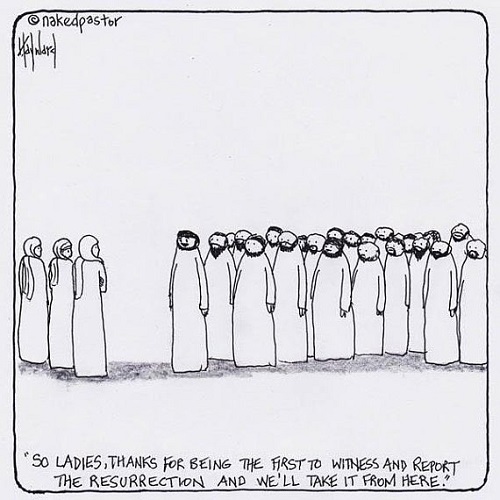
Men have no idea what it's like for women in complementarian churches

Cartoon by Naked Pastor (David Hayward) which shows 3 women and a large group of men. The men say, "So ladies, thanks for being the first to witness and report the Resurrection. And we'll take it from here." Image source.

I read this post, Life under Patriarchy: Death by a Thousand Cuts, which has a bunch of anecdotes about what it's like to be a woman in a conservative/complementarian church. This one in particular stuck out to me:

When I was alone as a woman in a meeting with the all-male eldership of my church, I explained how difficult it was as a woman to discern how to have both a gentle and quiet spirit and also have a voice in the church. One of the male elders, the NT greek “expert”, interrupted me to soften the meaning of 1 Timothy 2:12. I was referencing 1 Peter 3:4. His interruption (mansplaining) and my confusion about his confusion began the whole meeting badly. Afterwards, as I contemplated his mistake, I realized he had no idea of the burden women carry from these verses. No woman who takes her bible seriously in the conservative church world would confuse these two passages with one another. I’ve been processing the realization that men in the church don’t sit with the call to a “gentle and quiet spirit” the way women do ever since that terrible meeting when I tried to use my voice in a room full of aggressive men.

This struck me because it shows how Christian women who believe in complementarianism have to struggle with it because it just makes no sense. And Christian men who believe in complementarianism aren't experiencing that struggle. Maybe they aren't even aware of it at all! 

This has inspired me to write a few of my own anecdotes, here in this post. (Important background information: I'm a woman.) But first, let me define "complementarianism": So, "complementarian" Christians believe that God created men and women to be equal in worth, but to have different roles. In marriage, the wife has to submit to the husband, and the husband has to love the wife as Christ loves the church. Also, women are restricted in what leadership roles they can have in the church. This plays out differently in different churches, but basically, the senior pastor of the church has to be a man. Maybe a woman can be an "associate pastor" or a "children's director" or "women's pastor" or some other jargon. And in some churches, women can't teach adult men- they can only teach women or children. The details of this differ- is a woman allowed to read a bible passage out loud in front of the church? Does that count as "teaching"? Is a woman allowed to sing in front of the church? Sometimes when a woman talks from the pulpit, these churches have to call it "sharing" instead of "teaching." And some churches don't allow women to speak in front of the church at all.

(Trying to understand how this is "equal in worth" is always left as an exercise to the reader.)

---

When I was growing up, I believed in complementarian because I was taught that's what all Christians have to believe. That's what the bible said, supposedly. I was told that there were some Christians who didn't believe in complementarianism, but that's because they were rejecting the bible, they are bad Christians, they've been influenced by the evils of feminism, they think they know better than God, who made this perfect plan about gender.

So yes, I believed in complementarianism because I didn't know there were other options.

But, the thing is, complementarianism simply makes no sense. Why wouldn't a woman be allowed to do everything a man can do in the church? That sounds sexist and wrong. And what does it mean that a wife has to "submit" to her husband? So like, the husband can control her and tell her what to do? What? That sounds so wrong. Or, when they can't agree on something, the tiebreaker is gender? What? What on earth, that makes no sense.

So, the issue is, I believed I was required to believe in this. But, it makes no sense. So I needed to convince myself that it made sense.

And really, that's what all of Christian apologetics is. That's the problem with apologetics. It's not about following logic and changing your beliefs accordingly, as you search for the truth. It's about "I know I am supposed to believe this, please help me force myself to believe it." 

And yes, there are loads of ways that Christians try to argue that complementarianism isn't as sexist and wrong as it sounds. The wife has to submit to the husband, but they husband has to love the wife, even to the point of laying down his life for her, so actually the husband has the more difficult role. And, it's a lot of responsibility for the husband, to be the leader and have to make the decisions for the family, so the wife should be glad she doesn't have to worry her pretty little head about any of that. Also, she knows he loves her, and she trusts that he will make decisions that are best for their family, because he's such a great guy, so actually it's easy for her to submit to him.

And, they said, this doesn't apply to abusive situations. Some people hate these "wives submit to your husbands" passages because they've been used to justify abuse- but that's wrong! The husband should NOT abuse the wife! And if he is, she has the right to get away from him.

And, they said, normally the husband and wife should discuss things as equals, and agree on their decision together! It's only when they really really can't agree, that's the only time that "submit to your husband" comes into play. If they really really really can't agree, then the husband can make the final decision. But that would happen very rarely- in some people's marriages it never even happens at all!!!

Yeah, I don't buy any of this.

I used to. Because I believed this is what Christians had to believe.

But really, all it adds up to is, trying to make "wives submit to your husbands" mean something different than "wives submit to your husbands." Like... Don't worry! It's not what it sounds like!

How about instead, we just reject the entire thing, rather than concocting these elaborate rationalizations where we basically treat women and men as equals while claiming we totally believe that the women are "submitting" to the men?

Sheila Wray Gregoire has pointed out, the majority of Christians who say they believe in complementarianism don't actually practice it. In their actual, practical, day-to-day lives, they DON'T have situations where the husband and wife simply can't agree, so the husband pulls rank. In actual reality, they live like they are equals. 

They claim they are complementarian, but in practice they are egalitarian. Egalitarian is the alternative, the ideology which I was told Christians are not allowed to believe in. Egalitarian means equality between men and woman, and you don't make rules to restrict people based on their gender. (Please note, though, that many egalitarians don't support queer rights unfortunately. It's equality between straight cis men and straight cis women, and doesn't necessarily go any farther than that.)

And it's a good thing that most complementarians don't actually put it into practice. When people actually live that way, it is sexist, and harmful to women, and abusive.

So how about we just reject the whole thing, instead of pretending we're following it?

---

One time, at church, when I was in high school, I heard someone mention an organization called CBE- Christians for Biblical Equality. This is an egalitarian organization, whose mission is to promote the idea that women shouldn't be restricted from being leaders in the church, etc. Equality.

I was very surprised to hear about this, and my reaction was "... is that... legit?" And somebody at church told me, yes.

I couldn't make sense of it at the time. I guess I thought, surely if that's a legitimate interpretation of the bible, then of course that's what we should all believe. If Christians are truly allowed to be egalitarian, then why on earth would anybody be complementarian? Complementarianism just makes no sense at all, just so clearly makes no sense at all. Surely we believe in complementarianism because there aren't any other options, right? If this CBE stuff really is an option, well... of course I would believe it. Of course all of us would immediately believe it. ...Right?

I guess at the time, I knew very little about it, and didn't really believe it was legit. Because, surely if it was legit, if Christians were allowed to believe in it, well then how do you explain all the complementarian pastors I had met?

---

I used to have such faith that this was right, that when the bible said wives must submit to their husbands, or that women are more easily deceived, or women can't speak in church, I believed somehow it was right and good. I didn't understand how it was right, because obviously it sounds so wrong, but I had complete faith that if we just understood the bible correctly, and followed it, there would be no problems.

I remember one time, when I was in college, and I was with a group of friends driving home from a Christian conference. And we were discussing the bible passages that restrict women. I think there were a few boys and a few girls in this discussion. And, the way we were talking about it was very direct and blunt and not necessarily the sorts of things we would say in front of other people, because they would take it the wrong way because it sounded sexist.

And one of my friends, let's call him Edward, said, "I'm glad I can talk about this with you all, because I know that you're not going to think the bible is sexist. We know the apostle Paul wasn't sexist, and we are just trying to understand how."

Wow, I had so much faith.

---

The big change for me came when I found Rachel Held Evans's blog. That was where I first learned that Christians don't have to believe in complementarianism. Like I said, I had heard there are Christians who don't believe in complementarianism, but they are bad Christians, they are obviously wrong. Well, I read Rachel's blog, and she wasn't a bad Christian. She was the same as me. She was a bible nerd. She was asking all the questions I had always wanted to ask but couldn't put into words.

That's where I learned that we can just reject the whole thing. We don't have to tie ourselves in knots trying to explain how we believe wives have to submit to their husbands, but not like, in a sexist way. Rachel wrote about academic research about ancient Roman society, and how there were reasons that the writers of the bible wrote things that way, in that culture. But in our culture, it's completely different, so we don't have to believe in complementarianism.

Before, I thought I had to believe that there was at least something to it. When the bible says women shouldn't speak in church, in some sense that is true and right, it's just a matter of understanding how. Well, no. We don't have to believe there's anything to it. We can reject it entirely. It's an interesting historical exercise, to research the reasons why the biblical writers wrote that, and what it meant in their culture, but for our own situation now, it means nothing.

---

And that's also when I started reading ex-evangelical blogs, and there were so many stories about how complementarianism and patriarchy lead to abuse. Before, I had heard that there were some bad Christians who used this ideology to justify abuse, but I thought it happens very rarely, and those bad Christians are obviously wrong, so no need to really think about that too much. Well. No. In patriarchal churches, women are constantly mistreated. From small ways like assuming the women will do all the cooking and childcare for church events, to big ways like making a rape victim stand up in front of the church and "confess" her "sin."

Before, I had faith that good Christian leaders- whether they were men or women- were just trying to follow the bible to the best of their ability. I never thought about leaders who are protecting their own power. I never thought about who benefits from this ideology. I never thought about how the debate is different depending on whether you have skin in the game. I trusted that we all just wanted to obey what the bible said, even if it's hard.

Well. Not anymore.

---

I remember there were a few times, back when I was "on fire for God", when I prayed alone in my room, and I covered my head with a towel. Because the bible says women need to cover their heads when they pray. And I had never given it a thought before- I had never met any Christians who actually took that seriously. I think maybe 1 time in my life, I've heard of or met a Christian woman who wears a head covering to church because of those verses, but she said it was just her personal belief and she wasn't trying to tell other women what to do. (Some really conservative churches do require it, though, I have heard.) I was taught it was just a cultural thing and didn't apply to us in modern times.

But, sometimes, when I prayed, I was so desperate, trying to figure out how to get God to do what I wanted him to do. (The God I believed in back then was a he/him.) Like, I wanted my friends to "get saved" (ie, to convert to Christianity), and I wanted it SO MUCH, I was SO WORRIED about how terrible their lives must be without Jesus, I just wanted God to get them to change their beliefs, and I prayed so hard, why wasn't it working? Was there some cheat code I needed to figure out, in order to get my prayers to actually work? The bible says women need to cover their heads when they pray, maybe I should try that. Maybe that's what will get God to finally do it. Sounds ridiculous and sexist, but, worth a shot.

I never told any other Christians about this, because how would I even begin to explain it? The idea that we should actually believe that women are required to cover their heads when they pray- it just sounds absurd. All of my Christian friends would surely think it was absurd and sexist, right? But there it is, in the bible.

(And, if you're wondering, no, my friends still didn't "get saved" after that.)

---

In church, there was a discussion about "wives submit to your husbands," and I started asking for examples.

Because, when I said I just totally don't believe in "wives submit to your husbands," tons of women jumped up with the familiar talking points- "I know my husband loves me, and I trust him, so it's easy to submit to a man like that", etc. Yeah, I've heard it all before. I started asking for examples.

Examples. Asking these women, have there been any situations in your marriage, where you and your husband weren't able to agree, so in the end he just made the decision and you had to submit to him?

I only remember getting an actual answer from 1 woman. I think it was something about, they couldn't agree on what school to send their kid to, and in the end she just went with what her husband wanted. And, when she told me about it, I felt bad for asking. Because it seemed really emotional for her, really difficult for her to talk about. That was probably a bad time in her marriage, they probably argued about it, and there were strong emotions on both sides, and eventually she just reasoned that God wanted her to give up and let her husband do what he wanted, so she forced herself to submit.

That's what we're actually talking about here, when Christians say the husband has the "tiebreaker" vote. We're talking about something that was actually important to her, important enough to fight, to make a case, lay out the reasons to support her point of view, and in the end her god made her just give all that up, like it didn't matter. Because she's a woman and her husband is a man.

F all of that.

---

I posted a link on social media, and I described it as a blog post about "the equality of women in the church."

And one of my friends, let's call him Marvin, replied and said, "Women aren't equal! Some are short, some are tall, [and so on, a bunch of different adjectives describing different subgroups of women]"

And I thought, what on earth? Why is he pretending he doesn't understand what I'm talking about? He's acting like he thinks I said "all women are exactly the same" when actually what I meant was "equality between men and woman."

This anecdote is the first thing that came to mind, when I read that blog post I linked to at the top. Oh my goodness, what if he actually didn't understand what I meant? I thought he was acting clueless on purpose, but what if he wasn't? What if he hadn't spent a lifetime trying to make it make sense, when the bible says women can't do all the things men can do? What if he never really thought about it? What if he had no sense of the amazing freedom I experienced, when I found out I really can be a Christian and not be complementarian- that I can just believe men and women are equal, and not do this whole dance about how the bible says this or that?

Men have no idea.

---

But maybe I shouldn't judge the Christian men for having no idea, because I have committed a similar sin.

I'm straight, and back then, when I read the anti-gay passages in the bible, I just nodded along like there was no problem. If a man lies with a man, it is an abomination. Homosexuals will not inherit the kingdom of heaven. Same-sex relationships are unnatural, sinful, shameful, driven by lust. And I just nodded along, like, ah yes, disgusting.

Years later, I started reading blogs written by gay Christians. They wrote about how hard they struggled, trying to be good enough to be accepted by God, trying to repress themselves, reading the anti-gay passages of the bible and trying to make it make sense. They wrote about how much time they spent, tracking down ancient Greek words, trying to figure out what exactly these passages meant.

And of course, when I first started reading these blogs, I didn't agree with them if their conclusion was accepting themselves as gay. I cared about their struggles, but I couldn't believe that it was okay to accept yourself and go ahead and date people of the same gender. I thought Christians weren't allowed to believe that- only bad Christians who rejected the bible would say that same-sex relationships were okay. Rejecting God's perfect plan for gender, as if you know better than God.

But the more I read, the more I saw that they weren't bad Christians. They were bible nerds like me. They were trying their best to follow God.

And I changed my position, and now I support all queer rights. My God is genderqueer, They/Them. (And I'm asexual.)

It's funny, when someone on the internet talks about being queer and Christian, and then some rando posts a bible verse in reply, as if the queer Christian has never heard of Romans 1. Bro, queer Christians know those passages so much better than you do. Queer Christians have spent so much time, way too much time, parsing the minutiae of ancient Roman perspectives on sexuality.

Straight people have no idea.

And isn't it terrible, how Christians are expected to read bible passages which dehumanize entire demographics of people, and just accept that- because the bible says it, so it must be true? Best-case scenario for a good Christian, I suppose, is you read a bible passage that dehumanizes an entire demographic of people, and you just nod along and don't notice anything wrong. But what if you have personal experience that tells you something's wrong with what you just read in the bible? What if you yourself are a member of that demographic, or you have close friends who are? Then, as a good Christian who believes the bible, you have to force yourself to believe it, even when it sounds so wrong. You struggle to make it make sense, because you believe there are no other options.

How about we just reject the whole thing? 

If your God wants you to discriminate against other people, maybe find a new God. Every day you continue to believe in that kind of God, that's on you. What does it say about you, that you choose to worship a God like that?

---

There's one more thing I need to talk about: What does "faith" mean?

Because I read one blog post after another after another about how complementarianism is harmful, how it makes no sense, how it is used to cover up and perpetuate abuse. 

But... did that mean it was actually wrong? What if God commanded this for a reason? What if there's some really amazing reason why women shouldn't have the same rights as men, and as humans we just can't understand what it is? We're not God, what do we know?

Complementarianism obviously makes no sense- but I was taught that faith is doing things that appear to be ridiculous and foolish, because God commands us to, and somehow to God it makes sense. I was taught that's an important component of being a Christian: sometimes God will tell you to do something completely absurd, and you have to do it.

I don't believe that any more. Instead, I believe what Jesus said: A good tree cannot bear bad fruit. You can look at the results of following a certain ideology, and if those results are bad, you know the ideology itself is bad.

Reject the entire thing.

---

Related:

She was the first (Thank you, Rachel) 

It Doesn’t Actually Matter What Jesus Said About Divorce

They Prayed About It (a post about the #NashvilleStatement) 

I'm a woman, and God created me to do math and build robots

Tuesday, March 7, 2023

Blogaround

1. A Chinese Village Bet Its Future on Tourism. Then, COVID Hit. (March 1) "The village’s 200 or so inhabitants belong to the Yao ethnic minority that lives on both sides of the China-Laos border. Many local men go to Laos to find a wife. Most older people do not speak Mandarin, only Yao."

Also, Sixth Tone is writing a series on the tradition of "bride prices":

Who’s Profiting Off China’s Bride Prices? (February 22) "In rural parts of north China, such as Henan, Shandong, and the northern parts of Anhui province, the bride’s parents generally don’t keep the money for themselves, for fear of being accused of having sold their daughter. Instead, the money is passed to the bride for use in married life."

How to Price a Bride (March 2) "In this instance, the bride’s family was willing to lower its request in line with Bai’s expectations, but as an upstanding local family, they felt they couldn’t open negotiations with a below-average bride price. Instead, they waited for Bai to counter before immediately offering a compromise. Although it may seem unnecessarily roundabout, this negotiation process was essential to satisfying the moral sensibilities of both families."

This must be more of a thing in rural China and not in cities. I married a Chinese man and didn't get any money for it...

And one more from Sixth Tone: Citing Privacy, Wuxi Deletes 1 Billion Pieces of COVID-19 Data (March 3) "'The deletion of such data is in line with existing laws and safeguards the personal privacy of citizens against possible theft and misuse in the digital era,' stated a government notice, adding it reflected a 'people-centered' philosophy for governing data."

2. A deluge of artificial stories: The chatbot crisis at Clarkesworld (February 22) "Which leads to the current question that wiser minds than mine are currently conking skulls over: How does one continue to advance egalitarian and equity-oriented practices on a creative front, when new technology is leveling the playing field in the most brute force way imaginable—by steamrolling over any player with an open-door policy?"

3. A few things in defense of EA (March 4) "Earning to give might be weird, but its main effect is to cancel out the weirdness of extreme utilitarianism. It allows EA folks to basically reach the same conclusion that normies reached by not thinking about it that hard."

4. Let's talk endorsements (March 5) "First, though, my sense is that endorsements function slightly differently in Christian publishing. In many cases, an endorsement stands as a guarantor of theological orthodoxy (as particular camps define orthodoxy). ... Complementarian? Great, that’s all I need to know: 'This book is brilliant, everyone should read it.' End up on the right side of the lgbtq divide? 'This book is a must-read.'"

5. Pastors (and Others) Exempt from Tithing (March 5) "Pastors, if you decide to give regularly, I suggest you choose another entity besides your congregation as the recipient. It’s just weird to give back to the one that pays you."

6. The Fundamental Flaws in Josh Butler’s Argument (March 6) "Ephesians 5 Is Not About Sεx" Yes THANK YOU for saying this.

And another post also from Jackson Wu: The Poor are Honored through Exile (February 21) This is interesting, though I'm not sure I agree with it- I'm very skeptical of the idea that there could exist society-wide disasters that harm rich/elite people more than they harm poor people. But I like how Wu is bringing up the concept of God not treating the entire society as equally guilty, but viewing the poor as *not* deserving of the punishment that the upper class suffered.

7. P!nk - F**kin' Perfect (Lyric Video) I've shared this song before, but, I'm ex-evangelical and it's one of my favorite songs.

Sunday, December 11, 2016

Honest Advent: "Disobedient" is an Odd Word to Use Here

A teenage girl not listening to her father. Image source.
Today's Honest Advent reading is Ephesians 5:6-14:
Let no one deceive you with empty words, for because of such things God’s wrath comes on those who are disobedient. Therefore do not be partners with them.

For you were once darkness, but now you are light in the Lord. Live as children of light (for the fruit of the light consists in all goodness, righteousness and truth) and find out what pleases the Lord. Have nothing to do with the fruitless deeds of darkness, but rather expose them. It is shameful even to mention what the disobedient do in secret. But everything exposed by the light becomes visible—and everything that is illuminated becomes a light. This is why it is said:
“Wake up, sleeper, rise from the dead, and Christ will shine on you.”
First of all, the stuff about light and exposing evil is great. Don't cover up evil. Expose it. Just like Jesus said, there is nothing hidden which will not be disclosed. Yes. The truth will always come out eventually.

But I have a concern about the word "disobedient." It appears twice in this passage: "Let no one deceive you with empty words, for because of such things God’s wrath comes on those who are disobedient" and "It is shameful even to mention what the disobedient do in secret."

What does "disobedient" mean? It means someone who breaks the rules. As in, there are clearly-defined rules we are supposed to follow, and a "disobedient" person does not follow them.

That was the system of morality I used to believe in: God gives rules, and we have to follow them. Most of them- "do not steal", "do not kill"- make sense. We can see obvious reasons why it's good to follow those rules. But that's not the point. In this view, it doesn't matter if we can understand the reasons behind the rules. God commanded it, and that's that. That's why we also get rules that seem arbitrary/unimportant/baseless/anti-human, like "don't say 'oh my god'" or "same-sex romantic relationships are bad" or "women can't be leaders in church." Christians who subscribe to the "God made these rules" view of morality then have to scramble to come up with some kind of reason why God would command those things. But let's get this clear: This scramble to come up with reasons isn't about actually honestly evaluating whether the rule is worth following. Nope. It's an attempt to reassure yourself and others that this thing you're doing, basing your system of morality on blind obedience to "God's" commands, isn't a terrible idea. You already know you have to follow the rules, even if you can't find a single shred of anything that seems like a good reason- even if they actually seem like a really bad idea.

Fortunately, I no longer subscribe to that view of morality, where "disobedient" is the worst thing you can be. No, I believe "by their fruit you will know them," as Jesus said. People are able to understand morality and judge whether certain actions are right or wrong. We don't need a huge list of rules. If the bible commands something, but we can see that it's obviously a terrible idea, then nope, we're not following it. We are fully capable of making those kinds of decisions. We're not "too sinful" to know right from wrong, so sinful that we need to follow "God's rules" even if they seem completely terrible to us, because we can't trust our own sinful minds. (That's what I used to believe.)

In the view of morality I now follow, the term "disobedient" doesn't really make sense. It's not like we're children who don't know any better, and someone needs to make rules for us, which we could either obey or disobey. No, if I want to say someone did a bad thing, I would use a word like "immoral" or "evil." It's bad because it's cruel to people, not because it breaks some "rule."

And sometimes the most moral thing you can do is disobey "God's commands."

So getting back to Ephesians 5:6 and its use of the word "disobedient." Yeah, seems like all the bible translations use that word here. So. Okay, then I disagree with the bible.

And one more thing: the bit about "It is shameful even to mention what the disobedient do in secret" totally contradicts everything these verses say about exposing evil. Like, is there something I'm missing here? How can you expose "the fruitless deeds of darkness" if it's "shameful" to talk about them?

All right, that's all I have to say about this passage. I really like the stuff about exposing evil, bringing everything into the light. But the writer's use of the term "disobedient" indicates that I have some ideological differences with the writer.

Monday, August 29, 2016

Boundaries in Dating: Blame

A scene from "A Bug's Life." After Flik shows off his new invention, 3 other ants stare at him with disapproval. Image source.
Chapter 14 of Boundaries in Dating: How Healthy Choices Grow Healthy Relationships is about blame in a relationship. First the writers say that blame is not always bad:
Blame is not bad in and of itself. It has a good function. Blame separates out who is truly responsible for what in a problem, so that we are able to know how to solve it. ...

However, the blame that kills a good dating relationship is when one person sees herself as blameless and attributes almost all of the problems in the relationship to the other person. This sort of blame is not driven by a desire to ferret out reality in order to come to the truth about a matter. It comes from a much darker place in our hearts. This type of blame is based on a denial of our badness. When we cannot tolerate the reality of our mistakes, or that others might see that reality, we point the finger elsewhere. Blame is one of the gravest problems we face, spiritually and emotionally. It keeps us more concerned about being "good" than about being honest.
Okay, so there's our definition for "blame." In other words, blame is a problem when one partner believes that all the relationship problems are the other partner's fault, and they're unwilling to look at the situation realistically or acknowledge their own problems.

I'd like y'all to take a look at this bit:
Watch children grow in their blaming skills. It is so natural. When they are in trouble, they constantly scan the horizon, seeking someone to blame for their difficulties.
Wow, that line sounds like something that could come straight out of a Michael Pearl book. (Michael Pearl is a Christian leader who is best known for his book "To Train Up a Child" which teaches you God's way to beat your children.) But the writers of "Boundaries in Dating" (Dr. Cloud and Dr. Townsend) mean this in a COMPLETLEY DIFFERENT WAY than Pearl and all the evangelicals/fundamentalists who talk about children and original sin. Let me give a translation:

Boundaries in Dating: "Blaming is a very natural thing for humans to do- even children do it. Therefore it is TOTALLY UNDERSTANDABLE that the problem of blame would arise in a dating relationship. Don't worry! Here is our advice about how to solve the problem."

Pearl: "Look at the way children blame others for their problems. Wow, so sinful from such a young age. This is proof that the human heart is thoroughly evil. Yeah, totally evil, totally beyond hope, better follow our rules because if you don't, you'll definitely make bad choices and ruin EVERYTHING."

Anyway, I'm totally happy that "Boundaries in Dating" means it in a reasonable and healthy way. Just wanted to show you this because it's interesting how the exact same words can mean different things in different ideologies- both of which are Christian.

All right, back to "Boundaries in Dating." When blame is a problem in a relationship, it is hard for the two partners to open up to each other and be vulnerable, because they worry that their partner will use their weaknesses, mistakes, and sins against them. Or that their partner will keep bringing up things they did wrong in the past, as if the guilty partner will always be defined by that past sin and can never be good enough. Yes, that's a problem. Don't do that.

And then there's this really interesting passage about truth and love:
How does blame operate inside the one receiving it? Basically, it is experienced as truth without love, and that always feels like judgment or condemnation. All of us need to hear the truth about our selfishnss, sin or immaturity. For example, the first few times that Morgan told Travis that his undependability hurt and bothered her, she was helping him grow.

However, we cannot ingest truth from someone unless we know we are loved. It is too painful. We feel hated or simply that we are bad people. In fact, even when loving people tell us truth it still hurts. A friend of mine (Dr. Townsend's) recently underwent surgery. He had told me about it because he wanted my support. Afterward, he told me, "It hurt me that you didn't call me about how the surgery went." He is a long-term and close friend. He told me this in a straightforward but loving way. And I still felt really bad, in two ways. I felt the sadness and remorse we are supposed to feel when we realize we have wronged someone (2 Corinthians 7:10-11). And I also felt the "I am all bad" feelings that indicated that I am not finished in my ability to receive truth about myself. It only lasted a short while, much shorted than when I began getting involved in spiritual growth. But it was long enough to feel the sting.

The point is, if this is what truth feels like when we are safe and loved, how much worse is it when we are not? We experience deep wrath, either at ourselves or the other person, for that is the essence of what law without grace brings (Romans 4:15). So the only way to hear truth is in an atmosphere of love (Ephesians 4:15); otherwise, the "blamee" is placed in a state of condemnation that he must fight either by lashing out at you or at himself.
Wow. I don't know about you all, but I've never heard this take on "speaking the truth in love."

Let me tell you what it usually means when church people talk about "speaking the truth in love." Christians use this as an excuse to butt into your life and tell you what you're doing wrong, and act like they're doing you a huge favor by teaching you "what the bible says." We have this one verse that says "speak the truth in love" so that means as long as you love the person, as long as you feel like you're doing it to help them, then you're totally allowed to go point out all their sins. As I've said before, the definition of "love" that evangelicals use is pretty suspect. It's the "hate the sin, love the sinner" kind of love, the love that says "I know what's best for you, and love means doing everything I possibly can to push you to do it." You know, the love that won't let gay people just live their lives in peace, we love them so much that we have to keep harassing them until they stop being gay. That's what "speaking the truth in love" usually means. Christians are totally entitled to go point out everyone else's sins, as long as they're not, like, too mean about it.

But look at this sentence from "Boundaries in Dating": "However, we cannot ingest truth from someone unless we know we are loved." Did you catch that? "unless we know we are loved." If you have feelings of love in your heart, and your warped, hellish theology drives you to go around accusing everyone of rebelling against God, that doesn't count as love. Nope, it only counts if people "know [they] are loved." It only counts if it actually comes across as love. And when Christians tell people that what they're experiencing as hate is actually love and they should be grateful, that's gaslighting.

But... wow. When "Boundaries in Dating" talks about "speaking the truth in love", it's in the context of people who actually have a close and loving relationship with each other, and it's "speaking the truth" about an actual real-life problem that caused hurt in the relationship, not some abstract "God's law" that someone is breaking. Wow. It's not like someone is a target of your evangelism and you love them in an abstract, general sense. It's not like you're stealthily building a friendship so that you can bring them to the point where they take you seriously when you spring "the gospel" on them. Wow. It's like, people who are actually your friends. I don't think I've ever heard the idea of "speaking the truth in love" in that context.

Also, let's talk about this bit: "I felt the sadness and remorse we are supposed to feel when we realize we have wronged someone (2 Corinthians 7:10-11). And I also felt the "I am all bad" feelings that indicated that I am not finished in my ability to receive truth about myself." Wait wait wait, stop the presses. [Do people say that nowadays?] In the Christianity I learned, the "'I am all bad' feelings" were a very very important part. We believed that, in the deepest parts of our minds and hearts, we were sinful. Sure, we could act like good people. We could work hard to obey God. But every now and then, the sin nature would break through and reveal who we really were.

The bad was who we truly were; the good was just an act, a disguise. We deserve to go to hell, we deserve no happiness ever. That's what I believed. And every time we talked about Jesus' death, we felt that guilt, the "'I am all bad' feelings"- our sin was the reason he died, and we should feel guilty about it forever.

It's astonishing to me that Dr. Townsend believes you should only feel bad about yourself in a way that's proportional to what you actually did and the real-world hurt that it caused other people. He is saying you shouldn't feel "I am all bad." As if your sin was just a single event that you can address, learn from, and move on from, instead of a sign that all your efforts to obey God are just an act and you can never get away from your real, sinful nature.

Wow. I mean, wow. To be clear, I believe that what "Boundaries in Dating" is saying here is a MUCH HEALTHIER way to view our sins and mistakes. But... wow. Evangelicals would say "Boundaries in Dating" doesn't take sin seriously. To not believe "I am all bad"... wow. That goes completely against the "gospel" I learned in church.

(Okay, to be fair, evangelical Christianity does teach things like "we're not slaves to sin anymore, we have the power of God helping us and we can do anything, we are a new creation in Christ" which goes against the "we should forever feel bad about our role in Jesus' crucifixion" thing. In my experience, though, the "I am all bad" side was emphasized much more.)

Anyway, to sum up what I'm saying about "speaking the truth in love": In "Boundaries in Dating", they're using that term in the context of a friendship or dating relationship where both parties already care about each other, not as a justification to go barging into people's lives and claim you have the right to point out all their sins because you are motivated by "love." And I've never heard "speaking the truth in love" used this way before. This is connected to their larger point about blame- they are saying that when you point out what someone did wrong, the person will only be able to take that criticism in a healthy way if they know that you love them. Let me repeat: only if they KNOW you love them. It's not about your intentions, it's about whether your words and actions are being read as loving.

Since we're talking about blame, we have to touch on the idea of victim-blaming. I'm a feminist, and calling out victim-blaming as not okay is an important part of feminism. This chapter of "Boundaries in Dating" doesn't explicitly mention abuse or victim-blaming, but here's one part that was sort of ... interesting:

[content note for abuse and victim-blaming for this excerpt]
[this section is talking about how people in dating relationships might be quick to blame their partner for problems because they're not committed, they're not married, so it's easy to just end the relationship rather than examining their own role in the problem]

When you do not have to live with someone's faults, you are less prone to do the hard work of seeing your part in triggering them. A wife might notice that her covert withdrawal provokes the rage of her husband. She has seen the dance they do a hundred times, and she knows the only way it will resolve is for her to figure out what she needs to change. But a date can say, "I don't do rage" and exit. This creates more of an opportunity to think it is all him, and none her. This is not to diminish the gravity of the raging man's issue. But it perpetuates the likelihood that she will continue searching for an ideal mate who has no issues, and that she will miss dealing with her own.
Whoa. Whoa whoa whoa. Uhh, "rage"? This could be verbal abuse or emotional abuse. And the idea that the wife's "covert withdrawal provokes the rage of her husband"- so, it's not like the rage is a reasonable response to something she did, it's more like there are certain circumstances where the rage is more or less likely to happen. But the writers are framing it as if the wife is causing it.

This passage really creeps me out. It says "the only way" to fix the problem is for the wife to figure out how to not "provoke" her husband. And it says if she decided to end the relationship and find a partner who didn't rage at her, well she's not dealing with her issues and her expectations are unrealistic. Wow. Y'all. Wanting to find a partner who doesn't abuse you IS NOT AN UNREASONABLE STANDARD. You're never going to find a partner who has no faults, but don't take that to mean you're never going to find a partner who doesn't abuse you. (Hmm this reminds me of how evangelicals like to say "we're all sinners" when some famous Christian does something terrible, as if their crimes are totally normal and we're all the same. I would assume the "Boundaries in Dating" writers don't agree with that view though.)

If she wants to stay in the relationship, then yes, in a practical sense, she would need to figure out how she can change her behavior to help manage the problem. But that is not her only option. And whatever her decision is, nobody should ever suggest that abuse is partly her fault.

Also, as a former purity-culture girl, the idea that 'if you have problems in your dating relationship, there's no real commitment, you can just end it and find a new partner' is completely foreign to me. There have been times I spent way way way too long analyzing my own behavior and trying to figure out how to get my boyfriend to be less terrible, because of purity culture and how I was so afraid that breaking up was The Worst Thing Ever. (That was a long time ago, I am with a really great guy now.) Purity-culture girls need to know that it IS a good idea to end a relationship with a partner who doesn't treat you right. You deserve better, and things will get better. Breaking up is really hard and painful, but it can be a very very good thing.

Same thing goes for divorce.

And here's another section in "Boundaries in Dating" which I found very interesting:
Another way that blame can kill a dating realtionship is that the injured person can take on an attitude of moral superiority to her offender. She will be shocked and saddened by his behavior, and think, I would never be capable of the hurt that he has caused. While it may be true that he has hurt her deeply, she doesn't know the dark capabilities of her own heart (Romans 3:10-18).

Blamers are people who tend to take a victim stance. They feel helpless and run over by powerful people, and they do not see themselves as having much say-so in relationships. This is a child position, and therefore brings with it a sense of innocence. The result it that the blamer- who sees herself as an innocent victim- will forever hold the problem over the offender's head.

It is very hard for dating to survive this problem. The offender will try and try to get in his girlfriend's good graces, but will come back feeling one-down and inferior to his innocently hurt date. Though he needs to own what hurt he has caused, it is very difficult to do so with someone who sees themselves as an angel and him as a devil. He will eventually give up trying to do the impossible.

If you tend toward the morally superior position, look at it as something that is working against everything you want in life: mutually adult relationships, personal growth, and freedom. Begin realizing how capable we all are to sin and being hurtful. Actually, it is a relief to get away from a demand to be innocent. Living in reality is less work than living in a fantasy land.
So they think it's not healthy to see yourself as a victim. Actually, my psychologist has said similar things. That seems very different from what feminism says. But yeah, I can see how, from a point of view of helping victims to heal, you don't want them to believe that they're helpless and passive and have no control over their lives. So I'm not totally sure what to think about this. I think that people like to throw around the criticism "you have a victim mentality" to try to get people to shut up and quit demanding justice for the wrongs done to them. As a feminist, I'm not okay with that. On the other hand, I can see why a psychologist might not be excited about a patient defining themself as a victim. So... I guess it depends what the situation is and what the goal is. If anybody has any insight about this, leave a comment.

But the real reason I typed up the above passage- about blame and moral superiority- is that it really reminds me of something from purity culture. Any guesses?

[cue Jeopardy music]

If you guessed "What is 'if you had sex before marriage, then your pure spouse can hold it over your head forever'?" then DING DING DING YOU WIN.

I mean seriously. Every single thing about this description of the "innocently hurt" partner sounds EXACTLY LIKE how purity culture says a marriage between a virgin and non-virgin should go. If you had sex before you ever even met your spouse, well, your marriage will suffer for it FOREVER. Your spouse "saved themself" and therefore they deserve better. Oh, how gracious of them to "forgive" you. They deserve a perfect, pure marriage, and they're never going to have that because of YOU, you just had to go put yourself in a situation with temptation, didn't you? (I definitely internalized the idea that sex is such a horrifying dirty thing- it was unimaginable to me that any guy I would consider as a potential boyfriend would have participated in something so awful.)

In purity culture, there's no such thing as just forgiving and then being fine. No, premarital sex has to haunt you FOREVER- otherwise, how will we scare teenagers into not doing it?

And this line at the end was interesting: "Actually, it is a relief to get away from a demand to be innocent. Living in reality is less work than living in a fantasy land." Because, in the Christianity I learned, we are supposed to try to be "innocent"- completely sinless. Every little tiny sin deserves death and is enough to get Jesus crucified.

The last part of this chapter is about "curing blame." The authors advise us to be honest about our own faults, and to see both the good and bad qualities of our dating partner. Also, we should "set boundaries instead of blaming" which I think is really really important. When someone treats you wrong, you can retaliate by complaining and blaming- but in my experience, this never feels like enough. You feel powerless, like you can never make them feel bad enough to atone for what they did. Meanwhile, the other person feels like it's not fair how you keep bringing it up over and over. Avoid this by setting boundaries. "If you act like this, then I'm not going to be willing to see you for a week." It's not emotional, it's not manipulative, it's just "okay, here are the logical consequences for what you did." And once those consequences are finished, you don't keep bringing it up again and holding it over them.

"Boundaries in Dating" also says we can address the problem of blame by forgiving. They say, "Let go of the offense, and the need for revenge or perfect justice." Their next piece of advice is about grieving. This part is really good:
While forgiveness is objective in nature, grief is its emotional component. When we cancel a debt, we are letting go of the right to demand revenge. That letting go brings loss and a feeling of sadness.
Wow. Wow. In other words, forgiveness doesn't mean you're pretending everything is okay. Forgiveness means you lost something, and it's 100% reasonable and expected that you would have feelings about that loss. It is good and healthy to feel your feelings and allow yourself to be sad about it.

Wow. I don't know if I've ever heard forgiveness and grief tied together like that. In church, I learned that forgiveness is required, that I had no choice, I had to forgive any and all wrongs people committed against me, and I had to do it as fast as possible, because God had already forgiven me. (I now believe that, if someone did something REALLY bad to you, you have every right to NEVER forgive them, and it doesn't make you a bad Christian.) It was sort of unclear what exactly forgiveness was- I heard Christians say forgiveness doesn't mean saying what they did was okay- but I know I NEVER heard anything about "you have the right to be sad after you forgive someone."

All right, that's it for chapter 14. The main message of this chapter is that it's unhealthy to blame your partner for all the relationship problems, or to keep bringing up their past sins or mistakes. Yes, I totally agree. That's really good and heatlhy advice. They also have a shocking and astonishingly healthy take on the concept of "speaking the truth in love." And I love how their warning about blame and moral superiority sounds exactly like a marriage between a virgin and non-virgin in purity culture. However, I'm very creeped out by the bit about how a wife needs to take responsibility for her role in "provoking" her husband's "rage"- that just sounds like blaming abuse victims. (Maybe someone with more insight/experience with abuse could give their opinion in the comment section?) Overall, though, it's a much healthier understanding of sin and forgiveness than what I learned in church.

-------------------

A blog series reviewing the book Boundaries in Dating: How Healthy Choices Grow Healthy Relationships (introduction post is here)

Previous post: Know when to give up hope

Next post: Disrespect

AddThis

ShareThis