Saturday, October 14, 2023

Blogaround

Loki and Mobius. Image from season 2 episode 2 of "Loki." Image source.

1. Therapist Reacts to WRECK-IT RALPH (September 15) 27-minute video from Cinema Therapy.

2. Our Testers Have Requested This Video! (October 3) "There is more jiggory pokery we can perform here." 1-hour-0-minute sudoku solve video.

And this one: Who Is The REAL "Top G"? (September 30) 1-hour-16-minute sudoku solve video.

3. Second malaria vaccine to win global approval is cheaper and easier to make (October 3, via) [content note: big photo of a mosquito] This is great news!

4. Why mRNA Vaccine Researchers Won the Nobel Prize & Why We Can’t Forget Novavax (October 5) "The takeaway is that mRNA vaccines are incredible technology that not only saved millions of lives but may go on to save millions, or billions more as that technology is applied to other therapies."

5. Eminem - The Monster ft. Rihanna (Audio) (2013) I like this song for ex-evangelical reasons. "You're trying to save me, stop holding your breath."

6. Why some people prefer chestfeeding to breastfeeding – and no, they’re not trying to erase women (September 2) Really cool article that features a trans man who got pregnant, gave birth, and chestfed his child.

7. Homeschooling: Last Week Tonight with John Oliver (HBO) (October 9) 24-minute video from John Oliver.

Tuesday, October 10, 2023

Why Marriage as a Private Contract is a Bad Idea

Marriage certificate. Image source.

Every so often, I hear people making the argument, "The government shouldn't be involved in marriage at all. If you want to get married, you can just make a private contract with your partner, that says whatever you want, whatever terms the two of you are agreeing to." (Sort of a libertarian argument.)

(This could also be an idea for polyamorous people, but I'm not sure on the details for that, so in this post I'll just use the example of marriage between 2 people.)

And every time I hear this, I'm like, oh this is a scary bad idea.

If we actually changed the laws so this would be the case, I think this is what would happen: Most people who aren't lawyers aren't really interested in writing a contract themselves. So, probably some lawyer would write a standard template for a marriage contract, it would be gender-neutral and completely equal between the two partners, and most couples would just use that, and not think about it much. 

And for the couples who did that, it would be fine. They would be equals, and have all the legal protections that are reasonable to have in marriage.

But here's another thing that would definitely happen: Conservative religious groups would tell their members, "You must NOT use this standard marriage contract. It is based on worldly, evil, sinful ideas about marriage- like the idea that you can marry someone of the same gender, or the idea that the husband and wife are equal, rather than the husband being the leader. It is a SIN to get married and use this contract! You must use our contract instead."

And the conservative religious groups would make their own versions of the marriage contract. It would say things like, the wife must submit to the husband. It would have a very short list of acceptable reasons to get divorced- most likely you would be allowed to get divorced if your spouse physically abuses you, or cheats on you, but other than that, no, you can't get divorced. Or perhaps it would say divorce is NEVER allowed, regardless. It would put restrictions on women- for example, saying a woman has to be a stay-at-home mom when the couple has kids. And it would have details on exactly what hoops a wife must jump through, in order to get help if her husband isn't treating her right- ie, first she has to ask their pastor for help, and go through counseling to find out why it's her fault that he's abusing her, etc. And maybe the husband would have veto power over his wife's decisions about medical care, access to birth control, her education, her job, whether she's allowed to have a bank account, etc.

Oh yeah, religious groups would DEFINITELY make marriage contracts like that.

And for the girls who grow up in those conservative religious environments, that would be completely normal to them. Of course they would plan on using their church's version of the marriage contract, not the standard one that makes the husband and wife equal. Of course they would. They wouldn't even see it as a decision, they would never consider the standard contract as an option. That's only for bad, sinful, worldly people who have been influenced by the evils of feminism.

Actually, a lot of the legal rights related to marriage are about divorce. For example, I've heard people give advice "If you're thinking of buying a house with your partner, and you're not married, don't do it. You should be married if you're buying a house together- because then if you break up, there's a standard process for how to fairly divide up the finances related to the house. If you're not married, it will be so ugly and emotionally distressing trying to negotiate that." Typically, the only time you need to use the law to force your spouse to do something, is if you're divorcing. If the marriage is good, then you will treat each other right, regardless of what your actual legal rights are.

And people don't enter into marriage expecting to get divorced, so they're not thinking about what legal rights they would have in that situation. No, when you're planning your wedding, apparently you're not supposed to think about that. That would be unromantic. I certainly didn't think about any of the legal implications when I got married. It was just, we love each other, we want to spend our whole lives together, so we get married. And not really thinking about what marriage means in a legal sense.

So it's good that lawyers have thought about this, and feminist activists have thought about this, and the laws around marriage are fair. (Or, at least not explicitly sexist...) It's a good thing no-fault divorce is an option. Because people who are engaged- the ones who really *should* be thinking about this- are *not* thinking about it, because society says if you love each other then none of those things will ever be a problem, and if you're thinking about "what legal rights would I have if we divorce" then you're not really committed to the marriage.

My point is, in the hypothetical world where the government is not involved in marriage, and people can make their own marriage contracts, people would just go ahead and use a template contract from some official source, rather than actually thinking about what it means for them legally. Most couples would use a standard contract that makes the two partners equal, without thinking about it, and that would be fine. But couples in conservative religious groups would use their religion's version of the contract, without thinking about it.

I was taught all sorts of things about how "God designed" marriage to work, in church, in Sunday school, from Christian books, etc. The wife is supposed to submit to the husband. The husband is supposed to be the leader. All of this is seen as completely normal, in the evangelical church. Of course I believed that- I was taught that as a Christian, I had to believe that. That's how God said marriage should work.

It's one thing to believe that. To be taught that in church. To be surrounded by people who all think this kind of sexism is completely normal. It's a completely different thing to be legally bound by it.

It's hard enough for a woman in a bad marriage in a conservative church. Everyone wants to tell her that it's her fault, maybe because she didn't pray enough, didn't submit to her husband enough, didn't have sex with him enough. It's hard enough finding the courage to reject that ideology and realize that what she wants actually matters. It's hard enough when all her Christian friends ghost her because of it.

Imagine if she is also legally bound to those beliefs. That's horrifying.

In a practical sense, I think most couples who have a sexist marriage contract (in this hypothetical) would still have a good marriage. If they love each other, and the husband is a decent human being, then he won't actually use any of those rights. So Christians would believe that those contracts are totally fine, because usually there aren't problems. A false sense of security. They would think it was fine, but it wouldn't be fine- because when it goes wrong, it goes VERY wrong.

I can easily see young, idealistic girls who just want to do their best to obey God, finding examples of marriage contracts that are *much* more patriarchal and abusive than what the average person in their church has. And listening to rhetoric that says if they're really following God, they'll use the extremely patriarchal versions. Like me in purity culture- when my parents (who had life experience and common sense) told me some of the teachings of purity culture weren't right, I didn't listen because the purity books all said that this is the way to really follow God. I can easily imagine a 20-year-old girl getting married, choosing an extremely patriarchal marriage contract, and other Christians warning her against it, but she of course doesn't listen. She believes that if she got married with a contract where she had rights, that would mean she didn't really love her husband or have faith in God.

I can also imagine a young woman reading through her church's sample marriage contract, wisely thinking through what the actual implications are, and asking questions about why on earth her husband would have those rights to control her life. And the church people would act like it was bad for her to even ask about those things- of course her husband would never use those rights in a bad way! She shouldn't even be thinking about that! Just like when I asked church people what "submit to your husband" really means, and they all insisted "don't worry, the husband loves the wife and will make good decisions!" Okay... maybe... hopefully... but man I wouldn't want to be legally bound to that.

At weddings, people recite marriage vows which contain all sorts of promises to each other. But wedding vows are a very different thing than a legal contract. Wedding vows are about communicating the things you intend to do, because you love this person and you want to do those things for them. A legal contract is about what you'll be forced to do, even if in the future you decide you don't want to. Would you want lawyers parsing the exact words of your wedding vows, and arguing about whether your behavior in the marriage matched the vows or not? Would you want to have to present arguments in court, to try to convince a jury that your spouse didn't keep their vows?

(I've attended weddings where the bride's wedding vows included "submit to her husband" and the groom's wedding vows included "lead his wife." Imagine actually being legally bound to that.)

So, to sum up: It's a bad idea to allow everyone to make their own private marriage contracts, because in conservative religious groups, young people will be taught that they need to use their own group's sexist version of the contract. And of course they'll accept it without question, like I accepted the evangelical church's bad teaching about marriage. Wow, I'm glad I wasn't legally bound to it. When I decided I wanted to leave, I could leave.

But, unfortunately, I have 3 examples of ways that churches really have used laws or contracts to control people or restrict their rights in marriage. These are real things- these are not hypothetical.

Example 1: Church covenants

There are churches in the US which require people to sign a contract if they want to become members. The contract is called a "church covenant" or "membership covenant." This has led to problems such as:

  1. Someone no longer wants to be a member of the church, but the contract only allows them to quit for specific reasons, and the church leadership determines that their reasons aren't good enough, so they aren't allowed to quit.
  2. A woman wants to divorce her husband (for example, because she found out he is a child abuser) but the church says that's not a good enough reason to divorce, and because of the "covenant" she signed, the church has the legal right to "discipline" her for divorcing her husband.
  3. Or various other situations where a church puts someone under "church discipline" because the contract gives them the right to do that to members who are deemed to be "sinning."
Some links on this:

Wartburg Watch: Matt Chandler Proves That the Membership Covenant Is a Legal Document. 

Captain Cassidy: Church Discipline: Covenants and Contracts.

Matthew Paul Turner: Dear God, what is Matt Chandler thinking? 

No Eden Elsewhere: Before You Sign: What You Need to Know About Membership Covenants 

Todd Wilhelm: The Dirty Little Secret About Church Membership Covenants

And from me: Covenants. Because Future-You May Need Punishment. 

Do not sign one of these.

Example 2: Covenant marriage

So, this post is about a hypothetical world where conservative religious people enter into marriage contracts which don't have all the reasonable legal protections we have now. But, actually, this is a real thing that exists in 3 states in the US. It's called "covenant marriage" and wikipedia defines it this way:

Covenant marriage is a legally distinct kind of marriage in three states (Arizona, Arkansas, and Louisiana) of the United States, in which the marrying spouses agree to obtain pre-marital counseling and accept more limited grounds for later seeking divorce (the least strict of which being that the couple lives apart from each other for two years). Louisiana became the first state to pass a covenant marriage law in 1997;[1][2] shortly afterwards, Arkansas[3] and Arizona[4] followed suit. Since its inception, very few couples in those states have married under covenant marriage law.

Oh, look at that, if you live in Arizona, Arkansas, or Louisiana, you actually can enter into a marriage where you have fewer rights than a normal marriage. Yay religious freedom, or something...?

(I will note, though, that my hypothetical examples of conservative marriage contracts were explicitly sexist, but covenant marriage is not. In practice, though, because women are more likely to be victims of abuse, and women are more likely to be the ones filing for divorce, the practical results of covenant marriage would be disproportionately harmful to women.)

I first heard of covenant marriage at my church in college, when somebody in a Sunday school class mentioned it. He thought it was a totally great idea, and all Christian marriages should be covenant marriages. He said it meant that the couple couldn't just decide to divorce, they had to go through counseling first and try to heal the marriage. And I just nodded along because I had always heard people in church talking about how "these days people are getting divorced willy nilly because they are selfish, and that's the cause of all of society's problems" etc. 

Yes, I believe you shouldn't just immediately divorce if you have an argument. (But, does anyone actually do that, or is that just a myth that evangelicals are constantly repeating? I am skeptical.) I believe you should go to counseling and try to fix the problems and stay married. But here's the thing: If you're in a situation where one partner does not want to do that, and has to be forced by the law to go to counseling, well you're already past the point where the marriage could be saved. It doesn't help the situation at all, to force people to stay married. And, also, it's not safe to go to couple's counseling with an abusive partner- abusers are able to manipulate the therapist to make it look like they're not abusive. Sometimes, the victim just knows they need to get out of the marriage. They might not have evidence that will be able to convince other people that they have a "good enough reason" for divorce, but they know the truth, they know what they experienced, even if no one believes them. They know they need to get out. And being in a covenant marriage may force the victim to stay in a dangerous situation with an abuser.

It's one thing to teach people the general principles of how to solve problems in marriage, rather than get divorced. It's a completely different thing to make it an actual legal requirement. To have lawyers and judges butting into your personal life to debate whether what your spouse did to you is bad enough that you're allowed to leave them. 

The guidelines on how to have a healthy marriage are for people who want to have a healthy marriage. That's a good thing. Making it into a legal obligation, a "covenant marriage", would only affect the couples where one spouse isn't even trying to have a healthy marriage, and that is exactly the kind of bad situation where you need to NOT put more legal requirements on people. 

A post from Libby Anne: Jill and Jessa Duggar Have “Covenant” Marriages 

Example 3: Child marriage

Child marriage. Yes, this is a real thing that happens in the US. White American Christians think that child marriage is something that happens in foreign cultures in faraway countries- no, there are white American Christians right here pressuring their children to get married.

The majority of children who get married are girls. Sometimes they are marrying adult men, much older than them. Some states allow a child to get married with "parental consent" which really means the parents are pressuring the child into it, and the child doesn't have an actual choice. Because, if you're in an environment where child marriage is seen as an acceptable option, do you think that will also be an environment where a child saying no to her parents is an acceptable option? Hahaha, no.

And often, pregnancy is seen as a reason that we need to allow a teenager to get married. What on earth. Because, oh, wouldn't it be just terrible if a baby was born to unmarried parents. More terrible than a teenager being stuck in a legal arrangement that she's way too young for, apparently.

Girls who get married as teenagers are much less likely to complete high school or college. And if/when they realize they're in a bad situation and need to get out, it's so hard because they don't have the education or skills to get a job, and maybe they already have several children.

This is an example of religious groups pushing people into a marriage where they have fewer legal rights than in a normal marriage- because people under the age of 18 don't have the legal rights of an adult.

It's not something that happened in the evangelical culture I grew up in- the Christian groups which are pushing children into marriage are much more controlling and conservative than the evangelicals I know. But yes, my point is, if everyone is allowed to make their own versions of a legally-binding marriage contract, there absolutely will be very conservative groups pushing women into very bad marriages.

Some links:

Libby Anne: Louisiana Lawmakers Want to Marry Off Pregnant 15-Year-Olds 

Libby Anne: Virginia Reforms Troglodyte Marriage Law 

(And here's a link to the whole list of Libby Anne's posts on child marriage)

Washington Post: Why can 12-year-olds still get married in the United States?

The 19th: The 19th Explains: Why child marriage is still legal in 80% of U.S. states 

PBS: Child Marriage in America 

Politico: ‘Why Is Child Marriage Still Legal?’: A Young Lawmaker Tackles a Hidden Problem

And from me: All of the LOLs for this Sermon on "Marrying Young" (though this might not necessarily be about child marriage, just "marrying young," whatever that means)

---

Conservative religious groups have a lot of very controlling teachings about correct moral behavior. When you grow up in that environment, all of those teachings feel completely normal, and it doesn't even occur to you that you could choose to do something different. (No, you've been taught that people who choose to do something different are bad, sinful, evil.) 

In particular, they have a lot of very harmful teachings about marriage. About how a wife has to "submit" to her husband, about what kinds of reasons are or aren't acceptable reasons for divorce. These teachings have very real harmful effects- if a woman realizes that her husband is not treating her right, and she needs to divorce, her whole church community will turn against her and blame her, and also she likely has a bunch of children she needs to provide for, and maybe she has no college education because she was taught that women don't need that. This is a very real thing that happens (for example, we see it in the Shiny Happy People documentary). Imagine how much worse it would be if these women were literally legally bound to those patriarchal teachings. If they actually literally don't have the legal right to reject those teachings and get out. Which is absolutely what would happen if every religious group was writing its own version of a marriage contract for its members to use.

I know that's what would happen, because there already are examples of Christian groups in the US using contracts and laws to control people. Church covenants, covenant marriage, and child marriage.

We cannot change laws to allow everyone to just make marriage whatever they want it to be, because conservative religious groups will make it into something very harmful, which their members will totally accept when they're young and in love and have no awareness of what it actually means.

---

Followup post: On Marriage as an Immigrant in China

Related:

Covenants. Because Future-You May Need Punishment. 

I Can't Write Wedding Vows Without Thinking About Divorce

On "Unjust Marriage"

Thursday, October 5, 2023

The Great Sex Rescue: Attraction, and "Think Nothing More of it"

A bunch of pins colored like various LGBTQIA flags. Image source.

Links to all posts in this series can be found here: Blog series on "The Great Sex Rescue"

---

2 weeks ago. I wrote The Great Sex Rescue: Lust (about chapter 5 of The Great Sex Rescue: The Lies You've Been Taught and How to Recover What God Intended [affiliate link]) but I have 1 more thing I want to say about this chapter. 

So, the writers of "The Great Sex Rescue" are responding to the common evangelical teaching that lust is a "battle" that "all men" have to fight every day. Evangelical resources about lust have all kinds of anecdotes about how distressing it is for men to see women existing in public "immodestly." Well, the writers of "The Great Sex Rescue" don't buy this. They say it doesn't have to be a "battle":

The route to lust is not straightforward, and there are many, many chances to avoid lust that don't need to lead to stress. It is possible to notice a woman is beautiful, and even to feel a flash of attraction, and then to think nothing more of it and go on about your day.

I also found a blog post on their site, LUST SERIES: Noticing is Not Lusting! We Need to Free Men from this Fallacy (2019), which says it this way:

Do you believe that a man can notice a woman is beautiful or is nicely shaped but then do absolutely nothing else with that information? 

I understand the point they are making- people can notice that other people are attractive, without it becoming a big huge obsession that overtakes all of your thoughts as you try to repress it. I agree with this point, but since I'm asexual I really have no idea if that's how "lust" works or not.

But I just want to point this out because of the way it's worded. "Think nothing more of it." "Do absolutely nothing else with that information." I understand that when they use the word "nothing", what they mean is "don't be a creep" and "don't drive yourself crazy obsessing over whether or not you're 'lusting'", and things of that nature.

But. Let me tell you something. The way queer people experience attraction is not "think nothing more of it."

Hoo boy. No. In a society that tells us what kinds of attraction we're supposed to have, queer people don't simply feel attraction and then move on with life like it's no big deal. No, we feel attraction and question our entire identity. Or, for ace and aro people- we DON'T feel attraction, and then question our entire identity. We feel attraction- or don't feel attraction- and then wonder "is there something wrong with me?" 

We go looking for answers, and then we come upon a word, a label- and many queer people can tell you this- the way that suddenly everything can click into place when you find that label. How good and life-giving it is when you find people who have experienced the same things as you. Finding your identity. 

And then, how good and life-giving it is to come out. To say the words, "I'm gay", "I'm bi", "I'm asexual", and so on.

Even for bi people who are in a monogamous relationship with an opposite-sex partner. One might think that they don't need to come out, they can just let everyone think they're straight- but no, I've seen many bi people talking about how important their bi identity is, and how they want to come out. (For example, this thread from a bi woman married to a man.)

And I've seen women who are married to men, who got married young while they were still in purity culture and never had a chance to explore, and these women are realizing they're bi, and just... the way they gush about how amazing women are. The bisexual joy. It's so beautiful.

And I've also heard this story many times: "When I was 15 and I saw [whatever movie] with [whatever celebrity], that's when I realized I was gay" or "that's when I realized I was bi."

We don't notice someone is attractive and then "think nothing more of it." We build our identities on it.

And for aces and aros... we have words for so many different kinds of attraction. When you're going through the process of questioning if you're asexual, it's all about analyzing "I feel something for this person- is it sexual attraction? Is it romantic attraction? Is it sensual attraction? Is it aesthetic attraction?" We spend SO MUCH TIME analyzing our feelings and picking apart the differences between these different types of attraction. In my case, it turns out that when I thought I was experiencing sexual attraction, it was actually sensual attraction, and I was able to figure that out only because I stopped repressing myself and just allowed myself to feel my own desires- and discovered that they didn't lead to sex.

Queer people know how important it is to explore, to analyze, to know yourself, to take pride in your feelings of attraction or lack thereof. We don't just experience attraction and then move on with life like it doesn't matter. Perhaps after we've gone through the whole process, all the angst, the coming out, and we are confident in our queer identity, and then we notice someone attractive, at that point maybe it really is no big deal, like what is described in "The Great Sex Rescue." But wow, the amount of work it takes to get there.

And, actually, even if we're not talking about queerness, even if we're just talking about straight allo people, it can still be useful to notice what kind of people you are attracted to, and see if there are any patterns that could be unhealthy. For example, what does it mean if you're only attracted to people of a certain race? In the international community here in Shanghai, interracial relationships are very common. And I'm white and my husband is Chinese. And that's great- but we should be aware that there are problematic reasons why someone might be attracted to people of a certain race. Like if you're viewing them as "exotic" rather than as people. So instead of just experiencing attraction as little isolated incidents that don't mean anything, it can be useful to examine your feelings and see if you have biases that are affecting your feelings of attraction.

Another example: The book "Boundaries in Dating" had a chapter about the problem of being attracted to the wrong types of people- people you have intense feelings for, but they don't really have the personality traits to be a reliable partner in a healthy relationship. "Boundaries in Dating" said you should notice this pattern in your feelings of attraction, and you should think about what it says about you, psychologically. And make changes to yourself so you're no longer drawn to people who aren't good for you. I had never heard anything like that before, but I think it's true.

So even if you're not queer, it can still be useful to do some analysis on your feelings of attraction. Perhaps you will discover you have some unhealthy ways of thinking, and you can make changes to address those problems.

But you know what you shouldn't do, when you experience attraction? You shouldn't build a system of rules that other people need to follow so you won't feel those feelings. You shouldn't go around telling people what turns you on, so they can change their behavior to avoid those things. You shouldn't expect that other people will change the way they dress, just for you.

I'm talking about "modesty" here. The whole system of modesty exists because good Christian men feel attraction and then instead of "thinking nothing of it", they believe their feelings are the objective authoritative perspective that should therefore dictate what women are allowed to wear.

Yeah, don't do that. Not cool. Your feelings of attraction are your own business. Go ahead and analyze them, find other people with similar experiences, don't repress yourself, be proud of your identity. But don't use those feelings as a justification for making rules to control other people's lives. And don't be a creep.

So, my point is: "The Great Sex Rescue" says it's possible to feel attraction to someone, and then do nothing with it and move on with your life. What they mean is, you don't have to constantly "fight lust"- you can just act normal, instead of spending all your time obsessing over how hard it is to repress all your feelings. I agree with the overall message, but as a queer person, I have a huge problem with the wording. "Think nothing more of it"? That is so NOT how it works if you're queer. We don't "think nothing more of it" when we feel attraction (or when we realize that we haven't been feeling the attraction that we're expected to). We struggle. We look for answers. We find labels, find community, and celebrate that. We take pride in our identities.

---

Links to all posts in this series can be found here: Blog series on "The Great Sex Rescue"

Related:

In Purity Land, Only Straight Men Are Allowed To Have A Sexuality 

So this is new 

Orientation is About Finding the Pattern

Monday, October 2, 2023

Men have no idea what it's like for women in complementarian churches

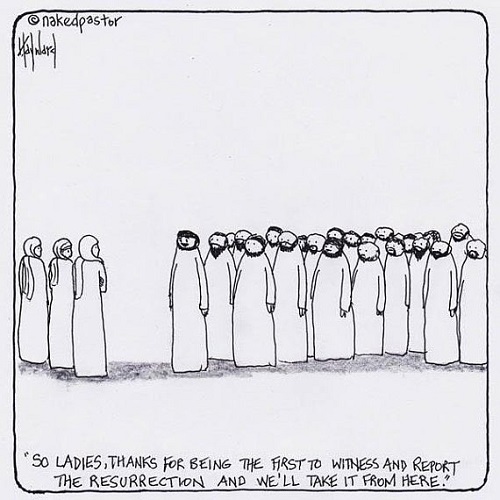
Cartoon by Naked Pastor (David Hayward) which shows 3 women and a large group of men. The men say, "So ladies, thanks for being the first to witness and report the Resurrection. And we'll take it from here." Image source.

I read this post, Life under Patriarchy: Death by a Thousand Cuts, which has a bunch of anecdotes about what it's like to be a woman in a conservative/complementarian church. This one in particular stuck out to me:

When I was alone as a woman in a meeting with the all-male eldership of my church, I explained how difficult it was as a woman to discern how to have both a gentle and quiet spirit and also have a voice in the church. One of the male elders, the NT greek “expert”, interrupted me to soften the meaning of 1 Timothy 2:12. I was referencing 1 Peter 3:4. His interruption (mansplaining) and my confusion about his confusion began the whole meeting badly. Afterwards, as I contemplated his mistake, I realized he had no idea of the burden women carry from these verses. No woman who takes her bible seriously in the conservative church world would confuse these two passages with one another. I’ve been processing the realization that men in the church don’t sit with the call to a “gentle and quiet spirit” the way women do ever since that terrible meeting when I tried to use my voice in a room full of aggressive men.

This struck me because it shows how Christian women who believe in complementarianism have to struggle with it because it just makes no sense. And Christian men who believe in complementarianism aren't experiencing that struggle. Maybe they aren't even aware of it at all! 

This has inspired me to write a few of my own anecdotes, here in this post. (Important background information: I'm a woman.) But first, let me define "complementarianism": So, "complementarian" Christians believe that God created men and women to be equal in worth, but to have different roles. In marriage, the wife has to submit to the husband, and the husband has to love the wife as Christ loves the church. Also, women are restricted in what leadership roles they can have in the church. This plays out differently in different churches, but basically, the senior pastor of the church has to be a man. Maybe a woman can be an "associate pastor" or a "children's director" or "women's pastor" or some other jargon. And in some churches, women can't teach adult men- they can only teach women or children. The details of this differ- is a woman allowed to read a bible passage out loud in front of the church? Does that count as "teaching"? Is a woman allowed to sing in front of the church? Sometimes when a woman talks from the pulpit, these churches have to call it "sharing" instead of "teaching." And some churches don't allow women to speak in front of the church at all.

(Trying to understand how this is "equal in worth" is always left as an exercise to the reader.)

---

When I was growing up, I believed in complementarian because I was taught that's what all Christians have to believe. That's what the bible said, supposedly. I was told that there were some Christians who didn't believe in complementarianism, but that's because they were rejecting the bible, they are bad Christians, they've been influenced by the evils of feminism, they think they know better than God, who made this perfect plan about gender.

So yes, I believed in complementarianism because I didn't know there were other options.

But, the thing is, complementarianism simply makes no sense. Why wouldn't a woman be allowed to do everything a man can do in the church? That sounds sexist and wrong. And what does it mean that a wife has to "submit" to her husband? So like, the husband can control her and tell her what to do? What? That sounds so wrong. Or, when they can't agree on something, the tiebreaker is gender? What? What on earth, that makes no sense.

So, the issue is, I believed I was required to believe in this. But, it makes no sense. So I needed to convince myself that it made sense.

And really, that's what all of Christian apologetics is. That's the problem with apologetics. It's not about following logic and changing your beliefs accordingly, as you search for the truth. It's about "I know I am supposed to believe this, please help me force myself to believe it." 

And yes, there are loads of ways that Christians try to argue that complementarianism isn't as sexist and wrong as it sounds. The wife has to submit to the husband, but they husband has to love the wife, even to the point of laying down his life for her, so actually the husband has the more difficult role. And, it's a lot of responsibility for the husband, to be the leader and have to make the decisions for the family, so the wife should be glad she doesn't have to worry her pretty little head about any of that. Also, she knows he loves her, and she trusts that he will make decisions that are best for their family, because he's such a great guy, so actually it's easy for her to submit to him.

And, they said, this doesn't apply to abusive situations. Some people hate these "wives submit to your husbands" passages because they've been used to justify abuse- but that's wrong! The husband should NOT abuse the wife! And if he is, she has the right to get away from him.

And, they said, normally the husband and wife should discuss things as equals, and agree on their decision together! It's only when they really really can't agree, that's the only time that "submit to your husband" comes into play. If they really really really can't agree, then the husband can make the final decision. But that would happen very rarely- in some people's marriages it never even happens at all!!!

Yeah, I don't buy any of this.

I used to. Because I believed this is what Christians had to believe.

But really, all it adds up to is, trying to make "wives submit to your husbands" mean something different than "wives submit to your husbands." Like... Don't worry! It's not what it sounds like!

How about instead, we just reject the entire thing, rather than concocting these elaborate rationalizations where we basically treat women and men as equals while claiming we totally believe that the women are "submitting" to the men?

Sheila Wray Gregoire has pointed out, the majority of Christians who say they believe in complementarianism don't actually practice it. In their actual, practical, day-to-day lives, they DON'T have situations where the husband and wife simply can't agree, so the husband pulls rank. In actual reality, they live like they are equals. 

They claim they are complementarian, but in practice they are egalitarian. Egalitarian is the alternative, the ideology which I was told Christians are not allowed to believe in. Egalitarian means equality between men and woman, and you don't make rules to restrict people based on their gender. (Please note, though, that many egalitarians don't support queer rights unfortunately. It's equality between straight cis men and straight cis women, and doesn't necessarily go any farther than that.)

And it's a good thing that most complementarians don't actually put it into practice. When people actually live that way, it is sexist, and harmful to women, and abusive.

So how about we just reject the whole thing, instead of pretending we're following it?

---

One time, at church, when I was in high school, I heard someone mention an organization called CBE- Christians for Biblical Equality. This is an egalitarian organization, whose mission is to promote the idea that women shouldn't be restricted from being leaders in the church, etc. Equality.

I was very surprised to hear about this, and my reaction was "... is that... legit?" And somebody at church told me, yes.

I couldn't make sense of it at the time. I guess I thought, surely if that's a legitimate interpretation of the bible, then of course that's what we should all believe. If Christians are truly allowed to be egalitarian, then why on earth would anybody be complementarian? Complementarianism just makes no sense at all, just so clearly makes no sense at all. Surely we believe in complementarianism because there aren't any other options, right? If this CBE stuff really is an option, well... of course I would believe it. Of course all of us would immediately believe it. ...Right?

I guess at the time, I knew very little about it, and didn't really believe it was legit. Because, surely if it was legit, if Christians were allowed to believe in it, well then how do you explain all the complementarian pastors I had met?

---

I used to have such faith that this was right, that when the bible said wives must submit to their husbands, or that women are more easily deceived, or women can't speak in church, I believed somehow it was right and good. I didn't understand how it was right, because obviously it sounds so wrong, but I had complete faith that if we just understood the bible correctly, and followed it, there would be no problems.

I remember one time, when I was in college, and I was with a group of friends driving home from a Christian conference. And we were discussing the bible passages that restrict women. I think there were a few boys and a few girls in this discussion. And, the way we were talking about it was very direct and blunt and not necessarily the sorts of things we would say in front of other people, because they would take it the wrong way because it sounded sexist.

And one of my friends, let's call him Edward, said, "I'm glad I can talk about this with you all, because I know that you're not going to think the bible is sexist. We know the apostle Paul wasn't sexist, and we are just trying to understand how."

Wow, I had so much faith.

---

The big change for me came when I found Rachel Held Evans's blog. That was where I first learned that Christians don't have to believe in complementarianism. Like I said, I had heard there are Christians who don't believe in complementarianism, but they are bad Christians, they are obviously wrong. Well, I read Rachel's blog, and she wasn't a bad Christian. She was the same as me. She was a bible nerd. She was asking all the questions I had always wanted to ask but couldn't put into words.

That's where I learned that we can just reject the whole thing. We don't have to tie ourselves in knots trying to explain how we believe wives have to submit to their husbands, but not like, in a sexist way. Rachel wrote about academic research about ancient Roman society, and how there were reasons that the writers of the bible wrote things that way, in that culture. But in our culture, it's completely different, so we don't have to believe in complementarianism.

Before, I thought I had to believe that there was at least something to it. When the bible says women shouldn't speak in church, in some sense that is true and right, it's just a matter of understanding how. Well, no. We don't have to believe there's anything to it. We can reject it entirely. It's an interesting historical exercise, to research the reasons why the biblical writers wrote that, and what it meant in their culture, but for our own situation now, it means nothing.

---

And that's also when I started reading ex-evangelical blogs, and there were so many stories about how complementarianism and patriarchy lead to abuse. Before, I had heard that there were some bad Christians who used this ideology to justify abuse, but I thought it happens very rarely, and those bad Christians are obviously wrong, so no need to really think about that too much. Well. No. In patriarchal churches, women are constantly mistreated. From small ways like assuming the women will do all the cooking and childcare for church events, to big ways like making a rape victim stand up in front of the church and "confess" her "sin."

Before, I had faith that good Christian leaders- whether they were men or women- were just trying to follow the bible to the best of their ability. I never thought about leaders who are protecting their own power. I never thought about who benefits from this ideology. I never thought about how the debate is different depending on whether you have skin in the game. I trusted that we all just wanted to obey what the bible said, even if it's hard.

Well. Not anymore.

---

I remember there were a few times, back when I was "on fire for God", when I prayed alone in my room, and I covered my head with a towel. Because the bible says women need to cover their heads when they pray. And I had never given it a thought before- I had never met any Christians who actually took that seriously. I think maybe 1 time in my life, I've heard of or met a Christian woman who wears a head covering to church because of those verses, but she said it was just her personal belief and she wasn't trying to tell other women what to do. (Some really conservative churches do require it, though, I have heard.) I was taught it was just a cultural thing and didn't apply to us in modern times.

But, sometimes, when I prayed, I was so desperate, trying to figure out how to get God to do what I wanted him to do. (The God I believed in back then was a he/him.) Like, I wanted my friends to "get saved" (ie, to convert to Christianity), and I wanted it SO MUCH, I was SO WORRIED about how terrible their lives must be without Jesus, I just wanted God to get them to change their beliefs, and I prayed so hard, why wasn't it working? Was there some cheat code I needed to figure out, in order to get my prayers to actually work? The bible says women need to cover their heads when they pray, maybe I should try that. Maybe that's what will get God to finally do it. Sounds ridiculous and sexist, but, worth a shot.

I never told any other Christians about this, because how would I even begin to explain it? The idea that we should actually believe that women are required to cover their heads when they pray- it just sounds absurd. All of my Christian friends would surely think it was absurd and sexist, right? But there it is, in the bible.

(And, if you're wondering, no, my friends still didn't "get saved" after that.)

---

In church, there was a discussion about "wives submit to your husbands," and I started asking for examples.

Because, when I said I just totally don't believe in "wives submit to your husbands," tons of women jumped up with the familiar talking points- "I know my husband loves me, and I trust him, so it's easy to submit to a man like that", etc. Yeah, I've heard it all before. I started asking for examples.

Examples. Asking these women, have there been any situations in your marriage, where you and your husband weren't able to agree, so in the end he just made the decision and you had to submit to him?

I only remember getting an actual answer from 1 woman. I think it was something about, they couldn't agree on what school to send their kid to, and in the end she just went with what her husband wanted. And, when she told me about it, I felt bad for asking. Because it seemed really emotional for her, really difficult for her to talk about. That was probably a bad time in her marriage, they probably argued about it, and there were strong emotions on both sides, and eventually she just reasoned that God wanted her to give up and let her husband do what he wanted, so she forced herself to submit.

That's what we're actually talking about here, when Christians say the husband has the "tiebreaker" vote. We're talking about something that was actually important to her, important enough to fight, to make a case, lay out the reasons to support her point of view, and in the end her god made her just give all that up, like it didn't matter. Because she's a woman and her husband is a man.

F all of that.

---

I posted a link on social media, and I described it as a blog post about "the equality of women in the church."

And one of my friends, let's call him Marvin, replied and said, "Women aren't equal! Some are short, some are tall, [and so on, a bunch of different adjectives describing different subgroups of women]"

And I thought, what on earth? Why is he pretending he doesn't understand what I'm talking about? He's acting like he thinks I said "all women are exactly the same" when actually what I meant was "equality between men and woman."

This anecdote is the first thing that came to mind, when I read that blog post I linked to at the top. Oh my goodness, what if he actually didn't understand what I meant? I thought he was acting clueless on purpose, but what if he wasn't? What if he hadn't spent a lifetime trying to make it make sense, when the bible says women can't do all the things men can do? What if he never really thought about it? What if he had no sense of the amazing freedom I experienced, when I found out I really can be a Christian and not be complementarian- that I can just believe men and women are equal, and not do this whole dance about how the bible says this or that?

Men have no idea.

---

But maybe I shouldn't judge the Christian men for having no idea, because I have committed a similar sin.

I'm straight, and back then, when I read the anti-gay passages in the bible, I just nodded along like there was no problem. If a man lies with a man, it is an abomination. Homosexuals will not inherit the kingdom of heaven. Same-sex relationships are unnatural, sinful, shameful, driven by lust. And I just nodded along, like, ah yes, disgusting.

Years later, I started reading blogs written by gay Christians. They wrote about how hard they struggled, trying to be good enough to be accepted by God, trying to repress themselves, reading the anti-gay passages of the bible and trying to make it make sense. They wrote about how much time they spent, tracking down ancient Greek words, trying to figure out what exactly these passages meant.

And of course, when I first started reading these blogs, I didn't agree with them if their conclusion was accepting themselves as gay. I cared about their struggles, but I couldn't believe that it was okay to accept yourself and go ahead and date people of the same gender. I thought Christians weren't allowed to believe that- only bad Christians who rejected the bible would say that same-sex relationships were okay. Rejecting God's perfect plan for gender, as if you know better than God.

But the more I read, the more I saw that they weren't bad Christians. They were bible nerds like me. They were trying their best to follow God.

And I changed my position, and now I support all queer rights. My God is genderqueer, They/Them. (And I'm asexual.)

It's funny, when someone on the internet talks about being queer and Christian, and then some rando posts a bible verse in reply, as if the queer Christian has never heard of Romans 1. Bro, queer Christians know those passages so much better than you do. Queer Christians have spent so much time, way too much time, parsing the minutiae of ancient Roman perspectives on sexuality.

Straight people have no idea.

And isn't it terrible, how Christians are expected to read bible passages which dehumanize entire demographics of people, and just accept that- because the bible says it, so it must be true? Best-case scenario for a good Christian, I suppose, is you read a bible passage that dehumanizes an entire demographic of people, and you just nod along and don't notice anything wrong. But what if you have personal experience that tells you something's wrong with what you just read in the bible? What if you yourself are a member of that demographic, or you have close friends who are? Then, as a good Christian who believes the bible, you have to force yourself to believe it, even when it sounds so wrong. You struggle to make it make sense, because you believe there are no other options.

How about we just reject the whole thing? 

If your God wants you to discriminate against other people, maybe find a new God. Every day you continue to believe in that kind of God, that's on you. What does it say about you, that you choose to worship a God like that?

---

There's one more thing I need to talk about: What does "faith" mean?

Because I read one blog post after another after another about how complementarianism is harmful, how it makes no sense, how it is used to cover up and perpetuate abuse. 

But... did that mean it was actually wrong? What if God commanded this for a reason? What if there's some really amazing reason why women shouldn't have the same rights as men, and as humans we just can't understand what it is? We're not God, what do we know?

Complementarianism obviously makes no sense- but I was taught that faith is doing things that appear to be ridiculous and foolish, because God commands us to, and somehow to God it makes sense. I was taught that's an important component of being a Christian: sometimes God will tell you to do something completely absurd, and you have to do it.

I don't believe that any more. Instead, I believe what Jesus said: A good tree cannot bear bad fruit. You can look at the results of following a certain ideology, and if those results are bad, you know the ideology itself is bad.

Reject the entire thing.

---

Related:

She was the first (Thank you, Rachel) 

It Doesn’t Actually Matter What Jesus Said About Divorce

They Prayed About It (a post about the #NashvilleStatement) 

I'm a woman, and God created me to do math and build robots

Saturday, September 30, 2023

Blogaround

1. The kingdom of heaven is like: “We Keep People Alive”: As Summers Get Deadlier, a Tiny Church Is Fighting Back (September 21, via) "On June 1, they set up a 'Cooling Center' sandwich board sign out front on Southern Avenue, and soon, 15 to 25 unsheltered, exhausted, and often addicted visitors were showing up each day, frequently with dogs."

2. Genetically Modified Pig’s Heart Is Transplanted Into a Second Patient (September 22) "The heart transplanted into Mr. Faucette came from a pig that had received 10 genetic modifications. Scientists removed three pig genes that cause rapid rejection of pig organs by the human immune system, while inserting six human genes that allow the immune system to accept the organ."

3. Penguins, Postcards & Preservation: Antarctica's Hidden Postal Gem! (September 25, via) The southernmost post office in the world, surrounded by penguins.

4. An Attempt At One Of The All Time Greats (September 27) 1-hour-22-minute meidjuluk/fillomino solve video. If you don't know what that is, don't worry, Simon will explain it.

5. Texas’ ban on certain drag shows is unconstitutional, federal judge says (September 26, via) "'The Court sees no way to read the provisions of SB 12 without concluding that a large amount of constitutionally-protected conduct can and will be wrapped up in the enforcement of SB 12,' the ruling reads. 'It is not unreasonable to read SB 12 and conclude that activities such as cheerleading, dancing, live theater, and other common public occurrences could possibly become a civil or criminal violation.'"

6. MEGAMIND and Nice Guy™ Syndrome (2022) 34-minute video from Cinema Therapy. I love the movie "Megamind" so much.

And also this one: Villain Therapy: LOKI (2021)

7. The Hollywood Writers Strike Proved That Collective Action Works (September 27, via) "They thought the general public wouldn’t support the writers. They were wrong. They thought they could starve the writers out. Once again, they were wrong."

8. What’s the worst job? (September 22) "Human beings are not adapted to microgravity and high radiation. We’ve got enough data now on the consequences of long-term living in space (where long-term is a matter of months — no one is going to be able to live their lives in space)."

9. I hate this article from "Christianity Today": Shannon Harris Wasn’t Content with Being a Purity Culture Stagehand (September 28) It's a review of Shannon Harris (ex-wife of Joshua Harris)'s new book, "The Woman They Wanted," which is about how she was required to give up her own dreams in order to fit the church's idea of what a good pastor's wife is supposed to be. The review starts out well, talking about how it was wrong that the church forced Harris to fit this role. 

But then it starts getting into how Harris has now come to an incorrect view of Christianity. When I say "incorrect," I mean incorrect by Christianity Today's standards. Like, oh now Shannon Harris is advising people to connect "to our own wisdom, to nature and our bodies, to our own fulfillment in work and pleasure, and to our own ways of being and doing." This is, apparently, according to Christianity Today, wrong.

So... basically, what Christianity Today wants to say is, it was wrong that the church forced Harris into a very narrow view of how she was supposed to live. It was wrong not because it was narrow, but because it wasn't the right narrow view. Instead, she is supposed to believe whatever narrow view Christianity Today has about what "the gospel" means.

Ugh, why can't you just let people live their lives? Why can't you just let people tell their own stories, and find meaning in the things that feel meaningful to them? 

Why is it that good Christians can only support survivors up to a certain point- yes, we can listen to them talk about the bad things that happened to them, yes we can agree that those things were wrong, but then when the survivor starts to talk about how their beliefs have changed as a result, oh no, stop, we have to write articles to warn people away from listening to this heresy! Come on.

It's like I said in my post When Christians Say "We're Sorry":

If Christians really are sorry, they know that people need to heal on their own terms.

But of course, like I said earlier, believing in hell screws this all up. Because how sorry can you really be, and how much freedom can you really allow a victim to have, when you believe in a God who won't care about that on judgment day? When you believe in a God who doesn't care that church people hurt this person, and for their own mental and emotional health, they never went to church again... when you believe in a God who says you're out if you don't believe these specific doctrines about Jesus- no excuses.

How sorry can you really be when you worship a God who puts "the gospel" above caring for victims?

How sorry can you really be if you still believe you have all the right answers and everybody better listen to you?

Anyway, I'm definitely interested in reading Shannon Harris's book.

Thursday, September 28, 2023

Twitter killed Tweetdeck. Also, I'm on Pillowfort now.

Logo for the site Pillowfort- it's fancy text that says "Pillowfort." Image source.

So, I'm still on twitter (@pnumber628), but I keep asking myself, why am I still on twitter? It's just Elon Musk starting drama now, one bizarre policy change after another (charging money for blue checks, not allowing people to view tweets if they're not logged in, changing the name to X, claiming he will remove the "block" feature, etc). I keep telling myself, I will probably quit using twitter soon, and that will be an improvement in my life.

Well. On August 17, I published a new post, and went over to Tweetdeck to schedule several tweets to promote it throughout the night (which is daytime in the US where most of my readers are), and... I can't access Tweetdeck. Instead I get a message that says I should pay for some upgraded version of twitter. What? So, a bit of googling finds this: Twitter finally figured out how to kill TweetDeck, by putting it behind a paywall.

And, all right, well that gave me the push I needed to get serious about quitting twitter. Like one of the main things I was using it for was promoting my blog... I would schedule around 4 tweets, every single day, with links to my new blog post from that day, or an old post from the archives. Now I can't, so like, what's even the point of using twitter?

Now you may say "well you can at least tweet a link manually every time you publish a new post, even if you can't schedule several of them to post throughout the day" but I don't even feel like doing that any more. So I haven't been tweeting about my new blog posts at all.

So then I made an account on Pillowfort. What is Pillowfort? It's a social media site that I've seen some ace bloggers talking about. It seems to be smaller than other social media sites, and people like it because it's generally a positive environment and not full of people arguing with each other. A lot of ace people there, a lot of queer people, a lot of artists sharing their art, a lot of people interested in various fandoms- that's my overall impression of what people are using Pillowfort for.

"Oh," you may say, "so Pillowfort allows you to schedule your posts, that's why you're using it as an alternative to twitter." Well no it doesn't. But I don't feel that I need to schedule several posts to promote each blog post I make, because on Pillowfort you're not constantly bombarded with new stuff- like, I don't feel like my posts will get lost in the noise. So I just put 1 post on Pillowfort for each new blog post I publish here.

It's not really an alternative to twitter- it doesn't do all the exact same things twitter does. But that's fine for me. I don't need it to do all the exact same things twitter does. I just want to be on a social media site that feels like it's actually worth using, not a site that makes me feel like "I'm gonna quit this soon, and that will make my life better."

If you're on Pillowfort, go ahead and follow me! Here's my page: https://www.pillowfort.social/perfectnumber628 . And for some posts about how to use Pillowfort, see this list of links (uh currently I don't have permission to view this link? maybe the user will change their privacy settings so we can see it? it was a really useful post with a bunch of links about using pillowfort), the Pillowfort101 community (where new users can ask questions), and Advice for new users. It's kind of different from what most people expect from social media sites- it doesn't have an "algorithm" (I mean, it does, "sort by timestamp" is an algorithm), it just shows you a feed of the users and communities you chose to follow, rather than bombarding you with whatever it guesses you will be interested in. So when you first get started, there's not really anything to see on your home feed. My advice is, go and follow a bunch of people and a bunch of communities, indiscriminately, and then later you can unfollow them if you don't like them. Whenever you see anything or anyone you feel like you might like, follow them. You can always unfollow later.

But the reason I'm still on twitter is... back in the day, I had a really really good community of ex-evangelical Christians/ ex-evangelical atheists/ feminist Christians/ progressive Christians/ queer Christians on twitter. I used to say "twitter is my church." This was way long ago, like 2014 maybe? Twitter started going downhill for me in 2016, when it became a lot of doomscrolling, lots of posts about all the bad things that are happening and why they're going to get worse. And there was more of that when the pandemic came in 2020. And just over time, it seems like a lot of the people I used to follow have drifted away. A lot of the bloggers I followed back then aren't blogging any more. I still see a few tweets every day that are worth reading- like jokes about growing up evangelical, or proclaiming that Christianity is about setting the captives free rather than whatever Republicans are claiming that Christianity is about... and that's why I still use twitter... but it's not like it was before, and I feel like maybe it's not worth it for me.

So, my real question is, where my queer Christians at?

Like where are the online spaces where people are talking about what Christianity can be when it's actually about doing justice, loving mercy, and walking humbly before God, rather than about following all the rules that some old straight white guys made up? Where everyone knows that the image of God is trans, because God contains all the genders, just like Genesis 1 says: They made the day and night and everything in between, They made the land and sea and everything in between, They made male and female and everything in between. I want to talk about Black Lives Matter and how Jesus was a victim of lynching, and Christ is crucified again every time an innocent black person is killed in the street by police. And what actual repentance for the sin of racism would look like- real repentance, rather than just pretending it doesn't matter any more. I want to be in a Christian environment where it's taken for granted that women have full equality with men- I don't want to waste my time on people who think "women can't be pastors" is a valid opinion to hold. I want to read the bible in new ways, feminist ways, trauma-informed ways, queer ways. To see the bible not as something that has 1 correct meaning that we have to work very hard to figure out, but as something that can be meaningful to different people in so many different ways, and that's beautiful.

And so on- I could go on forever about the Christianity I believe in.

Years and years ago, when I first started blogging, I did have an online Christian community like that. But now not really. There are still a bunch of very good blogs that I follow, but I don't feel like there's a space where we can all talk about our ongoing process of figuring these things out. Some blogs are so huge, I don't even try to wade into the comments section because my comments will get lost in there among all the others. Twitter used to be that space for me, but it's gone wayyyy downhill and now I don't have a space like that.

So, still looking for my queer Christian church.

But anyway, the point is, I'm on Pillowfort now! I'm really happy with it so far. Like I said, I like having a social media site that feels like it's actually worth using, not like "I'm going to quit this soon and that will make my life better." If you're on Pillowfort, go ahead and follow me!

Sunday, September 24, 2023

Blogaround

1. British media report rape and emotional abuse allegations against Russell Brand (September 16) [content note: rape]

2. Lauren Boebert Caught Fondling Date’s Genitals During Family-Friendly Musical: Video (September 15) "The incident spawned various social media posts, including many wit the phrase "Not a drag queen," along with the video of Boebert involved in the handsy behavior."

3. On the scientificity of string theory (September 17) "Frankly, you probably shouldn’t have any opinion on string theory at all, and it was a mistake for science communicators to have ever encouraged you to have one."

4. A Sin to Eat: The Untold Story of Anorexia as Religion (2022) [content note: eating disorders]

5. Review of the Problems with For Women Only by Shaunti Feldhahn (with download) (September 20) Glad to see this Christian marriage book being called out as harmful. I read this book, "For Women Only," probably when I was in high school, and basically what I remember from it was, "no but seriously, you need to have sex with him." It was advice for wives on how to have a good marriage, and somehow it just kept coming back to how men need sex so much, if you don't have sex with your husband enough, you're destroying his manly self-esteem, he's going into work every day feeling like a broken shell of a man, women just can't possibly ever understand how important sex is for men, etc. 

I read it back when I didn't know anything about what sex actually was, so I totally bought into it.

And, like... I can't blame all this on "For Women Only" because I've read a lot of other Christian resources that say the same things, but... when I started having sex, and it was painful (because of undiagnosed vaginismus) I felt like I couldn't tell my partner that it was painful, because oh it would be so terrible if a man feels "rejected", his self-esteem is so dependent on having a woman give him 100% positive experiences during sex and never suggesting that anything is wrong... I spent so much time trying to think of the most polite, positive way to say "this hurts, let's not do it."

Another anecdote- there was this one guy I was dating, who used to rub the ends of my fingers when we were holding hands, and I hated that so much, it just didn't feel good at all. But I felt like I couldn't just tell him "stop that," I had to come up with a very polite way to say it, so that he didn't "feel rejected" or whatever... It was just touching my fingers, it wasn't anything sexual, it wasn't a sin, it wasn't damaging my "purity", so I felt like I didn't have the right to say no. See, that's what purity culture teaches: instead of teaching consent, instead of teaching that it matters what I want, and if I don't want someone to do something to my body, I have the right to say no, regardless of whether I have a "good reason"... instead of that, purity culture teaches that you must ABSOLUTELY NOT do anything sexual before marriage, but if a guy wants to do something that's not off-limits (like having sex if you are married to him, or doing non-sexual things that don't affect "purity") then you have to say yes because it would be just terrible if a guy "feels rejected."

6. On Stage and in a Wheelchair (September 21) "There are 85 million people with disabilities in China, but the population is easy to overlook. In interviews and press engagements, Zhao has repeated the same message over and over: This isolation cannot continue. People with disabilities want to feel integrated, to be a part of normal life, and to feel seen."

7. Refusing to Censor Myself (September 11, via) "Because I suspected I wasn’t the first marginalized author who’d been asked to make this kind of edit, who’d been limited this way, who’d been forced to choose between opportunity and their own morals."

8. Life in a Glass House: Diatoms Shatter Young Earth Flood Geology (2015) "The YEC [young-earth creationist] flood geology hypothesis utterly fails to explain the observed distribution of diatom fossils."

9. Lost the Plot (Newsboys) | Lyric Video A song from 1996.

10. What Does Star Trek Actually Say About Euthanasia? (September 20) [content note: euthanasia, death] 42-minute video from Steve Shives.

Friday, September 22, 2023

The Great Sex Rescue: Lust

Distracted boyfriend meme. A guy is walking with his girlfriend, but he is turning his head to look at another woman, and the girlfriend looks exasperated. Image source.

Links to all posts in this series can be found here: Blog series on "The Great Sex Rescue"

---

We now come to chapter 5 of The Great Sex Rescue: The Lies You've Been Taught and How to Recover What God Intended [affiliate link]. This chapter is about the way that evangelicals talk about "lust."

The chapter starts out with an anecdote about a wedding that Gregoire and Lindenbach attended, where the couple wrote their own vows:

But at the end of the vows, we turned to each other with surprise. They forgot something important-- "forsaking all others." It was just an oversight but, nevertheless, that is a rather crucial promise. We're supposed to expect that our spouse will be able to say, in the words of the 1950s jazz group The Flamingos, "I only have eyes for you." Despite the stretch marks and the baby weight, despite the expanding middle and the receding hair, despite the years and the wrinkles and the fading health, we want to know "I am yours, and you are mine, exclusively and forever." That's safety. That's acceptance. That's love.

That's what we all dream of.

But is that all it can ever be-- just a dream?

Umm. Okay. You know some people are polyamorous, right? 

And some people aren't interested in marriage.

Like, it's literally not true that "we all dream of" having 1 lifelong monogamous partner.

I find it quite weird that the chapter about lust starts out with an anecdote about monogamy. Setting it up like lust and monogamy are opposites. Just seems like a really weird framing to me. 

And actually, later in the chapter we will see that their solution to lust is to respect people and recognize that they are entire human beings and not sex objects. (And yes, I agree with this solution.) So actually, this chapter ultimately says that respect is the opposite of lust. So why does the chapter start with a little story about monogamy?

I would say there are 2 separate issues here:

  1. You're lusting after some random person, objectifying them, imagining that they are just a sex object that exists to play out your fantasies- this is a sin against the random person.
  2. Your desire for this random person becomes such a big deal to you that it actually threatens your relationship with your actual partner- this is a sin against your partner.

I don't necessarily see why problem #1 would lead to problem #2. Yeah, sure, sometimes it would, like if someone cheats on their partner. But problem #1 is bad just by itself, without bringing concerns about faithfulness to a monogamous relationship into it. 

And, also, being attracted to other people is fine, that's just part of life for most people, it's not "lust", and I don't see it as having any relation to whether or not you're keeping your commitment to monogamy.

At this point, I think it would be helpful for me to bring in some concepts that are talked about a lot in the ace, aro, and polyamorous communities. ("Ace" means asexual spectrum, "aro" means aromantic spectrum.) Okay, so, there are several different types of things that may or may not be present in a relationship:

  1. Sexual feelings/actions
  2. Romantic feelings/actions
  3. Being life partners

Mainstream society says that you're supposed to do sexual things with exactly 1 person, you're supposed to do romantic things with exactly 1 person, and you're supposed to have a partner that you're committed to for life, to support each other through all of life's ups and downs, and that these all have to be the same person.

I'm really glad we have ace, aro, and polyamorous people to question this! It doesn't have to be that way! You could be married to someone and not have sex at all! You can date someone even if you don't understand what romance is! You can have a long-term committed relationship that isn't sexual or romantic at all! You could be married, and your spouse is your committed life partner and you have sex with them, and also you have sex with other people sometimes. Many possibilities!

It's all about knowing yourself and knowing what you want. What do you want, in terms of sex, in terms of romance, in terms of having a committed life partner?

For myself, maybe my answer is boring because I'm in a monogamous marriage and I do have sex with my husband. But, even so, I feel rebellious because I'm not following the definition of monogamy that I learned in purity culture- because when I'm attracted to some random person, I don't repress it. I just enjoy it for what it is, but obviously I know it's just some feelings and nothing real is going to come of it because I'm monogamous. 

And it doesn't threaten my relationship with my husband, because marriage is about choosing to be together, and being committed to each other- it doesn't mean we never have feelings about other people. We are 2 separate people with our own complicated lives, and we choose to live together, to support each other, to share our money, to raise our child together, all these very standard marriage things- and that's not threatened by having occasional feelings about other people, because those feelings are a totally different thing than the day-to-day reality of building our lives together. And yes we do have feelings of attraction for each other, but my point is, our relationship is so much deeper than that, and if there exists someone who's more attractive than my husband, well, so what? That doesn't threaten my marriage because my marriage is so much more than that.

Purity culture always made such a big deal about how it would be SO TERRIBLE if you compared your spouse to other people... for example, if you had sex with someone else before marriage, then when you're married and you're having sex with your spouse, you'll always be comparing them to your ex, and that would just be THE END OF THE WORLD or something... It feels so shallow to me now. Why would any of that matter? Our marriage is so much more than that.

All right we'd better move on because we're only a half page into this chapter and I've already written this much.

So, this chapter is about lust. One of the most popular Christian books on the topic of lust is "Every Man's Battle" which erases ace men right in the title, so you know it's gonna be bad. The authors of "The Great Sex Rescue" also think it's bad; this chapter is basically about the harm that is caused when people buy into the "Every Man's Battle" ideology.

"The Great Sex Rescue" sums up "Every Man's Battle" this way:

And what was this battle that every man was fighting? Lust. Every man struggles with it, every man is tempted by it, every man must fight really, really hard to overcome it.

Oh and also, remember how I said this "every man's battle" ideology acts like ace men don't exist? Well it also acts like gay men don't exist, because it's only talking about men lusting for women. It's also not great for bisexuals, because if the solution to lust is that men and women can't have close friendships with each other, then by that logic, bisexuals aren't allowed to have any friends at all.

The book "Every Man's Battle" features really over-the-top descriptions of men ogling women, masturbating near nonconsenting women, obsessing over breasts all the time, and it frames it like all of that is completely normal, this is just how God made men, and men need to fight the battle by treating women as threats and avoiding them. Gregoire has a really good blog post summing up just how bad this book is: A Summary of Issues with Every Man's Battle (with download).

Gregoire and her co-authors point out that this "every man's battle" ideology sets the bar so incredibly low for men. Like it's expected that men aren't able to treat women as people. Like men will inevitably see women as nothing more than sex objects- so instead of sex objects to fantasize about, men need to see them as sex objects to avoid.

Gregoire et al point out that one of the biggest problems is how attraction is conflated with lust. There's nothing wrong with being attracted to someone. There's nothing wrong with noticing. And they say that instead of fearing that every attractive woman is a threat that will pull men toward the sin of lust, men can simply notice a woman is attractive and then "Think nothing more of it and go on with your day." I like how their approach has no fear. Instead of fear, it's confidence that men can "defeat lust." (I personally can't tell you if lust actually works that way, because I'm asexual, lololololol.)

There are a few anecdotes in this chapter about men whose experiences are very different than what "Every Man's Battle" says:

The first chapter of Through a Man's Eyes [another book similar to "Every Man's Battle"] explains the battle that men face on a daily basis with sexual stimuli all around them: trying not to look at billboards on the drive to work, trying to bounce their eyes from the barista's chest, worrying that a female coworker in a tight blouse might sit directly across from them. In the book, we read the "Jack breathes a sigh of relief" when a coworker's skirt doesn't ride up too high, and "the next few hours are tough" because another attractive coworker is in high line of sight.

My (Sheila's) husband works in an almost all-female setting (he's a pediatrician; his colleagues are female, the nurses tend to be female, and the parents bringing in their kids tend to be female). Did he experience this level of stress all day? After reading that chapter, I asked him. He laughed. I asked again. He made another joke. I got rather perturbed that he wasn't taking me seriously.

"Wait," he said, "you're saying that there are guys who are stressed to go to work because they might lust? That's crazy." But could I believe my husband? The book told me all men struggle with this, but they don't know how to explain it or are afraid to confess their struggle to their wives.

And this story, from Chris, a commenter on Gregoire's blog:

As someone who grew up in the Every Man's Battle / purity movement era, I've been working on resetting my brain for a few years now. So many years of struggling daily to just avoid looking. The Bible says His burden is easy and His yoke is light, but spending every part of every day spending energy to make sure I didn't look at an attractive woman is the opposite of easy and light.

I was forced to confront my wrong thinking while on a vacation in Europe. The first day on a topless beach in Spain was excruciating. I was giving myself a migraine constantly bouncing my eyes but having nowhere to bounce them to. I was definitely not enjoying the beautiful beach nor enjoying time with my beautiful wife. 

Near the end of the first day I realized this was no way to live. I remembered your writing about focusing on the whole person without making them into a sexual object.

I talked to my wife and explained all this to her... With some fear and apprehension, I looked up at a beach full of [breasts] and started to talk through the process of not making them there for my sexual gratification. The rest of the trip was so relaxing and enjoyable, and I had such a good time with my wife on the beach. Since then, I can see an attractive woman and not become aroused.

I think Chris's story here is very important and powerful. It completely disproves some of the main foundational beliefs of purity culture- that men are overwhelmed by lust and can't control themselves, that women need to cover up and can't possibly expect a man to respect them if they aren't covered up, that a woman showing her body in public is inherently dangerous and is an attack on men, etc.

There's also a very good anecdote in the book about a husband who doesn't "struggle with lust" but his wife totally buys into the "all men struggle with lust" ideology, and so she's always paranoid that he's looking at other women, and that this is a threat to their marriage. She doesn't take him to swimming pools, she won't let them be friends with other couples if the wife is attractive, etc. Yeah, this is really messed-up. (And also, this is an example of lust getting conflated with concerns about commitment to monogamy, and I think that needs to be questioned. If your husband is attracted to other women, that's his own business and doesn't affect his relationship with you. Right? It only becomes a problem if he gets it in his head that he should actually take actions to go have romantic/sexual experiences with another person.)

I'm just thinking right now about how much energy I would have to spend worrying every day, if I thought my husband being *somewhat near* an attractive woman was a dangerous thing that threatened his love for me and commitment to our marriage. Wow, so glad I'm not doing that! He can talk to other women, he can meet up with a woman alone, whatever. I trust him. I also meet up with guys alone sometimes. I'm so glad it hasn't even occurred to me that that would be a problem. (No Billy Graham rule here!)

Moving along, the next bit of "The Great Sex Rescue" says that these books about lust claim that they want to help women understand men better. That women need to understand men's "struggles", or something. But, the authors of "The Great Sex Rescue" found, in their survey of 20,000 women, that women who believed in the "all men struggle with lust" message had lower levels of marital satisfaction and sexual satisfaction. There are a bunch of stats here; I'll just copy one of them: Women who believe "all men struggle with lust" are 79% more likely to agree with the statement "I engage in sex with my husband only because I feel I have to." This is so messed-up.

And there's this quote:

"Men seem like untrustworthy pigs whose minds and thoughts just go wherever they want," [Brenda] commented. "Is nothing sacred to them? As women, do we trust men after reading this? ... I feel that if anything ever happened to Fred, I'd never remarry because I would have very little trust in men." -- the wife of an author responds after reading her husband's words in Every Man's Battle

Yes, really. The "Every Man's Battle"'s author's wife says she's disgusted by what she "learned" about men from reading that book. Ya know, the more I'm out of purity culture, the more I realize that a lot of the things that Christian leaders teach about sex, marriage, dating, etc are not objectively true facts about how God Says This Is How It Works For Everyone, but actually just their own individual weird hangups. "Every Man's Battle" says this is just how all men are, and that's normal and women shouldn't expect men to be decent human beings, but actually the reality is, the authors are just describing themselves. Yikes.

I'm glad I didn't read "Every Man's Battle" back when I believed in purity ideology. I would have totally believed it, because what do I know, I'm not a boy, and one of the core tenets of purity culture is "women just can't possibly understand what men are going through." It's been really good and life-giving to me now whenever I see men on the internet just completely shocked by what evangelicals say "all men" are like- immature, no self-control, obsessed with sex all the time, incapable of respecting attractive women, self-esteem so fragile- I love to see men, especially non-Christian men, just so completely shocked at how wrong this is, how insulting, such a low view of men. Men are better than that, and should be held to a higher standard than that.

"The Great Sex Rescue" has an anecdote along those lines too:

[a blog commenter is talking about her husband who recently became a Christian, and had no idea that men supposedly "all struggle with lust"]

He has only recently become aware of the lust issue within the church, and he has been appalled. Most of his friends have generally been women-- he even had a best woman instead of a best man at our wedding-- and most of them are quite attractive. But even as a non-Christian he told me he didn't lust after them. It was far too disrespectful.

It is crazy to him-- and me-- that even as a non-Christian he could control himself, but the church treats this as an insurmountable obstacle for men who are indwelled with the Holy Spirit! He has told me that the easiest way not to disrespect women is to view them as people. If a non-Christian could figure that out, what is giving the church so much trouble?

I'm not a fan of the prejudice against non-Christians here, the idea that obviously Christians should be more moral than non-Christians. I say there's nothing wrong with being non-Christian, or Christian, or whatever religion, or non-religious. And I'm glad my husband is not a Christian- for one thing, he doesn't have all the purity baggage I have... But I appreciate this anecdote because of the contrast between how much of a big deal Christians make this, an "insurmountable obstacle"... and the non-issue it is for people outside the church.

Anyway, yeah, "The Great Sex Rescue" says the solution to lust is to respect people. To remember that the attractive people that you happen to see are whole people who have their own lives- they don't exist to be sex objects for you.

Here's their advice for men:

How Men Can Fight Lust:

The key to fighting lust is to see women as whole people rather than potential threats.

  1. When you are passing by a woman, instead of bouncing your eyes, look her in the eye, give a quick, friendly nod, and turn away.
  2. When you are with a woman, look her in the eye, and engage her in conversation. Ask her opinion about different topics.
  3. Don't live a sex-segregated life. Join groups where women are in leadership roles or where women's opinions are considered.
  4. Identify women in your life from whom you can learn, whether it's advice about work, parenting, finances, etc. Make it a practice to consult women as well as men when you are making a decision.

Yes, basically I agree with this, but also, wow the bar is on the floor. Why do these things even need to be said? Just act normal, don't act all jumpy and scared of sex every time there's a woman nearby. Women are people, just treat us like people.

So, yes, the bar is on the floor, but also, these things really do need to be said, and I'm glad that Gregoire and her co-authors are saying them. Because, wow, when I started reading her blog, and reading these kinds of messages... this is unlike anything I'd ever heard from Christians. Really. 

(And here's a fun little bit of my history: In 2012 I was thinking about these topics, and I wrote a post called Isn't dating the opposite of avoiding lust?. It addressed the idea that, if I'm supposed to avoid "temptation," then doesn't that mean I shouldn't date someone that I'm attracted to? If we're dating, spending a lot of time together, doesn't that make it likely that I will lust? How can I justify putting myself in a situation where I'm likely to sin? And the answer I gave was, no actually, this way of thinking is all backwards- because when I'm attracted to someone I don't know well, I view him kinda one-dimensionally, like his being attractive to me is his most important characteristic, and that sounds much more likely to cause "lust" than actually getting to know someone by dating him. Kinda interesting to me to realize I was writing about that in 2012, but also I had NO IDEA I was asexual, and I was using words like "hot" and "lust." Looking at it now, I know what I meant by those words, but now that I know that I'm asexual, I realize those words mean something different to most people, so I wouldn't write it that way now. And also, the last bit of the post, where 2012-Perfect-Number gives advice to before-2012-Perfect-Number, "Don't be so afraid. God gives us freedom." ... like wow yeah, that's so real.)

And "The Great Sex Rescue" has a few anecdotes from women about how they were treated by "good Christian men" who refused to even look at them or talk to them. Men who are good and godly and therefore won't take the risk of being anywhere near a situation that could lead to sexual temptation. This is not cool, and it leads to women feeling like they are dirty just for existing. (And, this is NOT how Jesus treated women. Jesus met women and talked to women and connected with their spiritual questions and emotional needs and so on, even in situations where society said it wasn't proper for a man to talk to a woman, and even when the women were sex workers. No Billy Graham rule here.)

The next section is about modesty, because modesty is the other side of the coin. Men are taught "you have to fight lust" and women are taught "you have to be modest, to help men fight lust." Yeah, I have blogged a lot about modesty, and I agree with the criticisms that Gregoire and her co-authors write here. I especially appreciate the quotes from Focus on the Family's "Brio" magazine, because I also read "Brio" when I was a teenager, and it influenced me to follow purity culture. Gregoire's co-author, Rebecca Lindenbach, says this:

My curves made it impossible to dress according to some people's modesty standards without going back a few centuries. My body became the problem. And Brio reinforced this idea that my body was dangerous with messages like these: "If a guy sees a girl walking around in tight clothes, a miniskirt or short shorts, you might as well hang a noose around the neck of his spiritual life."

Yeah, not cool how modesty ideology says female bodies are inherently dangerous and sinful.

And I'm glad to see "The Great Sex Rescue" mentions "The Modesty Survey" and Shaney Irene's excellent blog post from 2013, Why The Rebelution’s Modesty Survey Was A Bad Idea. Yeah, "The Modesty Survey" influenced me a lot... I guess it was so bad, that it caused me to obsess over it and worry and try to make it make sense, which led to me realizing the entire concept of modesty is bad and needs to be thrown away. So.

Some of my posts on modesty:
The Story of Me and Modesty - This is the post where I talk about how "The Modesty Survey" affected me.
August 20, 2022 Blogaround - I also wrote some opinions about "The Modesty Survey" here
Modesty is Causing Women to Stumble
The Male Equivalent to Modesty

I also love Laura Robinson's take on modesty: Women Are Never Going to Cover Themselves Enough to Get Men to Shut Up About Us 

Anyway, there's 1 more section left in this chapter of "The Great Sex Rescue", and it's about how evangelicals teach that "men are visual" and women are not, but actually that's not always true. There are women who are visually stimulated to have sexual thoughts, and there's nothing wrong with that, and it's NOT COOL how the church acts like these women don't exist.

I definitely agree with the point that Gregoire and her co-authors are making there! But I don't have any personal experience to mention because I'm asexual. 

Anyway, that sums up chapter 5. Overall, I agree with what the authors are saying in this chapter- the way that evangelical culture treats "lust" is harmful. Teaching men to see women as threats, to avoid women rather than risk falling into "lust", teaching women that all men are like this and we can't really expect a man to get his head out of the gutter and interact like a normal human being, and that goes even more when women are wearing "immodest" clothes- ugh, yeah, all of this is so incredibly messed-up. I agree with "The Great Sex Rescue"'s answer to this: respect, and treat each other like people rather than potential sex objects.

Still, I think this chapter falls short because it doesn't say anything about gay men or asexual men, and how they are erased by this "all men struggle with lust [toward women]" ideology. And also, that weird bit about monogamy at the beginning. Actually, I think the conversation about lust could benefit by clearly untangling the parts about "are you objectifying random people?" from the parts about "are my spouse's feelings of attraction to random people a threat to our marriage?"

---

Links to all posts in this series can be found here: Blog series on "The Great Sex Rescue" 

Related:

The First Time I Heard About "Locker Room Talk" Was When the Church Taught Me About Modesty 

The church taught me to be afraid of my own body and my own thoughts. Here are the receipts. 

BREAKING NEWS: Purity Culture Adherents Completely Miss the Point

Miss me with your "we are all sexually broken" hot takes. I'm asexual.

AddThis

ShareThis