Friday, October 20, 2023

Blogaround

1. I feel like I should say something about what's going on in Palestine? I don't know what to say though, it's just horrifying, and posting on the internet "I stand with Palestine" doesn't actually help anything... I just wish people would stop bombing people.

2. Idaho hospital closes its maternity ward, citing the state’s ‘political climate’ (March 22)

3. The Trouble With Circular Reasoning Is.... (!) (October 15) 1-hour-21-minute sudoku solve video.

4. China joins Apostille Convention - no legalization for public documents (March 14) Well this will (hopefully) decrease the amount of bureaucracy that immigrants in China (like me) have to deal with. See, the way it is now, if you're applying for a visa or something in China, you have to bring a bunch of documents, and if the documents were issued in other countries, they need to be "legalized" by some Chinese authority to prove they are real. I'm not sure exactly what documents this change will apply to- off the top of my head, I'm thinking about things like diplomas and marriage licenses. (But also, don't get too excited- I would be 0% surprised if China invents some new bureaucracy steps to replace the old ones.) The change goes into effect on November 7, 2023. 

5. Sex and the end of the world (October 16) "The future they’re being told they’re never going to have was already a life of futility and meaninglessness. So when they’re told that future won’t be there for them, they’re not going to think about all the things they’re never going to get to learn or to teach, to create, to build, to share, to discover, or to enjoy. They’re not going to think about how they’ll never get to break every chain, or to let justice roll down like waters. The main thing they’ll think about missing out on will be the main thing they’ve heard about in youth group from day one: sex."

Damn. Preach.

6. Ending Junk Fees, the Most Annoying Thing in American Commerce (October 15, via) "We’ve all experienced these in one form or another. You go to a hotel, and instead of being given the price quoted to you online, they add a $25 'amenity' fee, or 'resort' fee, or something like that." Wow, reading this article, I'm like... astonished at the idea that the government could really stop businesses from charging hidden fees. Like, I always thought that's just the way it is, and as a consumer you need to know that the price it says isn't really the price it is, and be prepared for that. But, man, no, it DOESN'T have to be that way.

I remember the first time I came to China, buying things at a mall or restaurant, and the price that it said on the price tag was the price it ACTUALLY WAS, and that BLEW MY MIND. No extra is charged for tax or tip- that's all already included in the price on the price tag. And now that I think about it, even for bigger things in China (hotel rooms, etc), the price that it says is, quite often, LITERALLY the price that IT IS, even though I've always been prepared to pay more because that's what I expect as an American.

7. Solving Fractal Mazes (October 18) "With all that explanation, I hope you’re half as excited about fractal mazes as I am." Yesssss.

8. Making It So: A Memoir [affiliate link] I just found out that Patrick Stewart has published a memoir. Oh I am so excited about this!

9. Trump Gets the Corporate Death Penalty (And It's Getting Worse) (October 7) 22-minute video from Legal Eagle, explaining what's going on with the orange antichrist's businesses in the state of New York. Basically the court ruled that he loses all of his business licenses in New York. Wow. As one of the comments says, "You know it's bad when the lawyers stop saying allegedly."

10. Biden urges striking auto workers to ‘stick with it’ in picket line visit unparalleled in history (September 27) "The fact of the matter is that you guys, the UAW, you saved the automobile industry back in 2008 ... you made a lot of sacrifices. You gave up a lot. And the companies were in trouble. Now they’re doing incredibly well and guess what? You should be doing incredibly well."

11. Once Upon a Studio | Official Trailer | Disney+ (September 22) There's a new short film to celebrate Disney's 100th anniversary, and it's SO GOOD. It's cartoon characters from almost all of their movies, coming together to take a photo. The link I'm posting here is just a short trailer- I didn't find the entire video available on youtube. (I watched it on bilibili, a Chinese video site.)

Tuesday, October 17, 2023

On Marriage as an Immigrant in China

A world map, with a heart in the US connected to a heart in Europe. Image source.

I'm a US citizen; my husband is a Chinese citizen. We got married in China, we live in China, and we have a son who was born in China. A few days ago I wrote a post called Why Marriage as a Private Contract is a Bad Idea, which included the idea that people don't think about the fact that marriage is an actual legal arrangement which comes with certain rights/obligations/restrictions- they just think in romantic terms like "we want to spend the rest of our lives together, so, we get married." This post will be about how that relates to my situation as an immigrant who got married in China.

When we got married, the legal process of it worked thusly: I had to go to the US consulate in Shanghai and get a document that states I wasn't already married. (If I had been married before, I would have had to bring proof of divorce or death, when I went to get this document from the US consulate.) I just had to swear that I'm not already married, and the US consulate didn't do anything to check if it's true or not, they just believed me and wrote up a paper that says so.

Then we had to go to my husband's hometown, because his hukou is from there. What is a hukou, you ask? Ah. Well. The hukou system is very important in China, so let me explain it. A hukou is a document that all Chinese citizens should have, that states what city in China you are officially a resident of. In the city where your hukou is, you enjoy some rights that non-locals don't have- things related to access to public services like schools, health care, buying property, etc. Some hukous are better than others- for example, a Beijing or Shanghai hukou is seen as really valuable to have, whereas a hukou for some little city in the middle of nowhere, like, who cares.

It's not that each individual has a hukou- it's the household that has the hukou, and all the family members' names are on it. So for many people (such as my husband) their hukou has their parents' names on it, and their name. And the actual physical document is in the parents' possession, in their hometown. Lots of people in Shanghai are in this situation- they live in Shanghai, but their hukou is a hukou from their hometown rather than a Shanghai hukou, and they don't actually have it physically, their parents have it in a different city.

In China, lots of people move from small cities to big cities to find jobs. But just because you move to another city, and live there for a long time, doesn't mean you can change your hukou to that city. Each city has requirements about what you have to do to get a hukou (for example, how many years you have to work and pay taxes, how high your salary has to be, what level of education you should have, etc). I know people who, after living in Shanghai for a long time, were able to get a Shanghai hukou, and remove their name from their parents' hukou.

Anyway. So. When Chinese people get married, it has to be in one spouse's hukou city. They can't just get married anywhere. So, we went back to Hendrix's hometown, brought all our documents, and got our marriage licenses there. (We later held the wedding in the US- in China, getting legally married is a completely separate event from the wedding.)

Okay, so that's the legal aspect of getting married in China. Also, we have to be a man and woman because China doesn't allow same-sex marriage. (Same-sex couples would have to go to a different country to get married, I'm not sure on the details of this, sounds complicated.) Beyond that, I didn't think about the legal aspects at all.

Later, we started the process of applying for a US green card for my husband (but now we're not sure about the timeline for moving to the US, so we're currently not really moving forward with it). That's a very significant legal benefit that comes from marriage- if you're married to a US citizen, there's a straightforward, reasonable process to get a US green card, and eventually US citizenship. If you're not, well... it might not even be possible.

In China, my status as a legal immigrant is dependent on my job, not my marriage. If you're in China on a marriage visa, you're not legally allowed to work, so that's why I don't have a marriage visa. But it is nice to know that if I lose my job, and I can't find a new job before my residence permit expires, I can do the paperwork to change to a marriage visa, rather than being forced to leave China. (A "residence permit" is basically the same thing as a visa but if it's long-term they call it a residence permit instead of a visa. Also, I know that "marriage visa" isn't the correct technical term here, but I am trying not to get this blog post too bogged down in the minutiae of Chinese bureaucracy.)

There are things that are much more inconvenient for me than for a Chinese citizen, and even some things that I can't do at all, so I just ask my husband to do them for me, which works out well. For example, when buying imported products online, it's often a requirement to have a Chinese ID card, and the seller needs to use your ID card number for some customs bureaucracy stuff. If you don't have a Chinese ID card, you could either ask a Chinese citizen to buy the thing for you, or you can message the seller and explain that you don't have an ID card, and ask if they have a workaround. (Sometimes the seller will use their own ID card for it.)

Also, my husband has a bank account with a better interest rate than mine. I tried to open one, but it required a Chinese ID card. So, we keep a lot of our savings in this account, which only he has access to. But I am the organized one who tells him when to put money in, and when to spend money from that account. And I also have my own bank account with my own savings. (In China there aren't joint bank accounts.)

So, that's an overview of the ways that the legal aspects of marriage- where he is a citizen and I am an immigrant- have affected our lives. ("Hey babe I'm sending you a link for some deodorant that needs a Chinese ID card to buy, can you buy it for me?" - that's mostly what immigrant marriage is.)

Sometimes I read news articles about women who immigrated to the US and married American men, and how a woman in that situation can be very vulnerable. If her husband abuses her, she may feel like she's not able to divorce him, because it would affect her immigration status.

I don't have anything like that in my marriage, but I wonder if it's always true that a marriage between an immigrant and a citizen will have a power dynamic which could potentially turn bad. The root of it is, citizens always have more rights than immigrants. And an immigrant married to a citizen has more rights than an immigrant not married to a citizen. So, it is necessarily true that the immigrant will have more legal rights if they stay in the marriage than if they don't. 

(Thinking about how people usually view this kind of marriage in very romantic terms, like "wow our love is so strong, it crosses the boundaries of culture, race, nations, and language, how beautiful" without thinking at all about the practicalities of it.)

Honestly, though, it's probably impossible to have a relationship that doesn't have any kind of "power dynamic" at all. (And maybe "power dynamic" isn't even the right word here- is it only a "power dynamic" if it's likely to turn harmful?) The two partners are two different people, each with their own unique resources, which the other partner can have access to if they stay in the relationship. Is that a "power dynamic"?

---

Okay, but things are different if you have kids.

When I was pregnant a few years ago, I joined a few social media groups for international women in China who are partnered with Chinese men. And that's where I first heard about the massive amount of bureaucracy you have to wade through if you have a child who has 1 Chinese citizen parent and 1 foreign parent. See, China doesn't recognize dual citizenship, and yet, according to Chinese law, our son is a Chinese citizen because his dad is a Chinese citizen, and according to US law, our son is a US citizen because I am, so, uh... he does *have* two citizenships, but China doesn't *recognize* it, what on earth does that mean? 

Well, the short version is, it means more paperwork for me. (And it means that China calls it "nationality conflict" [国籍冲突] instead of "dual citizenship." ... So basically dual citizenship, except with extra bureaucracy because they're pretending it's not dual citizenship.)

There were a whole bunch of bureaucracy-related decisions we had to make, after our son was born. On his birth certificate, do we put his Chinese name or English name? Do we get him a US passport? Do we get him a Chinese passport? Do we get him both passports? (Note that apparently it's illegal to get him both passports- but some parents do that.) Do we put him on the Chinese parent's hukou?

(There's nothing *wrong* with having a child in this situation- plenty of people do. The government employees never treat us like we've done something wrong, they just often don't know how to handle it because my son doesn't fit nicely into any of their categories.)

Okay, so I had to think through all of those options and figure out what would be best for our family. I'm really glad there are social media groups with other moms in this situation, because most people in China have no idea about any of this. I had no idea it would be so complicated.

But, when thinking through all these bureaucracy things for my son, it wasn't just about "how much of a pain is it to apply for a pro-forma visa vs a Chinese travel document?" I was also advised by the other moms to think very seriously about what it would mean for my child custody rights if we divorced.

Basically, the issue is, China considers the child to be a Chinese citizen- not recognizing dual citizenship. If you divorce in China, the Chinese court will give custody to the Chinese side of the family, and the foreign parent doesn't have rights. This is what I've heard- I don't know the exact details. If you're in that situation, talk to a lawyer, don't take this blog post as legal advice.

I've heard a lot of bad stories, in these social media groups for international moms married to Chinese men. Women posting things like "I want to divorce my husband, but I know that I would not be able to get custody of my child" [often followed by "and he never actually does any of the work of being a father- he'll just send the kid back to his hometown to live with her grandparents"]. Or "my husband says he will divorce me when our child is over 2 years old, because if the child is under 2, the court is more likely to award custody to the mother." Just really scary stuff. I've heard stories of women who divorced their husbands, and then the woman went back to her own country without her kids- oh god, don't do that, don't leave China without your kids if you're on bad terms with your husband- you might never get those kids back. I even heard about a woman who made plans with her husband that she would move to another country first, and then later he would come and bring their kids, but instead he suddenly cut off contact with her after she had left China. Oh god. 

I've heard that, if the husband runs off with the children without your consent, Chinese courts will not hold that against him, and actually will award custody to him because the children already live with him and it would be difficult for the children to suddenly have to move- whereas, if you take the children and get the hell out of China, and then your custody battle is in a court in the US/Canada/Europe/etc, it's likely the court will say you kidnapped the children and that will look very bad for you.

Power dynamics.

If you really want to protect your rights as the non-Chinese parent, to the fullest extent that you can, here's what you need to do:

  • When the baby is born, put an English name on the birth certificate. This way, it will be impossible to add the child to the Chinese family hukou. Only people whose names are Chinese characters can be added to the hukou.
  • DO NOT allow the Chinese side of the family to put your child on the hukou. (If you did the previous step correctly, then you don't need to worry about this.) I have heard of cases where the Chinese side of the family put the child on the hukou without the mom's consent- yikes. (But honestly this is because for Chinese people, it's simply unimaginable to not have a hukou- they likely never even thought that *not* putting the child on the hukou was an option.)
  • Renounce your child's Chinese citizenship. (If your child is on the hukou, there is an extra step you have to do first: remove the child from the hukou. The hukou is likely in the grandparents' possession, so now you have to talk to them and convince them to remove the child from the hukou- yeah, good luck with that. This is why the previous step is important.) Renouncing the child's Chinese citizenship requires a bunch of paperwork and consent from both parents- so you have to do this when things are going well in your marriage, not when you're about to divorce.
  • Good job! If the child is not a Chinese citizen, then in the event of a divorce, it's likely the the Chinese court will award custody to the foreign parent.
  • If you've failed to do the above steps, and you want to divorce, you should move out of China, together with your husband and child, and after you've established your life in a different country, then file for divorce. You'll likely have a better time there than in a Chinese court.
Before my son was born, I talked to a bunch of moms about this, and got advice like "do NOT put your baby on the hukou" and "before I got pregnant, I made my husband agree that we will renounce the baby's Chinese citizenship as soon as possible" and less intense ones like "yeah we put our baby on the hukou, *shrug*". There are women who are extremely serious about advising other women to protect their rights, and also women who are aware that these risks exist but are confident they won't get divorced, so they don't worry too much about it.

(Please note that there are some other benefits to renouncing the child's Chinese citizenship. It's not just about the foreign parent not wanting the Chinese parent to screw them over in a child custody battle. Remember how I said that China doesn't "recognize" dual citizenship, so it makes things more complicated? A lot of bureaucracy stuff for the child is much simpler if the child is a fully foreign citizen, rather than being "both." For example, registering for school.)

I didn't know how to think about it. I had never considered marriage in those terms- like, how to make sure your spouse doesn't have the legal right to screw you over. Honestly, I don't want to think about marriage in that way. I don't want to think about *my* marriage in that way. 

And, society tells us that we're not supposed to think about those things, because that means you don't have confidence in your marriage, and it'll be a self-fulfilling prophecy and you'll end up divorcing. But the immigrant women in these social media groups, they know how it really works. They know there are very real risks of losing your children, if you don't consider these things and you end up getting divorced. I was told "you can't be naive and romantic about this."

I eventually came to this conclusion: I want to make the choices that are best for my son, rather than doing things that are sub-optimal for him, in the interest of protecting my own rights. He lives in China, so it will be more convenient for him if his legal name is in Chinese characters, rather than English. And we didn't want to renounce his Chinese citizenship- we want to let him make his own decision about that when he's old enough. I want to follow the law in China, so we didn't get him a Chinese passport, only a US passport. To enter and exit China, instead of a visa, he can use a document called an "entry exit permit" or "travel document", this is basically a passport issued to Chinese citizens who can't have a Chinese passport for whatever reason. (This is the workaround that the Chinese government invented because you're not supposed to have a Chinese passport and foreign passport.) We did not put him on my husband's hukou, because there's no benefit to it- it's not a Shanghai hukou, so it doesn't do anything for us, living in Shanghai.

Anyway, that's what we're doing. Uh so, I guess I didn't really take the advice to protect my own rights for child custody... I just really don't know what to do with that advice. It's very... game theory... like *not* choosing the option that's better for everyone overall, because it would put me as an individual in a position where other people could take advantage of me if they wanted.

I don't want game theory in my marriage. But am I too naive and romantic? I can say "marriage shouldn't be like that", but in reality it sometimes is like that, so, if you do end up in that situation, don't you want to be in a position where your rights are protected? Divorce IS real. Seems like a bad idea for me to just pretend that it's not. It's real, and it can be very bad. Especially for immigrants.

Long ago, when we were engaged, I remember reading a blog post where the writer said, "I wouldn't marry someone that I wouldn't divorce." Okay, that's worded confusingly, let me explain: What they meant was, you should marry someone that you trust will still treat you fairly, even if you divorce. Not someone who's going to fight dirty. I understand the point they're making, but also, I don't really know what to do with this advice either...? Nobody thinks they're going to get divorced, so does it even make sense to plan for that?

But in everything else you do, it's wise to have a backup plan in case it doesn't work. Is marriage different? Well, I think it is... because it's about love... uh right?

And here's another thing: International marriages require more trust than a marriage between 2 citizens who live in their own country. I don't know if it would really be practical, to think "the law doesn't protect my rights, so I need to set additional boundaries in order to never be in a situation where I'm vulnerable and my spouse could take advantage." In practice, it needs to be the opposite- it needs more trust, not less.

People in an international marriage frequently find themselves in situations where they have to depend on their spouse for help with navigating the language or culture. Suppose you're traveling together in Spouse A's country, and Spouse B has no idea how things work, so Spouse B has to trust Spouse A to basically handle all the decisions. And then of course, sometimes it works the other way, you're in Spouse B's country and Spouse A needs to listen to Spouse B's expertise on how to do things. This is super normal in an international marriage. You have to depend on each other like that.

(Is that a power dynamic?)

And there have been several times that I traveled to the US with my son, and my husband didn't come with us. This is also incredibly normal for immigrant families. Taking a trip to the other side of the world is a big deal- plane tickets are very expensive, and you have to take 2 weeks off work (2 weeks is a good amount, if it's less than 2 weeks it's not really worth it, you won't even be done with jet lag and your vacation will already be over). So, it's often the case that one parent isn't able to come on the trip, or feels it wouldn't be worth the cost. Again, SUPER normal for immigrant families. 

I frequently see people posting in social media groups "I'm traveling to another country with my kids, and my husband isn't coming, do I need to have him sign something to give me permission?" Yes, many countries require some kind of signed document from the other parent. And there are always people in the social media groups ready to help- "yes, here's a template you can fill in and have him sign." This is super normal. 

And if your marriage is good and you trust each other, then no big deal. I guess I would say, maybe don't let your spouse take the kids and go to the other side of the world, if there are warning signs that maybe they're planning to not come back? But normally, of course you trust each other, so it's not an issue.

There was even one time I was traveling to the US with my son, without my husband, and I had to get some paperwork for my son from the Chinese consulate in the US, and it took longer than expected. It took so long that I had to cancel my return flight because the Chinese consulate hadn't mailed me my stuff yet. (Bureaucracy!) I cancelled our return flights (from the US to China), waited a few more days till I got the documents in the mail, and then bought tickets for the flight back to China.

And all of that is no big deal. Yeah my husband missed us, and wished we could come back sooner, but, it was fine, it was only a few days. But I guess if you feel you should never be in a situation where your spouse can screw you over, it would be different... you realize, I *cancelled* our return flight. If you didn't trust your spouse, would you insist that instead of cancelling, they rebook for a different day immediately, despite not knowing exactly when the required documents would come in the mail? But, plane tickets are expensive- is it practical to live that way?

My point is, in an international marriage, it's very common that sometimes one spouse takes the kids and goes on vacation to the other side of the world. (Is that a power dynamic?) You see what I mean, an international marriage requires more trust- it's not going to work with less.

The way marriage should be is, you treat each other right because you love each other and want to have a good relationship- not because the law forces you to. But, when people divorce, they no longer have an incentive to treat each other right, so they do need to be forced by the law. And in an international marriage, well, you should be aware that the laws regarding divorce are different in different countries. And as an immigrant, you're at a disadvantage compared to a citizen. There are many stories of very ugly things that happen, when international couples divorce.

But, what do you even do with that information? Should you really make decisions proactively to protect your own rights in the case of divorce, even if those decisions aren't what's best for your child/ your marriage/ your family? I'm sure that the women who lost custody of their children in a Chinese court wish they had made those decisions, instead of trusting their partner. Is it unwise for me to live like I'll never be at risk for that, so I don't have to worry about it?

I don't want my marriage to be like that- I want to be a team, a family. But of course that's what everyone thinks when they get married- nobody expects they're going to divorce, but the reality is that some couples do divorce. (And maybe, when a marriage is breaking down, there is a transition point, where you no longer prioritize the marriage, but you prioritize your own rights, at your spouse's expense.) I don't know what I'm supposed to do with this information.

The overly-romantic view of international marriage is "our love is so beautiful, it transcends the boundaries of culture, race, language, and nationality" but the reality is more complicated than that. If you divorce, the immigrant spouse is likely to be in a situation where they don't have the same legal rights as the citizen spouse (in particular, in China, a foreign parent is very unlikely to be awarded custody if the children are Chinese citizens). A divorce can be ugly and painful in ways that wouldn't happen in a divorce between 2 citizens. At the same time, the practical reality of being from 2 completely different cultures will frequently require the 2 spouses to trust and depend on each other in ways that citizen couples don't have to. And it's very common that one spouse will take the children and travel to their home country, without the other spouse being present- which is totally fine, unless your spouse happens to be the kind of person who is going to take the children to the other side of the world and then disappear, in which case, what would you even do???

I guess marriage is a lot of things- it's love that reaches across cultures; it's trusting and supporting each other in practical ways every day; it's a legal arrangement where the exact details of what rights you have may or may not matter, depending on whether your spouse is a decent human being. How to reconcile all of this? That's a big question.

---

Related:

Why Marriage as a Private Contract is a Bad Idea

On "Unjust Marriage" 

Paperwork for My Immigrant Baby

Shanghai is a good place for immigrants. (And I have feelings about it.)

If your relationship isn't seen as "Marriage", not sure what green card options you have 

US Immigration and the Definition of Marriage 

This "Do Not Intermarry With Them" Stuff Hits Different Now

---

I love this song because it's called "International Love." We played this song at our wedding. Please ignore all the other lyrics except the part that says "international love."

Saturday, October 14, 2023

Blogaround

Loki and Mobius. Image from season 2 episode 2 of "Loki." Image source.

1. Therapist Reacts to WRECK-IT RALPH (September 15) 27-minute video from Cinema Therapy.

2. Our Testers Have Requested This Video! (October 3) "There is more jiggory pokery we can perform here." 1-hour-0-minute sudoku solve video.

And this one: Who Is The REAL "Top G"? (September 30) 1-hour-16-minute sudoku solve video.

3. Second malaria vaccine to win global approval is cheaper and easier to make (October 3, via) [content note: big photo of a mosquito] This is great news!

4. Why mRNA Vaccine Researchers Won the Nobel Prize & Why We Can’t Forget Novavax (October 5) "The takeaway is that mRNA vaccines are incredible technology that not only saved millions of lives but may go on to save millions, or billions more as that technology is applied to other therapies."

5. Eminem - The Monster ft. Rihanna (Audio) (2013) I like this song for ex-evangelical reasons. "You're trying to save me, stop holding your breath."

6. Why some people prefer chestfeeding to breastfeeding – and no, they’re not trying to erase women (September 2) Really cool article that features a trans man who got pregnant, gave birth, and chestfed his child.

7. Homeschooling: Last Week Tonight with John Oliver (HBO) (October 9) 24-minute video from John Oliver.

Tuesday, October 10, 2023

Why Marriage as a Private Contract is a Bad Idea

Marriage certificate. Image source.

Every so often, I hear people making the argument, "The government shouldn't be involved in marriage at all. If you want to get married, you can just make a private contract with your partner, that says whatever you want, whatever terms the two of you are agreeing to." (Sort of a libertarian argument.)

(This could also be an idea for polyamorous people, but I'm not sure on the details for that, so in this post I'll just use the example of marriage between 2 people.)

And every time I hear this, I'm like, oh this is a scary bad idea.

If we actually changed the laws so this would be the case, I think this is what would happen: Most people who aren't lawyers aren't really interested in writing a contract themselves. So, probably some lawyer would write a standard template for a marriage contract, it would be gender-neutral and completely equal between the two partners, and most couples would just use that, and not think about it much. 

And for the couples who did that, it would be fine. They would be equals, and have all the legal protections that are reasonable to have in marriage.

But here's another thing that would definitely happen: Conservative religious groups would tell their members, "You must NOT use this standard marriage contract. It is based on worldly, evil, sinful ideas about marriage- like the idea that you can marry someone of the same gender, or the idea that the husband and wife are equal, rather than the husband being the leader. It is a SIN to get married and use this contract! You must use our contract instead."

And the conservative religious groups would make their own versions of the marriage contract. It would say things like, the wife must submit to the husband. It would have a very short list of acceptable reasons to get divorced- most likely you would be allowed to get divorced if your spouse physically abuses you, or cheats on you, but other than that, no, you can't get divorced. Or perhaps it would say divorce is NEVER allowed, regardless. It would put restrictions on women- for example, saying a woman has to be a stay-at-home mom when the couple has kids. And it would have details on exactly what hoops a wife must jump through, in order to get help if her husband isn't treating her right- ie, first she has to ask their pastor for help, and go through counseling to find out why it's her fault that he's abusing her, etc. And maybe the husband would have veto power over his wife's decisions about medical care, access to birth control, her education, her job, whether she's allowed to have a bank account, etc.

Oh yeah, religious groups would DEFINITELY make marriage contracts like that.

And for the girls who grow up in those conservative religious environments, that would be completely normal to them. Of course they would plan on using their church's version of the marriage contract, not the standard one that makes the husband and wife equal. Of course they would. They wouldn't even see it as a decision, they would never consider the standard contract as an option. That's only for bad, sinful, worldly people who have been influenced by the evils of feminism.

Actually, a lot of the legal rights related to marriage are about divorce. For example, I've heard people give advice "If you're thinking of buying a house with your partner, and you're not married, don't do it. You should be married if you're buying a house together- because then if you break up, there's a standard process for how to fairly divide up the finances related to the house. If you're not married, it will be so ugly and emotionally distressing trying to negotiate that." Typically, the only time you need to use the law to force your spouse to do something, is if you're divorcing. If the marriage is good, then you will treat each other right, regardless of what your actual legal rights are.

And people don't enter into marriage expecting to get divorced, so they're not thinking about what legal rights they would have in that situation. No, when you're planning your wedding, apparently you're not supposed to think about that. That would be unromantic. I certainly didn't think about any of the legal implications when I got married. It was just, we love each other, we want to spend our whole lives together, so we get married. And not really thinking about what marriage means in a legal sense.

So it's good that lawyers have thought about this, and feminist activists have thought about this, and the laws around marriage are fair. (Or, at least not explicitly sexist...) It's a good thing no-fault divorce is an option. Because people who are engaged- the ones who really *should* be thinking about this- are *not* thinking about it, because society says if you love each other then none of those things will ever be a problem, and if you're thinking about "what legal rights would I have if we divorce" then you're not really committed to the marriage.

My point is, in the hypothetical world where the government is not involved in marriage, and people can make their own marriage contracts, people would just go ahead and use a template contract from some official source, rather than actually thinking about what it means for them legally. Most couples would use a standard contract that makes the two partners equal, without thinking about it, and that would be fine. But couples in conservative religious groups would use their religion's version of the contract, without thinking about it.

I was taught all sorts of things about how "God designed" marriage to work, in church, in Sunday school, from Christian books, etc. The wife is supposed to submit to the husband. The husband is supposed to be the leader. All of this is seen as completely normal, in the evangelical church. Of course I believed that- I was taught that as a Christian, I had to believe that. That's how God said marriage should work.

It's one thing to believe that. To be taught that in church. To be surrounded by people who all think this kind of sexism is completely normal. It's a completely different thing to be legally bound by it.

It's hard enough for a woman in a bad marriage in a conservative church. Everyone wants to tell her that it's her fault, maybe because she didn't pray enough, didn't submit to her husband enough, didn't have sex with him enough. It's hard enough finding the courage to reject that ideology and realize that what she wants actually matters. It's hard enough when all her Christian friends ghost her because of it.

Imagine if she is also legally bound to those beliefs. That's horrifying.

In a practical sense, I think most couples who have a sexist marriage contract (in this hypothetical) would still have a good marriage. If they love each other, and the husband is a decent human being, then he won't actually use any of those rights. So Christians would believe that those contracts are totally fine, because usually there aren't problems. A false sense of security. They would think it was fine, but it wouldn't be fine- because when it goes wrong, it goes VERY wrong.

I can easily see young, idealistic girls who just want to do their best to obey God, finding examples of marriage contracts that are *much* more patriarchal and abusive than what the average person in their church has. And listening to rhetoric that says if they're really following God, they'll use the extremely patriarchal versions. Like me in purity culture- when my parents (who had life experience and common sense) told me some of the teachings of purity culture weren't right, I didn't listen because the purity books all said that this is the way to really follow God. I can easily imagine a 20-year-old girl getting married, choosing an extremely patriarchal marriage contract, and other Christians warning her against it, but she of course doesn't listen. She believes that if she got married with a contract where she had rights, that would mean she didn't really love her husband or have faith in God.

I can also imagine a young woman reading through her church's sample marriage contract, wisely thinking through what the actual implications are, and asking questions about why on earth her husband would have those rights to control her life. And the church people would act like it was bad for her to even ask about those things- of course her husband would never use those rights in a bad way! She shouldn't even be thinking about that! Just like when I asked church people what "submit to your husband" really means, and they all insisted "don't worry, the husband loves the wife and will make good decisions!" Okay... maybe... hopefully... but man I wouldn't want to be legally bound to that.

At weddings, people recite marriage vows which contain all sorts of promises to each other. But wedding vows are a very different thing than a legal contract. Wedding vows are about communicating the things you intend to do, because you love this person and you want to do those things for them. A legal contract is about what you'll be forced to do, even if in the future you decide you don't want to. Would you want lawyers parsing the exact words of your wedding vows, and arguing about whether your behavior in the marriage matched the vows or not? Would you want to have to present arguments in court, to try to convince a jury that your spouse didn't keep their vows?

(I've attended weddings where the bride's wedding vows included "submit to her husband" and the groom's wedding vows included "lead his wife." Imagine actually being legally bound to that.)

So, to sum up: It's a bad idea to allow everyone to make their own private marriage contracts, because in conservative religious groups, young people will be taught that they need to use their own group's sexist version of the contract. And of course they'll accept it without question, like I accepted the evangelical church's bad teaching about marriage. Wow, I'm glad I wasn't legally bound to it. When I decided I wanted to leave, I could leave.

But, unfortunately, I have 3 examples of ways that churches really have used laws or contracts to control people or restrict their rights in marriage. These are real things- these are not hypothetical.

Example 1: Church covenants

There are churches in the US which require people to sign a contract if they want to become members. The contract is called a "church covenant" or "membership covenant." This has led to problems such as:

  1. Someone no longer wants to be a member of the church, but the contract only allows them to quit for specific reasons, and the church leadership determines that their reasons aren't good enough, so they aren't allowed to quit.
  2. A woman wants to divorce her husband (for example, because she found out he is a child abuser) but the church says that's not a good enough reason to divorce, and because of the "covenant" she signed, the church has the legal right to "discipline" her for divorcing her husband.
  3. Or various other situations where a church puts someone under "church discipline" because the contract gives them the right to do that to members who are deemed to be "sinning."
Some links on this:

Wartburg Watch: Matt Chandler Proves That the Membership Covenant Is a Legal Document. 

Captain Cassidy: Church Discipline: Covenants and Contracts.

Matthew Paul Turner: Dear God, what is Matt Chandler thinking? 

No Eden Elsewhere: Before You Sign: What You Need to Know About Membership Covenants 

Todd Wilhelm: The Dirty Little Secret About Church Membership Covenants

And from me: Covenants. Because Future-You May Need Punishment. 

Do not sign one of these.

Example 2: Covenant marriage

So, this post is about a hypothetical world where conservative religious people enter into marriage contracts which don't have all the reasonable legal protections we have now. But, actually, this is a real thing that exists in 3 states in the US. It's called "covenant marriage" and wikipedia defines it this way:

Covenant marriage is a legally distinct kind of marriage in three states (Arizona, Arkansas, and Louisiana) of the United States, in which the marrying spouses agree to obtain pre-marital counseling and accept more limited grounds for later seeking divorce (the least strict of which being that the couple lives apart from each other for two years). Louisiana became the first state to pass a covenant marriage law in 1997;[1][2] shortly afterwards, Arkansas[3] and Arizona[4] followed suit. Since its inception, very few couples in those states have married under covenant marriage law.

Oh, look at that, if you live in Arizona, Arkansas, or Louisiana, you actually can enter into a marriage where you have fewer rights than a normal marriage. Yay religious freedom, or something...?

(I will note, though, that my hypothetical examples of conservative marriage contracts were explicitly sexist, but covenant marriage is not. In practice, though, because women are more likely to be victims of abuse, and women are more likely to be the ones filing for divorce, the practical results of covenant marriage would be disproportionately harmful to women.)

I first heard of covenant marriage at my church in college, when somebody in a Sunday school class mentioned it. He thought it was a totally great idea, and all Christian marriages should be covenant marriages. He said it meant that the couple couldn't just decide to divorce, they had to go through counseling first and try to heal the marriage. And I just nodded along because I had always heard people in church talking about how "these days people are getting divorced willy nilly because they are selfish, and that's the cause of all of society's problems" etc. 

Yes, I believe you shouldn't just immediately divorce if you have an argument. (But, does anyone actually do that, or is that just a myth that evangelicals are constantly repeating? I am skeptical.) I believe you should go to counseling and try to fix the problems and stay married. But here's the thing: If you're in a situation where one partner does not want to do that, and has to be forced by the law to go to counseling, well you're already past the point where the marriage could be saved. It doesn't help the situation at all, to force people to stay married. And, also, it's not safe to go to couple's counseling with an abusive partner- abusers are able to manipulate the therapist to make it look like they're not abusive. Sometimes, the victim just knows they need to get out of the marriage. They might not have evidence that will be able to convince other people that they have a "good enough reason" for divorce, but they know the truth, they know what they experienced, even if no one believes them. They know they need to get out. And being in a covenant marriage may force the victim to stay in a dangerous situation with an abuser.

It's one thing to teach people the general principles of how to solve problems in marriage, rather than get divorced. It's a completely different thing to make it an actual legal requirement. To have lawyers and judges butting into your personal life to debate whether what your spouse did to you is bad enough that you're allowed to leave them. 

The guidelines on how to have a healthy marriage are for people who want to have a healthy marriage. That's a good thing. Making it into a legal obligation, a "covenant marriage", would only affect the couples where one spouse isn't even trying to have a healthy marriage, and that is exactly the kind of bad situation where you need to NOT put more legal requirements on people. 

A post from Libby Anne: Jill and Jessa Duggar Have “Covenant” Marriages 

Example 3: Child marriage

Child marriage. Yes, this is a real thing that happens in the US. White American Christians think that child marriage is something that happens in foreign cultures in faraway countries- no, there are white American Christians right here pressuring their children to get married.

The majority of children who get married are girls. Sometimes they are marrying adult men, much older than them. Some states allow a child to get married with "parental consent" which really means the parents are pressuring the child into it, and the child doesn't have an actual choice. Because, if you're in an environment where child marriage is seen as an acceptable option, do you think that will also be an environment where a child saying no to her parents is an acceptable option? Hahaha, no.

And often, pregnancy is seen as a reason that we need to allow a teenager to get married. What on earth. Because, oh, wouldn't it be just terrible if a baby was born to unmarried parents. More terrible than a teenager being stuck in a legal arrangement that she's way too young for, apparently.

Girls who get married as teenagers are much less likely to complete high school or college. And if/when they realize they're in a bad situation and need to get out, it's so hard because they don't have the education or skills to get a job, and maybe they already have several children.

This is an example of religious groups pushing people into a marriage where they have fewer legal rights than in a normal marriage- because people under the age of 18 don't have the legal rights of an adult.

It's not something that happened in the evangelical culture I grew up in- the Christian groups which are pushing children into marriage are much more controlling and conservative than the evangelicals I know. But yes, my point is, if everyone is allowed to make their own versions of a legally-binding marriage contract, there absolutely will be very conservative groups pushing women into very bad marriages.

Some links:

Libby Anne: Louisiana Lawmakers Want to Marry Off Pregnant 15-Year-Olds 

Libby Anne: Virginia Reforms Troglodyte Marriage Law 

(And here's a link to the whole list of Libby Anne's posts on child marriage)

Washington Post: Why can 12-year-olds still get married in the United States?

The 19th: The 19th Explains: Why child marriage is still legal in 80% of U.S. states 

PBS: Child Marriage in America 

Politico: ‘Why Is Child Marriage Still Legal?’: A Young Lawmaker Tackles a Hidden Problem

And from me: All of the LOLs for this Sermon on "Marrying Young" (though this might not necessarily be about child marriage, just "marrying young," whatever that means)

---

Conservative religious groups have a lot of very controlling teachings about correct moral behavior. When you grow up in that environment, all of those teachings feel completely normal, and it doesn't even occur to you that you could choose to do something different. (No, you've been taught that people who choose to do something different are bad, sinful, evil.) 

In particular, they have a lot of very harmful teachings about marriage. About how a wife has to "submit" to her husband, about what kinds of reasons are or aren't acceptable reasons for divorce. These teachings have very real harmful effects- if a woman realizes that her husband is not treating her right, and she needs to divorce, her whole church community will turn against her and blame her, and also she likely has a bunch of children she needs to provide for, and maybe she has no college education because she was taught that women don't need that. This is a very real thing that happens (for example, we see it in the Shiny Happy People documentary). Imagine how much worse it would be if these women were literally legally bound to those patriarchal teachings. If they actually literally don't have the legal right to reject those teachings and get out. Which is absolutely what would happen if every religious group was writing its own version of a marriage contract for its members to use.

I know that's what would happen, because there already are examples of Christian groups in the US using contracts and laws to control people. Church covenants, covenant marriage, and child marriage.

We cannot change laws to allow everyone to just make marriage whatever they want it to be, because conservative religious groups will make it into something very harmful, which their members will totally accept when they're young and in love and have no awareness of what it actually means.

---

Followup post: On Marriage as an Immigrant in China

Related:

Covenants. Because Future-You May Need Punishment. 

I Can't Write Wedding Vows Without Thinking About Divorce

On "Unjust Marriage"

Thursday, October 5, 2023

The Great Sex Rescue: Attraction, and "Think Nothing More of it"

A bunch of pins colored like various LGBTQIA flags. Image source.

Links to all posts in this series can be found here: Blog series on "The Great Sex Rescue"

---

2 weeks ago. I wrote The Great Sex Rescue: Lust (about chapter 5 of The Great Sex Rescue: The Lies You've Been Taught and How to Recover What God Intended [affiliate link]) but I have 1 more thing I want to say about this chapter. 

So, the writers of "The Great Sex Rescue" are responding to the common evangelical teaching that lust is a "battle" that "all men" have to fight every day. Evangelical resources about lust have all kinds of anecdotes about how distressing it is for men to see women existing in public "immodestly." Well, the writers of "The Great Sex Rescue" don't buy this. They say it doesn't have to be a "battle":

The route to lust is not straightforward, and there are many, many chances to avoid lust that don't need to lead to stress. It is possible to notice a woman is beautiful, and even to feel a flash of attraction, and then to think nothing more of it and go on about your day.

I also found a blog post on their site, LUST SERIES: Noticing is Not Lusting! We Need to Free Men from this Fallacy (2019), which says it this way:

Do you believe that a man can notice a woman is beautiful or is nicely shaped but then do absolutely nothing else with that information? 

I understand the point they are making- people can notice that other people are attractive, without it becoming a big huge obsession that overtakes all of your thoughts as you try to repress it. I agree with this point, but since I'm asexual I really have no idea if that's how "lust" works or not.

But I just want to point this out because of the way it's worded. "Think nothing more of it." "Do absolutely nothing else with that information." I understand that when they use the word "nothing", what they mean is "don't be a creep" and "don't drive yourself crazy obsessing over whether or not you're 'lusting'", and things of that nature.

But. Let me tell you something. The way queer people experience attraction is not "think nothing more of it."

Hoo boy. No. In a society that tells us what kinds of attraction we're supposed to have, queer people don't simply feel attraction and then move on with life like it's no big deal. No, we feel attraction and question our entire identity. Or, for ace and aro people- we DON'T feel attraction, and then question our entire identity. We feel attraction- or don't feel attraction- and then wonder "is there something wrong with me?" 

We go looking for answers, and then we come upon a word, a label- and many queer people can tell you this- the way that suddenly everything can click into place when you find that label. How good and life-giving it is when you find people who have experienced the same things as you. Finding your identity. 

And then, how good and life-giving it is to come out. To say the words, "I'm gay", "I'm bi", "I'm asexual", and so on.

Even for bi people who are in a monogamous relationship with an opposite-sex partner. One might think that they don't need to come out, they can just let everyone think they're straight- but no, I've seen many bi people talking about how important their bi identity is, and how they want to come out. (For example, this thread from a bi woman married to a man.)

And I've seen women who are married to men, who got married young while they were still in purity culture and never had a chance to explore, and these women are realizing they're bi, and just... the way they gush about how amazing women are. The bisexual joy. It's so beautiful.

And I've also heard this story many times: "When I was 15 and I saw [whatever movie] with [whatever celebrity], that's when I realized I was gay" or "that's when I realized I was bi."

We don't notice someone is attractive and then "think nothing more of it." We build our identities on it.

And for aces and aros... we have words for so many different kinds of attraction. When you're going through the process of questioning if you're asexual, it's all about analyzing "I feel something for this person- is it sexual attraction? Is it romantic attraction? Is it sensual attraction? Is it aesthetic attraction?" We spend SO MUCH TIME analyzing our feelings and picking apart the differences between these different types of attraction. In my case, it turns out that when I thought I was experiencing sexual attraction, it was actually sensual attraction, and I was able to figure that out only because I stopped repressing myself and just allowed myself to feel my own desires- and discovered that they didn't lead to sex.

Queer people know how important it is to explore, to analyze, to know yourself, to take pride in your feelings of attraction or lack thereof. We don't just experience attraction and then move on with life like it doesn't matter. Perhaps after we've gone through the whole process, all the angst, the coming out, and we are confident in our queer identity, and then we notice someone attractive, at that point maybe it really is no big deal, like what is described in "The Great Sex Rescue." But wow, the amount of work it takes to get there.

And, actually, even if we're not talking about queerness, even if we're just talking about straight allo people, it can still be useful to notice what kind of people you are attracted to, and see if there are any patterns that could be unhealthy. For example, what does it mean if you're only attracted to people of a certain race? In the international community here in Shanghai, interracial relationships are very common. And I'm white and my husband is Chinese. And that's great- but we should be aware that there are problematic reasons why someone might be attracted to people of a certain race. Like if you're viewing them as "exotic" rather than as people. So instead of just experiencing attraction as little isolated incidents that don't mean anything, it can be useful to examine your feelings and see if you have biases that are affecting your feelings of attraction.

Another example: The book "Boundaries in Dating" had a chapter about the problem of being attracted to the wrong types of people- people you have intense feelings for, but they don't really have the personality traits to be a reliable partner in a healthy relationship. "Boundaries in Dating" said you should notice this pattern in your feelings of attraction, and you should think about what it says about you, psychologically. And make changes to yourself so you're no longer drawn to people who aren't good for you. I had never heard anything like that before, but I think it's true.

So even if you're not queer, it can still be useful to do some analysis on your feelings of attraction. Perhaps you will discover you have some unhealthy ways of thinking, and you can make changes to address those problems.

But you know what you shouldn't do, when you experience attraction? You shouldn't build a system of rules that other people need to follow so you won't feel those feelings. You shouldn't go around telling people what turns you on, so they can change their behavior to avoid those things. You shouldn't expect that other people will change the way they dress, just for you.

I'm talking about "modesty" here. The whole system of modesty exists because good Christian men feel attraction and then instead of "thinking nothing of it", they believe their feelings are the objective authoritative perspective that should therefore dictate what women are allowed to wear.

Yeah, don't do that. Not cool. Your feelings of attraction are your own business. Go ahead and analyze them, find other people with similar experiences, don't repress yourself, be proud of your identity. But don't use those feelings as a justification for making rules to control other people's lives. And don't be a creep.

So, my point is: "The Great Sex Rescue" says it's possible to feel attraction to someone, and then do nothing with it and move on with your life. What they mean is, you don't have to constantly "fight lust"- you can just act normal, instead of spending all your time obsessing over how hard it is to repress all your feelings. I agree with the overall message, but as a queer person, I have a huge problem with the wording. "Think nothing more of it"? That is so NOT how it works if you're queer. We don't "think nothing more of it" when we feel attraction (or when we realize that we haven't been feeling the attraction that we're expected to). We struggle. We look for answers. We find labels, find community, and celebrate that. We take pride in our identities.

---

Links to all posts in this series can be found here: Blog series on "The Great Sex Rescue"

Related:

In Purity Land, Only Straight Men Are Allowed To Have A Sexuality 

So this is new 

Orientation is About Finding the Pattern

Monday, October 2, 2023

Men have no idea what it's like for women in complementarian churches

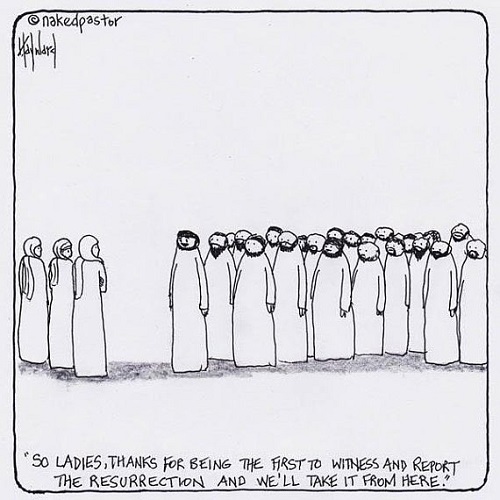
Cartoon by Naked Pastor (David Hayward) which shows 3 women and a large group of men. The men say, "So ladies, thanks for being the first to witness and report the Resurrection. And we'll take it from here." Image source.

I read this post, Life under Patriarchy: Death by a Thousand Cuts, which has a bunch of anecdotes about what it's like to be a woman in a conservative/complementarian church. This one in particular stuck out to me:

When I was alone as a woman in a meeting with the all-male eldership of my church, I explained how difficult it was as a woman to discern how to have both a gentle and quiet spirit and also have a voice in the church. One of the male elders, the NT greek “expert”, interrupted me to soften the meaning of 1 Timothy 2:12. I was referencing 1 Peter 3:4. His interruption (mansplaining) and my confusion about his confusion began the whole meeting badly. Afterwards, as I contemplated his mistake, I realized he had no idea of the burden women carry from these verses. No woman who takes her bible seriously in the conservative church world would confuse these two passages with one another. I’ve been processing the realization that men in the church don’t sit with the call to a “gentle and quiet spirit” the way women do ever since that terrible meeting when I tried to use my voice in a room full of aggressive men.

This struck me because it shows how Christian women who believe in complementarianism have to struggle with it because it just makes no sense. And Christian men who believe in complementarianism aren't experiencing that struggle. Maybe they aren't even aware of it at all! 

This has inspired me to write a few of my own anecdotes, here in this post. (Important background information: I'm a woman.) But first, let me define "complementarianism": So, "complementarian" Christians believe that God created men and women to be equal in worth, but to have different roles. In marriage, the wife has to submit to the husband, and the husband has to love the wife as Christ loves the church. Also, women are restricted in what leadership roles they can have in the church. This plays out differently in different churches, but basically, the senior pastor of the church has to be a man. Maybe a woman can be an "associate pastor" or a "children's director" or "women's pastor" or some other jargon. And in some churches, women can't teach adult men- they can only teach women or children. The details of this differ- is a woman allowed to read a bible passage out loud in front of the church? Does that count as "teaching"? Is a woman allowed to sing in front of the church? Sometimes when a woman talks from the pulpit, these churches have to call it "sharing" instead of "teaching." And some churches don't allow women to speak in front of the church at all.

(Trying to understand how this is "equal in worth" is always left as an exercise to the reader.)

---

When I was growing up, I believed in complementarian because I was taught that's what all Christians have to believe. That's what the bible said, supposedly. I was told that there were some Christians who didn't believe in complementarianism, but that's because they were rejecting the bible, they are bad Christians, they've been influenced by the evils of feminism, they think they know better than God, who made this perfect plan about gender.

So yes, I believed in complementarianism because I didn't know there were other options.

But, the thing is, complementarianism simply makes no sense. Why wouldn't a woman be allowed to do everything a man can do in the church? That sounds sexist and wrong. And what does it mean that a wife has to "submit" to her husband? So like, the husband can control her and tell her what to do? What? That sounds so wrong. Or, when they can't agree on something, the tiebreaker is gender? What? What on earth, that makes no sense.

So, the issue is, I believed I was required to believe in this. But, it makes no sense. So I needed to convince myself that it made sense.

And really, that's what all of Christian apologetics is. That's the problem with apologetics. It's not about following logic and changing your beliefs accordingly, as you search for the truth. It's about "I know I am supposed to believe this, please help me force myself to believe it." 

And yes, there are loads of ways that Christians try to argue that complementarianism isn't as sexist and wrong as it sounds. The wife has to submit to the husband, but they husband has to love the wife, even to the point of laying down his life for her, so actually the husband has the more difficult role. And, it's a lot of responsibility for the husband, to be the leader and have to make the decisions for the family, so the wife should be glad she doesn't have to worry her pretty little head about any of that. Also, she knows he loves her, and she trusts that he will make decisions that are best for their family, because he's such a great guy, so actually it's easy for her to submit to him.

And, they said, this doesn't apply to abusive situations. Some people hate these "wives submit to your husbands" passages because they've been used to justify abuse- but that's wrong! The husband should NOT abuse the wife! And if he is, she has the right to get away from him.

And, they said, normally the husband and wife should discuss things as equals, and agree on their decision together! It's only when they really really can't agree, that's the only time that "submit to your husband" comes into play. If they really really really can't agree, then the husband can make the final decision. But that would happen very rarely- in some people's marriages it never even happens at all!!!

Yeah, I don't buy any of this.

I used to. Because I believed this is what Christians had to believe.

But really, all it adds up to is, trying to make "wives submit to your husbands" mean something different than "wives submit to your husbands." Like... Don't worry! It's not what it sounds like!

How about instead, we just reject the entire thing, rather than concocting these elaborate rationalizations where we basically treat women and men as equals while claiming we totally believe that the women are "submitting" to the men?

Sheila Wray Gregoire has pointed out, the majority of Christians who say they believe in complementarianism don't actually practice it. In their actual, practical, day-to-day lives, they DON'T have situations where the husband and wife simply can't agree, so the husband pulls rank. In actual reality, they live like they are equals. 

They claim they are complementarian, but in practice they are egalitarian. Egalitarian is the alternative, the ideology which I was told Christians are not allowed to believe in. Egalitarian means equality between men and woman, and you don't make rules to restrict people based on their gender. (Please note, though, that many egalitarians don't support queer rights unfortunately. It's equality between straight cis men and straight cis women, and doesn't necessarily go any farther than that.)

And it's a good thing that most complementarians don't actually put it into practice. When people actually live that way, it is sexist, and harmful to women, and abusive.

So how about we just reject the whole thing, instead of pretending we're following it?

---

One time, at church, when I was in high school, I heard someone mention an organization called CBE- Christians for Biblical Equality. This is an egalitarian organization, whose mission is to promote the idea that women shouldn't be restricted from being leaders in the church, etc. Equality.

I was very surprised to hear about this, and my reaction was "... is that... legit?" And somebody at church told me, yes.

I couldn't make sense of it at the time. I guess I thought, surely if that's a legitimate interpretation of the bible, then of course that's what we should all believe. If Christians are truly allowed to be egalitarian, then why on earth would anybody be complementarian? Complementarianism just makes no sense at all, just so clearly makes no sense at all. Surely we believe in complementarianism because there aren't any other options, right? If this CBE stuff really is an option, well... of course I would believe it. Of course all of us would immediately believe it. ...Right?

I guess at the time, I knew very little about it, and didn't really believe it was legit. Because, surely if it was legit, if Christians were allowed to believe in it, well then how do you explain all the complementarian pastors I had met?

---

I used to have such faith that this was right, that when the bible said wives must submit to their husbands, or that women are more easily deceived, or women can't speak in church, I believed somehow it was right and good. I didn't understand how it was right, because obviously it sounds so wrong, but I had complete faith that if we just understood the bible correctly, and followed it, there would be no problems.

I remember one time, when I was in college, and I was with a group of friends driving home from a Christian conference. And we were discussing the bible passages that restrict women. I think there were a few boys and a few girls in this discussion. And, the way we were talking about it was very direct and blunt and not necessarily the sorts of things we would say in front of other people, because they would take it the wrong way because it sounded sexist.

And one of my friends, let's call him Edward, said, "I'm glad I can talk about this with you all, because I know that you're not going to think the bible is sexist. We know the apostle Paul wasn't sexist, and we are just trying to understand how."

Wow, I had so much faith.

---

The big change for me came when I found Rachel Held Evans's blog. That was where I first learned that Christians don't have to believe in complementarianism. Like I said, I had heard there are Christians who don't believe in complementarianism, but they are bad Christians, they are obviously wrong. Well, I read Rachel's blog, and she wasn't a bad Christian. She was the same as me. She was a bible nerd. She was asking all the questions I had always wanted to ask but couldn't put into words.

That's where I learned that we can just reject the whole thing. We don't have to tie ourselves in knots trying to explain how we believe wives have to submit to their husbands, but not like, in a sexist way. Rachel wrote about academic research about ancient Roman society, and how there were reasons that the writers of the bible wrote things that way, in that culture. But in our culture, it's completely different, so we don't have to believe in complementarianism.

Before, I thought I had to believe that there was at least something to it. When the bible says women shouldn't speak in church, in some sense that is true and right, it's just a matter of understanding how. Well, no. We don't have to believe there's anything to it. We can reject it entirely. It's an interesting historical exercise, to research the reasons why the biblical writers wrote that, and what it meant in their culture, but for our own situation now, it means nothing.

---

And that's also when I started reading ex-evangelical blogs, and there were so many stories about how complementarianism and patriarchy lead to abuse. Before, I had heard that there were some bad Christians who used this ideology to justify abuse, but I thought it happens very rarely, and those bad Christians are obviously wrong, so no need to really think about that too much. Well. No. In patriarchal churches, women are constantly mistreated. From small ways like assuming the women will do all the cooking and childcare for church events, to big ways like making a rape victim stand up in front of the church and "confess" her "sin."

Before, I had faith that good Christian leaders- whether they were men or women- were just trying to follow the bible to the best of their ability. I never thought about leaders who are protecting their own power. I never thought about who benefits from this ideology. I never thought about how the debate is different depending on whether you have skin in the game. I trusted that we all just wanted to obey what the bible said, even if it's hard.

Well. Not anymore.

---

I remember there were a few times, back when I was "on fire for God", when I prayed alone in my room, and I covered my head with a towel. Because the bible says women need to cover their heads when they pray. And I had never given it a thought before- I had never met any Christians who actually took that seriously. I think maybe 1 time in my life, I've heard of or met a Christian woman who wears a head covering to church because of those verses, but she said it was just her personal belief and she wasn't trying to tell other women what to do. (Some really conservative churches do require it, though, I have heard.) I was taught it was just a cultural thing and didn't apply to us in modern times.

But, sometimes, when I prayed, I was so desperate, trying to figure out how to get God to do what I wanted him to do. (The God I believed in back then was a he/him.) Like, I wanted my friends to "get saved" (ie, to convert to Christianity), and I wanted it SO MUCH, I was SO WORRIED about how terrible their lives must be without Jesus, I just wanted God to get them to change their beliefs, and I prayed so hard, why wasn't it working? Was there some cheat code I needed to figure out, in order to get my prayers to actually work? The bible says women need to cover their heads when they pray, maybe I should try that. Maybe that's what will get God to finally do it. Sounds ridiculous and sexist, but, worth a shot.

I never told any other Christians about this, because how would I even begin to explain it? The idea that we should actually believe that women are required to cover their heads when they pray- it just sounds absurd. All of my Christian friends would surely think it was absurd and sexist, right? But there it is, in the bible.

(And, if you're wondering, no, my friends still didn't "get saved" after that.)

---

In church, there was a discussion about "wives submit to your husbands," and I started asking for examples.

Because, when I said I just totally don't believe in "wives submit to your husbands," tons of women jumped up with the familiar talking points- "I know my husband loves me, and I trust him, so it's easy to submit to a man like that", etc. Yeah, I've heard it all before. I started asking for examples.

Examples. Asking these women, have there been any situations in your marriage, where you and your husband weren't able to agree, so in the end he just made the decision and you had to submit to him?

I only remember getting an actual answer from 1 woman. I think it was something about, they couldn't agree on what school to send their kid to, and in the end she just went with what her husband wanted. And, when she told me about it, I felt bad for asking. Because it seemed really emotional for her, really difficult for her to talk about. That was probably a bad time in her marriage, they probably argued about it, and there were strong emotions on both sides, and eventually she just reasoned that God wanted her to give up and let her husband do what he wanted, so she forced herself to submit.

That's what we're actually talking about here, when Christians say the husband has the "tiebreaker" vote. We're talking about something that was actually important to her, important enough to fight, to make a case, lay out the reasons to support her point of view, and in the end her god made her just give all that up, like it didn't matter. Because she's a woman and her husband is a man.

F all of that.

---

I posted a link on social media, and I described it as a blog post about "the equality of women in the church."

And one of my friends, let's call him Marvin, replied and said, "Women aren't equal! Some are short, some are tall, [and so on, a bunch of different adjectives describing different subgroups of women]"

And I thought, what on earth? Why is he pretending he doesn't understand what I'm talking about? He's acting like he thinks I said "all women are exactly the same" when actually what I meant was "equality between men and woman."

This anecdote is the first thing that came to mind, when I read that blog post I linked to at the top. Oh my goodness, what if he actually didn't understand what I meant? I thought he was acting clueless on purpose, but what if he wasn't? What if he hadn't spent a lifetime trying to make it make sense, when the bible says women can't do all the things men can do? What if he never really thought about it? What if he had no sense of the amazing freedom I experienced, when I found out I really can be a Christian and not be complementarian- that I can just believe men and women are equal, and not do this whole dance about how the bible says this or that?

Men have no idea.

---

But maybe I shouldn't judge the Christian men for having no idea, because I have committed a similar sin.

I'm straight, and back then, when I read the anti-gay passages in the bible, I just nodded along like there was no problem. If a man lies with a man, it is an abomination. Homosexuals will not inherit the kingdom of heaven. Same-sex relationships are unnatural, sinful, shameful, driven by lust. And I just nodded along, like, ah yes, disgusting.

Years later, I started reading blogs written by gay Christians. They wrote about how hard they struggled, trying to be good enough to be accepted by God, trying to repress themselves, reading the anti-gay passages of the bible and trying to make it make sense. They wrote about how much time they spent, tracking down ancient Greek words, trying to figure out what exactly these passages meant.

And of course, when I first started reading these blogs, I didn't agree with them if their conclusion was accepting themselves as gay. I cared about their struggles, but I couldn't believe that it was okay to accept yourself and go ahead and date people of the same gender. I thought Christians weren't allowed to believe that- only bad Christians who rejected the bible would say that same-sex relationships were okay. Rejecting God's perfect plan for gender, as if you know better than God.

But the more I read, the more I saw that they weren't bad Christians. They were bible nerds like me. They were trying their best to follow God.

And I changed my position, and now I support all queer rights. My God is genderqueer, They/Them. (And I'm asexual.)

It's funny, when someone on the internet talks about being queer and Christian, and then some rando posts a bible verse in reply, as if the queer Christian has never heard of Romans 1. Bro, queer Christians know those passages so much better than you do. Queer Christians have spent so much time, way too much time, parsing the minutiae of ancient Roman perspectives on sexuality.

Straight people have no idea.

And isn't it terrible, how Christians are expected to read bible passages which dehumanize entire demographics of people, and just accept that- because the bible says it, so it must be true? Best-case scenario for a good Christian, I suppose, is you read a bible passage that dehumanizes an entire demographic of people, and you just nod along and don't notice anything wrong. But what if you have personal experience that tells you something's wrong with what you just read in the bible? What if you yourself are a member of that demographic, or you have close friends who are? Then, as a good Christian who believes the bible, you have to force yourself to believe it, even when it sounds so wrong. You struggle to make it make sense, because you believe there are no other options.

How about we just reject the whole thing? 

If your God wants you to discriminate against other people, maybe find a new God. Every day you continue to believe in that kind of God, that's on you. What does it say about you, that you choose to worship a God like that?

---

There's one more thing I need to talk about: What does "faith" mean?

Because I read one blog post after another after another about how complementarianism is harmful, how it makes no sense, how it is used to cover up and perpetuate abuse. 

But... did that mean it was actually wrong? What if God commanded this for a reason? What if there's some really amazing reason why women shouldn't have the same rights as men, and as humans we just can't understand what it is? We're not God, what do we know?

Complementarianism obviously makes no sense- but I was taught that faith is doing things that appear to be ridiculous and foolish, because God commands us to, and somehow to God it makes sense. I was taught that's an important component of being a Christian: sometimes God will tell you to do something completely absurd, and you have to do it.

I don't believe that any more. Instead, I believe what Jesus said: A good tree cannot bear bad fruit. You can look at the results of following a certain ideology, and if those results are bad, you know the ideology itself is bad.

Reject the entire thing.

---

Related:

She was the first (Thank you, Rachel) 

It Doesn’t Actually Matter What Jesus Said About Divorce

They Prayed About It (a post about the #NashvilleStatement) 

I'm a woman, and God created me to do math and build robots

AddThis

ShareThis